What Allows a Cutaway Collar Shirt to Reflect Collar Structure and Neckwear Compatibility?
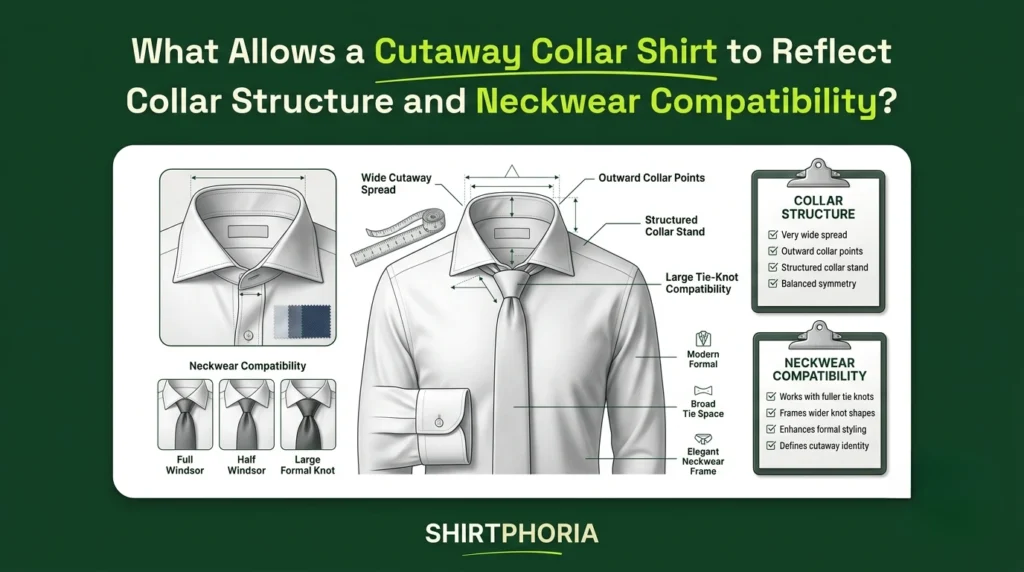
The Cutaway Collar Shirt is defined by a wide, often near-horizontal collar spread that exposes more neckwear space than standard shirt collars, making collar structure, knot volume, and visual balance inseparable.
Choosing a Cutaway Collar Shirt is not simply a matter of preference. Its unusually wide collar opening changes how the shirt interacts with tie knots, tie fabric, collar stays, jacket lapels, and the shape of the neckline.
This guide explains how the Cutaway Collar Shirt uses wide collar geometry, collar-band structure, interlining, collar stays, and tie-knot volume to create a clean, formal, and visually balanced neckline.
A cutaway collar can be worn with a tie or open-neck, but either choice depends on proportion and structural support. Fuller knots such as the Full Windsor are often the safest match for an extreme cutaway, but they are not mandatory in every case.
What Defines the Unique Structural Anatomy of a Cutaway Collar Shirt?
The unique structural anatomy of a Cutaway Collar Shirt is defined by a very wide collar spread, controlled collar leaves, and enough collar-band support to keep the points stable across the chest.
The cutaway collar is a form of Spread Collar, but its points open farther outward than those of a classic spread collar. Sources identified in the brief, including Gentleman’s Gazette and Stenströms, describe cutaway collars as wider than standard spread collars and capable of approaching a nearly horizontal line.
This geometry exposes more of the neck and tie area, so the collar depends heavily on support, proportion, and knot volume.
How Does Wide Collar Spread Define the Cutaway Collar Shirt?
Wide collar spread defines the Cutaway Collar Shirt because the collar points angle outward so far that the shirt opening becomes a broad frame for the tie knot, neck, and upper chest.
A Forward Point Collar creates a relatively narrow opening. A classic Spread Collar opens farther outward. A cutaway collar pushes the points wider still.
Practical diagnostic models may describe the collars approximately like this:
- Forward Point Collar: often around 60°–80°.
- Classic Spread Collar: often around 100°–130°.
- Cutaway Collar: often above 140° and sometimes approaching horizontal.
These figures are practical comparison ranges rather than universal manufacturing standards. Exact measurements vary between shirtmakers and measuring methods.
A cutaway collar can normally be identified through three visible features:
- The collar points angle strongly outward rather than downward.
- The tie knot sits inside a broad collar opening.
- More shirt front is exposed near the neck than with a point collar or moderate spread collar.
The result is a wide-to-horizontal visual frame rather than the narrow vertical frame created by a point collar.
How Do Collar Band Height and Collar Leaf Length Control Cutaway Collar Balance?
Collar band height and collar leaf length control Cutaway Collar Shirt balance by adding vertical support to a collar shape that naturally emphasizes horizontal width.
The collar band is the vertical strip of fabric around the neck that supports the fold-over portion of the collar.
The collar leaf is the visible section that folds away from that band to form the collar points.
A cutaway collar needs enough band support to prevent its broad opening from collapsing outward. At the same time, the collar leaves need controlled length so the points sit cleanly around the shirt and jacket.
Too little collar-band support can cause the collar to flatten or collapse, particularly when the shirt is worn without a tie.
Too much band height can crowd the neck, feel rigid, or give the collar an excessively severe appearance.
Collar-leaf length has a similar two-sided requirement. Leaves that are too short can appear visually weak, while overly long leaves can interfere with jacket lapels or curl outward.
The goal is therefore proportion rather than maximum stiffness or size.
The Cutaway Collar Shirt is a highly engineered variation within broader dress shirt collar structure and formality, where collar angle, stiffness, and neckwear space determine how the shirt functions.
Why Does the Cutaway Collar Shirt’s Wide Spread Matter for Formality?
The Cutaway Collar Shirt’s wide spread matters for formality because it creates a deliberate, tie-focused neckline that usually works best with structured shirts, tailored jackets, and fuller neckwear knots.
The collar does not become formal simply because its points are wide.
Formality comes from a system that includes collar geometry, collar stiffness, tie knot, fabric smoothness, jacket construction, and the setting in which the shirt is worn.
A wider spread often creates a more dressed or assertive appearance when paired with tailoring because it gives the knot and jacket lapels more visual space.
How Does Horizontal Spread Change the Visual Role of the Collar?
Horizontal spread changes the visual role of the Cutaway Collar Shirt by shifting attention away from downward collar points and toward the tie knot, neck opening, and jacket V-zone.
A point collar directs the eye downward through two relatively close collar points.
A cutaway collar widens that frame.
This wider opening gives the knot more visual prominence and allows the collar to interact more directly with the jacket lapels.
The effect depends on balance. A very wide collar paired with narrow lapels or an undersized knot can appear disconnected. A proportionate knot and structured jacket give the wide collar a clearer visual relationship with the rest of the outfit.
How Do Interlining and Collar Rigidity Support Cutaway Collar Formality?
Interlining and collar rigidity support Cutaway Collar Shirt formality by helping the wide collar points hold a crisp line instead of curling, drooping, or spreading unevenly.
Interlining is the hidden structural layer positioned between the visible layers of collar fabric.
Two common construction approaches affect how the collar behaves.
Fused Interlining uses an interlining layer adhered to the collar fabric. The purpose is to create crispness, stronger shape retention, and a cleaner edge.
Floating Interlining is not bonded in the same way. It sits between the fabric layers and is secured by construction, giving the collar a softer and more flexible feel.
The brief identifies Mayfair & Legacy and Permanent Style as support sources for these construction distinctions.
A fused construction can help an extreme cutaway hold a sharper form. A floating construction can create a softer feel, but it may depend more on pressing, fabric choice, and structural support to maintain the collar line.
The correct amount of rigidity sits between two failure states.
Too little stiffness allows the points to curl, collapse, or float.
Too much stiffness can make the collar uncomfortable, restrict movement, or create an artificially severe appearance.
The ideal collar is controlled enough to hold its wide shape while remaining flexible enough to move naturally with the neck.
How Does the Cutaway Collar Shirt’s Wide Opening Dictate Neckwear Compatibility?
The Cutaway Collar Shirt’s wide opening dictates neckwear compatibility because the tie knot must visually fill the exposed collar space without leaving the band empty or crowding the neckline.
Collar-knot matching is therefore a space problem before it becomes a taste problem.
A wide collar opening can support a fuller knot because the knot has more horizontal room. Sources identified in the brief, including T.M.Lewin, Charles Tyrwhitt, Apposta, and Rampley & Co., support pairing wider collars with substantial knots such as the Full Windsor or Half-Windsor.
Why Does Knot Volume Need to Match Cutaway Collar Spread?
Knot volume needs to match Cutaway Collar Shirt spread because a wide collar opening creates negative space that a narrow knot may fail to occupy.
Tie knot volume means the visible width, height, and thickness of the finished knot.
A small knot inside a very wide cutaway can leave excessive empty space near the top button and collar band.
The opposite problem occurs when the knot becomes too large.
An oversized knot can crowd the neck, force the collar points outward, and make the entire collar-knot relationship look compressed.
The correct knot fills the opening without pushing against the collar.
Which Tie Knots Work Best With a Cutaway Collar Shirt?
The best tie knots for a Cutaway Collar Shirt are usually fuller knots such as the Full Windsor and Half-Windsor, while narrow knots require caution because they can look undersized in the wide opening.
Full Windsor — Strongest Default
The Full Windsor knot is usually the safest option for an extreme Cutaway Collar Shirt because its broad triangular shape can fill a wide opening cleanly.
Its size suits the horizontal geometry of an aggressive cutaway, particularly when the tie fabric has enough structure to maintain the knot.
Half-Windsor — Flexible Alternative
The Half-Windsor knot works well when the cutaway is moderate, the tie fabric has enough body, or the wearer wants less bulk than a Full Windsor creates.
It can provide enough width for a cutaway without filling the entire neck area.
Four-in-Hand — Conditional Choice
The Four-in-Hand knot is usually the riskiest option for an extreme cutaway because its narrow, asymmetrical shape can leave too much exposed collar space.
It can still work when the cutaway is softer, the tie fabric is thick enough to create additional volume, or the styling is intentionally more relaxed.
Very Large Knots — Avoid When Overbuilt
A knot can also become too large for a cutaway.
Very bulky knots should be avoided when they crowd the neck, distort the collar points, or make the shirt and tie relationship look forced.
The functional target is simple: the knot should occupy the collar opening without forcing the collar apart.
Comparison: How Do Cutaway Collar Shirts Balance Structure Against Other Collar Spreads?
Cutaway Collar Shirts become easier to understand when compared with classic spread and forward point collars, because each collar shape creates a different relationship between collar angle, knot size, and visual formality.
The following angle figures are practical diagnostic ranges rather than universal shirtmaking standards.
| Collar TypePractical Spread RangeBest Neckwear MatchVisual RoleTie Fabric FitFailure Risk | |||||
|---|---|---|---|---|---|
| Cutaway Collar Shirt | Often above 140° and may approach horizontal depending on maker | Full Windsor, Half-Windsor, fuller knots | Maximizes knot visibility and creates a broad formal frame | Medium-to-heavy silk, wool, cashmere, or ties with enough body | Small knots look lost; oversized knots can crowd the neck |
| Classic Spread Collar Shirt | Often around 100°–130° in diagnostic models | Half-Windsor, Pratt, Windsor, or medium knots | Balances collar points with knot visibility | Medium-weight silk, grenadine, or standard business tie fabrics | Small knots may look weak; very large knots may appear compressed |
| Forward Point Collar Shirt | Often around 60°–80° in diagnostic models | Four-in-Hand or compact knots | Creates a narrower, more vertical frame | Thin silk, knit ties, or slimmer fabrics | Large knots can crowd the narrow opening |
The comparison shows why tie-knot advice cannot be separated from collar geometry.
A Forward Point Collar has limited horizontal space, so compact knots usually fit naturally.
A classic spread collar can support a broader range of knot sizes.
A Cutaway Collar Shirt creates the largest opening and therefore demands the most deliberate balance between knot volume and collar width.
Common Mistakes That Break Cutaway Collar Shirt Balance
Cutaway Collar Shirt balance fails when the collar opening, tie knot, collar stiffness, or jacket structure moves outside the proportion range the collar was designed to support.
- Using a knot that is too small: A compact knot leaves empty space beneath the wide collar opening. Use a Half-Windsor, Full Windsor, or a tie fabric with more body when the cutaway is extreme.
- Using a knot that is too large: An oversized knot crowds the neck, distorts the collar, and can shorten the neck visually. Reduce knot volume or choose a slightly less extreme spread.
- Treating the Full Windsor as mandatory: The Full Windsor is often a safe option, but a Half-Windsor can work when its size suits the actual opening and tie fabric.
- Ignoring collar stays: Missing or weak stays can allow the points to curl or float. Use correctly sized stays and replace bent stays when point control deteriorates.
- Using thin knit ties with an extreme cutaway: Thin knit ties commonly form compact knots that may fail to fill a very wide opening. Reserve them for moderate cutaways or intentionally relaxed styling.
- Wearing an open-neck cutaway with a weak collar stand: A soft collar can collapse when it loses the physical support of a tie. Choose stronger collar-band construction or a less extreme open-neck collar.
- Pairing an extreme cutaway with very conservative tailoring: A very wide cutaway can look overly assertive in restrained business settings. A classic spread collar may create better visual balance.