How Does a Wing Collar Shirt Align Design and Formality for Ceremonial Use?
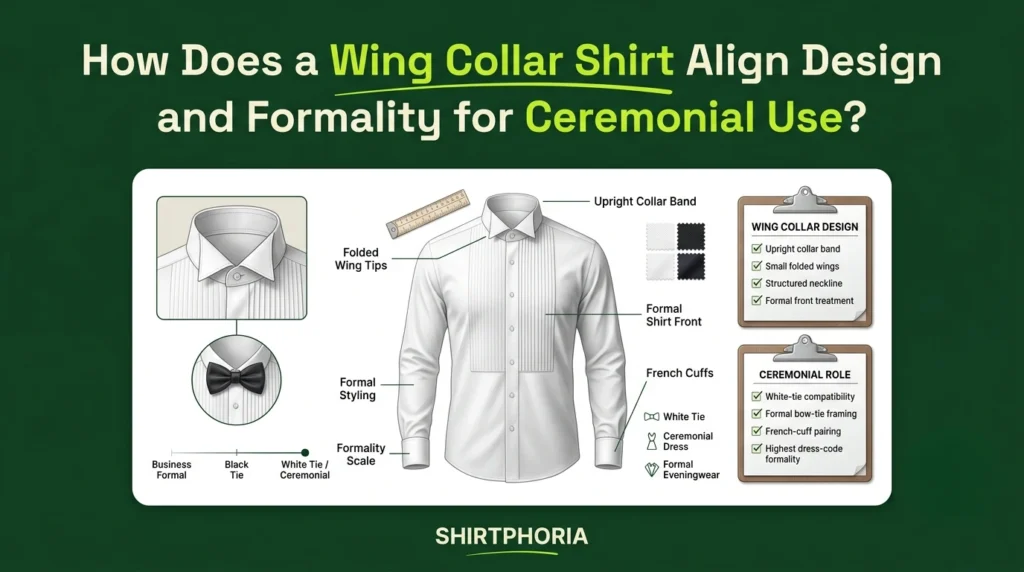
A wing collar shirt aligns with ceremonial formality when its upright collar band, folded wing tips, bow tie, shirt front, fasteners, cuffs, color, and jacket follow one coherent formalwear standard.
The wing collar is easy to recognize, but recognizing it is not the same as knowing how to wear it correctly. Its small folded tips and exposed upright band create a distinctive eveningwear profile, yet the collar is only one part of a larger formal system.
This distinction matters because white tie and black tie do not apply identical rules. The wing collar is most securely associated with traditional white tie, where it works alongside a white formal shirt, white bow tie, formal shirt front, appropriate cuffs, white waistcoat, and tailcoat. Black tie is less uniform: current British guidance generally favors a turndown collar, while some modern formalwear systems continue to accept the wing collar.
The practical question, therefore, is not simply whether a shirt has wing tips. Proper ceremonial alignment depends on how the collar works with the shirt front, fasteners, bow tie, cuffs, color, jacket, and the authority or tradition governing the event.
This guide explains the anatomy of a wing collar shirt, its white-tie and black-tie roles, tuxedo-shirt construction, cuff differences, color boundaries, common failure modes, and a repeatable method for checking whether the complete outfit follows one consistent formalwear standard.
Quick Answer: What Is a Wing Collar Shirt Used For?
A wing collar shirt is used primarily for ceremonial eveningwear because its upright collar band and small folded tips frame a bow tie without forming the full fold-over leaves of a standard turndown collar. It is central to traditional white tie, can appear with tuxedos or tailcoats, and remains a source-dependent black-tie option when paired with an appropriate formal shirt front.
It is not a normal office collar. Current Debrett’s black-tie guidance favors a turndown collar, while some modern formalwear systems continue to permit wing collars for black tie.
What Design Elements of the Wing Collar Shirt Establish Ceremonial Formality?
The design elements that distinguish a wing collar shirt are its upright collar band, two folded front tips, open bow-tie frame, and integration with a formal shirt front.
Physically, the wing collar differs from an ordinary turndown collar because most of its collar body remains upright. Only the small front sections fold outward to create the characteristic wings. A turndown collar instead uses larger leaves that fold around the neck and normally sit over or beside the neckwear.
Because the wing collar represents one specialized point within the broader dress shirt collar configuration system, comparing it with ordinary dress-shirt collars clarifies why its ceremonial use is limited.
The shape itself does not physically create formality. Historical convention and current dress-code rules give the construction its ceremonial meaning. The physical collar positions and frames the neckwear; the governing formalwear system determines when that design is appropriate.
Why Does the Upright Collar Stand Matter on a Wing Collar Shirt?
The upright collar stand matters on a wing collar shirt because it positions the folded tips around the bow-tie area without folding the entire collar body over the shirt.
Compared with a conventional turndown collar, the wing collar leaves more of the collar band upright and exposed. This creates the open frame associated with formal bow-tie presentation.
Traditional detachable wing collars can be taller, stiffer, and more visually prominent than many modern attached wing collars. That difference is important because a classical full-dress collar may look and behave differently from the softer wing collars commonly sewn directly into modern tuxedo shirts.
The goal is controlled proportion rather than maximum height or stiffness. The collar should frame the neckwear without painful pressure, severe gaping, uncontrolled exposure of the shirt band, or an exaggerated shape that makes the outfit appear costume-like.
There is no universal collar-stand height that works for every wearer. Neck length, collar construction, bow-tie size, and the proportions of the shirt and jacket all influence the final appearance.
How Do the Folded Wing Tips Frame the Bow Tie?
The folded wing tips frame the bow tie by creating two controlled points near the knot while leaving most of the collar band upright.
Folded Wing Tips → Frame → Bow-Tie Knot.
The tips should appear crisp and reasonably balanced around the neckwear. Their purpose is not to carry the full physical weight of the bow tie. Instead, they contribute to the visual structure of the collar and help create its recognizable ceremonial identity.
Several visible problems can weaken this effect. Wing tips may curl, collapse, become severely asymmetrical, disappear unpredictably behind the bow tie, or extend so far that they crowd the knot.
The opposite extreme can also cause problems. Oversized or excessively rigid tips may dominate the neckwear and make an otherwise correct formal outfit look theatrical rather than controlled.
A well-integrated wing collar therefore depends on balance: the tips should remain visible enough to establish the collar architecture without competing with the bow tie.
How Do White Tie and Black Tie Change Wing Collar Shirt Rules?
White tie and black tie change wing collar shirt rules because strict white tie treats the detachable wing collar as part of a prescribed full-dress system, while black-tie authorities differ over whether a wing or turndown collar is appropriate.
This distinction prevents one of the most common formalwear mistakes: treating every wing collar as automatically correct for every evening dress code.
Why Is the Wing Collar Shirt Central to White Tie?
The wing collar shirt is central to traditional white tie because the dress code coordinates a white formal shirt, starched wing collar, studs, white bow tie, white waistcoat, and black tailcoat.
Under current British dress-code guidance, Debrett’s describes white tie as a complete formal system involving a black tailcoat, white Marcella shirt, detachable wing collar, shirt studs, cufflinks, white hand-tied bow tie, and white waistcoat.
The important point is that the collar does not operate independently. White-tie alignment requires the collar, shirt front, fasteners, cuffs, bow tie, waistcoat, tailcoat, and shirt color to support the same standard.
A modern shirt with an attached wing collar should therefore not automatically be classified as a correct white-tie shirt. Its front construction, fastening method, cuff design, fabric, and relationship with the rest of the outfit may belong to a different modern tuxedo-shirt system.
Classical full dress has also used specialized shirt construction that differs from ordinary formal shirts. Historical examples often combine detachable collars with structured shirt fronts and dedicated formal fastenings rather than merely adding wing tips to a conventional dress shirt.
The safest way to assess white tie is to begin with the selected authority or event rule and verify each required component individually.
How Should a Wing Collar Shirt Be Treated in Black Tie?
A wing collar shirt is a source-dependent black-tie option because some modern formalwear guides permit it, while current British guidance commonly favors a turndown collar.
Debrett’s specifies a turndown collar for current British black tie. By contrast, Penguin’s Formal Wear presents both wing and turndown collars among modern tuxedo-shirt options.
Contemporary British guidance commonly favors a turndown collar for black tie, while some modern formalwear systems continue to accept either a wing or turndown collar.
This means a wing collar should not be described as universally required, universally preferred, or universally prohibited for black tie.
A turndown collar is usually the safer option when an invitation simply says black tie, no historical or institutional requirement is supplied, the rest of the tuxedo follows a contemporary configuration, or the wearer intends to follow current British guidance.
A wing collar can still be appropriate when the selected formalwear system permits it, the host or institution specifies it, a historical or strongly ceremonial presentation is intended, and the rest of the shirt is designed to support that choice.
The correct decision comes from the complete system rather than from the collar in isolation.
How Does a Wing Collar Shirt Integrate With Tuxedo Shirt Construction?
A wing collar shirt integrates with formal shirt construction by coordinating the collar, bow tie, shirt front, fastening method, cuffs, fabric, and evening jacket.
Because the wing collar operates as part of a complete formal shirt system, the broader tuxedo shirt construction guide explains how bib fronts, studs, collars, cuffs, and plackets work together.
A collar can be visually appropriate while the rest of the shirt remains inconsistent with the dress code. For example, a formal wing collar combined with an ordinary business-shirt front may fail to reproduce the full-dress system required by a strict authority.
Likewise, a historically inspired stiff front can conflict with a modern black-tie system if other components are selected from unrelated traditions.
The shirt should therefore be assessed as a coordinated construction rather than a collection of individually formal-looking details.
How Do Bib Fronts, Piqué, Pleats, and Shirt Studs Support a Wing Collar Shirt?
Bib fronts, piqué, pleats, and shirt studs support a wing collar shirt by creating the visible formal-shirt front required or accepted by the selected eveningwear system.
Historical full-dress construction is especially structured. Gentleman’s Gazette describes classical full-dress shirts using elements such as a collarless tunic-style body, detachable wing collar, stiff Marcella or piqué bosom, shirt studs, and historically appropriate formal cuffs.
A stiff bosom or piqué bib creates a deliberately structured visible front beneath the waistcoat and tailcoat. Studs can replace ordinary visible buttons where the governing full-dress construction calls for them.
Modern black-tie shirts offer a broader set of front treatments. Depending on the selected system, these can include pleated fronts, piqué fronts, plain formal fronts, concealed fly fronts, or stud-compatible fronts.
These constructions should not be treated as interchangeable rules.
A pleated front does not automatically make a shirt white-tie correct. A piqué front does not automatically mean the shirt belongs exclusively to white tie. Similarly, not every tuxedo shirt must display studs when its approved design instead uses a concealed formal fastening system.
The important question is whether the front matches the collar, dress code, and evening jacket.
Why Does the Placket Matter on a Wing Collar Shirt?
The placket matters on a wing collar shirt because the visible fastening system must match the shirt front and formality required by the selected dress code.
The placket is the reinforced front-opening construction that carries the shirt’s buttons, buttonholes, studs, or concealed fastening.
On an ordinary dress shirt, visible buttons may form a normal part of the front. Formal evening shirts can use different systems.
Shirt studs are removable formal fasteners that replace ordinary visible buttons on selected shirt fronts.
A fly front conceals the ordinary button closure beneath an additional layer of fabric, producing a cleaner uninterrupted appearance.
Traditional or source-specific white-tie systems may prescribe visible studs. Modern black-tie shirts can use studs, concealed fly fronts, or other formal fronts accepted by their governing system.
These details should be evaluated in three separate ways:
- The fastening must physically secure the shirt.
- The fastening influences the visible appearance of the shirt front.
- The dress code determines whether that fastening system is appropriate.
No single placket construction applies to every formal shirt.
What Cuffs Should a Wing Collar Shirt Use?
The correct cuffs for a wing collar shirt depend on the selected dress code and governing authority because current white-tie guidance and historical full-dress construction do not describe one identical cuff convention.
This is an area where simplified rules can easily become inaccurate. French cuffs are common on modern tuxedo shirts, but that does not make them the universal cuff for every wing-collar configuration.
Why Are French or Double Cuffs Common on Black-Tie Wing Collar Shirts?
French or double cuffs are common on black-tie wing collar shirts because many modern tuxedo shirts use folded cuffs secured with cufflinks.
A French cuff folds back on itself before being fastened. The cufflink passes through aligned openings in the folded layers and becomes part of the visible formal accessory system.
This construction works naturally with modern tuxedo shirts because it coordinates with other evening accessories and provides a deliberately formal finish at the wrist.
Penguin’s practical modern tuxedo-shirt guidance includes French-cuff construction among contemporary formal shirt options.
The correct description is therefore that French or double cuffs are common and appropriate in modern black tie.
They should not be described as universally mandatory, and their use should not automatically be transferred to every historical full-dress shirt.
Why Are White-Tie Cuffs Source-Dependent on a Wing Collar Shirt?
White-tie cuffs are source-dependent on a wing collar shirt because current Debrett’s guidance specifies double cuffs, while historical full-dress construction may use stiff single-link cuffs.
White-tie cuff guidance is source-dependent: current British guidance may specify double cuffs, while historical full-dress construction uses stiff single-link cuffs.
Debrett’s current British white-tie guidance specifies double cuffs. Gentleman’s Gazette, when describing historical full-dress construction, discusses stiff single-link cuffs rather than folded-back French cuffs.
A single-link cuff uses a single layer of material rather than a cuff folded back over itself. It can still be secured with links, but its construction belongs to a different historical shirt tradition.
Neither rule should be extracted from its context and presented as the universal answer for every white-tie shirt.
The wearer should follow the invitation, host requirements, institutional rules, regional convention, or selected historical standard.
The correct cuff is the cuff required by the selected white-tie system, not a cuff chosen from an isolated internet rule.
Cuffs should also be judged together with the collar, bib, shirt studs, bow tie, waistcoat, and tailcoat. A cuff may be historically legitimate yet still conflict with an event governed by a different current authority.
What Diagnostic States and Failure Modes Define Wing Collar Shirt Formality?
Wing collar shirt formality can be diagnosed by identifying the dress code, selecting the governing authority, and checking whether the collar, bow tie, shirt front, fasteners, cuffs, color, and jacket follow the same system.
The following states are qualitative and observable. They are not universal tailoring measurements. Their purpose is to identify alignment, under-alignment, and conflict without inventing unsupported numeric thresholds.
| Variable | Under-Aligned State | Aligned State | Over-Aligned or Conflict State | Diagnostic Fix |
|---|---|---|---|---|
| Collar Stand | The collar collapses, gaps severely, or fails to frame the bow-tie area. | The upright band remains controlled and proportionate without painful pressure. | The stand appears excessively rigid, uncomfortable, or costume-like. | Choose a better-proportioned collar and verify attached versus detachable construction. |
| Wing-Tip Condition | The tips curl, collapse, or disappear unpredictably. | The tips remain crisp, controlled, and reasonably symmetrical. | The tips appear oversized, harsh, or crowded by the bow tie. | Press, starch where appropriate, adjust the bow tie, or replace the collar. |
| Bow-Tie Fit | The bow tie is too small, poorly tied, or leaves the collar frame visually weak. | The correct bow-tie color and proportion fit the selected dress code. | The bow tie crowds the wing tips or uses the wrong ceremonial color. | Use the prescribed bow-tie color and adjust its scale. |
| Shirt Front | The shirt uses an ordinary front where the selected system requires a formal bib or studs. | The piqué, pleated, studded, plain formal, or concealed front matches the dress code. | The bib is excessively bulky or belongs to a conflicting shirt tradition. | Match the shirt front to the selected white-tie or black-tie authority. |
| Fastening System | Ordinary visible buttons conflict with a stud-required full-dress system. | Studs or a concealed formal front match the selected shirt construction. | Decorative fastening overwhelms or conflicts with the shirt front. | Use the fastening system prescribed for the selected formal shirt. |
| Cuff Type | Casual cuffs or unsupported cuff construction reduce formal alignment. | The cuffs match the selected current or historical authority. | A cuff from one formalwear tradition is presented as universally correct in another. | Verify whether the selected system uses double, French, or single-link cuffs. |
| Shirt Color | A colored shirt conflicts with strict white-tie requirements. | White supports strict white tie and remains the safest classic black-tie choice. | A creative color is presented as if it were strict ceremonial full dress. | Use white for strict ceremony and separate creative color styling from white-tie rules. |
| Jacket Type | A business suit or unrelated jacket conflicts with the full-dress shirt. | A tailcoat supports white tie; a dinner jacket supports black tie. | White-tie and black-tie components are mixed without a defined authority. | Match the shirt system to the correct evening jacket. |
| Dress-Code Context | The shirt appears excessively ceremonial for business, cocktail, or smart casual. | The event and selected authority support the complete shirt system. | The wing collar is forced into modern black tie where the governing guidance requires a turndown collar. | Follow the invitation and selected authority; use a turndown collar when appropriate. |
The shirt-color boundary is especially important. White is part of the strict white-tie system. A colored formal shirt can still work in a creative or dressy setting, but it should not be treated as equivalent to ceremonial full dress.
For a separate creative-formal color context outside strict white-tie rules, amethyst purple styling explains how a colored shirt can be coordinated without redefining ceremonial full dress.
That separate styling context does not make purple white-tie correct, does not replace the white full-dress shirt, and does not alter the mechanical construction of the wing collar.
Why Both Under-Alignment and Over-Alignment Matter
Formalwear can fail in more than one direction.
Too little collar control may cause collapse or severe gaping. Excessive rigidity can create discomfort or make the collar look costume-like.
Too little wing-tip control can produce curling and asymmetry. Oversized or excessively stiff tips can crowd the bow tie.
An ordinary shirt front can appear under-formal where a prescribed full-dress front is required. An excessively bulky or mismatched bib can distort the visible jacket opening.
Casual cuffs can weaken ceremonial alignment. At the same time, a historically valid cuff can still conflict with a current authority that prescribes a different construction.
A colored shirt may work perfectly well in creative formal styling while remaining incompatible with strict white tie.
The goal is therefore not maximum stiffness, decoration, or historical detail. The goal is consistency within the selected system.
Critical Gates for Final Classification
A wing collar alone is never enough to approve a white-tie outfit.
A shirt and outfit cannot receive White-Tie Aligned status if a required component under the selected authority is missing, including:
- White formal shirt
- Accepted wing collar
- Correct white bow tie
- Appropriate shirt front
- Required fastening system
- Accepted cuff construction
- White waistcoat
- Tailcoat
Likewise, an outfit should not receive Black-Tie Accepted Under the Selected Tradition status unless:
- The chosen guidance permits the wing collar.
- A black bow tie is used.
- The shirt front is tuxedo-appropriate.
- The cuffs are formal.
- The dinner jacket supports the selected system.
After checking these gates, the outfit should receive one of six diagnostic outcomes:
- White-Tie Aligned — All required components under the selected white-tie authority are present and coherent.
- White-Tie Incomplete — The wing collar is present, but one or more required white-tie components are missing or conflicting.
- Black-Tie Accepted Under the Selected Tradition — The selected black-tie system permits the wing collar and the complete tuxedo configuration supports it.
- Modern Black Tie Better Served by a Turndown Collar — The governing guidance or contemporary outfit configuration favors a turndown collar.
- Ceremonially Mismatched — Components from incompatible dress codes or traditions are combined without a clear governing rule.
- Insufficient Information — The invitation, governing authority, or necessary outfit details are not known well enough to classify the result.
Essential Checklist for Verifying a Wing Collar Shirt’s Ceremonial Alignment
A wing collar shirt meets ceremonial alignment when the collar, bow tie, shirt front, fasteners, cuffs, color, jacket, and dress-code authority support the same formal standard.