How Can a Spread Collar Shirt Use Collar Structure and Formality to Define Its Role?
A spread collar shirt defines its role through the wider distance between its collar points, which opens the neckline, creates horizontal visual emphasis, and gives larger tie knots more room to sit cleanly.
A spread collar shirt is not defined only by collar points that extend outward. Its identity comes from the relationship between collar spread, collar-point direction, tie space, collar stiffness, collar-band support, and the outfit in which it is worn.
Many readers recognize that a Spread Collar can look dressy, but they may not understand how spread width affects face shape, tie-knot choice, jacket balance, and formality. A collar can appear wide while still failing to frame the face or tie effectively if its construction is too soft, too stiff, or disproportionate to the wearer.
This guide explains how the spread collar shirt uses collar width, structure, and tie-space control to shape visual proportion, neckwear compatibility, professional styling, and buying decisions.
Spread collar guidance is not absolute. Face shape, neck length, jacket lapel width, tie fabric, collar stiffness, shirt construction, and personal preference all affect the final result.
Why Is Spread Collar Shirt Structure Important for Professional Dressing?
Spread collar shirt structure is important for professional dressing because collar width affects face framing, tie-knot space, jacket compatibility, and the shirt’s overall level of polish.
A moderate spread can create an open and balanced frame beneath a suit jacket. A wider spread can make the collar more visually prominent, while a softer spread can work in less formal outfits.
The collar does not determine professionalism by itself. Fabric, shirt color, pattern, fit, tie choice, jacket construction, and dress-code context all contribute to the final impression.
Readers comparing collar structure across formal shirt families can review the broader guide to dress shirts.
How Spread Collar Width Supports Visual Proportionality
Spread collar width supports visual proportionality by drawing the eye outward and creating more horizontal balance around the face.
The relationship can be summarized clearly:
Wider collar spread creates horizontal visual emphasis.
The outward direction of the Collar Points increases the visible width beneath the jaw. This can reduce the impression of vertical length and may help a longer or narrower face appear more balanced.
Permanent Style explains that collar spread can influence the visual relationship between the collar and face. Wider collars may help prevent a narrow face from appearing excessively long, although this should be treated as classic menswear guidance rather than a fixed anatomical rule. The Permanent Style guide to shirt collars provides further context on collar spread and face balance.
A wide spread can create the opposite effect on an already broad or round face. If the collar points extend too far outward, they may add more apparent width instead of creating balance.
Collar height also changes the result. A taller spread collar may provide more visual support around a long neck, while an excessively high collar can crowd a shorter neck.
The jacket matters as well. Broad lapels may support a wider Spread Collar, while narrow lapels can make an extreme spread appear disconnected from the rest of the outfit.
How the Spread Collar Shirt Fits Into Modern Dress-Shirt Styling
The spread collar shirt fits into modern dress-shirt styling because its open collar shape can work with suits, sport coats, and smart business-casual outfits when the construction and fabric match the setting.
It is a common professional collar option because it can frame medium and fuller tie knots while maintaining a clean line beneath a jacket.
A crisp white or light-blue spread collar shirt can work with a business suit and tie. A softer spread collar made from textured cotton can work open-neck beneath an unstructured blazer.
The same collar shape can therefore move across different levels of formality. Its role changes according to fabric smoothness, color, pattern, stiffness, tie use, and jacket structure.
A spread collar should not be assumed to be formal in every version. An extremely soft collar, casual fabric, or bold pattern can make the shirt feel more relaxed even when the points remain widely separated.
Once the visual role is clear, the next step is examining the physical construction that creates and preserves the spread collar’s shape.
What Structural Elements Define the Aesthetic of a Spread Collar Shirt?
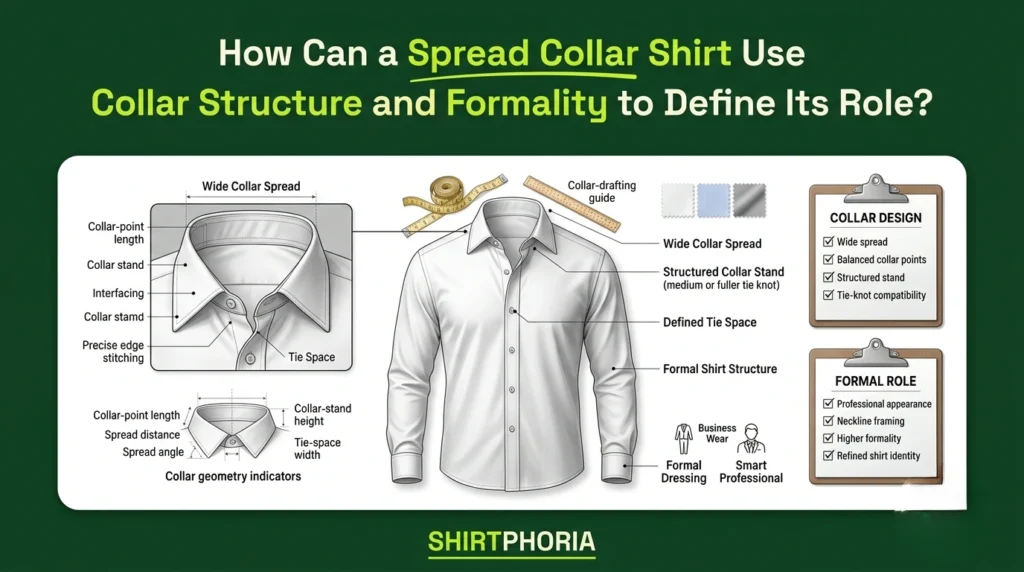
The aesthetic of a spread collar shirt is defined by collar-point distance, collar-band support, interlining, collar stays, and the amount of open tie space between the collar points.
The visible width comes from Collar Spread and point direction. Hidden construction determines whether the collar remains controlled, rolls softly, wings outward, or collapses during wear.
Not all spread collars feel the same. Interlining type, fabric weight, Collar Band design, collar height, point length, and collar-stay use can create a crisp formal collar or a softer business-casual version.
How Collar-Point Distance Shapes a Spread Collar Shirt
Collar-point distance shapes a spread collar shirt by opening the neckline and creating more horizontal space than a narrow Point Collar.
Spread collars are commonly associated with wider openings, although exact measurements vary by shirtmaker and collar pattern. A moderate spread may sit close to a semi-spread shape, while a Cutaway Collar extends the points farther outward.
New & Lingwood explains that a spread collar provides more room for wider tie knots or thicker tie materials. It also distinguishes between collar styles through differences in collar-point distance. The New & Lingwood guide to shirt collar types provides further context on these differences.
Some makers distinguish smaller semi-spread collars from wider spread collars by collar-point distance, so measurements should be treated as maker-specific rather than universal.
The structural relationship can be summarized as follows:
Wider collar-point distance creates open tie space and horizontal framing.
The increased space can support a fuller knot, but wider does not automatically mean better. Excessive spread can expose too much empty area when the knot is small.
Point direction also affects the result. Collar points that angle outward create more horizontal emphasis than points that angle downward, even when both collars are described as spread styles.
How Interlining Supports a Spread Collar Shirt
Interlining supports a spread collar shirt by adding hidden structure that influences whether the collar feels soft, firm, flexible, or crisp.
Interlining is the hidden support layer inside the collar that helps determine stability, stiffness, softness, and shape retention.
Fused interlining is bonded to the outer collar fabric and can create a cleaner or firmer finish. Sewn or softer interlining can allow greater flexibility and a more natural roll.
Neither type is automatically superior. The best construction depends on the shirt fabric, collar width, jacket use, tie requirements, comfort preference, and intended level of formality.
The i-Stays guide to shirt collar structure explains how interlining, collar bands, collar stays, and construction details influence collar stability and shape retention.
Excessive stiffness can make a wide collar look rigid or wing-like. The points may appear disconnected from the shirt front or resist sitting naturally beneath the jacket lapels.
Weak support can create the opposite problem. The collar may collapse, curl, or spread unevenly, particularly when worn without a tie.
Suitable interlining should preserve the intended spread while allowing the collar to move naturally with the wearer’s neck and jacket.
How Collar Stays and the Collar Band Preserve Spread Collar Shape
Collar stays and the collar band preserve spread collar shape by helping the collar points stay aligned and supporting the collar’s posture around the neck.
Collar Stays are narrow inserts placed inside channels near the collar points. They can help the points remain sharper and reduce curling or lifting.
Some spread collars use removable stays, while others use built-in support. Removable stays may make care and replacement easier, but they are not automatically better than permanent stays.
The Collar Band wraps around the neck and forms the base from which the collar leaf extends. It helps the collar sit around the neck and influences how the points frame the tie and jawline.
A balanced collar band supports the collar without pinching the neck or creating excessive gaps. Poor band support can cause pulling, puckering, or weak collar posture.
The stays, interlining, and band must work together. Strong stays cannot fully correct a damaged collar band, and firm interlining cannot compensate for an opening that is visually disproportionate to the wearer.
Functional Density Table
| Component | Function | Best-Case Result | Failure Mode |
|---|---|---|---|
| Collar-Point Distance | Opens the space between collar points | Creates horizontal framing and room for fuller tie knots | Too wide can make an already broad face look wider or expose too much tie space |
| Interlining | Adds hidden collar support | Helps the collar retain shape and control stiffness | Too stiff can feel rigid; too soft can collapse, curl, or wing outward |
| Collar Stays | Help stabilize collar points | Keeps collar points sharper and more aligned | Missing, warped, or weak stays can allow the collar points to lift or curl |
| Collar Band | Supports the collar around the neck | Helps the collar sit cleanly under a jacket and around a tie | Poor band support can create pulling, puckering, or weak collar posture |
| Tie Space | Controls how much room the knot has between collar points | Lets fuller knots sit cleanly when the spread is wide enough | Too much space can make a small knot look lost; too little space can crowd a large knot |
How Does a Spread Collar Shirt Adapt Its Formality for Different Roles?
A spread collar shirt adapts its formality through fabric, color, collar stiffness, tie choice, jacket pairing, and the width of the collar spread.
The collar alone does not make an outfit formal. A crisp spread collar in smooth white cotton can support formal business clothing, while a soft spread collar in textured fabric can work in business-casual or open-neck settings.
The width should remain proportionate to the rest of the outfit. An extreme collar opening may appear dramatic with a restrained business suit, while a moderate spread may move more easily between formal and relaxed contexts.
When a Spread Collar Shirt Works in Formal Business Dressing
A spread collar shirt works in formal business dressing when the shirt uses a crisp fabric, controlled collar structure, a suit or tailored jacket, and a tie knot that fills the collar space without looking oversized.
White and light-blue shirts are common formal business choices because they provide a restrained background for suits and ties. They are useful conventions rather than universal requirements.
Smooth broadcloth, poplin, or fine twill can help the spread collar appear clean beneath a structured jacket.
The knot should fill the opening without touching or forcing the collar points outward. A Half-Windsor Knot or proportionate Windsor Knot can work when the collar space and tie fabric support the added volume.
The jacket lapels should relate visually to the collar width. Wider lapels may balance a broader spread, while narrow lapels may work better with a moderate spread.
The shirt fit remains essential. A clean collar opening cannot create a polished result if the collar gaps, pinches, twists, or separates from the jacket collar.
When a Spread Collar Shirt Works in Business Casual Dressing
A spread collar shirt can work in business casual dressing when the collar has enough structure to sit cleanly under a blazer without relying on a tie.
Suitable interlining supports open-neck collar posture. The collar should frame the neck without collapsing flat against the shirt or winging sharply away from it.
Softer interlining, Oxford cloth, brushed cotton, or open-neck styling can make the Spread Collar feel less formal.
A moderate spread often works more naturally in business-casual settings than an extreme cutaway shape. It provides visual openness without dominating the outfit.
An unstructured blazer, chinos, wool trousers, or refined denim can work with a softer spread collar when the fabric and color remain coherent.
Very wide or very stiff spread collars can appear overly formal or dramatic in relaxed settings. The shirt should support the outfit rather than draw attention only to the collar.
How Spread Collar Shirts Compare With Cutaway Collar Shirts
Spread collar shirts compare with cutaway collar shirts by sharing a wider collar opening, while cutaway collars usually push that horizontal opening into a more dramatic shape.
A standard Spread Collar leaves substantial space around the knot while keeping the collar points directed partly downward.
A Cutaway Collar moves the points farther outward and sometimes slightly backward. This creates a more extreme horizontal line and exposes more of the tie knot and neck area.
Cutaway collars can support fuller knots when the collar opening and outfit are balanced. They can also look visually dominant when paired with a very small knot or narrow jacket lapels.
Readers comparing more dramatic collar openings can review the guide to cutaway collar shirts.
Which Neckwear Pairs Most Effectively With a Spread Collar Shirt?
Neckwear pairs effectively with a spread collar shirt when the tie knot fills the collar space without looking squeezed, lost, or disproportionate.
Wider spread collars can accommodate wider knots or thicker tie materials because the distance between the points creates more visible room.
This does not mean every spread collar requires a Full Windsor. A moderate spread may work better with a Half-Windsor Knot, a controlled Windsor Knot, or even a compact Four-in-Hand Knot when the collar opening is not especially wide.
Tie fabric can change knot volume significantly. A thick wool tie creates a fuller knot than a lightweight silk tie, even when both use the same method.
How to Match Tie Knot Volume to Spread Collar Width
Matching tie knot volume to spread collar width requires comparing the size of the knot with the open space between the collar points.
A Four-in-Hand Knot can still work with a moderate spread when the tie fabric produces enough body. A very small Four-in-Hand may appear lost in a wide or cutaway opening.
A Windsor Knot can fill a wide opening, but it should not become so large that it presses against the collar band or dominates the wearer’s face.
The shirt should be tested with the intended tie rather than evaluated from collar width alone.
How Tie Fabric Weight Changes the Spread Collar Effect
Tie fabric weight changes the spread collar effect because thicker fabrics create fuller knots, while thinner fabrics create smaller knots that may leave more visible space.
Heavy silk, wool, or textured ties can fill wider collar openings more easily. Their fabric creates greater volume before the knot style is considered.
Lightweight silk ties may produce a smaller knot. They can work well with moderate spread collars or with knot styles that add controlled width.
A thick tie does not automatically require a Windsor Knot. Combining heavy fabric with a large knot may create excessive bulk.
A thin tie does not automatically look wrong with a spread collar. The result depends on the collar width, knot technique, tie width, jacket lapels, and wearer proportions.
The goal is proportional balance. The knot should appear connected to the collar rather than squeezed between the points or isolated inside excessive space.
How Does the Spread Collar Shirt Compare to Other Collar Structures?
Comparing the spread collar shirt with other collar structures highlights its wider opening, horizontal visual emphasis, and flexible formality range.
The Point Collar provides a narrower and more vertical frame. The Button-Down Collar emphasizes softness and relaxed structure, while the Cutaway Collar extends spread geometry into a more dramatic horizontal opening.
No collar type is universally better. Each creates a different relationship between the face, neck, tie, jacket, and shirt fabric.
The Collar Structure Matrix
| Feature | Spread Collar Shirt | Point Collar Shirt | Button-Down Shirt | Cutaway Collar Shirt |
|---|---|---|---|---|
| Visual Direction | Wider and more horizontal | Narrower and more vertical | Softer and more relaxed | Very wide and more dramatic |
| Tie Knot Compatibility | Medium to fuller knots when space allows | Compact knots when space is narrow | Small or medium knots, often worn casually | Fuller knots when the opening is very wide |
| Face-Shape Tendency | Can help longer or narrower faces look more balanced | Can help wider faces appear narrower | More casual and forgiving, but not universal | Can look dramatic and may over-widen some faces |
| Formality Tendency | Business, formal, and smart-casual depending on fabric and styling | Traditional dress-shirt use | Business-casual, Ivy, casual, and relaxed tailoring use | Dressy or dramatic depending on styling |
| Main Structural Risk | Can expose too much tie space or widen the face if mismatched | Can look too narrow, stiff, or crowded with a large knot | Can look too casual for strict formal dress codes | Can look too theatrical if the outfit is not balanced |
| Key Attribute | Wider collar opening | Narrow vertical framing | Soft roll and casual structure | Extreme horizontal openness |
A Spread Collar can work across several formality levels because its behavior changes with fabric and structure.
A Point Collar may be preferable when the wearer wants a compact knot and vertical face framing.
A Button-Down Collar may work better when open-neck styling, softness, and casual structure are priorities.
A Cutaway Collar provides the greatest horizontal emphasis and usually requires the most careful coordination with the knot, lapels, and wearer’s facial proportions.
Key Takeaways and Buyer’s Checklist for the Spread Collar Shirt
The key takeaways for choosing a spread collar shirt are to match the spread width to the wearer’s face, the tie knot to the collar space, and the collar structure to the outfit’s formality.
The shirt should be tested with a tie and jacket whenever possible. A collar that appears balanced on its own may become too wide once it is placed beneath narrow lapels.
Open-neck use should also be tested. The collar should maintain posture without forcing the points outward or collapsing against the chest.
Spread Collar Shirt Pass, Warning, and Fail Diagnostic
A spread collar shirt passes the structural test when its collar opening frames the face, supports the tie knot, and stays clean under the jacket without collapsing or winging outward.
| Diagnostic Level | Visible Signal | Likely Cause | Correction |
|---|---|---|---|
| Pass | Collar points sit cleanly, the knot fills the space, and the collar frames the face without widening it excessively | Balanced spread width, suitable interlining, correct knot size, and compatible jacket lapels | Maintain the current collar, knot, and jacket pairing |
| Warning | The knot looks small, the collar space looks empty, or the collar points begin to wing outward | Spread too wide for the knot, weak collar support, thin tie fabric, or poor collar-stay alignment | Use a fuller knot, choose a more moderate spread, adjust collar stays, or select a better-supported collar |
| Fail | The collar makes the face look wider, collapses under the jacket, exposes too much tie space, or looks theatrical in a formal setting | Spread too wide, unsupported interlining, wrong tie-knot scale, mismatched face shape, or overly dramatic collar design | Choose a narrower spread, change the knot size, improve collar support, or move to a point collar or moderate spread collar |
A warning does not always require replacing the shirt. A fuller knot, thicker tie fabric, corrected collar stays, or a different jacket may restore balance.
A permanently distorted collar, damaged interlining, or weak collar band may be difficult to correct. The shirt may need to be moved from formal use to more relaxed outfits.
Visual Decision Guide: Face Shape to Collar Choice
The best collar choice depends on whether the wearer needs more horizontal balance, more vertical emphasis, or a softer casual frame.
Longer or narrower face → Moderate or wider spread → Medium or fuller knot → Spread collar shirt
Wider or rounder face → Narrower collar spread → Compact knot → Point collar shirt
Very dramatic tailoring goal → Very wide opening → Fuller knot → Cutaway collar shirt
Casual outfit or relaxed tailoring → Button-down collar → Open collar or small knot → Softer shirt structure
This is classic menswear styling guidance rather than a fixed rule. Neck length, jacket lapel width, shirt fabric, collar stiffness, and personal preference can change the most suitable choice.
A wearer with a narrow face can still choose a Point Collar if the opening is not extremely narrow. A wearer with a wide face can wear a Spread Collar when the width, knot, and jacket remain proportionate.
The complete outfit should determine the final decision.
Spread Collar Shirt Buying Decision Matrix
Buying the right spread collar shirt requires matching the collar’s structure to the setting where the shirt will be worn most often.
| Intended Use | Best Collar Direction | Recommended Structure | Risk to Avoid |
|---|---|---|---|
| Formal office or business setting | Moderate spread | Crisp fabric, suitable interlining, clean collar stays | Spread too wide, knot too small, or collar too stiff |
| Wedding or formal event | Moderate to wider spread, depending on tie and jacket | Smooth dress fabric, balanced collar support, proportional knot | Treating every wedding outfit as requiring an extreme spread |
| Business casual or open-neck blazer outfit | Moderate spread or softer spread | Softer interlining, stable collar band, fabric with enough body | Collar collapse, winging, or overly formal stiffness |
| Travel or casual smart dressing | Moderate spread or button-down alternative | Lower-maintenance fabric and flexible support | Excessive stiffness or a collar that will not sit cleanly after wear |
For frequent suit use, the buyer should test the collar with the jacket lapels and preferred knot.
For open-neck wear, the collar should retain enough shape to frame the neck without requiring a tie.
For travel, the fabric and internal support should recover reasonably after folding and extended wear. A collar that creases sharply or wings outward may be difficult to maintain away from home.
Frequently Asked Questions About Spread Collar Shirts
A spread collar shirt is defined by a wider distance between its collar points, an open neckline, increased tie space, and horizontal visual framing.
A moderate or wider spread can work with a Half-Windsor, a proportionate Windsor, or another knot whose volume matches the available collar space and tie-fabric thickness.
Yes. Open-neck wear works best when the interlining, collar band, fabric, and point support keep the collar from collapsing or winging outward.
A moderate or wider spread may add horizontal visual balance to a longer or narrower face, but this is a flexible styling guideline rather than a fixed rule.
An overly wide spread can expose too much tie space, make a small knot look lost, visually widen the face, or appear disproportionate beside narrow jacket lapels.
Terms Explained
| Term | Definition |
|---|---|
| Spread Collar | A collar with points positioned farther apart than those of a point collar. |
| Collar Spread | The distance and angle between the collar points. |
| Collar-Point Distance | The visible distance separating the two collar tips. |
| Tie Space | The opening where the tie knot sits between the collar points. |
| Interlining | The hidden internal support layer that influences collar stiffness, softness, and shape retention. |
| Collar Stay | A narrow insert used near a collar point to help it remain straight. |
| Collar Band | The upright strip around the neck that supports the collar leaf. |
| Half-Windsor | A medium-volume tie knot that can suit moderate spread collars. |
| Cutaway Collar | A more extreme spread style whose points extend farther outward or slightly backward. |
| Horizontal Framing | A visual effect that directs attention outward beneath the face. |
Conclusion
In conclusion, the spread collar shirt matters because its wider collar opening affects face balance, tie-knot proportion, and the overall formality of a dress-shirt outfit.
The spread collar shirt is defined by collar-point distance, Tie Space, interlining, Collar Stays, Collar Band support, and proportional styling.
The visible spread creates horizontal framing, while hidden construction determines whether the collar remains clean, soft, rigid, or unstable.
A wider opening can support fuller knots, but knot size must still match the tie fabric, face, jacket, and exact collar pattern. A spread that is too wide can expose empty space or broaden the face, while a spread that is too narrow can crowd a large knot.
The best spread collar shirt is not the widest or stiffest option. It is the one whose collar width, knot size, face framing, jacket lapels, and outfit context work together.
A spread collar shirt works best when its width frames the face cleanly, its knot fills the space naturally, and its structure supports the outfit without overpowering it.