What Are Natural Fiber Shirts in Relation to Sustainability, Fabric Composition, and Wearability?
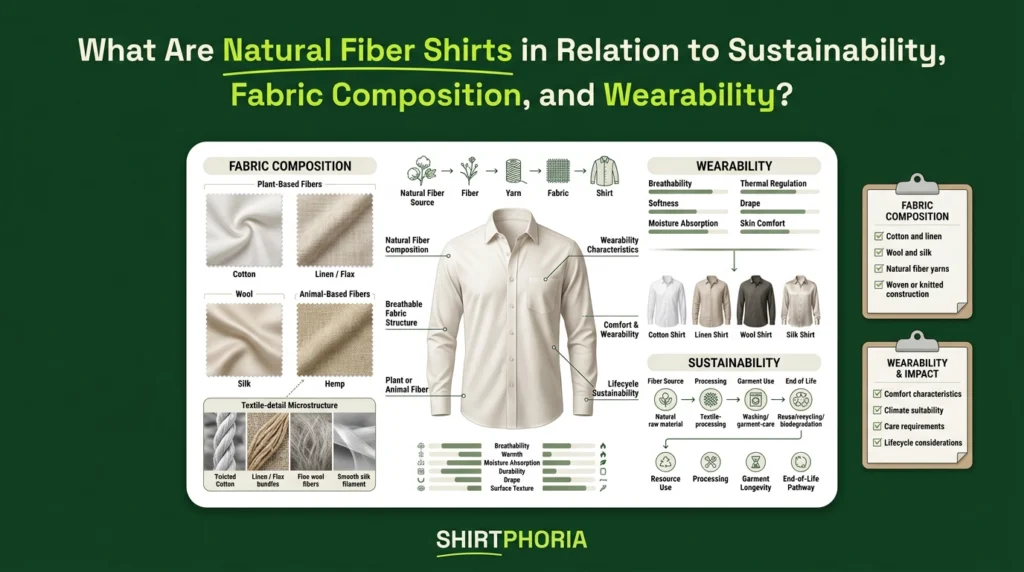
Natural fiber shirts are shirts made entirely from plant- or animal-derived natural fibers, while shirts that combine natural and synthetic fibers should be identified by their exact blend composition; in either case, wearability and sustainability depend on construction, fabric weight, density, finishing, sourcing, durability, care, and end-of-life conditions.
A shirt described as cotton, linen, wool, silk, or another natural material cannot be evaluated accurately from the highlighted fiber name alone. The garment’s complete fiber-content label is needed to distinguish a single-fiber natural textile from an all-natural blend or a natural-synthetic blend.
For example, a shirt labeled 100% cotton has a different composition classification from a cotton-linen shirt or a cotton shirt containing polyester or elastane. The presence of cotton does not make every material in a blended textile natural.
This guide explains how natural fiber shirts are classified by plant and animal origin, how actual fiber composition affects wearability, how major natural materials differ, and how sustainability should be assessed across the garment lifecycle.
Fiber origin establishes material identity, but the finished shirt also depends on yarn structure, weave or knit construction, fabric weight, density, finishing, garment design, care, and the conditions in which it is worn.
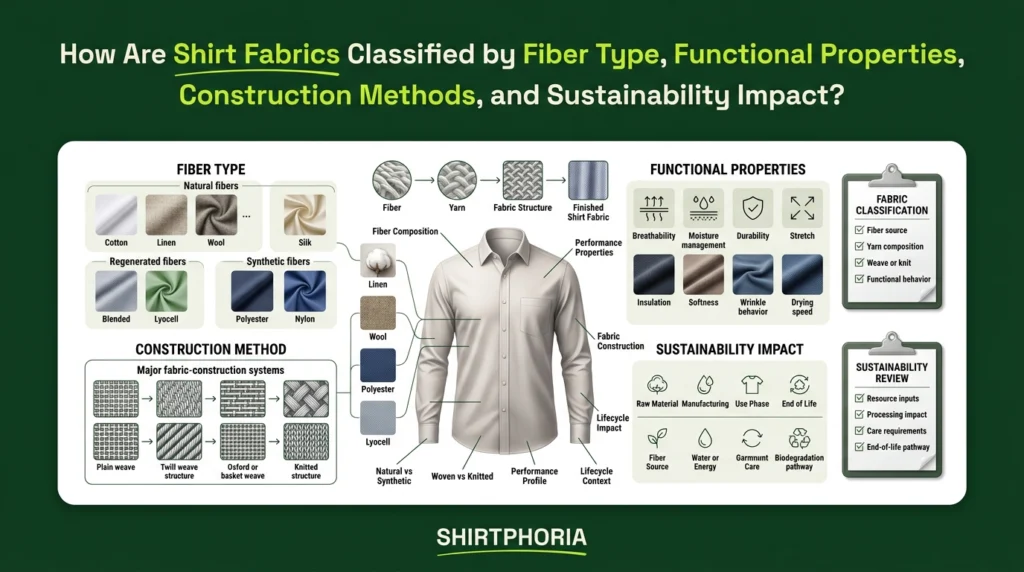
Natural fibers form one branch of the broader shirt fabric classification system.
Why Does Understanding Natural Fiber Shirts Matter When Evaluating Fabric Sustainability and Wearability?
Understanding natural fiber shirts matters because biological origin, actual composition, construction, and finishing influence moisture behavior, thermal response, tactile comfort, maintenance, durability, and lifecycle impact.
Natural-fiber classification provides a useful starting point, but it does not guarantee identical performance among shirts containing the same fiber.
Two 100% cotton shirts, for example, can behave very differently if one is a lightweight, relatively open fabric and the other is a heavier, denser twill. Their moisture absorption may share a cotton-related basis, but air exchange, heat retention, drape, wrinkle response, and drying behavior can differ because of construction.
Classification therefore improves prediction without replacing evaluation of the finished textile.
How Does Natural Fiber Composition Influence Shirt Comfort and Wearability?
Natural fiber composition influences shirt wearability through properties such as moisture absorption, tactile feel, drape, thermal behavior, and resilience, while textile construction, fabric weight, density, and finishing determine how strongly those characteristics appear in the finished garment.
Plant-based fibers such as cotton, linen, hemp, and ramie are primarily cellulose fibers. Animal-derived fibers such as wool and silk are protein-based. Their different molecular and physical structures influence how they interact with moisture, heat, mechanical stress, and the skin.
Moisture absorption, however, should not be confused with drying speed. A textile can absorb substantial moisture yet take longer to release it under particular conditions.
Air exchange also depends heavily on construction. An open, lightweight fabric may allow more airflow than a dense construction made from the same fiber.
Softness works in a similar way. Fiber grade and diameter matter, but yarn preparation, surface finishing, weave or knit structure, laundering, and garment design can all modify how a shirt feels.
Wearability therefore emerges from several interacting variables rather than from natural origin alone.
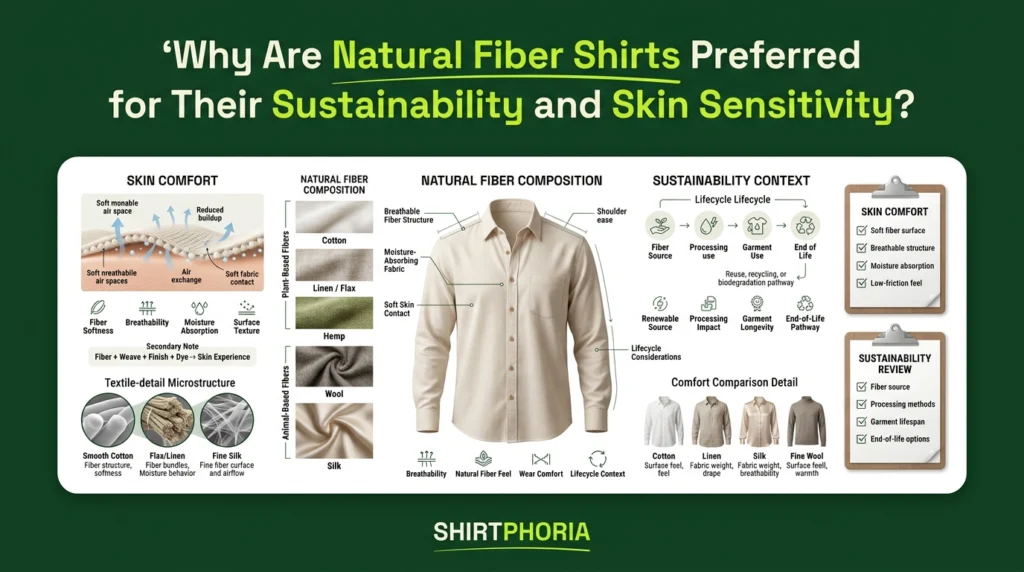
Why Can Natural Fiber Shirts Appeal to Wearers With Skin-Sensitivity Concerns?
Natural fiber shirts may appeal to wearers concerned about skin comfort when the finished textile combines suitable softness, moisture handling, airflow, low friction, and compatible finishing, but natural origin does not make a shirt automatically hypoallergenic or irritation-free.
Heat, perspiration, friction, surface texture, and finishing chemistry can all influence how a shirt feels against the body.
The underlying fiber is only one part of this interaction. Dyes, resins, coatings, adhesives, elastic components, softeners, and other textile-processing materials can also affect skin contact.
This is why cotton, linen, wool, silk, and other natural fibers should not be described universally as hypoallergenic.
Individual sensitivities also vary. One wearer may find a particular wool textile comfortable while another dislikes its surface feel. Linen can feel crisp initially but may become softer with wear and laundering. Cotton can feel soft, yet a rough yarn, dense structure, or particular finish may change the experience.
DermNet’s guidance on textile contact dermatitis also shows why reactions associated with clothing cannot always be attributed to the base fiber alone. Persistent or suspected allergic skin reactions require appropriate professional assessment rather than fabric-selection advice alone.
A deeper examination of these trade-offs appears in natural fiber shirt sustainability and skin sensitivity.
How Are Natural Fiber Shirts Classified by Plant and Animal Fiber Origin?
Natural fiber shirts are classified first by biological origin, separating plant-derived cellulose fibers such as cotton, linen, hemp, and ramie from animal-derived protein fibers such as silk and wool.
This biological classification establishes where the fibers originate. It does not establish the complete composition of the finished shirt.
A cotton-polyester shirt, for example, contains a plant-derived natural fiber and a synthetic fiber. It should therefore be described by its actual blend rather than treated as fully natural.
The garment’s fiber-content label is usually the strongest practical source consumers have for verifying composition.
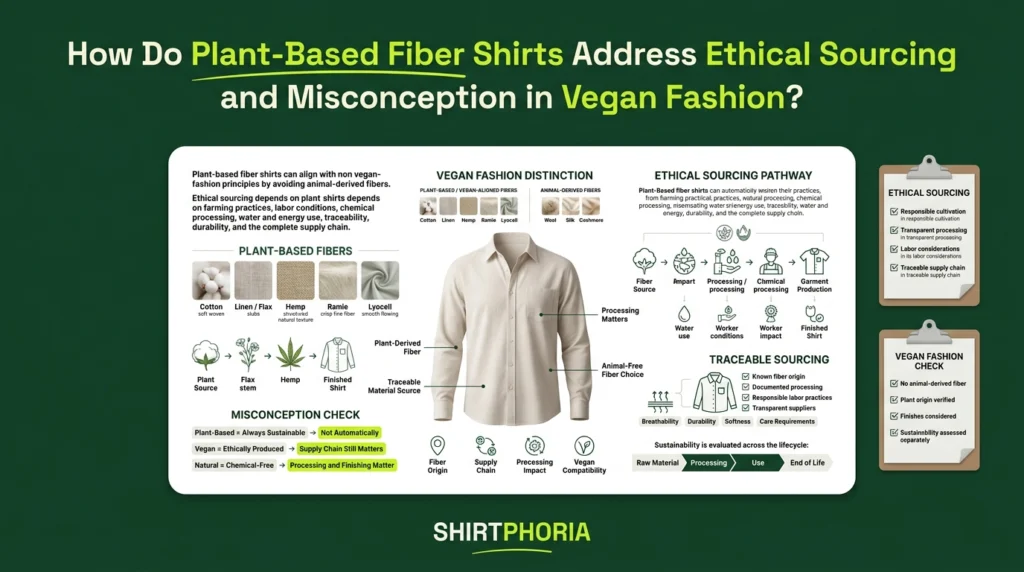
How Are Plant-Based Natural Fibers Used in Shirts?
Plant-based natural shirt fibers are cellulose materials obtained from different plant structures, with cotton derived from seed fibers and linen, hemp, and ramie derived from stem or bast-fiber systems.
Cellulose is the structural carbohydrate that forms an important part of plant cell walls and provides the material basis for many plant textile fibers.
Cotton develops around the seeds of the cotton plant, which makes it a seed-derived cellulose fiber.
Linen is produced from flax. Unlike cotton, flax provides textile fibers from its stem.
Hemp and ramie also belong to the bast-fiber group.
A bast fiber is a textile fiber obtained from the inner stem or phloem region of certain plants.
Although cotton, linen, hemp, and ramie share cellulose-based chemistry, they are not functionally identical. Their fiber dimensions, stiffness, flexibility, surface characteristics, strength, moisture behavior, and response to processing can differ.
Fiber extraction and preparation further modify the final material. Spinning, yarn design, weaving, knitting, softening, finishing, and laundering can substantially change the textile that reaches the wearer.
Plant-derived origin therefore describes the material source. It does not, by itself, establish sustainability, softness, durability, breathability, or environmental superiority.
How Are Animal-Based Natural Fibers Used in Shirts?
Animal-based natural shirt fibers are protein-based materials such as silk and wool whose structures produce different moisture, insulation, resilience, drape, texture, and care behavior from plant-derived cellulose fibers.
Silk is a protein filament produced by silkworms. Its filament structure can support a smooth surface and fluid drape in suitable shirt fabrics.
Wool is a protein fiber obtained primarily from sheep in common apparel applications. Its structure and natural crimp can contribute insulation, resilience, and interaction with moisture vapor.
Being protein-based does not make silk and wool functionally equivalent.
Silk can form fine, smooth, flowing textiles, while wool can provide very different levels of loft, resilience, insulation, and texture depending on fiber fineness and construction.
Fiber diameter can strongly influence tactile perception, particularly with wool. Yarn structure, finishing, fabric weight, and textile construction further modify hand-feel and thermal behavior.
Care requirements also differ between products. Some silk and wool shirts require careful laundering or specialist care, but this should be evaluated from the garment instructions rather than assumed solely from fiber category.
How Does Fiber Composition Affect the Classification of Natural Fiber Shirts?
Fiber composition determines whether a shirt uses a single natural fiber, combines multiple natural fibers, or combines natural and synthetic fibers within the same textile.
Three useful classifications are:
- Single-fiber natural shirt: one natural fiber, such as 100% cotton or 100% linen.
- Natural-natural blend: two or more natural fibers, such as cotton-linen.
- Natural-synthetic blend: one or more natural fibers combined with synthetic fibers, such as cotton-polyester or cotton-elastane.
The actual percentages should be recorded whenever the garment label provides them.
A shirt marked 100% cotton is clearly different from one marked 60% cotton / 40% polyester. Likewise, a 98% cotton / 2% elastane shirt contains a synthetic component even though cotton dominates its composition.
The percentage of each fiber can influence stretch, moisture behavior, wrinkle response, drying, tactile feel, durability, and care.
Percentages do not act independently, however. Yarn design, fabric construction, weight, density, finishing, and garment design can amplify or reduce their practical effects.
There is therefore no universal percentage threshold that should be invented to decide whether a mixed-fiber garment becomes a "natural fiber shirt." An ambiguous blend is better described using its verified composition.
How Do Cotton, Linen, Silk, Wool, and Other Natural Fibers Differ in Shirt Performance?
Cotton, linen, silk, wool, hemp, and ramie differ in shirt performance because their fiber structures produce distinct tendencies in moisture behavior, tactile feel, insulation, resilience, drape, strength, wrinkle response, and maintenance.
These characteristics are tendencies rather than fixed outcomes. Fiber quality, yarn structure, fabric construction, mass, density, finishing, laundering, and garment design can substantially modify them.
Where objective textile properties such as air permeability, dimensional change, wrinkle recovery, moisture behavior, or abrasion performance are measured, standardized methods such as AATCC Standard Test Methods and Procedures provide an appropriate testing framework. Laboratory measurements still need to be interpreted according to their test conditions rather than treated as universal comfort scores.
How Does Cotton Perform as a Natural Shirt Fiber?
Cotton performs as a versatile natural shirt fiber because its cellulose structure supports moisture absorption, a generally comfortable hand, dyeability, and compatibility with many woven and knitted constructions.
Cotton’s ability to absorb moisture contributes to its widespread use in shirts, but absorption and drying are separate properties. A cotton textile that absorbs perspiration effectively can still retain moisture longer than a less absorbent textile under the same conditions.
Its tactile character also varies.
Fine yarns and suitable finishing can create a smooth cotton shirt, while heavier yarns or different constructions can produce a more textured result.
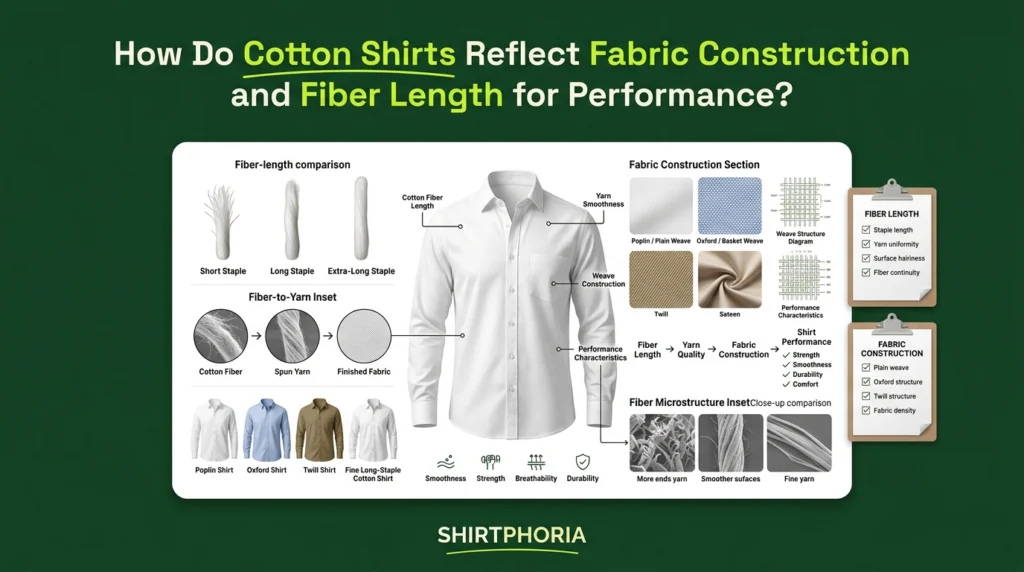
Cotton can be used in poplin, Oxford, twill, jersey, and many other structures.
A cotton poplin may feel relatively smooth and structured. Oxford construction can create more visible texture. Twill changes the interlacing pattern and can affect drape and surface character. Jersey introduces a knitted loop structure that can provide different stretch and softness.
Cotton’s limitations can include wrinkling, dimensional change under unsuitable care, potentially slower drying, and highly construction-dependent airflow.
For these reasons, the label "100% cotton" does not predict one fixed level of breathability, warmth, softness, durability, or maintenance.
How Does Linen Perform as a Natural Shirt Fiber?
Linen performs as a strong, absorbent, and potentially high-airflow natural shirt fiber because flax-derived fibers combine distinctive moisture behavior with a crisp hand and strong structural character.
Linen can absorb moisture, but moisture uptake should still be distinguished from moisture release, evaporation, and total drying time.
The fiber is also associated with a characteristically crisp hand. Depending on fiber processing and fabric finishing, a new linen shirt may initially feel firmer than a soft cotton textile. Repeated wear and laundering can change that tactile character.
Flax fibers can provide substantial fiber-level strength, but fiber tensile strength should not be treated as identical to the durability of a finished shirt. Seams, yarn quality, weave, abrasion, finishing, and garment construction also affect wear life.
Wrinkling is another characteristic commonly associated with linen. This is a material behavior rather than automatic evidence of low quality.
Airflow depends especially on textile structure. A lightweight, relatively open linen fabric may support substantial air exchange, while a denser linen construction can behave differently.
For this reason, linen should not simply be declared the "most breathable" fiber without defining the fabric construction and comparison conditions.
How Does Silk Perform as a Natural Shirt Fiber?
Silk performs as a smooth and fluid natural shirt fiber because its fine protein filaments can create low surface roughness, characteristic sheen, lightweight constructions, and distinctive drape.
Its smooth surface and filament structure help explain why silk can create flowing shirt fabrics with a refined tactile character.
Silk is also associated with characteristic luster, although sheen varies according to yarn, fabric structure, dyeing, finishing, and surface treatment.
A lightweight feel is possible with silk but is not guaranteed. Fabric mass and construction still determine how substantial the finished textile feels.
Care can be a significant consideration.
Depending on the textile, silk can be vulnerable to snagging, abrasion, staining, water-related marking, or maintenance requirements that are more demanding than those of many everyday cotton shirts.
Silk’s reputation as a luxury material should not be used as evidence that it has superior thermal performance, sustainability, strength, or skin compatibility.
Its suitability depends on what the shirt is expected to do.
How Does Wool Perform as a Natural Shirt Fiber?
Wool performs as a thermally adaptable natural shirt fiber because its protein structure, crimp, and moisture interaction can contribute insulation, moisture buffering, resilience, and odor-management tendencies in suitable constructions.
Wool fibers can trap air within appropriate textile structures, contributing to insulation.
Their interaction with moisture vapor can also help buffer changing moisture conditions around the body.
This does not mean every wool shirt is a heavy cold-weather garment.
Lightweight shirting wool can produce a much thinner and less insulating textile than heavy wool used for outerwear. Fabric mass, yarn structure, density, and finishing remain important.
Tactile character varies considerably. Fine wool fibers can feel very different from coarser fibers, making fiber diameter one contributor to whether the textile feels smooth or prickly to a particular wearer.
Care can also involve trade-offs. Unsuitable heat, moisture, or agitation can contribute to felting or dimensional changes in some wool textiles.
Specialist-care requirements may therefore be important when evaluating a particular garment.
Wool should not be described universally as warm, itchy, odor-resistant, or difficult to maintain because the finished textile can vary substantially.
How Do Hemp and Ramie Extend the Natural Fiber Shirt Category?
Hemp and ramie extend the natural fiber shirt category through plant-derived bast fibers whose structural characteristics can contribute absorbency, strength, crispness, and useful airflow potential in appropriate textile constructions.
Hemp is obtained from a bast-fiber system and can produce strong, structured textiles. Its surface may initially feel firmer than some cotton fabrics, although processing, blending, finishing, and laundering can modify the final hand.
Airflow depends on how the hemp textile is constructed rather than on its fiber name alone.
Ramie is another plant-derived bast fiber. It can contribute strength, absorbency, crispness, and relatively low elasticity.
Low elasticity can help explain its structured character, but it can also influence flexibility and wrinkle behavior.
Both fibers may be blended with cotton or other materials to modify tactile or mechanical characteristics.
Their less common use in mass-market shirts does not indicate inherently inferior performance. Market prevalence and textile performance are separate questions.
As with linen, fiber-level tensile strength should not automatically be translated into a claim about finished-shirt durability.
How Do Natural Fiber Shirts Perform Across Climate, Comfort, and Use Case?
Natural fiber shirts perform differently across climates and wearing conditions because air permeability, moisture behavior, insulation, fabric weight, density, tactile feel, and drape interact to determine practical comfort.
Fiber identity helps establish the material profile, but climate suitability depends heavily on the finished textile.
Which Natural Fiber Shirts Perform Best in Hot and Humid Conditions?
Natural fiber shirts suited to hot and humid conditions typically combine useful air exchange with appropriate moisture handling, making linen, hemp, lightweight cotton, and selected lightweight natural-fiber constructions strong candidates rather than universal winners.
Air permeability cannot be predicted accurately from fiber name alone.
A lightweight, relatively open cotton textile can allow substantially different air movement from a dense cotton twill. Linen can offer useful airflow potential, but a heavy or dense linen construction can behave differently from an open one.
The same construction principle applies to hemp, silk, and lightweight wool.
Moisture behavior also needs to be separated into several processes:
- absorption;
- transport;
- evaporation;
- moisture release;
- and drying.
An absorbent textile may take up perspiration effectively but remain damp for longer under certain conditions. Another material may absorb less internally yet dry more quickly.
Open constructions can increase airflow, but they can also reduce opacity or structure. This creates a practical trade-off between ventilation, appearance, and fabric body.
For hot and humid conditions, selection should therefore consider fiber, construction, fabric weight, density, activity level, humidity, and drying requirements together.
Which Natural Fiber Shirts Perform Better in Cool or Variable Conditions?
Natural fiber shirts suited to cool or variable conditions generally depend more on insulation, moisture buffering, fabric mass, thickness, density, and layering compatibility than on fiber name alone.
Wool can be relevant because suitable wool structures combine insulation with moisture interaction.
Heavier cotton can also create a very different thermal profile from lightweight cotton. A dense cotton shirt may retain more warmth than an open, lightweight construction made from the same fiber.
Silk may function effectively in some lightweight layering systems, but its relevance depends on construction, fabric mass, and how the garment is used.
Layering is therefore part of the textile system.
A shirt worn under a sweater or jacket does not need to perform exactly like a shirt worn as the only upper-body layer.
There is no useful universal rule that all wool is warm or all cotton is cool. Construction and fabric mass matter too much for that simplification.
How Do Natural Fiber Shirts Differ in Softness, Drape, and Skin Feel?
Natural fiber shirts differ in softness, drape, and skin feel because fiber diameter, surface structure, yarn quality, finishing, construction, laundering, and individual sensitivity influence how the textile interacts with the body.
Cotton can produce a familiar soft hand, although the result depends on fiber quality and textile preparation.
Linen commonly begins with a crisper structural feel and can soften with wear and laundering.
Silk can create a particularly smooth surface and fluid drape.
Wool varies widely. Fine fibers and appropriate finishing can produce soft shirting, while coarser materials may feel more noticeable against the skin.
Hemp and ramie often produce a more structured hand, although processing and blending can soften their tactile character.
Finishing is especially important because softeners and other treatments can change surface friction and hand-feel without changing the underlying fiber identity.
There is therefore no universal softness ranking that applies to every shirt or every wearer.
Natural Fiber Shirt Use-Case Decision Matrix
| Wearability NeedStrong Natural-Fiber CandidatesWhy They May WorkMain Consideration | |||
|---|---|---|---|
| Hot and humid weather | Linen, hemp, lightweight cotton | Can combine useful airflow potential with moisture absorption and warm-weather comfort | Construction density, fabric weight, drying behavior, activity, and opacity still matter |
| Everyday versatility | Cotton | Broad construction options, familiar hand-feel, useful moisture absorption, wide availability | Wrinkling, dimensional change, drying, and airflow vary substantially by fabric |
| Cool or variable conditions | Wool, heavier cotton | Insulation, moisture buffering, fabric mass, and layering compatibility | Weight, construction, care requirements, and individual comfort |
| Smooth formal drape | Silk | Smooth surface, fluid drape, and lightweight textile possibilities | Abrasion, staining, care, and maintenance requirements |
| Structured warm-weather casual wear | Hemp, linen | Strong bast fibers with crisp texture and useful airflow potential in suitable constructions | Initial crispness, wrinkling, density, finishing, and drying behavior |
These are strong candidates rather than universal winners. Fiber quality, construction, fabric weight, density, finishing, individual comfort, activity, humidity, and climate can materially change performance.
How Should the Sustainability of Natural Fiber Shirts Be Evaluated?
The sustainability of natural fiber shirts should be evaluated across the complete material and garment life cycle because renewable biological origin does not account for sourcing practices, agricultural or animal inputs, manufacturing, dyeing, finishing, garment longevity, care, or end-of-life outcomes.
A material life cycle is the connected sequence of raw-material production, textile production, garment manufacture, use, care, and end-of-life stages through which environmental impacts can occur.
Renewable biological origin and low environmental impact are therefore different concepts.
A plant or animal fiber may come from a renewable source while still involving substantial impacts elsewhere in its lifecycle.
Likewise, no single environmental metric should automatically represent total sustainability. Water, energy, emissions, chemical management, land use, durability, care, and end-of-life are different dimensions.
How Does Raw-Material Sourcing Affect the Sustainability of Natural Fiber Shirts?
Raw-material sourcing influences natural fiber shirt sustainability through variables such as land use, irrigation, agricultural inputs, soil management, biodiversity effects, fiber yield, and animal-husbandry practices.
Plant fibers begin with agricultural systems.
Cotton, flax, hemp, and ramie can involve different crop-management practices, geographic conditions, irrigation systems, fertilizer use, pesticide practices, yields, and soil-management strategies.
Animal-derived materials introduce different considerations.
Wool production, for example, can involve land use, animal husbandry, feed systems, grazing management, and fiber-processing requirements.
This means two shirts made from the same named fiber can have different sourcing profiles.
Two cotton shirts are both cotton, but cultivation region, agricultural practices, processing, energy supply, and manufacturing systems can differ.
Renewable origin alone therefore does not establish low environmental impact.
Cross-fiber comparisons require compatible evidence rather than unsupported statements that one crop universally uses less water, land, energy, or agricultural input than another.
How Do Processing, Dyeing, and Finishing Affect Natural Fiber Shirt Sustainability?
Processing, dyeing, and finishing add environmental impacts to natural fiber shirts through spinning, fabric formation, preparation, coloration, finishing chemistry, energy demand, water use, and wastewater generation.
Raw fibers must be transformed before they become shirts.
Processing can include cleaning or preparation, spinning, weaving or knitting, scouring, bleaching, dyeing, printing, finishing, cutting, and garment assembly.
Each stage can involve different inputs.
Dyeing and wet processing can require water, energy, chemical management, and wastewater control depending on the system.
Finishing can further change both environmental and performance characteristics.
Wrinkle-resistant, stain-resistant, water-repellent, softening, and easy-care treatments can modify a natural textile after its base fabric has been produced.
Those treatments can affect care requirements, tactile feel, wrinkle response, and skin interaction as well as the processing profile.
The environmental performance of the finished shirt therefore cannot be inferred solely from the raw-fiber origin.
How Do Durability, Care, and End-of-Life Affect Natural Fiber Shirt Sustainability?
Durability, care, and end-of-life influence natural fiber shirt sustainability because garment lifespan affects replacement frequency while laundering, drying, ironing, specialist care, repairability, material composition, and disposal conditions shape later lifecycle stages.
A garment that remains usable for longer can reduce replacement frequency, although a long lifespan does not erase impacts created during production.
Repairability can further extend useful wear if damaged seams, buttons, or minor fabric problems can be repaired rather than causing the entire garment to be discarded.
Care requirements also matter.
Washing temperature, washing frequency, tumble drying, air drying, ironing, and specialist cleaning can create different use-phase requirements.
Silk and wool shirts may have different maintenance demands from many everyday cotton or linen shirts, although the care label should determine the actual routine.
End-of-life is more complex than simply asking whether a fiber is biodegradable.
Fiber chemistry matters, but so do dyes, finishes, sewing thread, labels, buttons, elastane, synthetic blends, and disposal conditions.
A biodegradable fiber does not necessarily decompose rapidly or completely in every landfill, soil, compost, or marine environment.
Biodegradability should therefore not be treated as a synonym for environmental harmlessness.
How Should Organic and Certified Natural Fiber Shirts Be Assessed?
Organic and certified natural fiber shirts should be assessed by identifying the specific sourcing, processing, chemical, environmental, and social criteria verified by the certification rather than treating certification as proof of zero impact.
Certification has a defined scope.
The Global Organic Textile Standard (GOTS) establishes requirements for eligible organic textile supply chains and textile processing.
Its value lies in the requirements it verifies within that scope.
Certification does not eliminate all impacts associated with transportation, garment manufacturing, laundering, drying, ironing, durability, repairability, or final disposal.
An organic label also does not guarantee better airflow, softness, durability, wrinkle resistance, or other shirt-performance characteristics.
Certification should therefore be evaluated alongside fiber composition, construction quality, garment longevity, care requirements, and the broader material lifecycle.
How Do Natural Fiber Shirts Differ From Synthetic Fiber Shirts at a High Level?
Natural fiber shirts differ from synthetic fiber shirts primarily in raw-material origin and fiber chemistry, while practical differences in moisture behavior, drying, resilience, wrinkle response, stretch, durability, comfort, and environmental impact depend on the complete textile system.
Natural and synthetic fibers form different material families, but neither category should be treated as universally superior.
How Do Natural and Synthetic Shirt Fibers Differ in Composition and Performance?
Natural shirt fibers originate from plant or animal biological materials, while common synthetic shirt fibers are manufactured polymers, producing different characteristic tendencies in moisture absorption, drying, resilience, stretch, wrinkle behavior, and tactile feel.
Cotton and linen are cellulose-based natural fibers. Wool and silk are protein-based natural fibers.
Polyester and elastane are examples of synthetic fibers with different chemical structures and performance roles.
Natural fibers often show different moisture-absorption tendencies from common synthetic fibers. Some synthetic textiles can dry relatively quickly, but drying depends on the complete yarn and fabric system.
Synthetic fibers can also contribute resilience, wrinkle-related performance, elastic extension, or abrasion characteristics depending on the material.
These are tendencies rather than guarantees.
A dense synthetic textile can behave very differently from a lightweight engineered one. A heavy natural textile can behave differently from a lightweight open construction using the same fiber.
Regenerated cellulosic fibers such as viscose, modal, and lyocell should also remain distinct from both naturally occurring fibers and conventional synthetic polymers.
How Do Their Environmental Trade-Offs Differ?
Natural and synthetic shirt fibers present different environmental trade-offs because biological feedstocks, agricultural inputs, fossil-derived polymers, manufacturing energy, pollution pathways, garment durability, recycling systems, and end-of-life behavior differ across material systems.
Natural fibers can involve agriculture, land, water, soil, fertilizer, pesticide, or animal-husbandry considerations.
Common synthetic polymers can involve fossil-derived feedstocks, polymer production, manufacturing energy, and microfiber or microplastic shedding concerns.
Durability also matters because garment life affects replacement frequency.
Recycling creates another layer. Both natural and synthetic textiles can face recycling limitations, particularly when multiple materials, trims, finishes, or elastane are combined.
End-of-life pathways are therefore product- and infrastructure-dependent.
The useful conclusion is not natural = sustainable and synthetic = unsustainable. The environmental profile depends on the specific material system and lifecycle.
The category boundary becomes clearer when natural fibers are compared with synthetic fiber shirts.
How Do the Major Natural Fiber Shirt Materials Compare?
The major natural shirt fibers differ across origin, moisture behavior, thermal profile, tactile feel, maintenance, use-case suitability, and sustainability considerations, making multi-attribute comparison more useful than a single overall ranking.
There is no universal "best natural fiber" because the desired textile profile changes with climate, activity, formality, tactile preference, maintenance tolerance, and sustainability priorities.
| Natural FiberFiber OriginDefining Wearability TraitCommon LimitationTypical Shirt UseSustainability Consideration | |||||
|---|---|---|---|---|---|
| Cotton | Plant – cellulose / seed fiber | Soft, absorbent, versatile across many constructions | Wrinkling, dimensional change, and slower drying can occur | Everyday, casual, business, dress, Oxford, poplin, jersey | Impact varies with cultivation, irrigation, agricultural inputs, processing, finishing, lifespan, and care |
| Linen | Plant – flax / bast fiber | Absorbent, crisp, strong, with high airflow potential in suitable constructions | Characteristic wrinkling and initially crisp hand | Warm-weather casual and dress-casual shirts | Flax cultivation, retting, processing, dyeing, finishing, lifespan, and care determine the final profile |
| Silk | Animal – protein filament | Smooth surface and fluid drape | Abrasion, staining, and more demanding care | Dress and refined lightweight shirts | Sericulture, processing, dyeing, durability, care, and end-of-life influence impact |
| Wool | Animal – protein fiber | Insulation, moisture buffering, and resilience | Possible itch perception, felting, heat sensitivity, specialist care | Lightweight performance shirting and cool-weather shirts | Animal husbandry, land use, processing, garment longevity, laundering, and care influence impact |
| Hemp | Plant – bast fiber | Strong, structured, absorbent, with useful airflow potential | Can feel crisp or coarse depending on processing | Casual and warm-weather shirts | Agriculture, fiber processing, finishing, lifespan, and care determine environmental outcomes |
| Ramie | Plant – bast fiber | Strong, crisp, absorbent | Low elasticity and potential stiffness | Lightweight structured shirting and blends | Processing intensity, finishing, garment longevity, composition, and end-of-life influence impact |
These are representative profiles. Yarn structure, construction, fabric weight, density, finishing, blend ratio, garment design, climate, and wearer preference can materially alter the behavior of each fiber.
What Natural Fiber Shirt Misconceptions Should You Avoid?
The most common misconceptions about natural fiber shirts occur when biological origin is incorrectly treated as proof of sustainability, complete natural composition, universal comfort, hypoallergenic performance, or identical textile behavior.
How Can You Avoid Assuming Every Natural Fiber Shirt Is Automatically Sustainable?
You can avoid assuming every natural fiber shirt is automatically sustainable by separating renewable biological origin from impacts created during sourcing, processing, garment use, and disposal.
Rule: Natural origin and lifecycle sustainability are separate concepts.
Reason: Agriculture, animal sourcing, processing, dyeing, finishing, energy, garment lifespan, care, recycling, and disposal all influence environmental performance.
Example: A cotton shirt remains a natural-fiber product even when its cultivation, processing, finishing, or care requirements create substantial lifecycle impacts.
The appropriate evaluation therefore considers the complete lifecycle rather than applying a binary sustainable/unsustainable label.
How Can You Avoid Assuming Natural Fiber Means 100% Natural Composition?
You can avoid assuming a shirt has fully natural composition by checking its complete fiber-content label rather than relying on the material emphasized in its product name or marketing.
Rule: Verify the full fiber-content label.
Reason: A shirt marketed around cotton, linen, wool, or another natural material can contain synthetic components.
Example: A cotton stretch shirt containing elastane is a natural-synthetic blend rather than a single-fiber natural textile.
Exact fiber percentages provide a clearer classification than promotional terminology.
How Can You Avoid Judging Natural Fiber Wearability From Fiber Name Alone?
You can avoid judging natural fiber wearability from fiber name alone by evaluating yarn structure, weave or knit construction, fabric weight, density, finishing, and garment design alongside fiber identity.
Rule: Fiber identity is one contributor to finished-fabric performance.
Reason: Construction and finishing can materially alter air permeability, warmth, moisture transport, stretch, texture, wrinkle behavior, and drape.
Example: A dense cotton twill can provide a substantially different airflow and thermal profile from a lightweight linen plain weave even though both textiles use natural fibers.
The finished textile therefore matters more than the fiber name alone.
How Can You Avoid Treating All Natural Fibers as Functionally Similar?
You can avoid treating all natural fibers as functionally similar by recognizing that seed fibers, bast fibers, protein filaments, and animal hair fibers possess different physical structures and performance tendencies.
Rule: Evaluate each fiber according to its own material properties.
Reason: Cotton, linen, silk, wool, hemp, and ramie differ in moisture interaction, resilience, insulation, drape, strength, tactile feel, and care.
Example: A lightweight linen shirt and a wool shirt can produce very different thermal outcomes even though both qualify as natural-fiber garments.
Natural is therefore a material-origin category, not a single performance profile.
How Can You Choose the Right Natural Fiber Shirt?
Choosing the right natural fiber shirt requires verifying its actual composition, matching its moisture and thermal profile to the wearing environment, evaluating construction and weight, accepting its care requirements, assessing lifecycle considerations, and confirming its intended use.
A useful decision process combines label evidence with practical textile evaluation.
Step 1 – Verify the Natural Fiber Origin and Composition
The first step in choosing a natural fiber shirt is to identify each constituent fiber and verify whether the garment is single-fiber natural, natural-natural blended, or natural-synthetic blended.
Read the garment fiber-content label first.
Identify every listed fiber and record the percentages where available.
For example:
- 100% cotton = single-fiber natural.
- Cotton + linen = natural-natural blend.
- Cotton + polyester = natural-synthetic blend.
- Cotton + elastane = natural-synthetic blend.
Do not confuse construction terms such as Oxford, twill, poplin, or jersey with fiber identity.
If the composition cannot be verified, classify it as uncertain rather than guessing from appearance or touch.
Step 2 – Match the Natural Fiber to Climate and Comfort Needs
The second step is to match the natural-fiber profile to the wearing environment by evaluating air exchange, moisture behavior, insulation, tactile feel, activity level, humidity, and individual comfort.
In hot or humid conditions, useful airflow and appropriate moisture behavior can be priorities.
In cooler environments, insulation, moisture buffering, fabric mass, and layering compatibility may become more important.
Activity level matters because a shirt worn during active movement faces different heat and moisture demands from one worn in an air-conditioned office.
Texture and individual tactile preference should also be considered.
Climate suitability should never be assigned from fiber name alone.
Step 3 – Evaluate the Fabric Construction and Weight
The third step is to evaluate how the natural fiber has been converted into fabric because weave or knit structure, fabric weight, thickness, and density determine how strongly its underlying material characteristics appear during wear.
Determine whether the fabric is woven or knitted.
Then identify a more specific structure where practical.
Examples include:
- poplin;
- Oxford;
- twill;
- jersey;
- and open linen weaves.
Assess fabric weight and density where reliable information is available.
An open, lightweight structure can behave very differently from a dense, heavy textile using the same fiber.
Remember that thin appearance alone does not prove high air permeability.
Step 4 – Evaluate Care and Durability Requirements
The fourth step is to determine whether the shirt’s wrinkle behavior, laundering requirements, drying demands, dimensional stability, abrasion resistance, and specialist-care needs fit the wearer’s maintenance tolerance.
Read the care label.
Consider:
- washing requirements;
- drying instructions;
- ironing;
- dimensional-change or shrinkage risk;
- wrinkle behavior;
- surface abrasion;
- structural durability;
- and specialist care.
Silk or wool may require different routines from many cotton shirts, although actual garment instructions should always take priority over category assumptions.
Also distinguish fiber strength from garment durability. Strong individual fibers cannot compensate automatically for weak yarns, poor seams, unsuitable construction, or damaging care.
Step 5 – Assess Sustainability Using Lifecycle Criteria
The fifth step is to assess natural fiber shirt sustainability through sourcing, certification, processing, garment lifespan, laundering, repairability, pollution pathways, and end-of-life considerations rather than relying on the word "natural."
Review any available sourcing information.
Check credible certification and understand its scope.
Consider processing and finishing claims.
Estimate whether the garment appears constructed for useful long-term wear.
Examine laundering and drying requirements because the use phase is part of the lifecycle.
Consider repairability and whether the garment uses mixed materials that could complicate recycling or disposal.
Unknown lifecycle information should remain unknown rather than being filled with assumptions.
Step 6 – Match the Natural Fiber Shirt to Its Intended Use
The final step is to match the complete natural-fiber profile to the intended climate, activity level, formality, tactile preference, maintenance tolerance, sustainability priorities, and expected wear frequency.
Consider two contrasting situations.
For a hot-weather casual shirt, a lightweight linen, hemp, or cotton construction with useful airflow may fit the intended use. A dense construction of the same fiber may provide a different experience.
For cooler or variable conditions, lightweight wool or a heavier cotton textile may be more appropriate where insulation and layering matter.
Neither example establishes a universal winner.
The final choice should optimize for the wearer’s actual requirements rather than fiber prestige or the word "natural."
Natural Fiber Shirt Profile
| Evaluation FieldRequired Output | |
|---|---|
| Natural Fiber Origin | Plant-derived / Animal-derived |
| Specific Fiber(s) | Cotton / Linen / Hemp / Ramie / Silk / Wool / Other |
| Composition Classification | Single-fiber natural / Natural-natural blend / Natural-synthetic blend |
| Fiber Percentages | Record exact label percentages where available |
| Construction | Woven / Knit + specific structure where identifiable |
| Fabric Profile | Weight, density/openness, moisture, airflow, thermal, tactile, wrinkle, durability |
| Skin-Comfort Considerations | Texture, friction, moisture, finishing, known individual sensitivities |
| Care Profile | Washing, drying, ironing, dimensional-change risk, specialist care |
| Sustainability Considerations | Sourcing, processing, certification, lifespan, care, repairability, end-of-life |
| Intended Use | Climate, activity, formality, wear frequency |
| Confidence Level | Label-confirmed / Evidence-supported / Probable / Uncertain |
A successful evaluation should finish with a structured textile profile and conditional use-case decision rather than simply identifying the dominant fiber.
If a classification remains Probable or Uncertain, use this verification order:
- Re-check the sewn-in fiber-content and care labels.
- Check the manufacturer’s official technical or product specification.
- Check credible retailer documentation when manufacturer information is unavailable.
- Where exact fiber identity or percentage is materially important and documentation cannot verify it, use professional textile identification or laboratory fiber analysis rather than guessing.
- Update the classification when stronger evidence contradicts the original assessment.
What Is the Quick Checklist for Evaluating Natural Fiber Shirts?
A complete natural fiber shirt evaluation should verify fiber origin, actual composition, construction, climate performance, tactile comfort, care requirements, durability, lifecycle sustainability, uncertainty, and intended use before the shirt is selected.
Natural Fiber Shirt Evaluation Checklist
Frequently Asked Questions
A natural fiber shirt is made from verified plant- or animal-derived fibers. A shirt containing synthetic components should be described by its actual blend composition rather than treated as fully natural.
No. A shirt marketed as cotton can also contain polyester, elastane, or other fibers. The sewn-in fiber-content label should be checked to verify the complete composition.
Common plant-derived shirt fibers include cotton, linen, hemp, and ramie. Cotton is a seed fiber, while linen, hemp, and ramie are associated with stem or bast-fiber systems.
Silk and wool are common animal-derived natural shirt fibers. They are protein-based materials with different structures and performance tendencies.
No. Sustainability also depends on sourcing, processing, dyeing, finishing, garment lifespan, laundering, repairability, recycling, and end-of-life conditions.
There is no universal winner. Linen, hemp, lightweight cotton, and other suitable natural-fiber constructions can work well when fabric weight, openness, humidity, activity, and drying requirements are considered together.
Terms Explained
| TERM | DEFINITION |
|---|---|
| Natural Fiber | A textile fiber obtained from plant or animal biological material. |
| Cellulose | The structural carbohydrate that forms an important part of plant cell walls and is the material basis for many plant textile fibers. |
| Bast Fiber | A textile fiber obtained from the inner stem or phloem region of certain plants. |
| Plant-Derived Fiber | A natural textile fiber originating from plant material, such as cotton, linen, hemp, or ramie. |
| Animal-Derived Fiber | A natural textile fiber originating from animals, such as silk or wool. |
| Single-Fiber Natural Shirt | A shirt made from one verified natural fiber, such as 100% cotton or 100% linen. |
| Natural-Natural Blend | A textile combining two or more natural fibers, such as cotton and linen. |
| Natural-Synthetic Blend | A textile combining one or more natural fibers with synthetic fibers, such as cotton-polyester or cotton-elastane. |
| Fiber Composition | The constituent fibers present in a textile and their stated percentages. |
| Air Permeability | The ability of air to pass through a textile under defined conditions. |
| Material Life Cycle | The connected sequence of raw-material production, textile production, garment manufacture, use, care, and end-of-life stages. |
| GOTS | The Global Organic Textile Standard, which establishes requirements for eligible organic textile supply chains and processing. |
| Wearability | The practical comfort and suitability of a garment under specific climate, activity, tactile, and maintenance conditions. |
Conclusion
In conclusion, natural fiber shirts are defined by verified plant- or animal-derived fibers and their actual composition, while comfort, performance, sustainability, maintenance, and practical suitability depend on the complete textile and garment system.
Plant-derived materials such as cotton, linen, hemp, and ramie are cellulose fibers, while silk and wool belong to the animal-derived protein-fiber category. These different fiber structures contribute different tendencies in moisture interaction, tactile feel, drape, insulation, resilience, strength, and care.
Natural origin establishes material identity, but it does not automatically establish quality, comfort, skin compatibility, durability, performance, biodegradability, or sustainability.
Composition must also be verified. A 100% cotton shirt is a single-fiber natural textile. Cotton-linen is a natural-natural blend. Cotton-polyester or cotton-elastane is a natural-synthetic blend and should be described by its actual composition.
Construction, fabric weight, density, yarn structure, finishing, garment design, durability, laundering, and care further modify how the finished textile performs.
Environmental evaluation requires the same multi-variable approach. Sustainability is best assessed through the material and garment lifecycle rather than through a single fiber label.
For practical selection, verify the fiber label and percentages, match the material to climate and comfort requirements, inspect construction and weight, evaluate care and durability, assess lifecycle considerations, and match the completed profile to the intended use.
When information remains uncertain, retain an appropriate confidence level and verify it through garment labels, manufacturer documentation, or professional analysis rather than converting an assumption into fact.
Understanding natural fiber shirts through origin, composition, construction, wearability, and lifecycle impact allows you to choose by measurable textile performance rather than by the word ‘natural’ alone.