Weave vs. Weight: How to Test What Prevents Shirts from Sticking in Dry Heat
A shirt does not stay comfortable in dry heat simply because it is lightweight; a controlled weave vs. weight shirt adhesion test helps determine whether weave openness or GSM better delays fabric-to-skin sticking under matched conditions. The common advice to “just wear lightweight shirts” in the heat often fails because it ignores airflow, weave structure, baseline fabric contact, and moisture behavior.
This guide explains how to isolate weave openness from fabric weight, define a practical Time to Stick (TTS) point, compare four weave-weight clusters, avoid bad test data, and turn repeated results into a practical dry-heat shirt selection rule. Time to Stick (TTS) serves as a practical field metric for this evaluation, not a laboratory textile standard, allowing an analytical tester to systematically document how different fabrics behave under physical stress.
Download the Template Guide
Take the weave vs. weight test offline. Download our printable PDF template to track your field trials and keep the cluster matrix cheat sheet right in your testing gear.
Why Do Shirts Stick to the Skin in Dry Heat?
Shirts stick to the skin in dry heat when sweat, baseline fabric contact, and restricted airflow combine to reduce free fabric movement and weaken evaporative cooling. Evaporation depends heavily on moisture movement and continuous air exchange. While dry heat generally supports rapid evaporation, persistent fabric contact traps moisture against the body, overriding the climate’s natural evaporative advantage.
How to Recognize Fabric-to-Skin Adhesion in Dry Heat
Premature fabric-to-skin adhesion is defined as the moment a shirt stops moving freely over the upper back or shoulder blade area and begins clinging to damp skin during normal movement. Premature fabric-to-skin adhesion reduces free air movement across the torso. The upper back and shoulder blade area serves as a highly useful observation zone because it represents a large, movement-sensitive region that you can monitor consistently while walking. When adhesion occurs here, it traps heat, restricts the fabric’s natural mechanical movement, and makes the garment feel noticeably hotter under exertion. The degree of this cling can be influenced by how hydrated outer skin layers (the stratum corneum) change skin-fabric friction, though friction changes vary significantly by fabric and individual physiology.
Why Low GSM Can Still Cause Early Shirt Adhesion
A low-GSM shirt can still cling early because GSM measures fabric mass per unit area, not the amount of air that can pass through the fabric structure. Low GSM combined with a tight weave restricts airflow. In textile evaluation, ASTM D3776/D3776M serves as the standard test method for measuring this fabric mass per unit area. If a low-weight fabric utilizes a highly dense, tight weave, it blocks air exchange despite feeling exceptionally light in the hand. Once a fabric holds enough moisture, it may lose structure, cling closer to the skin, and reduce free air movement, demonstrating that GSM provides useful but incomplete data when evaluated alone.
How to Ask the Weave vs. Weight Test Question
The core question defining this experiment is: under matched dry-heat conditions, does weave openness or fabric weight/GSM do more to delay the shirt’s stick point? Answering this requires shifting perspective away from evaluating garments solely by their hanger weight or hand feel. The test evaluates the structural performance of the garment during sustained heat exposure. A useful test must compare repeated results under strictly matched conditions to yield defensible data.
What Does the Weave vs. Weight Shirt Adhesion Test Measure?
The weave vs. weight shirt adhesion test isolates and measures two distinct structural properties—weave openness and GSM—to determine which factor more strongly influences fabric-to-skin adhesion under matched dry-heat conditions. While air permeability represents the closest formal external textile-testing concept, Time to Stick (TTS) operates as this article’s practical field metric to observe these variables in motion.
How to Define Weave Openness as the Airflow Variable
Weave openness is the structural spacing and pathway between yarns that influences how easily air can move through a fabric. Open weaves allow body heat and moisture vapor to move away from the skin more easily than tight, closed weaves. This physical spacing heavily dictates a fabric’s air permeability—a formal textile property measured under standards like ISO 9237 or ASTM D737. Observing visual weave openness does not directly replace formal air-permeability laboratory testing, but it strongly predicts how freely air will exchange through the garment during field use.
How to Define GSM as the Fabric Weight Variable
GSM, or grams per square meter, is a measure of fabric mass per unit area that influences physical weight, body, and drape, but does not automatically predict airflow. GSM dictates how substantial or structured a shirt feels on the body. Different fibers possess different moisture regain properties—cotton absorbs moisture differently than polyester—so fiber content must be controlled before judging the impact of GSM. Heavier fabrics can sometimes delay adhesion if their structural integrity prevents the damp fabric from collapsing onto the skin, allowing space for airflow.
How to Separate Weave Structure From Fabric Mass
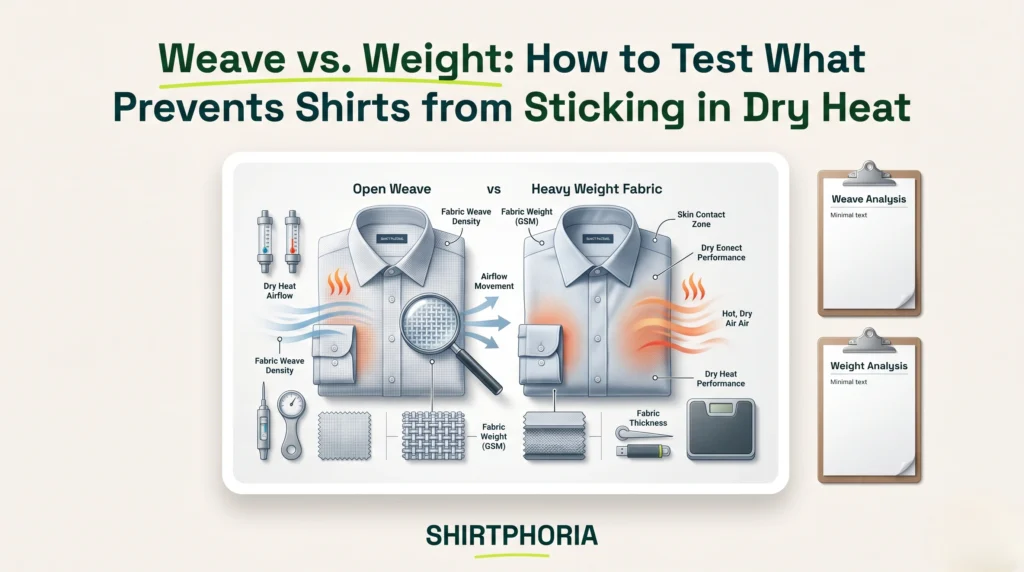
The objective of this test is to separate weave structure from fabric mass so the tester can determine whether a shirt fails because the weave is closed, because the fabric is heavy, or because both variables interact. Casual shopping advice frequently collapses weave and weight into one vague idea of “lightness.” Isolating these variables allows a tester to reach a much more defensible conclusion regarding shirt comfort. You should not blame GSM for poor heat performance until weave structure, fit category, and fiber content have been completely controlled.
Threads are packed densely. Even if the fabric mass is light, the airflow pathway is physically blocked.
Threads are thicker and heavier, but structural gaps remain open, allowing constant heat and vapor exchange.
How Should You Interpret Time to Stick Results?
Time to Stick (TTS) results should be interpreted as comparative field data that is valid only under the matched conditions used during the test. Time to Stick (TTS) numbers lose all meaning if the wearer, route, pace, fiber, fit, temperature, sun exposure, and trial method are not rigorously controlled.
How to Identify Low, Borderline, and Strong TTS Results
Low, borderline, and strong Time to Stick (TTS) results should be judged relative to the repeated results inside the tester’s own controlled trial set. The exact minute count that constitutes a “strong” result in a desert climate will differ entirely from a strong result in a milder dry heat. The most reliable performance signal is the calculated difference between repeated averages across comparable shirts, rather than any fixed universal threshold.
Why Repeated Averages Matter More Than Single Results
Repeated average Time to Stick (TTS) matters more than a single result because one trial can be distorted by wind, sweat rate, pacing, or microclimate changes. Calculating an average across repeated trials systematically reduces the influence of one unusual or anomalous run. Following this reliability rule prevents testers from making purchasing decisions based on random variance.
| Result Pattern | Meaning | Required Action |
|---|---|---|
| Consistently lower TTS than comparison shirts | Early adhesion under the tested conditions | Treat as a weaker dry-heat candidate. |
| Similar TTS across shirts | Borderline or mixed result | Repeat trials before forming a conclusion. |
| Consistently higher TTS across repeated trials | Better delayed adhesion under the tested conditions | Use the winning variable as a buying signal. |
| One unusually high or low trial | Possible outlier | Retest before averaging. |
| Results changed after route, pace, or weather shifted | Invalid comparison | Discard or rerun the trial. |
How Do the Four Weave-Weight Testing Clusters Compare?
To analyze the data effectively, testers must compare shirts across four weave-weight clusters, isolating tight versus open structures against low versus high fabric mass. This structured analysis focuses tightly on the physical interaction between airflow and mass.
How to Compare Tight Weave and Low GSM Shirts
Shirts with a tight weave and low GSM may feel light in the hand, but they can still restrict airflow and reach the stick point early during exertion. This light hand-feel misleads the buyer because the physical weight suggests breathability. The actual comfort risk stems directly from the tight airflow pathway preventing air exchange, not the low fabric mass itself. Under matched conditions, these shirts can trap heat rapidly once moisture builds.
How to Compare Tight Weave and High GSM Shirts
Shirts combining tight weave with high GSM can carry elevated adhesion and discomfort risk in dry heat because they pair restricted airflow with higher fabric mass. This specific cluster tests the compounded, negative effect of blocked air exchange and added weight on the torso. While performance still depends upon fiber type, garment fit, chemical finish, and trial conditions, this pairing generally restricts both moisture release and mechanical movement.
How to Compare Open Weave and Low GSM Shirts
Shirts with open weave and low GSM may provide a strong airflow advantage, although very light open fabrics can sometimes lose structure once damp. The likely benefit here is obvious: low mass paired with an easy physical pathway for airflow. The paired risk, however, is that insufficient structural body may allow the damp fabric to collapse entirely onto the skin during heavy exertion. Testers must watch for this exact balance between too-low mass and highly open structure.
How to Compare Open Weave and High GSM Shirts
Comparing open weave and high GSM shirts tests whether superior airflow can offset heavier fabric mass under matched dry-heat conditions. This specific cluster challenges the simplistic belief that lighter always means cooler. A heavier open-weave fabric can sometimes maintain its rigid drape, hold the fabric slightly away from the body, and successfully delay adhesion, though this relies entirely on the fabric’s specific structural finish.
Question: Does light weight overcome restricted airflow?
Signal: Fabric may feel incredibly light in the hand, but rapidly traps moisture and sticks early during exertion.
Question: Does airflow plus low mass delay sticking?
Signal: Extremely strong dry-heat candidate, though ultra-light fabrics risk structural collapse when heavily saturated.
Question: Does heavy weight worsen a low-airflow structure?
Signal: Highest risk category. Pairs restricted heat release with heavy fabric mass, leading to rapid, suffocating adhesion.
Question: Can airflow offset heavier fabric mass?
Signal: May successfully delay sticking despite feeling heavy, as rigid structural gaps maintain separation from damp skin.
How Do You Analyze Weave vs. Weight Shirt Adhesion Test Results?
Analyzing the results of the weave vs. weight shirt adhesion test requires aggregating Time to Stick (TTS) data for each cluster to determine which structural variable shows the strongest repeated influence on comfort. Testers must focus strictly on averages and keep all final conclusions conditional to the specific testing environment.
How to Calculate Average Time to Stick for Each Cluster
Testers must group shirts by weave and GSM category, then calculate the average Time to Stick (TTS) for each cluster to prevent one anomalous run from corrupting the analysis. Repeated trial averages provide a significantly more stable signal than single data points. This straightforward arithmetic step ensures the data is reliable for the reader without requiring complex statistical software.
How to Identify Whether Weave Openness or GSM Changes TTS More Strongly
By comparing average Time to Stick (TTS) for open-weave clusters against tight-weave clusters, and low-GSM clusters against high-GSM clusters, testers can identify which isolated variable produced the strongest delay in adhesion. For example, if Cluster 4 (Open/Heavy) consistently produces a higher Time to Stick (TTS) than Cluster 1 (Tight/Light), the data suggests weave openness may act as the stronger comfort factor under those matched conditions. This result should guide buying rules strictly within similar environments and activity levels.
How to Write a Cautious Insight Statement from the Test
Testers must write cautious insight statements that describe what happened under the tested conditions without claiming universal proof. You must avoid making absolute claims about garment superiority unless the testing framework encompasses massive, varied-condition trials across multiple wearers.
“In these matched dry-heat trials, open-weave shirts produced a higher average Time to Stick (TTS) than tight-weave shirts. This suggests that weave openness may be a stronger comfort driver than GSM alone under the tested conditions.”
Interactive: Your Personal TTS Leaderboard
Use this tool to log your field tests. Add your shirts below, and the leaderboard will automatically rank them from highest Time to Stick (TTS) (best delayed adhesion) to lowest (fastest to stick). Your data is saved locally on your browser.
| Rank | Shirt ID | Weave & Weight | TTS (Min) | Action |
|---|
How Do You Avoid Bad Data in the Weave vs. Weight Shirt Test?
To avoid generating bad data in the weave vs. weight shirt test, testers must identify and eliminate confounding variables that distort Time to Stick (TTS) measurements. The most common error is incorrectly blaming weave structure or GSM for poor performance when garment fit, fiber content, walking route, pace, or weather actually changed mid-test.
How to Fix Inconsistent Fit Before Blaming Weave or GSM
If a shirt has an inconsistent or excessively tight fit, it may reach the stick point prematurely because the fabric already sits close to the skin. Fit directly dictates baseline fabric contact. Testers must match fit categories—such as standard, slim, or relaxed—before attempting to compare fabric structure.
Why You Should Avoid Comparing Different Fiber Blends in the Same Test
Testers must avoid comparing different fiber blends within the same weave-weight matrix because distinct fiber moisture behavior can obscure the effects of weave and GSM. Linen, cotton, polyester, and elastane blends all absorb, move, and release moisture at completely different rates. Comparing different fibers requires its own separate, controlled experiment.
How to Handle Borderline Results Before Making a Conclusion
When two shirts produce nearly identical Time to Stick (TTS) results, testers must avoid premature conclusions and repeat the trials to account for marginal differences in sweat rate, pace, wind, or microclimate. Borderline results are those that fall too close together to trust from a single trial set. Repeating the trials ensures the tester does not overclaim tiny, insignificant differences in minute counts.
How to Separate Comfort Feeling from the Measured Stick Point
Testers must separate subjective comfort feelings from the measured stick point because a shirt can feel light while still adhering early. Comfort notes provide incredibly useful context, such as noting when a shirt feels “light but sticky” versus “warm but still moving.” However, Time to Stick (TTS) remains the firm, primary comparison metric. Laboratory instruments like the TPACC Wet Cling Tester confirm that wet cling involves measurable friction forces, but field testers rely on the visible stick point to standardize their observations.
Know When the Weave vs. Weight Test Result is Not Reliable
A test result must be treated as unreliable if major changes occurred in weather, walking route, pacing, garment condition, or trial repetition. Unreliable trials should be discarded entirely or rerun from the beginning. Purchasing rules based on a single unrepeated trial or compromised methodology lead to highly flawed wardrobe choices.
| Testing Problem | Why It Distorts the Result | Required Fix |
|---|---|---|
| Different shirt fit | Tight fabric touches skin earlier | Use similar fit categories. |
| Different fiber content | Moisture behavior changes | Compare the same fiber type. |
| Different walking pace | Body heat and sweat output change | Use the same pace and route. |
| Changing sun exposure | Fabric surface temperature changes | Use the same route and time window. |
| Only one trial conducted | One result may be random variance | Repeat each shirt test. |
| Relying only on subjective comfort | Feeling is useful but not precise | Keep TTS as the primary metric. |
| Using old and new garments together | Wear and laundering can change fabric behavior | Match garment condition where possible. |
How Should You Choose Dry-Heat Shirts After the Weave vs. Weight Test?
After completing the weave vs. weight test, consumers should translate repeated Time to Stick (TTS) results into practical buying rules by prioritizing the structural attributes that performed best in their specific environment. This testing data directly informs smarter purchasing, provided the advice remains conditional on the repeated test results rather than broad assumptions.
How to Prioritize Open-Weave Shirts When TTS Results are Higher
If repeated test data shows that open-weave clusters consistently produce higher Time to Stick (TTS) metrics, consumers should elevate weave openness as a primary selection criterion for dry heat. This rule strictly applies to similar climates, activities, and fit categories.
How to Use GSM as a Secondary Signal, Not the Only Comfort Rule
GSM remains a relevant metric for garment weight and structure, but it should be evaluated alongside airflow instead of being used as the only comfort rule. GSM must be evaluated alongside airflow. GSM continues to matter for fabric drape, opacity, physical structure, and heat feel, but the mass measurement alone cannot reliably predict physical sticking behavior.
How to Choose Shirts That Balance Airflow, Drape, and Movement
The optimal dry-heat shirt is rarely just the thinnest fabric available; it is the garment that balances airflow, drape, and movement well enough to delay adhesion. Too little physical structure allows damp fabric to collapse limply onto the skin, while too much mass traps heat and restricts crucial airflow. Finding the best dry-heat garment requires identifying this balanced structural result.
| Test Data Result | Corresponding Selection Rule |
|---|---|
| Open weave consistently has higher TTS | Prioritize weave openness over weight in similar dry-heat conditions. |
| Low GSM consistently has higher TTS | Prioritize lighter fabric mass within the same fiber and fit category. |
| Open/high-GSM beats tight/low-GSM | Treat airflow structure as a stronger signal than weight alone. |
| Results are mixed across clusters | Choose based on a balance of airflow, fit, drape, and repeat-test comfort notes. |
| Only one trial was completed | Repeat the test protocol before making a final purchasing decision. |
What Are the Final Takeaways from the Weave vs. Weight Shirt Adhesion Test?
The final takeaways from the weave vs. weight shirt adhesion test emphasize strict control of variables, consistent measurement of the stick point, and cautious application of repeated results to practical wardrobe choices.
Before Testing: Define the exact stick point and match fiber type, fit category, garment condition, route, and pace.
During Testing: Record Time to Stick (TTS) in minutes and note temperature, humidity, sun exposure, and comfort observations.
After Testing: Calculate the average Time to Stick (TTS) for each shirt and compare results by weave-weight cluster.
Analysis: Treat weave openness and GSM as separate variables instead of collapsing them into one idea of “lightness.”
Reliability: Discard or rerun trials affected by route changes, pace changes, weather shifts, or one-off anomalies.
Conclusion: Write a cautious insight statement based on repeated results, not assumptions.
Frequently Asked Questions
Terms Explained
| TERM | DEFINITION |
|---|---|
| Time to Stick (TTS) | A practical field measurement defining how long a garment delays uncomfortable clinging to the skin under controlled exertion. |
| GSM (Grams/Square Meter) | A standard measurement of fabric mass per unit area. It dictates how substantial or structured a fabric feels but does not automatically predict airflow. |
| Weave Openness | The structural spacing and physical pathway between yarns that determines how easily air and moisture vapor can move through a fabric. |
| Air Permeability | A formal textile property (measured via ISO 9237) indicating how freely air moves through a fabric structure. |
| Stratum Corneum | The hydrated outer layer of human skin, which can significantly alter skin-fabric friction and perceived stickiness when damp. |
| Accumulated Stickiness | A textile research concept demonstrating that perceived cling and physical friction forces grow exponentially during prolonged wet contact. |
Conclusion
In conclusion, preventing a shirt from sticking in dry heat requires more than choosing the lightest available fabric; a controlled weave vs. weight shirt adhesion test provides a practical framework for separating fabric structure from fabric mass by measuring how long each garment delays the stick point. This field methodology challenges the prevailing “lightweight equals cool” assumption by forcing the tester to analyze airflow and weave structure as distinct performance variables. While GSM remains a highly useful baseline measurement, GSM alone functions as an incomplete metric for predicting physical comfort and cling in hot environments. By utilizing Time to Stick (TTS) as a repeatable comparison metric rather than claiming it acts as a formal laboratory standard, testers can generate reliable insights tailored to their specific environments. Under matched conditions, weave openness may frequently emerge as the stronger predictor of delayed fabric-to-skin adhesion, provided repeated Time to Stick (TTS) results support the pattern.