What Is the Sleeve Construction of a Raglan Sleeve Shirt?
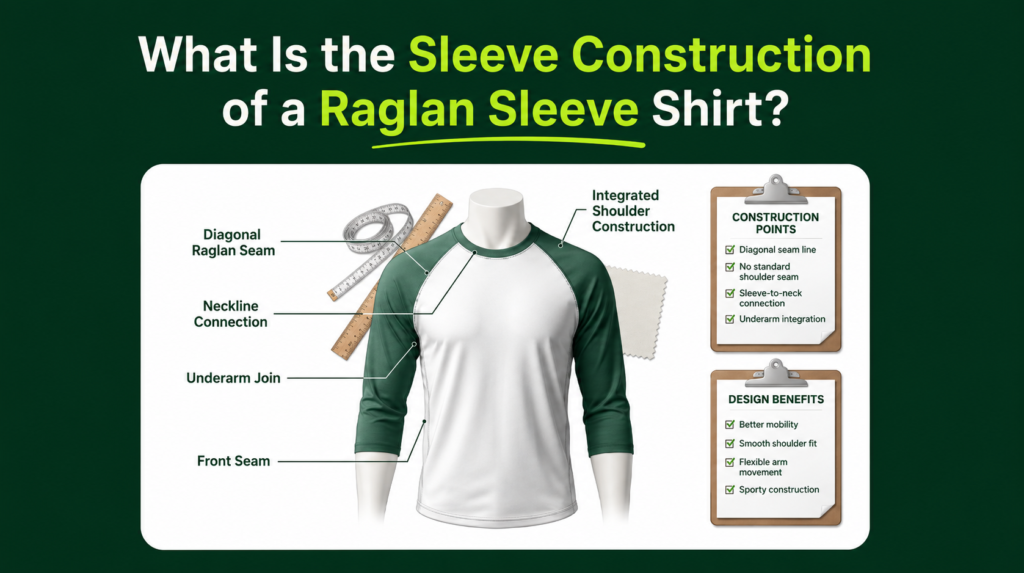
Raglan sleeve construction is a tailoring and patternmaking method where the sleeve extends toward the neckline instead of ending at a separate shoulder seam, creating a diagonal seam from the underarm area to the collar or neckline.
Many readers recognize the familiar appearance of a baseball-style shirt, but fewer understand that raglan construction is a specific garment-engineering method rather than simply a color-blocking style. Its defining feature is the way the sleeve panel extends into the shoulder and neckline area.
This guide breaks down raglan sleeve construction, compares it with set-in sleeve construction, explains how its pattern anatomy affects movement and fit, and identifies source-safe modern raglan-related variations.
The standard technical term for the visible neckline-to-underarm line is the raglan seam or diagonal raglan seam. It may be described informally as a “Diagonal Glide Line” because the eye can follow it from the neckline toward the underarm. However, “Diagonal Glide Line” is only an explanatory phrase and is not an official tailoring term.
The performance of a raglan sleeve depends on the complete garment. Pattern shape, fabric stretch, garment size, sleeve width, seam finish, neckline stability, underarm depth, and intended use all influence whether the construction succeeds.
Why Is Understanding Raglan Sleeve Construction Essential for Fit and Function?
Understanding raglan sleeve construction is essential for fit and function because the diagonal seam path changes how the sleeve, shoulder, neckline, and bodice share movement tension.
A conventional set-in sleeve attaches around a defined armhole and normally creates a visible shoulder endpoint. A raglan sleeve extends beyond that point and becomes part of the upper shoulder and neckline structure.
This does not mean raglan construction is automatically better than set-in construction. The two methods serve different fit, movement, and styling goals.
Set-in sleeves commonly provide stronger shoulder definition and more precise tailoring. Raglan sleeves often create a softer shoulder transition and can offer more room around the upper arm and underarm when the pattern is properly balanced.
How Does Raglan Sleeve Construction Affect Shoulder Mobility?
Raglan sleeve construction can support shoulder mobility by moving the main sleeve seam away from the shoulder apex and giving the underarm area more room for arm movement.
The shoulder apex is the upper point of the shoulder where a conventional shoulder seam or sleeve-cap area often needs precise alignment. In raglan construction, the main sleeve-attachment line travels diagonally away from that point.
Pattern Studio 101 explains that raglan sleeves use a seam running from the underarm toward the neckline and can provide additional underarm room for comfortable movement. The source also describes one-piece and two-piece raglan drafting options. raglan pattern making
The construction relationship can be summarized as:
Diagonal raglan seam → shifts seam tension away from the shoulder apex → may support freer arm movement.
The actual movement result still depends on fabric stretch, garment ease, sleeve width, neckline stability, torso fit, and overall pattern balance.
A poorly fitted raglan shirt can still feel restrictive. For example, a narrow sleeve, short bodice, tight cuff, stiff fabric, or unstable neckline can reduce movement comfort even when the sleeve uses raglan construction.
How Does Raglan Construction Create a Soft Shoulder Silhouette?
Raglan construction can create a soft shoulder silhouette because the sleeve seam does not end at a fixed shoulder point in the same way a set-in sleeve does.
The diagonal seam visually blends the sleeve and upper bodice. This can make the shoulder transition appear smoother, more sloped, or more relaxed.
The visual relationship is:
No fixed shoulder endpoint → softer shoulder transition → more relaxed visual silhouette.
This effect is not universal. Fabric drape, sleeve volume, shoulder shape, garment size, and seam curvature influence the final appearance.
A soft jersey fabric may follow the body closely and create a smooth transition. A thick sweatshirt fabric may produce a broader or bulkier shoulder shape. An oversized pattern may appear relaxed, while an unbalanced pattern may look shapeless.
How Does Raglan Sleeve Construction Differ from Traditional Set-In Sleeves?
Raglan sleeve construction differs from traditional set-in sleeve construction because the sleeve extends toward the neckline, while a set-in sleeve is attached around an armhole called the armscye.
The armscye is the shaped armhole edge where a set-in sleeve is sewn to the front and back bodice. It surrounds the upper arm and receives the curved sleeve cap.
In raglan construction, the sleeve extends into part of the shoulder and neckline area rather than attaching only around a conventional armscye.
| Feature | Raglan Sleeve Construction | Set-In Sleeve Construction |
|---|---|---|
| Primary Seam Path | Diagonal seam from neckline or collar area toward the underarm. | Circular seam around the armscye. |
| Shoulder Definition | Softer and more sloped shoulder transition. | Sharper and more structured shoulder point. |
| Movement Comfort | Can feel more forgiving during reaching when properly fitted. | Can feel restrictive if the sleeve cap or shoulder point is tight. |
| Fit Precision | More forgiving across some shoulder widths. | Requires more precise shoulder alignment. |
| Visual Signature | Sporty, casual, relaxed, or technical depending on fabric and cut. | Formal, tailored, structured, or classic depending on garment type. |
| Main Risk | Underarm bunching, neckline distortion, or excess sleeve volume. | Shoulder pulling, sleeve-cap tightness, or seam pressure. |
Neither construction is universally better.
A set-in sleeve may be more suitable when a garment requires a defined shoulder line, formal structure, or precise tailoring. A raglan sleeve may work better when a softer silhouette, relaxed fit, or more movement tolerance is desired.
The correct choice depends on the garment type, fabric, wearer, and intended activity.
How Can You Identify the Raglan Seam Path?
The easiest way to identify raglan sleeve construction is to follow the diagonal seam that runs from the neckline or collar area toward the underarm.
This neckline-to-underarm line is the diagonal raglan seam.
For reader understanding, it may be described as a “Diagonal Glide Line” because it visually travels across the shoulder area. However, the correct construction term remains raglan seam or diagonal raglan seam.
The seam is not always positioned at the same angle. It does not have to measure exactly 45 degrees.
Its slope can vary according to:
- Neckline shape
- Collar design
- Shoulder slope
- Garment size
- Sleeve volume
- Pattern style
- Intended visual effect
The identification relationship is:
Neckline-to-underarm seam → identifies raglan construction → separates it from set-in sleeve construction.
Color contrast may make the seam easier to see, but color blocking is not required. A single-color shirt can still use true raglan construction.
How Does Raglan Panel Integration Change the Bodice?
Raglan panel integration changes the bodice because part of the shoulder area becomes part of the sleeve panel rather than remaining entirely within the front and back bodice pieces.
The bodice is the main torso section of the garment. In a set-in design, the bodice usually contains the full shoulder area up to the armscye.
In a raglan pattern, portions of the shoulder area are transferred into the sleeve pattern. This means the sleeve panel contributes to the shape of the shoulder and neck opening.
The sleeve is therefore not simply attached to the side of the bodice. It becomes a structural part of the upper garment.
The front bodice, back bodice, sleeve panel, neckline, shoulder apex, and diagonal seam path must work together. If one section is poorly balanced, the garment may twist, pull, bunch, or distort.
How Can the Technical Components of Raglan Sleeve Construction Be Broken Down?
Breaking down the technical components of raglan sleeve construction reveals how the diagonal seam, sleeve panel, bodice pieces, underarm area, and neckline work together.
The exact pattern shape differs across garment categories.
A lightweight T-shirt may use a simple one-piece sleeve. A sweatshirt may use a wider underarm shape. A jacket may use a two-piece sleeve for greater control. A knitted sweater may create a raglan-like line through shaping rather than conventional woven-fabric pattern pieces.
Raglan construction must therefore be analyzed according to the specific garment rather than treated as one fixed pattern.
What Is the Diagonal Raglan Seam?
The diagonal raglan seam is the main construction line that runs from the neckline or collar area toward the underarm and visually defines the raglan sleeve.
This seam relocates the sleeve attachment away from a conventional shoulder endpoint. It creates the boundary between the sleeve panel and the remaining front or back bodice.
The seam may be straight, gently curved, sculpted, or manipulated. Its exact shape depends on the drafting method and garment design.
For reader understanding, the seam can be pictured as a “Diagonal Glide Line,” but that phrase should not be treated as formal industry terminology.
The safest movement explanation is:
The diagonal raglan seam can act like a movement-tolerant construction line because it shifts the seam away from the shoulder point.
The construction relationship is:
Diagonal raglan seam → relocates sleeve attachment → changes shoulder movement behavior.
The seam does not absorb energy, guarantee mobility, or automatically eliminate pulling. Its practical effect depends on the entire garment pattern.
What Is the Sleeve Panel in Raglan Construction?
The sleeve panel in raglan construction extends farther toward the neckline than a standard set-in sleeve, which changes how the shoulder area is divided between sleeve and bodice pieces.
Some raglan sleeves are drafted as one piece. Others are drafted as two pieces with separate front and back sleeve sections or an additional shaping seam.
A 1-piece raglan sleeve may extend continuously from the neckline area to the sleeve hem without a seam along the top of the shoulder.
A 2-piece raglan sleeve divides the sleeve into multiple sections. This can give the patternmaker more control over sleeve shape, shoulder contour, arm position, and fabric volume.
Not all raglan sleeves are one-piece constructions. The exact sleeve-panel arrangement depends on garment type, fabric, pattern method, and design goal.
The phrase “monolithic sleeve panel” may be used as a simplified description of certain one-piece patterns, but it is not a universal technical rule.
How Does Neckline Collar Integration Work in Raglan Construction?
Neckline collar integration in raglan construction works because the upper portions of the sleeve panels help form part of the neck opening alongside the front and back bodice pieces.
In many basic garments, the neck opening is formed mainly by the front and back bodice. In raglan construction, the upper sleeve sections also join the neckline.
The construction relationship is:
Sleeve panel reaches neckline → joins bodice at neck opening → changes collar-construction sequence.
The neckline may be finished with:
- Ribbing
- Binding
- A collar piece
- A facing
- Fold-over elastic
- Another stabilizing finish
The sewing sequence must account for the points where the sleeve panels, front bodice, and back bodice meet.
Neckline stability is important. If the seam lengths are inaccurate or the fabric stretches unevenly, the collar may twist, gape, pull, or lose its centered position.
How Can Readers Test Raglan Sleeve Construction for Fit and Movement?
Readers can test raglan sleeve construction for fit and movement by observing hem lift, underarm bunching, neckline stability, shoulder pressure, and seam comfort during controlled arm movements.
The following checklist is a practical garment-fit evaluation. It is not a laboratory measurement, medical assessment, formal ergonomic test, or industry-standard testing method.
| Diagnostic Input | How to Test It | Pass Signal | Warning Signal | Fail Signal |
|---|---|---|---|---|
| Overhead Reach | Raise both arms overhead three times. | Hem stays mostly stable. | Hem lifts slightly but settles back. | Hem lifts sharply or pulls across the torso. |
| Cross-Body Reach | Reach one arm across the chest. | Shoulder and upper sleeve move comfortably. | Mild pull appears near the upper sleeve. | Shoulder seam, underarm, or neckline restricts movement. |
| Underarm Bunching | Lower arms after overhead reach. | Fabric returns smoothly. | Some folds remain under the arm. | Fabric bunches, twists, or feels bulky. |
| Neckline Stability | Rotate both arms while wearing the garment. | Neckline stays centered. | Minor shift appears. | Neckline twists, pulls, or distorts. |
| Layering Comfort | Wear under a jacket or coat. | No painful seam overlap. | Mild seam awareness appears. | Bulky seam stacking or pressure occurs. |
| Skin Friction | Simulate repeated arm swing or backpack use. | No rough seam contact. | Mild seam awareness appears. | Rubbing or irritation risk appears. |
How Should Hem Lift Be Evaluated?
Hem lift should be evaluated by observing how much the lower edge of the garment rises when both arms move overhead.
A small amount of movement may be normal, especially in short, fitted, or low-stretch shirts. The important question is whether the hem settles back into place after the arms are lowered.
Sharp lift or strong pulling across the torso may indicate:
- Insufficient underarm room
- Inadequate garment ease
- A short bodice
- Narrow sleeves
- Stiff fabric
- Incorrect sizing
Raglan construction may reduce hem lift in some properly fitted garments, but it cannot guarantee a stable hem.
How Should Underarm Bunching Be Evaluated?
Underarm bunching should be evaluated by checking whether the fabric returns smoothly after reaching or lifting movements.
Some folds under the arm are normal because fabric must compress when the arms rest at the sides.
A possible fit problem appears when the fabric:
- Remains twisted
- Forms heavy bulk
- Pulls toward the neckline
- Restricts arm lowering
- Creates uneven tension across the torso
Underarm bunching may result from excessive sleeve volume, a low arm position, poor seam curvature, stiff fabric, or incorrect sizing.
How Should Neckline Stability Be Evaluated?
Neckline stability should be evaluated by checking whether the collar remains centered during repeated arm rotation.
A stable neckline should return to its normal position after movement. Minor temporary shifting may be acceptable.
Persistent twisting or pulling may indicate poor balance between the sleeve panels, bodice pieces, and neckline finish.
The problem may come from:
- Unequal raglan seam lengths
- Overstretched neckline fabric
- Weak collar recovery
- Incorrect neckband length
- Unbalanced sleeve panels
- Poor sewing control
How Should Layering Comfort Be Evaluated?
Layering comfort should be evaluated by wearing the raglan shirt under the type of jacket, coat, or overshirt normally used with it.
The wearer should notice whether multiple seams sit directly on top of one another.
This overlap is sometimes called seam stacking. It can create pressure, bulk, or discomfort under outerwear.
A diagonal raglan seam may reduce direct overlap with a conventional jacket shoulder seam. However, the result depends on fabric thickness, seam finish, outerwear cut, garment size, and layering order.
Users should compare garments with similar fabric weights, sizes, sleeve lengths, and intended uses before blaming sleeve construction alone.
How Can Raglan Sleeve Construction Support Functional Use Cases?
Raglan sleeve construction can support functional use cases when its diagonal seam path, underarm room, fabric choice, and garment fit align with the activity.
The construction is often found in:
- Casual shirts
- Sweatshirts
- Sportswear
- Work layers
- Knitwear
- Baseball-style tops
- Lightweight jackets
- Selected coats
- Technical garments
Its usefulness comes from the relationship between pattern shape and intended movement.
A properly sized raglan garment should provide enough room for the intended activity without producing uncontrolled fabric volume.
How Can Raglan Construction Support Dynamic Movement?
Raglan construction can support dynamic movement by giving the underarm and shoulder area more room to move than a tight set-in sleeve.
This can be useful during activities such as:
- Reaching
- Throwing
- Climbing
- Stretching
- Lifting
- Repeated arm swinging
The functional relationship is:
Underarm room → improves movement tolerance → may reduce pulling during active motion.
The benefit is conditional.
A tight sleeve can still restrict movement. A stiff fabric may resist folding and stretching. A narrow torso may pull upward. A short sleeve or tight cuff may limit the arm even when the shoulder area is comfortable.
Raglan construction may also reduce underarm bunching in some garments, but only when the sleeve shape, fabric, and garment size are properly balanced.
How Can Raglan Construction Help Layering Comfort?
Raglan construction can help layering comfort when its diagonal seam path reduces direct overlap with the shoulder seams of jackets, coats, or outer layers.
The relationship is:
Diagonal seam placement → may reduce direct seam overlap → can improve perceived layering comfort.
When thick seams overlap, the wearer may feel bulk or pressure. Moving one seam away from the conventional shoulder point can sometimes reduce this issue.
However, a thick raglan seam can still feel uncomfortable under a close-fitting jacket. An oversized shirt can also create folds beneath outerwear.
Layering comfort depends on:
- Fabric thickness
- Seam profile
- Jacket cut
- Sleeve width
- Garment size
- Layering order
- Seam finish
Raglan construction does not eliminate all pressure or friction.
How Can Raglan Construction Support Forgiving Size Grading?
Raglan construction can support forgiving size grading because it does not require the sleeve seam to sit exactly on the wearer’s shoulder edge.
A set-in sleeve usually appears most balanced when the shoulder endpoint aligns closely with the wearer’s actual shoulder.
A raglan sleeve lacks this fixed shoulder endpoint. This may allow some patterns to accommodate a broader range of shoulder widths.
The grading relationship is:
No fixed shoulder endpoint → increases fit tolerance → may support broader casual sizing.
This can be useful in relaxed knitwear, sportswear, sweatshirts, and casual tops.
The construction does not provide universal sizing adaptability. Poor pattern balance, stiff fabric, oversized volume, low underarms, or weak neckline control can still create a poor fit.
How Can Modern Raglan-Related Variations Be Explained Safely?
Modern raglan-related variations should be explained by separating traditional cut-and-sew raglan construction from seam-free knitwear technology and source-confirmed pattern modifications.
Not every garment with a smooth or uninterrupted shoulder area is a traditional raglan sleeve.
Construction should be identified through:
- Actual seam paths
- Pattern pieces
- Production method
- Garment documentation
- Reliable technical sources
Three useful categories are color-blocked raglan styling, Wholegarment as a seam-free knitwear comparison, and source-confirmed manipulated raglan variations.
How Does the Color-Blocked Athletic Aesthetic Use Raglan Construction?
The color-blocked athletic aesthetic uses raglan construction by placing contrasting fabric colors on the sleeves and body so the diagonal seam becomes a visible design feature.
Baseball-style shirts often use one color for the bodice and another for the sleeves. This makes the neckline-to-underarm seam easy to recognize.
Color blocking is a visual design choice. It is not a structural requirement.
A raglan shirt can be made from:
- One color
- Multiple colors
- One fabric
- Contrasting fabrics
- Printed panels
- Matching panels
Not all raglan shirts are baseball shirts, and not all shirts with contrasting sleeves use raglan construction. The seam path must still extend toward the neckline.
How Should Wholegarment 3D Knitting Be Compared with Raglan Construction?
Wholegarment 3D knitting should be compared with raglan construction only as a modern seam-free knitwear technology that can shape sleeve, shoulder, and body areas without traditional cut-and-sew seams.
SHIMA SEIKI explains that Wholegarment products are knitted three-dimensionally as complete garments on specialized Wholegarment knitting machines, reducing dependence on conventional cut-and-sew assembly. Wholegarment technology
Wholegarment is not a type of traditional raglan sleeve construction.
Traditional cut-and-sew raglan construction normally uses separate fabric pieces joined along diagonal sewn seams. Wholegarment technology forms the garment through an integrated 3D knitting process.
The comparison relationship is:
3D knit construction → reduces sewn-seam dependency → offers a modern comparison to cut-and-sew sleeve shaping.
Both methods may address how the sleeve, shoulder, and body interact, but they use different production systems.
Wholegarment should therefore be treated only as a seam-free knitwear comparison.
How Should Manipulated or Hybrid Raglan Variations Be Discussed?
Manipulated or hybrid raglan variations should be discussed only when the writer has a source or pattern example showing the exact construction being described.
SewingLab Milano discusses one-piece, two-piece, manipulated raglan, and saddle-sleeve-related pattern variations. This supports the fact that raglan pattern lines can be modified according to specific drafting goals. raglan pattern variations
A manipulated raglan variation may use:
- Altered seam curves
- Darts
- Gathers
- Pleats
- Added panels
- Shoulder shaping
- Saddle-related pattern sections
The exact construction must be verified from the actual pattern.
Terms such as “hybrid raglan” or “split raglan” should not be assigned one fixed structure without supporting evidence. Different designers may use similar labels for different pattern arrangements.
The safe wording is:
Some designers modify raglan-like sleeve shaping to balance movement tolerance with a more structured shoulder appearance, but the exact construction depends on the garment pattern.
The accuracy relationship is:
Source-confirmed pattern variation → defines construction accurately → prevents invented hybrid-sleeve claims.
When Can Raglan Sleeve Construction Fail?
Raglan sleeve construction can fail when the pattern, fabric, size, or neckline structure does not support the extra shoulder and underarm movement built into the design.
Every potential benefit has a corresponding trade-off.
Additional underarm room can become excess bulk. A soft shoulder line can appear too sloped. A movement-tolerant seam can pull the neckline if the pattern is unbalanced.
| Raglan Benefit | Possible Failure Mode | Correction |
|---|---|---|
| Softer shoulder line | Shoulder can look sloped or less formal. | Choose set-in sleeves for sharper tailoring. |
| More underarm room | Excess fabric can bunch under the arm. | Adjust size, sleeve width, or fabric stretch. |
| Diagonal seam path | Neckline can distort if the pattern is unstable. | Check neckline recovery and collar construction. |
| Movement tolerance | Benefit decreases in stiff or low-give fabrics. | Choose stretch fabric or add proper garment ease. |
| Layering comfort | Bulky fabric can still create pressure under outerwear. | Use thinner layers or low-profile seams. |
| Forgiving shoulder fit | Oversized raglan patterns can look shapeless. | Choose balanced shoulder slope and controlled volume. |
| Modern variation claims | Wholegarment or hybrid designs can be misclassified as traditional raglan. | Keep Wholegarment as a knitwear comparison and source-gate hybrid claims. |
How Can the Shoulder Silhouette Fail?
The shoulder silhouette can fail when the seam curve, sleeve volume, or fabric exaggerates the wearer’s shoulder slope.
A relaxed shoulder line may suit casual clothing but may appear too soft for formal tailoring.
The correction may involve:
- Choosing a set-in sleeve
- Reducing sleeve volume
- Adjusting the seam curve
- Using firmer fabric
- Improving shoulder balance
How Can Underarm Room Become Excessive?
Underarm room can become excessive when the pattern adds more volume than the fabric or activity requires.
This may cause:
- Persistent folds
- Twisting
- Bulk beneath outerwear
- A low arm position
- Reduced visual control
The correction may involve adjusting sleeve width, raising the underarm, selecting a different size, or choosing fabric with better drape.
How Can the Neckline Become Distorted?
The neckline can become distorted when the sleeve panels, bodice pieces, and collar finish do not remain balanced.
Because raglan sleeve panels contribute to the neck opening, movement in the sleeves can affect the collar.
Possible causes include:
- Uneven raglan seam lengths
- Excessive stretching during sewing
- Weak fabric recovery
- Incorrect neckband length
- Unbalanced pattern pieces
How Can Fabric Limit Movement Benefits?
Fabric can limit movement benefits when it is too stiff, thick, or low in stretch for the pattern.
Raglan construction may provide underarm room, but the fabric still needs to fold, drape, or stretch according to the activity.
A stiff fabric may create hard folds or transfer tension toward the neckline and torso.
The correction may involve choosing a more flexible fabric or adding appropriate garment ease.
How Can Oversizing Create a Shapeless Fit?
Oversizing can create a shapeless fit when the pattern adds uncontrolled volume across the sleeves, chest, and underarm.
A raglan sleeve may tolerate some variation in shoulder width, but that does not mean every oversized garment will remain balanced.
Controlled sleeve volume, stable neckline construction, and appropriate bodice length are still necessary.
The value of raglan construction depends on how well the seam path, fabric, neckline, underarm volume, source-supported construction type, and intended use work together.
Key Takeaways on Raglan Sleeve Construction
Evaluating raglan sleeve construction requires understanding its seam origin, movement logic, visual silhouette, pattern variation, source boundaries, and fit limitations.
Use this checklist to evaluate the construction, movement logic, pattern boundaries, and common fit limitations of a raglan sleeve shirt. Checked items are saved automatically on this device.
Frequently Asked Questions
The defining seam runs diagonally from the neckline or collar area toward the underarm. Color blocking can make it easier to see, but contrasting colors are not required for true raglan construction.
No. Raglan construction may support freer movement when the sleeve width, underarm depth, garment ease, fabric, neckline stability, and overall size are properly balanced.
A raglan sleeve extends into the shoulder and neckline area. A set-in sleeve uses a curved sleeve cap attached around the armscye and usually creates a more defined shoulder endpoint.
Yes. A one-piece raglan can form a continuous sleeve panel, while a two-piece raglan divides the sleeve into sections that give the patternmaker more control over contour, arm position, and fabric volume.
No. Wholegarment is a seam-free three-dimensional knitting technology. It can be compared with raglan construction as another way to shape the sleeve, shoulder, and body, but it is not traditional cut-and-sew raglan construction.
Terms Explained
| Term | Definition |
|---|---|
| Raglan Sleeve Construction | A sleeve-construction method in which the sleeve extends toward the neckline and joins the bodice along a diagonal seam. |
| Raglan Seam | The diagonal construction line that runs from the neckline or collar area toward the underarm. |
| Shoulder Apex | The upper shoulder point where conventional shoulder and sleeve-cap alignment often requires precise positioning. |
| Armscye | The shaped armhole edge around which a traditional set-in sleeve is attached. |
| Bodice | The main torso portion of a garment, including the front and back body pieces. |
| 1-Piece Raglan Sleeve | A raglan sleeve panel that may extend continuously from the neckline area toward the sleeve hem without a top-shoulder division. |
| 2-Piece Raglan Sleeve | A raglan sleeve divided into separate sections to provide additional control over contour, arm position, and volume. |
| Neckline Stability | The ability of the collar or neck opening to remain centered and recover after movement. |
| Garment Ease | The additional room built into a garment beyond body measurements to support comfort and movement. |
| Seam Stacking | The overlap of multiple garment seams in the same area, which can create bulk or pressure during layering. |
| Wholegarment | A three-dimensional seam-free knitting technology used as a comparison to, not a type of, traditional cut-and-sew raglan construction. |
| Manipulated Raglan | A source-confirmed variation in which the raglan seam or sleeve panel is altered through curves, darts, gathers, pleats, panels, or related shaping methods. |