Why Are Raglan Sleeve Shirts Commonly Chosen for Athletic Apparel?
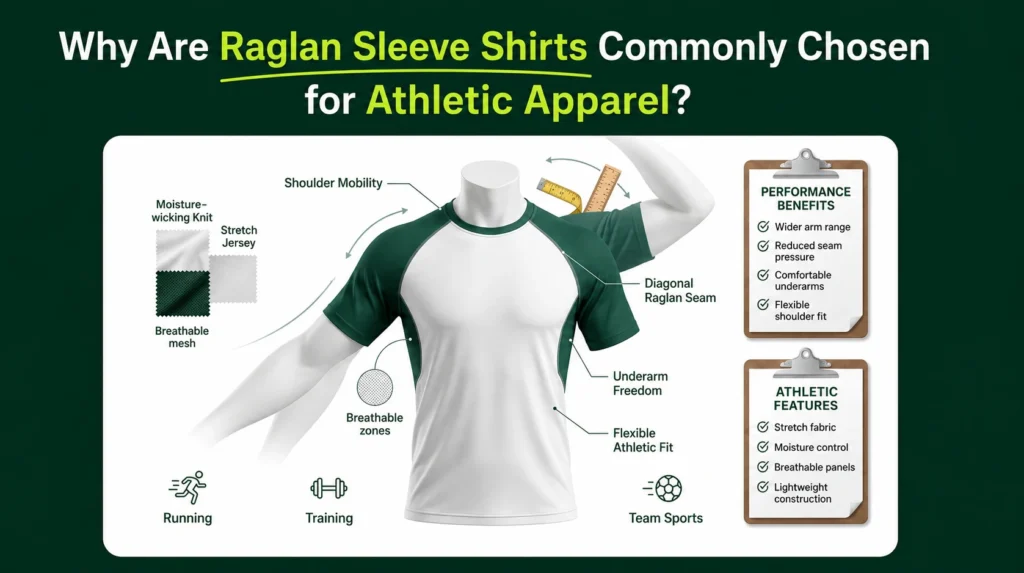
Raglan sleeve shirts are commonly chosen for athletic apparel because their diagonal sleeve construction can provide more underarm room, reduce shoulder-seam interference, and improve movement comfort when the shirt is properly fitted.
Many runners and athletes notice raglan sleeves in training shirts, baseball shirts, warm-up tops, and technical running shirts. However, their practical value comes from seam placement and fit behavior rather than their sporty appearance alone.
A raglan sleeve uses a diagonal seam that extends from the underarm area toward the neckline or collar. This design shifts the sleeve connection away from a fixed shoulder endpoint and changes how the shirt responds during reaching, lifting, throwing, climbing, and repeated running arm swing.
This guide explains why raglan sleeve shirts are commonly used in athletic apparel, how they compare with set-in sleeve shirts, and how runners or athletes can evaluate mobility, seam comfort, and technical fit.
Readers comparing sleeve design with broader running shirts should understand that sleeve construction is only one part of technical running-shirt design.
Athletic comfort also depends on fabric stretch, moisture management, garment size, seam finish, neckline stability, sleeve width, and the intended sport. Raglan construction can support movement comfort, but it does not guarantee improved athletic output.
Why Is the Choice of Raglan Sleeve Shirts Important for Athletic Movement?
The choice of raglan sleeve shirts is important for athletic movement because the diagonal seam path can reduce shoulder-seam interference during repeated reaching, swinging, lifting, and running motions.
A conventional set-in sleeve joins the sleeve to the bodice around an armhole. This arrangement creates a defined sleeve cap and usually places the upper sleeve connection near the edge of the shoulder.
A raglan sleeve extends toward the neckline instead. Its seam travels diagonally between the neck or collar area and the underarm.
Pattern Studio 101 explains that raglan construction uses a diagonal underarm-to-neckline seam, can be drafted in one-piece or two-piece forms, and provides additional room around the underarm for more comfortable arm movement. raglan pattern guide
The extra room can help when the shirt is used for movements involving repeated arm elevation or rotation. However, the construction works best when the fabric, garment size, sleeve shape, and seam finish are appropriate for the activity.
A raglan shirt made from rigid fabric may feel less comfortable than a properly fitted set-in shirt made from stretch material. Construction and execution must therefore be evaluated together.
How Can Raglan Sleeves Reduce Shoulder-Seam Interference?
Raglan sleeves can reduce shoulder-seam interference by moving the main sleeve seam away from the top shoulder point and distributing the sleeve connection diagonally toward the neckline.
A set-in sleeve places the sleeve attachment around the armhole and near the shoulder edge. If the shoulder point or sleeve cap is too tight, the wearer may notice fabric pulling during arm elevation or forward movement.
A raglan sleeve shifts that attachment into a diagonal seam path. The seam does not terminate at a fixed point on top of the shoulder.
This relationship can be summarized as:
Diagonal seam path → shifts seam pressure away from the shoulder point → may reduce pulling during athletic movement.
Some wearers may informally describe tight fabric pulling near the shoulder as a “Shoulder Jam Effect.” This is a reader-friendly description, not a recognized biomechanics or sports-science term.
The feeling can occur when the sleeve cap, shoulder width, fabric, or garment size does not allow enough movement. Raglan construction may reduce that sensation in some properly fitted shirts, but it cannot remove every source of restriction.
Do Raglan Sleeves Improve Athletic Endurance?
Raglan sleeves should not be described as directly improving athletic endurance unless the article cites sports-performance evidence that measures energy expenditure or endurance outcomes.
Garment comfort and athletic performance are not the same claim.
A shirt that pulls less around the shoulder may feel more comfortable during repeated motion. That comfort can make the garment less distracting, but it does not prove that the athlete will run longer, use less energy, or improve measurable endurance.
Raglan sleeve shirts may help athletes feel less fabric pulling near the shoulder, but that does not prove a measurable endurance gain.
Factors such as training, cardiovascular fitness, pacing, hydration, temperature, and overall equipment affect endurance. Sleeve construction should therefore be evaluated as a garment-comfort feature rather than a direct performance enhancer.
How Does the Anatomy of Raglan Sleeve Shirts Support Athletic Mobility?
The anatomy of raglan sleeve shirts can support athletic mobility by combining diagonal seam placement, underarm room, and fabric ease around the shoulder and upper arm.
The defining diagonal raglan seam runs from the underarm area toward the neckline. This differs from a set-in sleeve, which is attached around a conventional armhole.
The raglan sleeve may be drafted as one piece without a separate upper shoulder seam. It may also be divided into two pieces to provide additional shaping or design control.
Neither form automatically provides better mobility. The result depends on:
- The shape of the raglan seam
- Underarm depth
- Sleeve width
- Fabric stretch
- Torso ease
- Neckline stability
- Seam construction
- Garment size
A well-balanced pattern can provide enough room for movement while keeping the shirt stable. A poorly balanced pattern may create underarm bunching, neckline pulling, or excess fabric volume.
How Should the “Kinetic Hinge” Idea Be Explained Safely?
The “Kinetic Hinge” idea can be used only as a simple metaphor for how raglan sleeve construction moves the sleeve connection away from the fixed shoulder seam area.
It is not an official engineering, textile, or biomechanics term. A raglan seam does not operate as a mechanical hinge.
The phrase can help readers visualize how the shirt changes around the shoulder. Rather than placing a sleeve endpoint directly on the shoulder edge, the raglan seam extends diagonally toward the neckline.
This may allow the surrounding fabric to respond more comfortably during:
- Running arm swing
- Overhead reaching
- Throwing
- Climbing
- Lifting
- Stretching
- Cross-body movement
The practical relationship is:
No fixed shoulder-seam endpoint → more forgiving shoulder movement → improved perceived mobility in some athletic shirts.
The shirt does not provide 360-degree rotation or unlimited movement. Human shoulder movement, garment design, and fabric properties remain limiting factors.
How Does Diagonal Seaming Create a Movement-Tolerant Zone?
Diagonal seaming creates a movement-tolerant zone by shifting the sleeve seam away from the top shoulder area and allowing the underarm section to move with less direct seam resistance.
The term “movement-tolerant zone” describes how the garment may behave in practice. It does not refer to a measured anatomical or engineering zone.
During overhead reaching, the upper sleeve and underarm fabric must move with the arm. If the sleeve cap, shoulder point, or armhole is too tight, tension may travel across the shoulder or lift the shirt hem.
A properly shaped raglan pattern can redistribute some of that movement across the diagonal seam and underarm area. The effect depends on garment ease, sleeve width, seam curvature, and fabric flexibility.
The diagonal seam should not be described as an “active expansion zone” unless the phrase is clearly identified as a visual metaphor. The seam itself does not expand unless the fabric and stitching allow it.
How Do Raglan Sleeve Shirts Affect Friction and Chafing Risk in High-Movement Sports?
Raglan sleeve shirts can affect friction and chafing risk by changing where seams sit on the shoulder and upper arm, but seam comfort also depends on stitching, fabric, sweat, fit, and movement duration.
Repeated movement can cause fabric and seams to pass over the same skin areas many times. Moisture, rough thread, raised seam allowances, tight sizing, and loose fabric movement can increase irritation risk.
Raglan construction may move a seam away from the top shoulder point. This can be useful when conventional shoulder seams would otherwise sit beneath a backpack, hydration vest, protective layer, or technical shell.
However, raglan construction does not prevent chafing. Friction can still occur along the diagonal seam, underarm, neckline, side seam, or sleeve edge.
How Can Seam Placement Reduce High-Rub Shoulder Contact?
Seam placement can reduce high-rub shoulder contact when the raglan seam avoids sitting directly under backpack straps, outer layers, or repeated arm-swing pressure points.
The acromion process is the bony point near the top and outer edge of the shoulder. A garment seam positioned over this area may become noticeable when compressed by a strap or fitted outer layer.
Moving the seam away from the top shoulder area may reduce seam pressure under straps or outer layers.
This does not guarantee comfort. A diagonal seam can still fall beneath a backpack strap depending on:
- The seam angle
- Shirt size
- Wearer’s shoulder width
- Backpack design
- Strap position
- Seam thickness
- Fabric texture
Athletes who use hydration vests, running packs, or backpacks should test the shirt while wearing the actual equipment. A seam that feels comfortable without a pack may become noticeable after the strap is tightened.
How Should Aerodynamic Drag Claims Be Controlled?
Aerodynamic drag should not be attributed to raglan sleeve construction alone because drag depends more on garment fit, fabric surface, looseness, body position, speed, and environmental conditions.
A raglan sleeve may contribute to a close or stable fit, but the diagonal seam is not itself an aerodynamic technology.
A close, stable athletic shirt may reduce loose-fabric flapping, but raglan construction alone should not be treated as an aerodynamic technology.
A loose raglan shirt can still flap during running or cycling. A close-fitting set-in shirt may remain more stable if its fabric and pattern are better matched to the wearer.
Claims about measurable drag reduction require controlled testing involving speed, fabric, garment shape, airflow, and athlete position. Without that evidence, raglan construction should be discussed only as a fit and seam-placement choice.
How Should Runners Evaluate the Technical Features of Raglan Sleeve Shirts?
Runners should evaluate raglan sleeve shirts by checking fabric stretch, moisture management, seam finish, underarm comfort, neckline stability, and movement behavior during repeated arm swing.
Raglan construction is only one part of a technical running shirt.
Readers comparing sleeve construction with broader technical shirt features should also evaluate breathability, stretch, moisture control, and seam finish.
A technically useful running shirt should manage the relationship between fabric, movement, heat, moisture, and fit. A diagonal seam cannot compensate for material that holds excessive sweat, becomes heavy, or lacks enough stretch for the intended activity.
Athletes should evaluate the entire shirt under realistic conditions rather than choosing it based only on the raglan appearance.
How Do Material Integration and Movement Features Work Together?
Material integration and movement features work together when the shirt combines stretch fabric, moisture management, stable fit, and seam placement that does not pull during arm swing.
Fabric stretch can come from elastic fibers or from the mechanical structure of the knit. Both can help the shirt follow movement, although the amount and direction of stretch vary.
Moisture management refers to how the fabric handles sweat. Depending on the textile, moisture may spread across the material, move away from the skin, or dry more efficiently than it would in a heavier absorbent fabric.
Fit stability means the shirt remains reasonably positioned during motion. The neckline should not twist, the hem should not lift sharply, and the sleeve should not create concentrated pulling.
The relationship can be summarized as:
Stretch fabric + stable seam placement → smoother arm swing → improved perceived running comfort.
A raglan sleeve made from stiff fabric may perform worse than a set-in sleeve made from stretch fabric. The sleeve label alone is therefore not enough to predict comfort.
How Does Flatlock Stitching Support Raglan Construction?
Flatlock stitching can support raglan construction by creating smoother, lower-profile seams that reduce bulk and may improve comfort during repeated movement.
Traditional seams may place seam allowances inside the garment, where several layers of fabric create a raised ridge. A flatlock seam joins the fabric in a flatter configuration and can reduce the amount of bulk pressing against the skin.
SPF Textile explains that flatlock stitching creates flatter, smoother, low-profile seams and is commonly used in close-to-skin activewear and high-movement areas where reduced seam bulk can improve comfort. flatlock stitching
The construction relationship is:
Flatlock seam → lower seam bulk → may reduce friction during repeated movement.
Flatlock stitching does not eliminate all chafing. Comfort still depends on thread texture, stitch tension, seam placement, fabric moisture, garment fit, and activity duration.
A close-fitting shirt with smooth seams could be described informally as a “Muscle-Wrapped Precision Layer.” That phrase is a visual metaphor, not a technical textile classification or sports-performance claim.
The 3-Step Motion Test: How Can Athletes Test Raglan Sleeve Mobility?
Athletes can test raglan sleeve mobility by using a simple reach, rotate, and flex sequence that checks fabric pull, seam pressure, and neckline stability.
This is a practical buyer evaluation rather than a laboratory range-of-motion test.
Step 1: Reach
Raise both arms overhead several times.
Check whether:
- The hem lifts sharply
- The torso fabric pulls upward
- The underarm feels tight
- The neckline moves out of position
- The sleeve restricts full comfortable reach
A small amount of hem movement may be normal. Sharp lifting or strong torso tension may suggest insufficient underarm room, limited stretch, a short bodice, or the wrong size.
Step 2: Rotate
Swing both arms forward and backward as though running.
Check whether:
- The diagonal seam rubs
- The shoulder area pulls
- The shirt rotates around the torso
- The neckline shifts from side to side
- Loose fabric flaps or folds excessively
The seam should remain comfortable during repeated arm swing. Mild fabric movement is normal, but concentrated pulling may indicate poor fit or unsuitable seam placement.
Step 3: Flex
Bend and extend the elbow while rotating the shoulder.
Check whether:
- The underarm fabric bunches
- The sleeve pinches
- The seam feels raised
- The cuff restricts movement
- The neckline or hem moves excessively
The test should be repeated while wearing any backpack, vest, or outer layer normally used during the activity.
Raglan Athletic-Shirt Evaluation Checklist
- Fabric stretches enough for overhead reach.
- Raglan seam does not rub under backpack straps or outer layers.
- Underarm area does not bunch during arm swing.
- Neckline stays stable during shoulder rotation.
- Flatlock or low-profile seams are used in high-rub zones.
- Moisture-management fabric is used for running or high-sweat activity.
Compared to Other Constructions: Are Raglan Sleeve Shirts Always Better?
Raglan sleeve shirts are not always better than other athletic shirt constructions; they are useful when the athlete needs shoulder movement tolerance, seam comfort, and coverage during repeated upper-body motion.
Set-in sleeves can work effectively in athletic garments when the shoulder alignment, sleeve cap, fabric, and garment ease are correct. Sleeveless shirts also remove sleeve seams entirely but provide less shoulder and upper-arm coverage.
| Feature | Raglan Sleeve Shirts | Set-In Sleeve Shirts | Sleeveless / Tank Tops |
|---|---|---|---|
| Reach Comfort | Can feel more forgiving if fabric and underarm fit are correct. | Can feel restrictive if the shoulder point or sleeve cap is tight. | Allows arm exposure but does not provide sleeve coverage. |
| Chafe Risk | May reduce top-shoulder seam pressure, especially with flatlock seams. | May create shoulder or sleeve-cap pressure if poorly fitted. | Can reduce sleeve-seam friction but may create underarm or strap friction. |
| Load / Strap Comfort | May reduce seam overlap under straps if the raglan seam avoids pressure points. | Shoulder seam may sit under backpack or vest straps. | No sleeve seam, but straps can still rub bare skin. |
| Weather Coverage | Provides shoulder and upper-arm coverage. | Provides shoulder and upper-arm coverage. | Offers less shoulder and upper-arm protection. |
| Best Use Case | Running, baseball-style shirts, warm-ups, training tops, and high-movement shirts when properly fitted. | Structured athletic polos, casual athletic shirts, and garments needing sharper shoulder shape. | Hot-weather training, basketball, gym use, or sports where arm exposure is preferred. |
| Main Failure Risk | Underarm bunching, neckline shift, or oversized sleeve volume. | Shoulder pulling, sleeve-cap pressure, or seam restriction. | Strap rub, underarm exposure, or reduced sun and abrasion coverage. |
Construction choice depends on the sport, climate, fabric, fit, strap use, desired coverage, and personal comfort.
A runner carrying a hydration vest may prefer a raglan shirt if its seams avoid strap pressure points. Another runner may prefer a sleeveless top in hot weather. An athlete who wants sharper structure may find a well-fitted set-in sleeve more suitable.
The best construction is the one that works with the wearer’s movement, equipment, environment, and fit preferences.
When Can Raglan Sleeve Shirts Fail in Athletic Apparel?
Raglan sleeve shirts can fail in athletic apparel when the fabric, size, seam finish, neckline, or underarm shape does not match the athlete’s movement pattern.
The diagonal seam is only one component of the garment. If the fabric, stitching, and fit are poorly selected, the intended comfort benefits may disappear.
| Intended Benefit | Possible Failure Mode | Correction |
|---|---|---|
| More underarm room | Excess fabric bunches during arm swing. | Choose a better size, slimmer sleeve, or stretch fabric. |
| Reduced shoulder-seam pressure | Raglan seam still rubs under straps or outer layers. | Test with backpack, vest, or jacket before use. |
| Better mobility feel | Stiff fabric restricts movement despite raglan cut. | Choose fabric with stretch or mechanical give. |
| Lower friction | Raised seams or rough thread still irritate skin. | Choose flatlock or low-profile seams. |
| Stable running fit | Neckline shifts during arm rotation. | Check neckline recovery and collar stability. |
| Layering comfort | Bulky fabric creates pressure under shells. | Use thinner technical layers. |
| Athletic versatility | Raglan styling looks too casual for some settings. | Choose set-in construction for sharper structure. |
How Can Extra Underarm Room Become a Problem?
Extra underarm room can become a problem when the pattern provides more fabric than the athlete needs.
The fabric may bunch during arm swing, collect under a fitted shell, or create a heavy fold near the armpit.
The problem may be corrected by choosing:
- A smaller or better-balanced size
- A slimmer sleeve
- A higher underarm shape
- A lighter fabric
- Material with better drape or stretch
More room is beneficial only when the pattern controls that volume effectively.
How Can Raglan Seams Still Cause Strap Pressure?
Raglan seams can still cause strap pressure when their angle places them directly beneath a backpack, hydration vest, or protective layer.
Not every raglan seam avoids the top shoulder. The angle varies according to the pattern.
Athletes should test the shirt with their actual equipment. They should also consider how the seam feels after the fabric becomes damp, since moisture may change friction and fabric behavior.
How Can Stiff Fabric Limit Movement?
Stiff fabric can limit movement when it cannot stretch, fold, or recover with the athlete’s arm motion.
A raglan pattern may provide underarm room, but rigid material can still pull across the upper arm, chest, or neckline.
Selecting stretch fabric or material with mechanical give may improve perceived movement comfort. Appropriate garment ease is also necessary.
How Can Raised Seams Increase Friction?
Raised seams can increase friction when thick seam allowances or rough thread repeatedly contact the skin.
This can occur even when the shirt uses raglan construction.
Flatlock or another low-profile seam may reduce the bulk, but seam quality, thread choice, tension, and placement must still be appropriate.
How Can Neckline Instability Affect Athletic Fit?
Neckline instability can affect athletic fit when repeated arm movement causes the collar to twist, pull sideways, gape, or ride upward.
Because raglan sleeve panels reach the neckline, tension from the sleeves can influence the neck opening.
Athletes should check:
- Collar recovery
- Neckband length
- Raglan seam balance
- Fabric stretch
- Shoulder rotation behavior
- Shirt size
A stable neckline should remain reasonably centered during repeated movement.
How Can Bulky Fabric Reduce Layering Comfort?
Bulky fabric can reduce layering comfort by creating thick folds beneath technical shells, jackets, or vests.
Even when the raglan seam avoids direct overlap with an outer shoulder seam, excess sleeve or underarm fabric may create pressure elsewhere.
Thinner technical layers, controlled sleeve volume, and low-profile seams may improve the layering combination.
The benefit of raglan sleeve shirts depends on construction plus execution: seam path, fabric, fit, stitching, and use case must work together.
Why Are Raglan Sleeve Shirts Useful in High-Movement Athletic Apparel?
Raglan sleeve shirts are useful in high-movement athletic apparel because they can combine shoulder movement tolerance, underarm room, and seam placement that supports repeated arm motion.