How Are Performance Shirts Categorized Based on Athletic Versus Casual Applications?
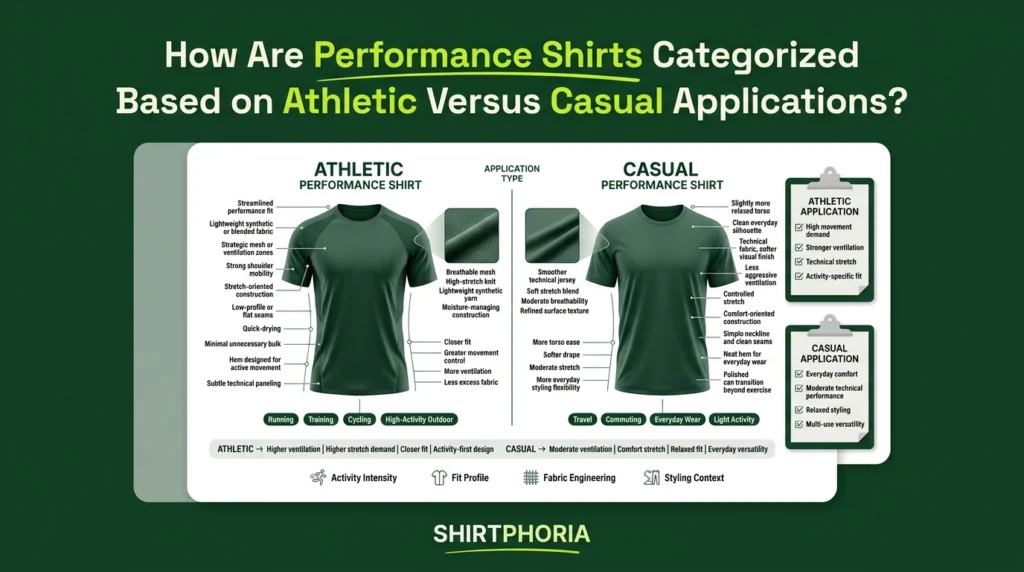
Performance shirts are categorized primarily by their intended application and supporting garment features: Athletic-Dominant shirts prioritize movement, moisture control, heat management, and reduced construction interference; Casual-Dominant shirts prioritize everyday comfort, visual versatility, and drape; Hybrid shirts combine meaningful characteristics from both applications.
Quick Answer: How Are Performance Shirts Categorized?
Performance shirt categorization uses several signals together: intended use, moisture evidence, fit, ventilation, seam construction, odor strategy, fabric structure, and visual design. Athletic-Dominant shirts favor high-output activity, Casual-Dominant shirts favor everyday versatility, and Hybrid shirts combine meaningful characteristics from both.
Marketing terms such as “technical,” “active,” and “performance” do not independently reveal whether a shirt is suitable for intense exercise, travel, commuting, or casual wear. The category should be based on the interaction between the garment’s verified properties and its intended application.
This guide explains the Shirtphoria Categorization Framework, a seven-criteria editorial system for evaluating whether a performance shirt is Athletic-Dominant, Casual-Dominant, or Hybrid.
The Shirtphoria Categorization Framework is a consumer-analysis heuristic created for Shirtphoria. It is not a textile-industry standard, laboratory certification, or independently validated scientific test.
Why Must We Differentiate Between Athletic and Casual Performance Shirts?
We must differentiate among Athletic, Casual, and Hybrid performance shirts because a garment performs best when its moisture behavior, fit, construction, and comfort profile match the intensity and duration of its intended use.
These categories describe dominant design priorities rather than rigid fibre classes. Polyester, nylon, Merino Wool, regenerated cellulosics, and blended fabrics can appear in more than one category depending on yarn structure, fabric construction, finishing, fit, and garment engineering.
A shirt designed for high-intensity running shirts may prioritize controlled fabric movement, moisture management, ventilation, and low-profile construction. A travel or commuter shirt may use some of the same fibres while prioritizing drape, visual subtlety, prolonged comfort, and everyday styling.
The category therefore comes from the garment system rather than one material label.
The Problem of “Technical Material Misuse”
Technical material misuse occurs when a shirt’s verified moisture, fit, ventilation, and seam capabilities do not match the wearer’s activity, climate, movement pattern, or expected wear duration.
The basic relationship is:
Application mismatch → exceeds or underuses garment capabilities → reduces comfort, utility, or value.
A Casual-Dominant performance shirt may provide softness, moderate moisture control, visual structure, and comfortable drape. Those properties can work well for commuting, travel, casual work, or low-to-moderate activity without being designed for maximum sweat output.
An Athletic-Dominant shirt can create the opposite mismatch. A highly ventilated, close-fitting, visibly technical garment may provide more specialization than a sedentary or casual environment requires.
Material identity alone cannot diagnose the mismatch. A natural, regenerated, or synthetic fibre can appear in any category.
During high-output activity, a shirt may become wet, cling, rub, or dry slowly if the completed fabric and garment construction cannot manage the moisture and movement conditions produced during use.
Category Boundary: A Casual-Dominant classification does not mean the shirt has no performance value. It means its strongest features support everyday use more than maximum athletic output.
Optimizing Cost-to-Performance Alignment
Differentiating among performance shirt applications improves cost-to-performance alignment because technical features create value only when they support tasks the wearer actually performs.
Cost-to-performance alignment is the relationship between the price premium paid for a shirt and the number of verified features that are useful for the wearer’s actual application.
Athletic-Dominant garments may use:
- mapped ventilation;
- ergonomic patterning;
- strategically positioned seams;
- specialized knits;
- bonded components;
- and activity-specific fit systems.
These features can increase design and manufacturing complexity.
The low-end failure occurs when the garment is underbuilt for the task. It may provide insufficient moisture management, movement allowance, ventilation, or friction control during repeated high-output activity.
The high-end failure occurs when the garment is overbuilt for everyday use. Additional engineering may add cost, technical appearance, cling, maintenance requirements, or other characteristics that provide little practical benefit to the wearer.
Actionable takeaway: Select verified task-relevant features rather than buying the shirt with the largest number of technical labels.
How Are Athletic Performance Shirts Engineered for High-Intensity Use?
Athletic-Dominant performance shirts are engineered for high-intensity use by combining activity-specific fit, controlled fabric movement, moisture transport, heat-release features, and construction intended to reduce avoidable friction.
No single seam, fibre, ventilation panel, or fit proves that a shirt is Athletic-Dominant. Strong classification comes from several aligned garment attributes.
The same principle applies when evaluating technical running features: the construction should be interpreted as a system rather than as isolated feature labels.
Core Feature 1: Targeted Fit and Seams — The “Second Skin” Principle
Athletic-Dominant performance shirts often use close, ergonomic, or movement-specific fits with strategically placed low-profile seams to limit loose-fabric movement and reduce raised contact points during repetitive motion.
Three common fit categories should be separated.
Compression fit intentionally applies close pressure or strong body contact.
Athletic fit usually sits closer to the torso and limbs than a conventional relaxed shirt, but it does not automatically create true compression pressure.
Ergonomic regular fit allows more ease while still shaping the garment around movement patterns and activity-specific reach.
Close fits can limit loose fabric from folding, catching, or shifting excessively, but they should not be interpreted as proof of improved muscle performance or medical support.
Flatlock Seams are seam constructions intended to create a flatter joint than many conventional raised seam structures. Their reduced profile can lower seam bulk where fabric repeatedly contacts the body.
Bonded Construction joins or stabilizes garment components through adhesive or bonding methods rather than relying only on conventional stitching. Bonding can reduce some seam bulk or create specific panel structures.
Neither system guarantees chafe-free performance.
Claim Boundary: Chafing also depends on seam placement, garment fit, fabric texture, moisture, activity duration, repetitive motion, and individual skin response.
Overlock Seams can also appear in Athletic garments. Their presence should not automatically be treated as evidence that a shirt is Casual-Dominant.
Core Feature 2: Advanced Moisture Management — The “Drying Performance” Criterion
Advanced moisture management in Athletic-Dominant shirts depends on the interaction among fiber surface properties, yarn geometry, knit or weave structure, capillary pathways, fabric finishes, and the textile area available for liquid spreading and evaporation.
The mechanical relationship is:
Engineered textile structure → spreads or transports liquid moisture → supports evaporation and next-to-skin comfort.
Polyester, nylon, and elastane blends are common in active apparel, but none is mandatory. Merino Wool and engineered hybrid fabrics can also appear in Athletic shirts when thermal comfort, odor behavior, or tactile comfort matter.
Surface Area-to-Volume Ratio describes the relationship between exposed surface area and the volume of a material. In moisture systems, increasing the area over which liquid spreads can increase the textile area available for evaporation.
That does not mean surface area alone determines drying. Final moisture behavior also depends on wetting, capillary movement, yarn construction, fabric structure, finishes, airflow, humidity, and garment fit.
AATCC TM195 provides objective measurement, evaluation, and classification of liquid moisture-management properties in textile fabrics.
That standard should not be expanded into claims it does not make. TM195 does not independently measure every aspect of drying rate, air permeability, breathability, or real-world thermal comfort.
A practical evidence hierarchy is:
- Independent standardized test data
- Manufacturer-reported data with a named test method
- Specific manufacturer claims without disclosed testing
- General product marketing
- Consumer inference from touch or appearance
A “quick-drying” statement without a disclosed test method remains a manufacturer claim rather than independently verified drying performance.
Core Feature 3: Integrated Venting and Zonal Mapping
Athletic-Dominant shirts may use Zonal Mapping to place mesh, perforation, or varied textile structures in areas expected to experience greater heat and moisture during movement.
Zonal Mapping is the deliberate placement of different textile structures or ventilation features according to activity-specific body zones.
Common areas include:
- the back;
- underarms;
- side panels;
- and upper torso.
Placement varies according to activity and garment design.
Visible mesh or perforation becomes a stronger Athletic signal when it aligns with other evidence such as activity labeling, ergonomic fit, strategic seam construction, and documented moisture features.
Zonal Mapping alone does not confirm Athletic status.
Its benefit also has a tradeoff.
Increased ventilation may support heat and moisture release during intense activity. Excessive openness may reduce warmth, opacity, coverage, durability, or everyday versatility.
Hybrid Boundary: Subtle zonal construction may also appear in commuter, golf, travel, or training-to-lifestyle shirts, producing an Athletic-Leaning Hybrid classification.
How Are Casual Performance Shirts Designed for Style and Everyday Comfort?
Casual-Dominant performance shirts combine selected technical functions with everyday aesthetics, prioritizing prolonged comfort, restrained visual design, fabric structure, drape, and practical versatility over maximum high-output specialization.
Casual-Dominant is an application category, not a quality grade. A Casual performance shirt can still use moisture management, stretch, odor treatment, or technical fibres.
The difference is how those features are prioritized.
Core Feature 1: Aesthetic Subtlety Uses Technical-Aesthetic Masking
Casual-Dominant performance shirts often use matte surfaces, heathering, restrained textures, conventional silhouettes, and cotton-like visual cues to reduce the overt workout appearance associated with some Athletic apparel.
Technical-aesthetic masking is the use of visual and tactile design choices that make a technically modified fabric resemble familiar everyday clothing.
The objective is visual versatility rather than concealment in a scientific sense.
Common approaches include:
- matte rather than highly reflective surfaces;
- heathered yarn effects;
- soft surface texture;
- familiar crew-neck, polo, or button-front shapes;
- less visible ventilation;
- more structured drape;
- and reduced use of obvious ergonomic paneling.
Appearance should remain a supporting signal.
A shiny textile is not automatically Athletic, and a matte textile is not automatically Casual. Dyes, yarn shape, knit construction, finishes, texture, and lighting can all alter surface appearance.
Core Feature 2: Odor Mitigation Supports Extended-Wear Use
Some Casual-Dominant and Hybrid performance shirts use fiber selection or odor-control treatments to delay noticeable odor development during travel, commuting, or repeated low-to-moderate activity.
The intended relationship is:
Odor-management strategy → limits a defined odor-development pathway → may extend acceptable wear under stated conditions.
According to its official technology description, Polygiene StayFresh inhibits the growth of odor-causing bacteria on treated textiles.
That description should remain tightly bounded.
Polygiene should not be described as:
- sterilizing fabric;
- neutralizing all bacteria;
- preventing every type of odor;
- providing medical protection;
- or guaranteeing a fixed number of odor-free days.
Odor-control technology can appear in Athletic, Casual, travel, workwear, and Hybrid products. It should not be used as a Casual-only classification signal.
Some travel-oriented shirts are marketed for extended wear, but acceptable wear duration varies according to wearer, activity, climate, treatment durability, laundering, and hygiene requirements.
Core Feature 3: Casual Shirts Prioritize Structure and Drape over Minimum Weight
Casual-Dominant performance shirts often prioritize shape, tactile comfort, visual structure, and drape rather than pursuing the lowest possible fabric weight.
These shirts may use:
- polyester-cotton blends;
- TENCEL™ Lyocell;
- TENCEL™ Modal;
- Merino Wool;
- synthetic blends;
- or other mixed-fibre constructions.
None of these fibres independently determines the category.
Official TENCEL™ fibre information supports bounded descriptions of TENCEL™ Lyocell and Modal in relation to softness and moisture control. These fibre properties should not automatically be converted into wrinkle-resistance claims.
Different materials can contribute different characteristics.
TENCEL™ Lyocell or Modal may be selected for softness, moisture control, and fluid hand-feel.
Cotton can contribute a familiar appearance and tactile feel.
Merino Wool may be selected where thermal comfort or odor behavior matters.
Polyester or nylon can contribute strength, stability, or moisture-related performance depending on the completed textile construction.
Readers comparing these materials can use a broader overview of shirt fabric types to understand how fibre identity differs from finished-fabric performance.
Wrinkle behavior still depends on fibre blend, yarn structure, fabric construction, finishing, garment design, storage, wear, and laundering.
The Casual structure tradeoff is also important.
Additional fabric structure can improve drape and visual polish. Too much structure or weight can reduce rapid drying, packability, or comfort during intense heat.
A Merino, TENCEL™, Modal, cotton-blend, or matte-finished shirt may still qualify as Athletic-Leaning or Hybrid when its moisture, fit, ventilation, and seam features support active use.
How Do Athletic and Casual Performance Shirts Compare by Feature Criteria?
Athletic-Dominant and Casual-Dominant performance shirts differ most clearly in their combined design priorities, while Hybrid shirts occupy the middle when meaningful features support both activity and lifestyle use.
| Feature CriteriaAthletic Performance ShirtsCasual Performance Shirts | ||
|---|---|---|
| Primary Goal | Prioritize movement, moisture transport, heat release, and reduced construction interference during activity. | Prioritize everyday comfort, visual versatility, drape, and practical wear duration. |
| Intended Use | Running, training, cycling, court sports, hiking, or other movement-intensive applications. | Travel, commuting, casual work settings, errands, and low-to-moderate activity. |
| Moisture Evidence | More likely to emphasize disclosed moisture-management, wicking, or drying-performance claims. | May provide moderate moisture control without maximum sweat-output specialization. |
| Material Strategy | Often uses synthetic-rich or engineered hybrid fabrics, but may also use Merino or other performance blends. | Often uses natural-looking, regenerated-cellulosic, wool, cotton, or synthetic blends selected for comfort and appearance. |
| Fit | Compression, close Athletic, or ergonomic movement-specific fit. | Standard, classic, relaxed, or softly shaped lifestyle fit. |
| Seam Construction | May use strategically positioned Flatlock, bonded, taped, or low-profile seams. Conventional seams may also appear. | Often uses conventional Overlock or cover-stitched construction, although low-profile seams may also appear. |
| Ventilation | More likely to include visible or subtle Zonal Mapping aligned with activity-specific heat zones. | More likely to use uniform fabric construction or visually restrained ventilation. |
| Odor Strategy | May use odor control to manage repeated sweating, training, or active use. | May use odor control to support travel, commuting, or extended low-intensity wear. |
| Visual Appearance | May display ergonomic panels, sport-specific cuts, mesh, perforation, or function-led textures. | More often uses matte, heathered, softly textured, or familiar everyday styling. |
| Weight and Structure | Often prioritizes low mass and moisture release, subject to sport, climate, and durability requirements. | Often accepts greater structure or weight to improve drape, tactile comfort, and versatility. |
| Hybrid Exception | A running or hiking shirt may use Merino, matte styling, or conventional-looking construction. | A travel, commuter, or golf shirt may use mapped ventilation, stretch, or low-profile seams. |
Key Classification Rule: No Single Feature Determines the Category
Final categorization requires combined evidence across several criteria.
Fibre content alone is insufficient. Seam type alone is insufficient. Fabric shine, odor treatment, stretch, or Zonal Mapping alone is also insufficient.
When evidence points meaningfully in both directions, the correct outcome is Hybrid or Unclear rather than a forced binary classification.
How Can You Categorize Any Performance Shirt Application?
The Shirtphoria Categorization Framework classifies a performance shirt by evaluating seven observable or verifiable criteria toward an Athletic, Casual, Hybrid, or Unclear application outcome.
Framework Boundary: “is a consumer-analysis heuristic created by Shirtphoria. It organizes garment evidence consistently but does not replace laboratory testing, manufacturer documentation, or activity-specific professional standards.”
Classification Bands
Add the seven criterion scores.
| Total ScoreClassification OutcomeInterpretation | ||
|---|---|---|
| +5 to +7 | Athletic-Dominant | A clear majority of evaluated features supports high-output activity. |
| +2 to +4 | Athletic-Leaning Hybrid | Athletic features dominate, but meaningful lifestyle characteristics remain. |
| −1 to +1 | Balanced Hybrid or Unclear | Evidence is balanced, conflicting, or too limited for a dominant classification. |
| −4 to −2 | Casual-Leaning Hybrid | Lifestyle features dominate, but meaningful Athletic characteristics remain. |
| −7 to −5 | Casual-Dominant | A clear majority of evaluated features supports everyday or lifestyle use. |
Seven criteria are used so a strong dominant result requires broad alignment rather than one isolated signal.
Scores near zero preserve uncertainty and Hybrid outcomes instead of manufacturing false binary certainty.
The total is a directional classification score. It is not a laboratory performance rating.
Evidence-Confidence Level
Count how many criteria are supported by observable, manufacturer-disclosed, or test-based evidence.
| Criteria With Usable EvidenceConfidence Level | |
|---|---|
| 6–7 criteria | High Confidence |
| 4–5 criteria | Moderate Confidence |
| 0–3 criteria | Insufficient Evidence |
A directional category does not automatically mean high certainty.
For example, a shirt could produce an Athletic-Leaning score while still having insufficient evidence if too many criteria were based on unknown or weak information.
Do not describe Moderate or Insufficient results as definitive.
Application-Match Zones
For high-intensity athletic use:
- Ideal Match: Athletic-Dominant with High or Moderate Confidence
- Transition Zone: Athletic-Leaning Hybrid
- Higher Mismatch Risk: Balanced Hybrid, Casual-Leaning Hybrid, Casual-Dominant, or Insufficient Evidence
For everyday casual or travel use:
- Ideal Match: Casual-Dominant with High or Moderate Confidence
- Transition Zone: Casual-Leaning Hybrid
- Higher Mismatch Risk: Athletic-Dominant when the wearer does not need specialized fit, ventilation, appearance, or construction
Mismatch risk means a greater chance of reduced task fit, comfort, versatility, or value. It does not automatically mean that a garment is unsafe.
Error-Proof Classification Protocol
Use the same process every time:
- Verify the manufacturer’s intended-use description.
- Record only observable, disclosed, or test-supported evidence.
- Score all seven criteria independently.
- Mark unavailable or conflicting evidence as zero.
- Add the directional category score.
- Calculate the separate evidence-confidence level.
- Compare the result with the intended activity.
- Classify the shirt as Athletic-Dominant, Athletic-Leaning Hybrid, Balanced Hybrid or Unclear, Casual-Leaning Hybrid, or Casual-Dominant.
- Reclassify the garment if stronger test data or product documentation becomes available.
Diagnostic Rule: When two or more major criteria contradict each other, retain a Hybrid or Unclear result until stronger evidence resolves the conflict.
Repeatability Rule: The framework result is repeatable only when the same definitions, evidence standards, and scoring rules are applied each time.
The Shirtphoria Categorization Checklist
Use these seven checks consistently. Score only observable, manufacturer-disclosed, or test-supported evidence, and keep unknown or conflicting evidence neutral.
Frequently Asked Questions
No. Fibre identity alone is insufficient. Fit, moisture evidence, ventilation, seams, odor strategy, fabric structure, visual design, and intended use should be evaluated together.
An Athletic-Dominant shirt shows broad alignment toward high-output use through features such as movement-oriented fit, moisture management, ventilation, and construction that reduces avoidable interference during repetitive activity.
A Casual-Dominant shirt prioritizes everyday comfort, visual versatility, structure, drape, and practical wear duration over maximum specialization for high-output activity.
Use a Hybrid result when meaningful evidence points in both Athletic and Casual directions or when the garment is designed to bridge activity and lifestyle use.
No. Broad marketing terms do not establish the category unless they are supported by observable construction, manufacturer documentation, or relevant test information.
Terms Explained
| TERM | DEFINITION |
|---|---|
| Athletic-Dominant | A performance-shirt category whose strongest verified features support high-output movement, moisture control, ventilation, and low construction interference. |
| Casual-Dominant | A category whose strongest features support everyday comfort, drape, visual versatility, and lifestyle wear. |
| Hybrid | A category that combines meaningful Athletic and Casual characteristics without a clear one-sided dominance. |
| Zonal Mapping | Deliberate placement of different textile structures or ventilation features according to activity-specific body zones. |
| Flatlock Seam | A relatively flat seam construction that can reduce bulk compared with more raised seam structures. |
| Bonded Construction | A joining or stabilizing method that uses adhesive or bonding techniques rather than relying only on conventional stitching. |
| Technical-Aesthetic Masking | Visual and tactile design choices that make a technically modified fabric resemble familiar everyday clothing. |
| Cost-to-Performance Alignment | The relationship between the price premium paid and the verified features that are actually useful for the wearer's application. |
| Evidence Confidence | A separate indication of how many classification criteria are supported by usable observable, manufacturer-disclosed, or test-based evidence. |
Conclusion
Successful performance shirt categorization depends on matching several verified features to intended use rather than relying on one fiber, seam, finish, treatment, or marketing label.
Athletic-Dominant shirts prioritize high-output function through features such as movement-oriented fit, moisture management, ventilation, and construction designed around repetitive activity.
Casual-Dominant shirts prioritize everyday versatility through prolonged comfort, familiar visual structure, practical moisture control, and lifestyle-compatible drape.
Hybrid shirts combine meaningful characteristics from both applications and should not be forced into a binary category.
A complete framework result includes three parts:
- a directional score;
- an evidence-confidence level;
- and an application-match interpretation.
Too little activity-specific engineering may reduce suitability for demanding use, while unnecessary specialization may reduce everyday value, comfort, or versatility.
The Shirtphoria Categorization Framework supports clearer garment analysis by separating observable evidence from broad marketing language.
Understanding how construction supports intended use is the key to selecting a performance shirt that fits both the task and the wearer.