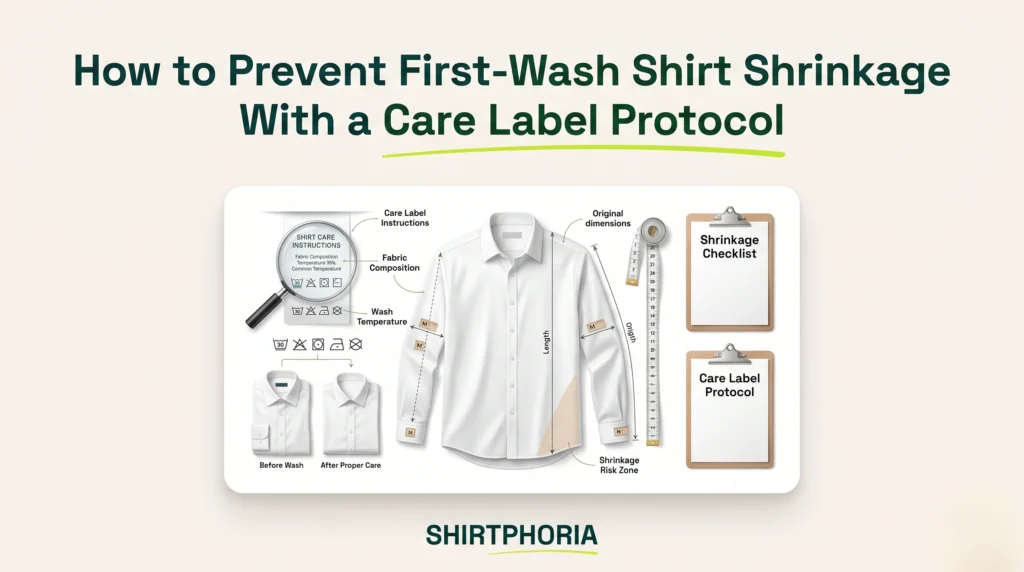
How to Prevent First-Wash Shirt Shrinkage With a Care Label Protocol
The first wash can reveal shrinkage risk, but you can reduce first-wash shirt shrinkage risk by translating the care label into a strict wash, drying, and measurement-tracking protocol before water touches the fabric. Washing a new shirt without checking the care label can expose the fabric to unnecessary heat, moisture, machine agitation, and drying stress.
The First-Wash Shirt Shrinkage Prevention protocol, also called the Shrinkage Shield in this guide, helps you translate care-label instructions into a safe, measurable plan. This guide walks you through reading the label, choosing the lowest-risk method, measuring the shirt, and tracking the first three wash cycles. Shrinkage Shield is an internal protocol name used to organize these steps, not an official textile-care standard.
Treat clothing care like a risk-managed system. Care-label instructions override all general fabric assumptions. The Federal Trade Commission requires that textile wearing apparel care labels provide regular care instructions and warnings. According to Swinburne University, heat, moisture, and machine movement interact to affect fiber relaxation and overall shrinkage risk.
Shrinkage Shield Printable Tracker
Download the official printable worksheet to log your shirt measurements offline. Keep it in your laundry room to track the first three washes accurately without needing your phone.
Why First-Wash Shirt Shrinkage Happens Before Fit Stabilizes
First-wash shirt shrinkage can happen when moisture, heat, machine movement, fabric construction, and fiber type interact, causing measurable changes in fit points such as sleeves, collar, chest, and body length. Shrinkage risk varies significantly based on fiber composition, fabric finish, weave, and the specific care method applied.
Water can enter fibers during the wash cycle, cause them to swell, and combine with the washing machine’s tumble and twist action to induce fiber contraction and relaxation shrinkage. The first wash may increase risk because it exposes untreated or unstabilized fibers to these stressors for the first time. Establishing a firm protocol helps reduce avoidable shrinkage and protects overall shirt fit stability.
FIGURE 1.1: Fiber Contraction Under Stress
The interaction of water and mechanical machine agitation causes swollen fibers to coil and contract, leading to relaxation shrinkage.
How to Set One First-Wash Shrinkage Rule Before Washing
A first-wash shrinkage rule protects the shirt by turning the care label’s highest-risk warning into one non-negotiable action before washing begins. Implementing a single Core Care Rule reduces avoidable shrinkage risk by establishing a strict safety boundary.
The Core Care Rule is the single safety mandate that must not be broken during the first wash. Concrete examples of a Core Care Rule include setting a boundary of “no dryer heat for the first wash,” deciding to “use only the care-label-approved wash temperature,” or determining to “dry flat if the label forbids tumble drying.”
How to Use Past Laundry Mistakes to Prevent New Shirt Shrinkage
Reviewing past laundry mistakes helps identify which fit points are most vulnerable, such as sleeve length, collar tightness, chest width, or shirt length. For example, ignoring a “cold wash” or “do not tumble dry” instruction on a linen or cotton shirt can lead to visible length change or immediate fit distortion. This assessment turns past errors into a clear, preventative first-wash action plan.
How to Read a Care Label Before the First Shirt Wash
Reading a care label before the first shirt wash means translating the manufacturer’s symbols and written instructions into physical choices for water temperature, agitation, drying, ironing, and professional cleaning. Care Label Symbology is the standardized system of textile-care symbols that communicates washing, bleaching, drying, ironing, and dry-cleaning instructions.
The Federal Trade Commission mandates that these care labels provide explicit garment-care instructions and warnings to guide consumer maintenance. Understanding these symbols, detailed by organizations like GINETEX, allows you to accurately process the care instructions without relying on assumptions.
FIGURE 1.2: Care Label Core Symbology
Standardized textile-care symbols dictate the physical boundaries for machine washing, tumble drying, flat drying, and professional dry cleaning.
How to Identify Shirt Fiber Composition Before the First Wash
The fiber composition listed on the care label helps predict shrinkage risk because cotton, linen, wool, rayon, viscose, and synthetic blends can respond differently to moisture, heat, agitation, and drying. Fiber content acts as the first risk signal, though it is not the final authority on garment care. Actual care protocol depends on the specific care label, fabric finish, weave, garment construction, and fiber blend. Cotton and rayon often carry a higher dimensional risk, but risk can vary widely between garments.
How to Set the Safest Water Temperature for First-Wash Shirt Shrinkage Prevention
The safest first-wash water temperature is the lowest label-approved setting that can clean the shirt without increasing shrinkage, fading, or fabric-stress risk. A strictly enforced label-approved temperature reduces thermal stress risk. Heat acts as a primary shrinkage trigger when combined with moisture, agitation, or drying friction.
The FTC dictates that washing instructions must state the appropriate water temperature when relevant to the garment’s care. If a care label specifies a 30°C setting, a cold wash, or a hand wash, you must translate that instruction into the precise physical setting on your machine or manually prepare a basin at that temperature.
How to Control Machine Agitation During a First Shirt Wash
Machine agitation can increase distortion risk because spinning, tumbling, and friction stress wet fibers and seams during the wash cycle. Washing-machine tumble and twist action contributes directly to shrinkage risk by agitating swollen fibers.
You must differentiate between a normal cycle, a gentle or delicate cycle, and manual hand washing. Selecting a lower agitation setting reduces mechanical stress on the garment. Rely on care-label approval to dictate the required agitation level.
How to Dry a New Shirt Without Triggering First-Wash Shrinkage
Drying a new shirt safely requires following the label’s drying command because tumble drying, high heat, and unsupported hanging can change shirt dimensions or shape. The GINETEX system provides explicit drying symbols such as tumble dry, do not tumble dry, line dry, and dry flat.
Tumble drying should be avoided when the label forbids it or when shrinkage risk is uncertain. Dryer heat increases shrinkage or distortion risk in susceptible fabrics, making it a critical variable to control during the drying phase.
How to Choose the Safest First-Wash Method by Shirt Fabric
Choosing the safest first-wash method requires cross-referencing the shirt’s fabric type with the care label so the wash and drying method reduces heat, agitation, and distortion risk. The following tables function as a safety guide to inform decisions based on the care label’s final authority. Garment finish, weave, blend, and manufacturer instructions can shift the actual risk level.
How to Evaluate First-Wash Shirt Shrinkage Risk by Fabric Type
Fabric type shapes first-wash shrinkage risk because cotton, linen, wool, rayon, viscose, and synthetic blends can react differently to moisture, agitation, heat, and drying. Cotton and rayon/viscose require extra caution because moisture, heat, and machine action can rapidly affect shrinkage risk in these shrink-prone materials. For fabrics like wool and linen, adhere strictly to care-label-first commands to manage their specific dimensional vulnerabilities.
How to Handle Pre-Shrunk or Garment-Washed Shirts During the First Wash
Pre-shrunk or garment-washed shirts may carry reduced shrinkage risk, but they still require care-label compliance because secondary fit change can occur through heat, agitation, or drying stress. A “pre-shrunk” tag indicates reduced risk; it does not eliminate all dimensional change. Never use a pre-shrunk label as permission to bypass the official care instructions.
Lower Risk
Medium Risk
High Risk
FIGURE 1.3: Fabric Shrinkage Risk Matrix
Cotton, linen, wool, and rayon pose higher dimensional risks when exposed to heat and agitation compared to stabilized synthetic blends.
| Shirt Condition | Safest First-Wash Method | Why |
|---|---|---|
| Unknown fabric or missing label | Cold hand wash only if low value and low risk; professional care for valuable/delicate shirts | Reduces heat and agitation exposure. |
| Cotton with low-temperature label | Low-temperature gentle machine wash | Keeps temperature and agitation controlled. |
| Wool blend | Follow label; use professional care if required | Wool can be sensitive, so label authority matters most. |
| Rayon/viscose | Cold gentle wash or hand wash only if label allows | Reduces distortion and fiber stress. |
| Shirt with “do not tumble dry” label | Air dry, line dry, or dry flat as directed | Avoids dryer heat and tumbling stress. |
How to Measure Shirt Fit Before and After the First Wash
Measuring shirt fit before and after the first wash is the most objective way to detect whether the shirt’s key fit points remain stable. Taking physical measurements reduces guesswork and catches small dimensional changes before they become permanent, repeated shrinkage.
How to Measure Target Fit Points Before the First Wash
Measuring collar circumference, chest width, sleeve length, shoulder width, and shirt length before the first wash creates the baseline needed to track fit change. Place the shirt flat on a smooth surface without stretching, hanging, or wrinkling the fabric. Maintain the same unit of measurement across the entire process to ensure the shrinkage measurement log yields accurate data.
How to Keep Shirt Measurements Consistent Across Each Wash
Consistent measurement requires laying the shirt flat, using the same tape measure, and measuring from the same start and end points every time. Inconsistent measuring technique creates false shrinkage readings. Photograph the specific measurement start and end points to verify consistency. Sleeve length shrinkage and body length changes are typically the easiest fit alterations to notice.
FIGURE 1.4: Anatomy of a Measurement
Establishing a precise baseline across the collar, chest, sleeve, and body length allows for objective tracking of first-wash fit stability.
| Measurement Change | Status | Action |
|---|---|---|
| 0–1% change | Stable zone | Continue the current care-label protocol. |
| 1–3% change | Watch zone | Reduce heat, agitation, or drying stress in the next wash. |
| 3%+ change | Shrinkage alert | Stop the current method and choose a safer wash/dry protocol. |
| Any functional fit loss | Fit failure | Consider professional care, damp reshaping, or tailoring advice. |
Note: These thresholds are practical home-tracking thresholds, not official textile-industry standards.
How to Execute a First-Wash Shrinkage Prevention Protocol
Executing a first-wash shrinkage prevention protocol requires turning label instructions, fabric risk, and measurement baselines into a written action plan before the wash begins. Follow each step as a deliberate physical action to enforce care-label safety.
How to Write a First-Wash Shirt Shrinkage Prevention Action Plan
A first-wash action plan prevents mid-cycle guesswork by recording the water temperature, agitation level, drying method, and measurement points before washing starts. Write this action plan before the garment ever touches water. For example: “For the first wash only, I will use the label-approved low-temperature setting, choose gentle agitation, avoid tumble drying, and measure sleeve length after air-drying.”
How to Run the First Wash Without Breaking the Protocol
Running the first wash successfully means following the selected water temperature, agitation level, drying method, and measurement plan without changing the method mid-cycle.
- Use the selected care-label-approved water temperature.
- Use the selected agitation level.
- Avoid dryer heat unless the label clearly allows it.
- Wash separately from heavy items.
- Do not change the method mid-cycle.
- Measure only after the shirt is fully dry.
| Variable | Too Low Harm | Safe Zone | Too High Harm |
|---|---|---|---|
| Water temperature | Soil may remain if the setting is too low for the cleaning need. | Use the safest care-label-approved temperature. | Shrinkage, fading, or finish damage risk increases. |
| Agitation | Soil may remain if the wash is too passive. | Use gentle or label-approved agitation. | Warping, seam stress, or fiber distortion can increase. |
| Drying heat | Drying may take longer without heat. | Air dry, dry flat, or use label-approved drying. | Shrinkage, distortion, or difficult-to-reverse fit change can occur. |
| Measurement precision | False stability readings may occur. | Measure the same flat points every time. | Over-measuring or inconsistent tension can create noisy data. |
| Damp reshaping | Minor distortion may remain untreated. | Use gentle reshaping only when fabric is damp and stable. | Excess stretching can distort seams or shirt proportions. |
How to Track the First Three Washes for Size Stability
Tracking the first three washes helps detect early fit change by comparing the same shirt measurements after each wash cycle. These first three washes provide a practical observation window to monitor stability. Adjust the subsequent wash protocol if your recorded measurements enter the watch zone or shrinkage alert zone.
FIGURE 1.5: The 3-Wash Stabilization Curve
Tracking measurements over the first three wash cycles reveals early fit changes before the garment reaches permanent dimensional stability.
How to use this tracker:
- Enter your original, unwashed measurement in the Baseline Target box.
- After the shirt dries from each wash, enter the new measurement in the row below.
- The tool automatically calculates your shrinkage percentage and saves your progress.
| Wash Cycle | Post-Wash Measurement | Change % | Verdict |
|---|---|---|---|
| Wash 1 | — | — | |
| Wash 2 | — | — | |
| Wash 3 | — | — |
How to Fix Early Signs of First-Wash Shirt Shrinkage
If post-wash measurements show early shrinkage, the safest response is to reduce future heat and agitation, attempt only gentle damp reshaping, and stop any method that worsens fit loss. Distinguish minor damp distortion from severe heat-related shrinkage to apply the appropriate response.
How to Reshape a Damp Shirt After Early First-Wash Shrinkage
Gentle damp reshaping may help correct minor shirt distortion, but it cannot reliably reverse severe shrinkage caused by heat, fabric structure change, or repeated drying stress. Textile Blocking involves gently reshaping damp fabric to its intended dimensions while it dries. Blocking must remain light and controlled. Aggressive pulling can permanently distort seams and overall shirt proportions. Wool, rayon, and delicate fabrics may require professional care rather than home blocking.
How to Stop Further Shirt Shrinkage After the First Wash
Stopping further shirt shrinkage requires adjusting the next wash to reduce heat, agitation, and drying stress below the conditions used in the cycle that caused measurement loss. Lower the water temperature within acceptable label limits, switch to a gentler agitation setting, and completely avoid tumble drying if uncertainty remains. Dry flat if the label supports it, and re-measure the shirt after the next wash.
How to Know When First-Wash Shirt Shrinkage Cannot Be Fully Reversed
Severe shrinkage may not be fully reversible when heat, fabric construction change, or repeated drying stress has changed the shirt beyond gentle reshaping. While minor distortion can occasionally improve with damp reshaping, severe collar shrinkage or sleeve length loss may require tailoring, professional cleaning advice, or outright replacement.
How to Handle First-Wash Shrinkage Risk When the Care Label Is Missing
When the care label is missing, the safest default is to reduce every controllable stressor: use low temperature, minimal agitation, and no dryer heat unless the shirt is low value and fabric risk is clearly understood. For high-value, delicate, wool, rayon, or unknown-fiber shirts, seek professional care. For low-risk, low-value items, use a cold hand wash and flat air-drying as a conservative baseline.
The Shrinkage Shield Execution Checklist
Frequently Asked Questions
Terms Explained
| TERM | DEFINITION |
|---|---|
| Relaxation Shrinkage | The natural contraction of swollen fibers when exposed to water and mechanical machine agitation during the wash cycle. |
| Core Care Rule | The single, non-negotiable safety mandate that must not be broken during the first wash, such as strictly avoiding dryer heat. |
| Care Label Symbology | The standardized system of textile-care symbols that visually communicates washing, bleaching, drying, ironing, and professional dry-cleaning instructions. |
| Thermal Stress | Fabric damage or elevated shrinkage risk caused by exposing the garment to excessive heat from water temperatures or tumble drying. |
| Textile Blocking | The deliberate process of gently reshaping damp fabric back to-its intended dimensions while it air-dries on a flat surface. |
Conclusion
In conclusion, preserving a new shirt’s fit begins before the first wash by translating the care label into a controlled protocol for temperature, agitation, drying, and measurement tracking. Reading the label, systematically controlling heat and machine agitation, selecting the verified drying method, and physically measuring the shirt form the pillars of first-wash shirt shrinkage prevention. The Shrinkage Shield serves as the internal protocol name to unify these protective steps. By using the First-Wash Shirt Shrinkage Prevention protocol and tracking the first three wash cycles, you reduce guesswork, catch early fit change, and protect your shirt’s fit over repeated washes.