How to Use the Commuter Crunch Shirt Fit Protocol to Eliminate Wardrobe Regret
A shirt that looks fine while standing can reveal different tension and mobility problems once posture changes in sitting and forward reach. The Mirror Lie occurs when a garment appears perfectly draped and clean in the static environment of a fitting room, only to expose tight waists, dragging shoulders, or restricted arms the moment you sit down.
We understand the deep frustration of investing in shirts that look sharp in the store but become distracting, restrictive, and embarrassing during a morning commute, a long meeting, or a desk-bound workday.
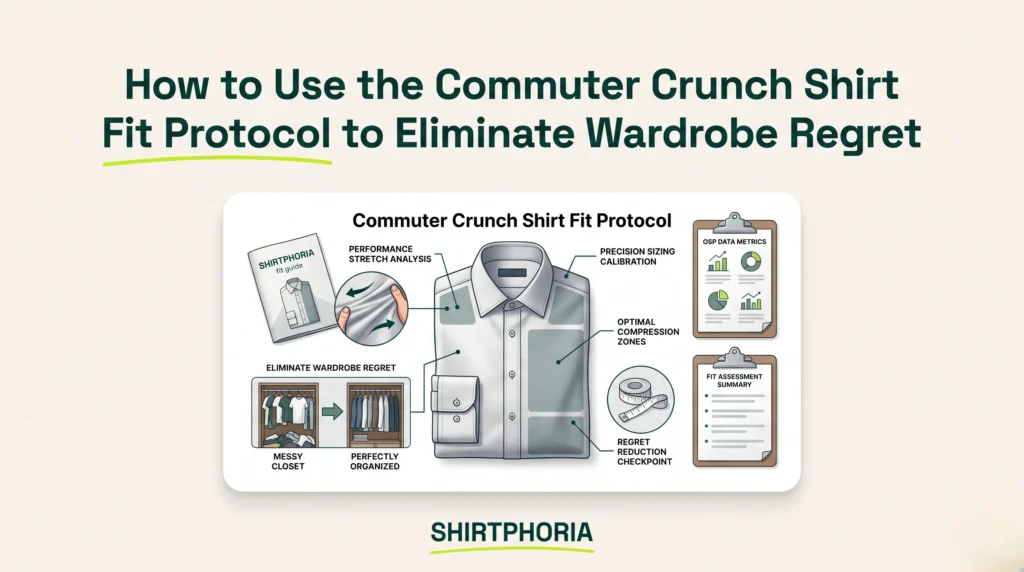
This guide explains the Commuter Crunch Shirt Fit Protocol, a practical in-store screening method designed to reveal whether a shirt can handle seated posture and forward reach before you buy it.
Download the Template Guide
Take the Commuter Crunch Shirt offline. Download our printable PDF template to track your wardrobe inventory and keep the modifier cheat sheet right in your closet.
Quick Answer: How Should a Dress Shirt Fit When Sitting Down in the Commuter Crunch Shirt Fit Protocol?
A dress shirt should fit sitting down without visible button strain, painful collar pressure, aggressive sleeve pullback, or upper-back restriction during a natural forward reach.
To achieve this, the garment must possess adequate wearing ease—the minimum extra room a garment needs beyond exact body measurements to remain comfortable, mobile, and visually stable under normal movement and posture change. Evaluating a dress shirt fit when sitting confirms whether this ease exists, making the seated fit test a more useful real-world filter than a mirror-only standing check.
Why the Commuter Crunch Shirt Fit Protocol Is Necessary
The Commuter Crunch Shirt Fit Protocol is necessary because static standing checks can hide the tension, drag, and mobility problems that appear when a shirt is tested in a seated working posture.
The Failure of Static Standing in Shirt Fit
The traditional static standing check is incomplete because sitting can change posture, pressure distribution, and how a shirt behaves across the waist, collar, and upper back. Research into the biomechanics of seated posture demonstrates that transitioning from standing to sitting alters torso geometry, often inducing backward pelvic rotation or spinal slumping that completely changes how upper-body garments interact with the body. Because sitting alters your physical dimensions, wearing ease becomes the practical difference between your body size and the garment size needed to preserve comfort and mobility.
Transitioning from standing to a seated posture alters torso geometry, demonstrating why the “Mirror Lie” hides required wearing ease.
The Goal of the Commuter Crunch System
The goal of the Commuter Crunch system is to install a repeatable defensive shopping habit that filters out shirts whose pattern or cut fails under normal seated use. This protocol operates as a practical screening method for ready-to-wear shopping, allowing you to confidently evaluate a slim fit vs classic fit rather than relying on universal tailoring laws. To make this system work, you must execute the protocol consistently every time you step into a fitting room.
How to Execute the Commuter Crunch Shirt Fit Protocol in Two Phases
Executing the Commuter Crunch Shirt Fit Protocol requires installing a Minimum Viable Habit (MVH) and tying it to a fixed trigger in the fitting room.
Mandating the Minimum Viable Habit (MVH)
The core Minimum Viable Habit (MVH) is simple: never purchase a shirt without sitting down in it for a brief seated fit check. This 20-to-30-second heuristic is usually enough to expose immediate structural tension points. For professionals who regularly wear a tie, the seated shirt fit test should always be performed with the top button closed to accurately replicate the neck setup during real-world use.
Anchoring the Habit to a Specific Trigger
To make the habit automatic, anchor it to a fixed trigger: the moment the final collar or cuff button is fastened. Memorize this mental script: “After I fasten the last button, I will immediately sit down and extend my arms into a natural forward-driving posture, using the protocol’s 10-and-2 cue.”
Quick-Start Execution Checklist
Follow this exact sequence to run a valid seated range-of-motion shirt fit test.
Once you are seated in the correct testing posture, you must immediately scan for structural dealbreakers and repeatable warning signs.
How to Identify Hard Fails in the Commuter Crunch Shirt Fit Protocol
In the Commuter Crunch Shirt Fit Protocol, a Hard Fail is a practical rejection signal: it identifies a shirt problem that often makes the garment a poor ready-to-wear purchase.
The “Button Bomb” Hard Fail
In the Commuter Crunch Shirt Fit Protocol, Button Bomb is our shorthand for severe seated button strain—visible pulling, tension lines, or gaping that appears once the wearer sits.
As detailed in apparel patternmaking principles, garments require adequate wearing ease to accommodate the expansion of the torso during movement; without it, seated strain becomes highly likely. When shirt buttons strain while sitting or a shirt feels tight at the waist when seated, the pattern inherently lacks the necessary volume to support a seated torso.
Visible seated button strain serves as a high-probability rejection signal in ready-to-wear shopping.
The “Back Vise” Hard Fail
Back Vise is our shorthand for severe upper-back restriction—when the shirt pulls sharply across the back and resists a normal forward reach.
This happens because reaching forward requires scapular protraction, which is simply the shoulder blades moving forward and apart. If a dress shirt pulls across the back during this movement, the yoke width, back shape, pleating, or overall cut does not provide enough movement tolerance for the wearer’s anatomy.
A natural forward reach forces the shoulder blades apart, requiring horizontal expansion across the shirt’s yoke to prevent back restriction.
Severe upper-back restriction operates as a practical rejection signal for ready-to-wear use, indicating the cut is structurally misaligned with your body mechanics.
The “Air Block” Hard Fail
Air Block is our shorthand for painful chest or rib restriction—when the shirt feels uncomfortably tight during a full seated breath or normal chest expansion.
Breathing and posture changes quickly expose shirts that are drafted too close through the chest or upper torso. Often, consumers try to fix this by simply sizing up, which leads to Chest Tenting—the excess, unflattering billow of fabric that appears when you buy a larger size in a cut that remains fundamentally incompatible with your frame.
Treat the Air Block as a practical rejection signal. While Hard Fails justify rejecting the garment, some issues begin as warnings and only become dealbreakers through severity, repetition, or clustering.
How to Identify Soft Fails in the Commuter Crunch Shirt Fit Protocol
Soft Fails are warning signs that indicate a smaller pattern mismatch; they are not always immediate dealbreakers, but they require investigation before purchase.
The “Cuff Retreat” Soft Fail
Cuff Retreat is our label for excessive sleeve pullback—when a forward reach causes the cuff to slide noticeably back from its resting position.
This issue frequently relates to the scye, or armhole depth. Garment construction mechanics dictate that the relationship between the armhole and the sleeve pattern directly affects mobility; an improperly balanced armhole causes the entire garment to lift and shift during movement, explaining why sleeves ride up when driving or reaching.
A lower armhole links the sleeve to the body of the shirt, restricting independent arm movement and causing the cuff to pull back (Cuff Retreat).
To troubleshoot, check your sizing and sleeve length first. If a longer size solves it cleanly, proceed. If the issue appears rooted in the cut or armhole balance, treat the shirt as a probable poor ready-to-wear match.
The “Collar Choke” Soft Fail
Collar Choke is our term for seated neck tension—a collar that feels significantly tighter once the wearer sits and leans forward naturally.
This tension often points to an issue with yoke balance, which describes how the upper shirt is shaped to sit across the shoulders, neck, and upper back. When a collar is tight when seated, it generally reflects an upper-body cut that does not harmonize with the wearer’s posture, neck setup, or natural forward lean.
Minor relief may sometimes be possible, but major seated neck tension often signals a broader upper-body fit mismatch.
When a Soft Fail Escalates in the Commuter Crunch Shirt Fit Protocol
A Soft Fail becomes a practical dealbreaker in the Commuter Crunch Shirt Fit Protocol when it is severe on first wear, appears alongside another warning, or repeats across multiple shirts in the same cut or brand block.
An isolated warning may be fixable, but multiple warning clusters signify a systemic pattern mismatch that should be treated as a hard fail.
Severity Escalation
A soft warning escalates when the symptom is strong enough to disrupt normal use immediately, even if the garment is technically wearable. Aggressive sleeve pullback, major seated collar pressure, or repeat drag during a simple forward reach should be treated much more seriously than minor cosmetic movement.
Cluster Escalation
A soft warning escalates when it appears together with another warning, because symptom clustering usually signals a broader pattern mismatch rather than an isolated annoyance. For example, experiencing Cuff Retreat alongside Collar Choke, or Collar Choke paired with an upper-back pull, highlights systemic pattern incompatibility. Clustered warnings must be treated as a stronger rejection signal than a single isolated soft fail.
Repetition Escalation
A soft warning escalates when the same issue repeats across multiple shirts in the same brand family, because repetition usually indicates a stable cut incompatibility rather than random variation. Recognizing this repetition is the key to preventing future mistakes. Once you understand how warnings escalate, you can judge more clearly whether a shirt is adjustable, tolerable, or structurally wrong for you.
How the “Can This Shirt Be Saved?” Matrix Works
| Symptom | Structural or Adjustable | First Fix Attempt | Practical Assessment | Abandon Brand? |
|---|---|---|---|---|
| The Button Bomb | Usually Structural | Try a roomier cut | Often a high-probability RTW mismatch | Yes, if roomier cuts ruin proportions |
| The Back Vise | Usually Structural | Try a different cut or brand block | Often a poor RTW purchase | Yes |
| The Cuff Retreat | Sometimes Adjustable | Try longer sizing first | Depends on whether length or cut is the root cause | Yes, if cut is the issue |
| The Collar Choke | Sometimes Adjustable | Recheck neck fit and upper-body cut | Minor relief may be possible; major seated tension often signals broader mismatch | Yes, if upper-body pull persists |
| Soft Fail Cluster | Often Structural in practice | Try one adjacent cut only | Repeated clustering usually signals deeper mismatch | Yes, after repeated confirmation |
Now that you can diagnose the failure on the spot, you must begin tracking these results to avoid repeating the same expensive mistake.
How to Log Results with the Commuter Crunch Shirt Fit Protocol
To stop repeating the same purchasing mistakes, treat the fitting room like a laboratory by logging the specific failure pattern each shirt reveals.
The Interactive “30-Try” Data Log
Use the live diagnostic tool below while in the fitting room. Answer the questions step-by-step to get an instant verdict on the shirt’s fit. The engine will automatically save your results to your persistent logbook to track your shopping patterns over time.
Is there severe button strain, pulling, or gaping at the waist?
Does the upper back severely restrict your reach?
Is there painful or extreme chest restriction?
Does the collar choke or feel significantly tighter?
How to Calibrate Buying Decisions with the Commuter Crunch Shirt Fit Protocol
Once you have logged repeated failures, you can use the Rule of 5 as a practical cutoff for abandoning a consistently incompatible brand or cut.
The “Rule of 5” for Protocol Refinement
The Rule of 5 is a consumer heuristic: if the same structural failure appears five times in a row within the same brand family, cut, or block, stop treating the mismatch as bad luck. Five repeated fails strongly suggest a fundamental pattern incompatibility.
Tracking five sequential fit failures on the same dimension transforms random shopping frustration into a definitive brand or cut rejection.
- Waist Output: Five repeated seated strain failures in the same slim cut justify moving to a roomier cut category.
- Back Output: Five repeated upper-back restriction failures in the same brand justify abandoning that brand’s block.
- Soft-Fail Output: Five repeated clustered soft warnings justify treating that cut as operationally incompatible even if no single shirt felt catastrophic.
Key Takeaways of the Commuter Crunch Shirt Fit Protocol
The Commuter Crunch Core Rules emphasize replacing static mirror checks with dynamic seated testing to reduce the risk of buying shirts that fail in normal use.
Terms Explained
| TERM | DEFINITION |
|---|---|
| Wearing Ease | The minimum extra room a garment needs beyond exact body measurements to remain comfortable, mobile, and visually stable under normal movement and posture change. |
| The Mirror Lie | When a garment appears perfectly draped and clean in the static environment of a fitting room, only to expose tight waists, dragging shoulders, or restricted arms the moment you sit down. |
| Scapular Protraction | The shoulder blades moving forward and apart during a natural forward reach. This causes the Back Vise hard fail if the shirt lacks sufficient ease across the upper back. |
| Chest Tenting | The excess, unflattering billow of fabric that appears when you buy a larger size to compensate for an incompatible cut through the chest or upper torso. |
| Scye | The armhole depth. An improperly balanced armhole links the sleeve directly to the shirt body, causing the cuff to ride up during movement (Cuff Retreat). |
| Yoke Balance | A practical description of how the upper shirt is shaped to sit across the shoulders, neck, and upper back. An unbalanced yoke often triggers seated collar tension. |
Conclusion
In conclusion, the Commuter Crunch Shirt Fit Protocol helps shift shirt buying away from deceptive fitting-room snapshots and toward more practical, movement-aware decisions. By relying on a dynamic seated mobility test, you can definitively reveal whether a shirt has enough ease, balance, and movement tolerance for real-world wear.
At Shirtphoria, our design philosophy prioritizes shirt patterns that aim to balance clean lines with practical seated comfort. True style requires functional comfort; if a shirt cannot survive the sit-down test, it does not belong in your closet.
The Commuter Crunch Shirt Fit Protocol and associated heuristics are practical engineering frameworks designed for garment fit optimization. They are not certified medical diagnostic tools. This guide is for informational and educational purposes only. Individual results may vary based on unique body mechanics, garment construction, and fabric properties. Always consult with a professional tailor for specific alteration requirements.