The Optimal Shirt Sizing Protocol (OSP): Technical Blueprint for Precision Fit
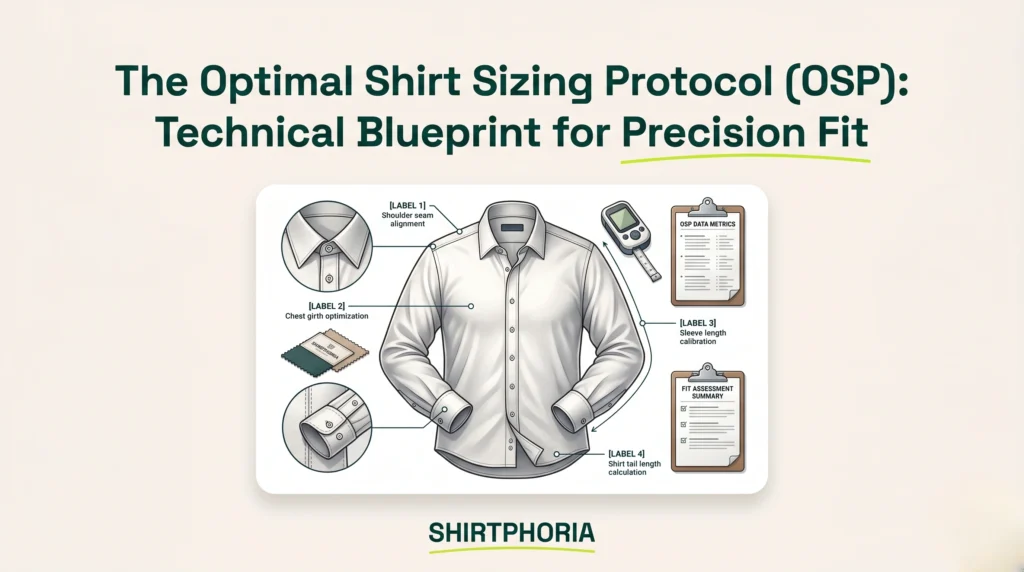
The Optimal Shirt Sizing Protocol (OSP) is your personal fit architect—a pro-grade diagnostic tool that successfully moves sizing from frustrating labels to objective, verifiable dimensions by calculating a personalized Target Measurement Profile (TMP).
Traditional sizing systems, relying on static alpha-labels (S, M, L), introduce unacceptable variability into the consumer experience. This lack of standardization results in a high Fit Frustration Score (FFS), where users are forced to guess rather than engineer their comfort.
This blueprint establishes the necessary technical and statistical mandates—grounded in ISO standards and Ease Theory—that validate the OSP. It then details the five sequential execution phases required for calculating, validating, and maintaining your TMP. Fit is not magic; it is a calculation.
Download the OSP Worksheet
Get the companion PDF blueprint to log your measurements, track your Technical Error of Measurement (TEM), and calculate your final Target Measurement Profile (TMP) offline.
Why Is Subjective Sizing Commonly Believed to Work?
Subjective sizing is commonly believed to work due to the powerful consumer simplicity of a single label, a cultural acceptance that garment fit requires inherent compromise, and a flawed psychological tendency to simplify the complex relationship between body dimension and garment dimension.
The Visual Nature of Retail Sizing and Labels
Retail sizing’s reliance on simple labels (S, M, L) is a primary reason for this belief, as it inherently emphasizes a fast, transactional purchase over the crucial, invisible elements of garment engineering, such as Garment Drop and Ease Allowance.
Technical Insight
The retail model relies on speed. To facilitate this, manufacturers design “Size M” to accommodate a chest range of approximately 5 cm (2 inches). While this tolerance lowers returns for the manufacturer, it creates significant fit variance for the wearer.
The Cultural Narrative of “Ease is Fluff”
The common, uneducated belief that “ease is fluff” is often incorrectly applied to fit, leading to the flawed assumption that minimal Positive Ease is best, a belief that compromises mobility and ensures garment failure.
There is a distinct difference between “slim fit” and “restricted movement.” Industry standards for Semi-Fitted shirting suggest a range of ≈ 10–12.5 cm of Positive Ease at the chest to ensure full range of arm movement. Ignoring this functional requirement in favor of a subjective aesthetic preference often leads to structural stress on the garment.
Retail “Low Armhole”
OSP “High Armhole”
The Assumption that Size Equals Shape
A common flawed assumption is that a fixed Chest Girth must inherently dictate a man’s Waist Girth and Taper profile, a belief that completely ignores the critical role of Garment Drop in achieving a flattering silhouette.
Anatomical attributes are independent variables; a chest size does not predict a waist size. The “V-taper” is created by the Garment Drop (the difference between chest and waist dimensions), not the size label. The OSP addresses this by recommending specific starting drops—3.0 inches for Slim Fit and 4.5 inches for Athletic Fit.
Retail “Boxy”
OSP “Athletic”
What Does Anthropometric Science Say About Why OSP is Necessary?
Anthropometric science indicates that the Optimal Shirt Sizing Protocol (OSP) is necessary because fit is not a subjective visual assessment but a quantifiable dimensional relationship between body and garment, requiring rigorous standardization and statistical analysis.
The Anatomy of Measurement Variability
The uncomfortable truth is that even careful body measurements are highly prone to Variability due to tissue compression and breathing. Research by Yoon & Radwin highlights that consumer self-measurement errors can reach up to +6.15 cm depending on the dimension measured.
Expansion
Furthermore, soft tissue areas like the waist are highly susceptible to the Technical Error of Measurement (TEM). The OSP utilizes ISO 8559-1:2017 definitions to enforce Soft Tissue Management and ensure data integrity.
The Science of Negative Ease
Contrary to uneducated fit practices, ignoring the material science of Negative Ease (NE) in stretch fabrics can cause structural fatigue and fabric degradation.
Negative Ease occurs when the Garment Dimension is smaller than the Body Dimension, relying on fabric stretch to fit. However, this must be calculated carefully. A fixed percentage of stretch scales aggressively; for example, a 10% reduction on a 48 inch chest removes 4.8 inches of fabric. Without careful grading, this massive reduction can lead to fabric transparency.
Protocol Execution: How to Achieve Perfect Fit
The OSP replaces frustrating guesswork with functional, reliable protocol steps that demonstrably achieve a perfect Target Measurement Profile (TMP) far more reliably than traditional, label-based sizing.
Protocol 1: Input Quality (PMP)
The principle is that a successful OSP begins with Input Quality, requiring all body measurements to be verified using the Precision Measurement Protocol (PMP) and the Protocol Silhouette Check (A ≥ B) before any calculation begins. To ensure accuracy, the Intra-observer TEM for Waist Girth must ideally be maintained between 0.20 cm and 0.47 cm.
TEM Measurement Tracking
Enter chest and waist measurements first.
Ready to start.
Log your first round to get feedback.
Final Stable Measurements (Median)
| Round | Chest | Waist | Δ | Score | Flag | Actions |
|---|
Protocol 2: Ratio Quantification
The principle is that quantification is the key to reproducible fit; therefore, determining the Chest Ease Ratio (CER) and Waist Taper Ratio (WTR) using OSP-defined guardrails is a critical step.
Protocol 3: Statistical Rigor
Confidence is built on volume. Users must collect data from ≥ 5 shirts, rating them on the OSP Proprietary 1-10 Fit Frustration Score (FFS) scale. To sanitize this data, the protocol mandates the use of the 1.5 × IQR Outlier Rule (Tukey Fence). This statistical method objectively identifies and removes measurements that are anomalies.
Protocol 4: TMP Formulation
The final Target Measurement Profile (TMP) is your personal fit formula—it synthesizes all data into the actionable solution, requiring a defined calculation, a Tie-Break Logic, and mandatory Re-validation Triggers for maintenance.
Subjective vs. Objective Fit Comparison
| Attribute | Size-Focused Approach | Skill-Focused Approach (OSP) |
|---|---|---|
| Area of Focus | Single Label (e.g., L) | Dimensional Profile (TMP) |
| Method | Guesswork & Returns | Protocol Execution & PMP |
| Result | Variability & FFS > 5 | Consistency & FFS < 2 |
Key Takeaways for Your TMP
A Checklist for What Really Achieves Perfect Fit
If your weight changes noticeably, re-check your TMP measurements.
Frequently Asked Questions
Answers about the Optimal Shirt Sizing Protocol (OSP).
Small changes in breathing, posture, or tape tightness can change your numbers. If your measurements aren’t consistent, your TMP will be wrong.
It’s only safe with stretch fabrics (like elastane/spandex). With non-stretch fabrics, it usually feels too tight and restricts movement.
“S/M/L” is made for speed, not precision. Two people can both wear “M” but have totally different chest-to-waist shape, so one ends up tight and the other baggy.
That extra room is called ease. A shirt matching your body exactly usually won’t fit comfortably unless it’s stretch fabric.
OSP Terms Explained
| Term | Definition |
|---|---|
| TMP | Target Measurement Profile: the personalized garment measurement window used to engineer fit. |
| FFS | Fit Frustration Score: how often sizing causes guessing, returns, or discomfort. |
| CER | Chest Ease Ratio: the relationship between body chest and garment chest (ease). |
| WTR | Waist Taper Ratio: the chest-to-waist shaping relationship that defines taper. |
| TEM | Technical Error of Measurement: measurement noise caused by technique inconsistency. |
| Negative Ease | When a garment measurement is smaller than the body and stretch compensates. |
Conclusion
In conclusion, the frustrating belief that subjective sizing works is a pervasive myth; while retail labels are a minor component of speed, they are vastly less important than the critical, trainable factors of measurement precision, statistical rigor, and functional fit quantification. By prioritizing protocol, function, and dimensional analysis, you can generate a Target Measurement Profile (TMP) that is mathematically engineered for your body.
The power to achieve a perfect fit is not in the size tag, but in your data.
Medical & Technical Disclaimer
The Optimal Shirt Sizing Protocol (OSP) and Target Measurement Profile (TMP) rely on statistical medians and generalized anthropometric data to engineer garment fit. They are not certified medical diagnostic tools. While grounded in clinical data regarding tissue compression and vascular physiology, this guide is for educational purposes only. Individual biological variances, fabric properties, and manufacturing tolerances mean that calculated targets are highly accurate guidelines rather than absolute guarantees. If you experience dizziness, facial flushing, or restricted breathing, remove the restrictive garment immediately and consult a healthcare professional.
© 2026 Shirtphoria. All rights reserved.
OSP Worksheet Preview
Confirm Action
Are you sure you want to proceed?