What Distinguishes the Fiber Properties of Pima Cotton Shirts?
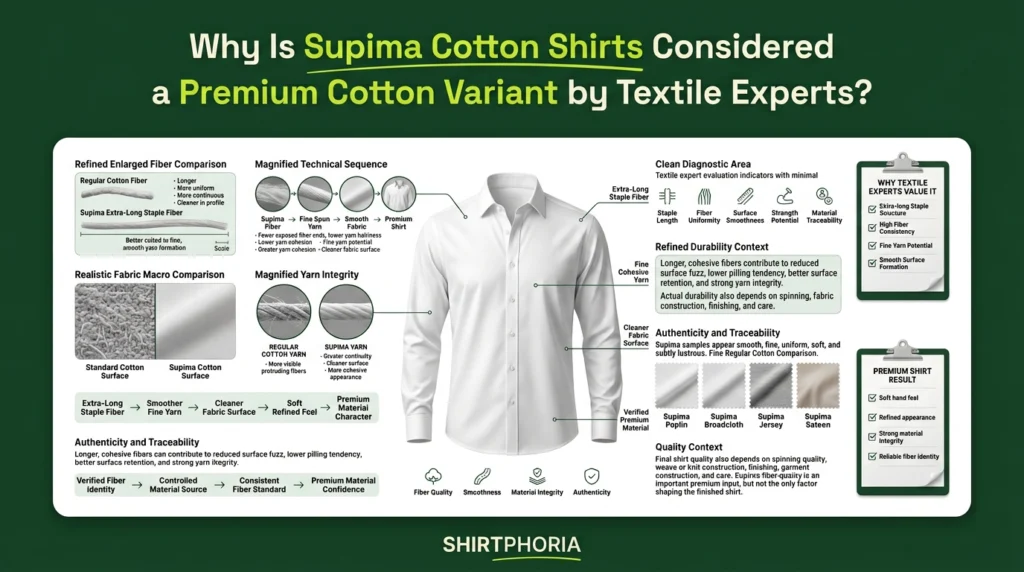
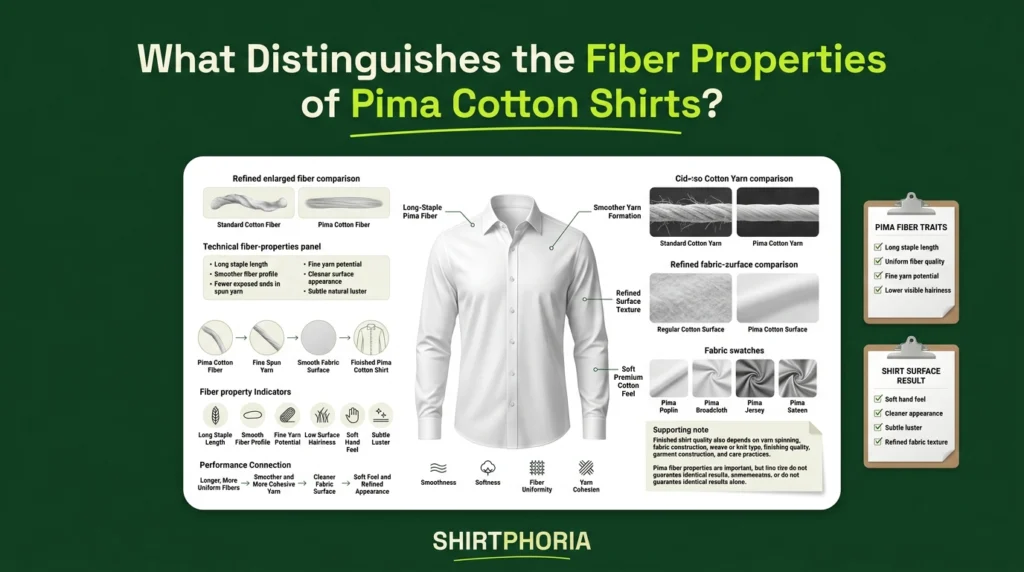
Pima cotton shirts are distinguished at the fiber level primarily by Pima cotton’s extra-long staple profile together with favorable strength, fineness, uniformity, and maturity-related characteristics that can support smoother, stronger, and more consistent yarn formation.
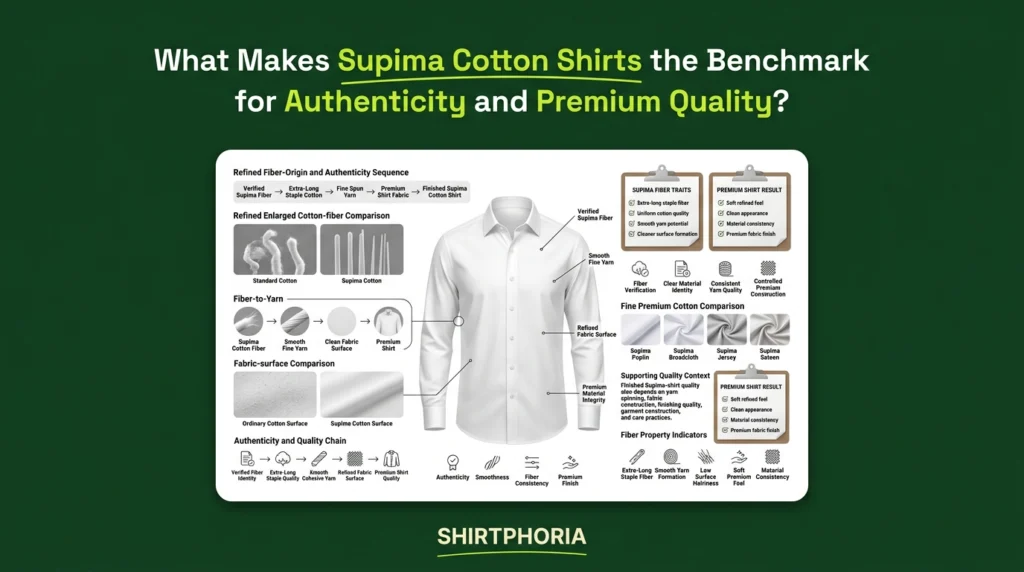
Pima cotton itself is the raw fiber. A Pima cotton shirt is the finished textile product created after that fiber has been cleaned, prepared, spun into yarn, formed into fabric, finished, cut, and sewn.
That distinction matters because the properties of raw cotton do not transfer automatically into the final garment.
The correct material chain is:
Fiber → Yarn → Fabric → Finished Shirt
Pima’s extra-long staple length is its most recognizable structural characteristic, but length alone does not define the complete quality of the fiber. Fineness, strength, uniformity, maturity, and micronaire provide different kinds of information about how cotton may behave during processing.
The central principle is simple:
Pima fiber quality creates textile potential; manufacturing determines how much of that potential survives in the finished garment.
What Fiber Characteristics Define Pima Cotton Shirts at the Material Level?
Pima cotton is distinguished by a fiber profile that combines extra-long staple length with favorable fineness, strength, uniformity, and maturity-related characteristics, creating strong potential for controlled spinning and refined yarn formation.
These properties work together, but they should not be treated as interchangeable measurements.
How Does Pima Cotton’s Extra-Long Staple Length Define Its Fiber Structure?
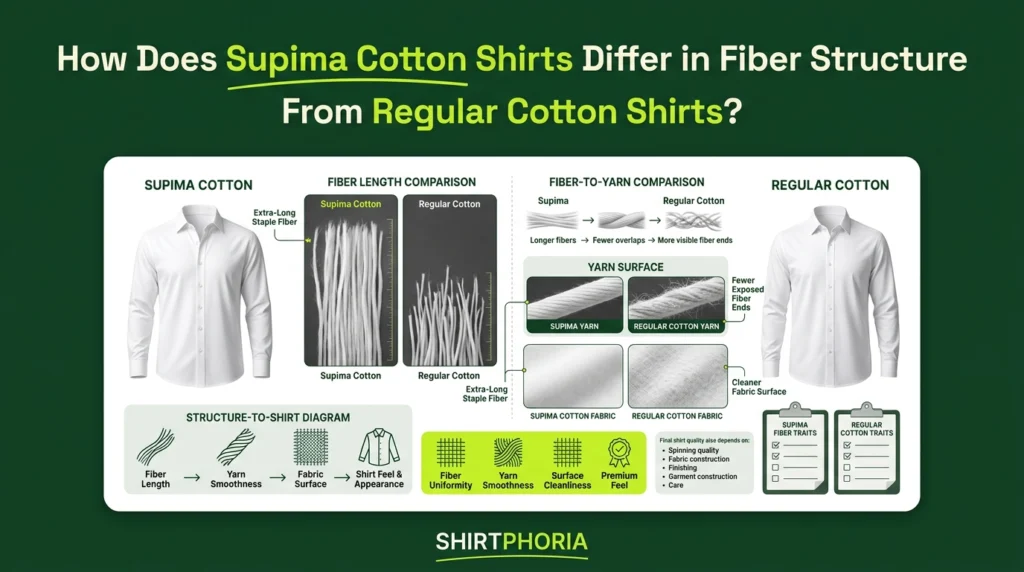
Pima cotton’s extra-long staple length defines its primary structural distinction because longer fibers provide greater opportunity for stable incorporation and overlap during spinning.
Staple length refers to the length characteristic of individual cotton fibers.
Longer fibers can remain engaged with neighboring fibers across a greater portion of the yarn structure. Under appropriate spinning conditions, this can support:
- greater fiber-overlap potential;
- improved yarn cohesion;
- better spinning control;
- finer-yarn production potential;
- and a cleaner, more refined yarn structure.
These are possibilities created by the raw material rather than guaranteed outcomes.
How Do Fineness, Strength, and Uniformity Complement Pima Fiber Length?
Fineness, strength, and uniformity complement Pima’s staple length because each property contributes a different type of yarn-quality potential.
A useful way to separate them is:
Length → overlap potential
Fineness → refinement potential
Strength → mechanical-support potential
Uniformity → consistency potential
A cotton sample can therefore have long fibers without every other property being equally favorable.
The properties must be evaluated individually before their combined influence is considered.
Why Should Pima Cotton Fiber Properties Be Evaluated as a System?
Pima cotton fiber properties should be evaluated as a system because no single measurement independently predicts spinning behavior, yarn performance, or finished-shirt quality.
Conceptually:
Length + fineness + strength + uniformity + maturity → yarn-quality potential
This is not a standardized quality equation. Instead, it illustrates why identifying only one characteristic—such as staple length—does not provide a complete evaluation of cotton quality.
How Does Extra-Long Fiber Length Distinguish Pima Cotton Shirts?
Pima cotton’s extra-long staple length distinguishes it by increasing the opportunity for fibers to remain engaged across longer portions of a spun yarn, supporting overlap, cohesion, and refined yarn construction under suitable spinning conditions.
How Does Longer Pima Fiber Create Greater Overlap Inside Yarn?
Longer Pima fibers can create greater overlap because each fiber can remain aligned and mechanically engaged with neighboring fibers across a longer continuous portion of the spun yarn.
Fiber overlap describes the extent to which neighboring fibers share portions of the yarn structure.
Fibers in spun cotton yarn are not chemically bonded together. Their cohesion depends on factors such as alignment, contact, twist, friction, fiber characteristics, and yarn design.
Long fibers provide more opportunity for neighboring fibers to overlap.
That can improve yarn-cohesion potential when the spinning system uses those fibers effectively.
How Can Longer Pima Fibers Reduce Exposed Fiber-End Opportunities?
Under otherwise comparable yarn linear density, fiber fineness, and spinning conditions, longer Pima fibers can reduce opportunities for fiber-end occurrences along a given yarn length because each fiber contributes a longer continuous segment to the yarn structure.
The relationship can be summarized as:
Longer continuous fiber segment → fewer fiber-end opportunities along comparable yarn length → cleaner yarn-surface potential
This should not be interpreted as meaning shorter fibers always require a greater total number of fibers.
Total fiber count also depends on fiber fineness, yarn linear density, yarn cross-section, and spinning architecture.
However, where other important variables are comparable, longer continuous fibers can help limit disruptive fiber-end opportunities at the yarn surface.
That may contribute to lower yarn hairiness and reduced surface fuzziness.
Why Can Pima Staple Length Support Finer Yarn Production?
Pima’s long staple length can support finer yarn production because greater continuous fiber length can provide useful spinning control and cohesion when yarns are engineered at finer scales.
This does not mean every Pima cotton shirt contains fine yarn.
Yarn fineness is a design choice influenced by spinning, fiber selection, fabric requirements, and intended garment performance.
It is also important to separate fiber fineness from yarn fineness. One describes individual fibers; the other describes a structure composed of many fibers.
How Does Fiber Fineness Shape the Quality Potential of Pima Cotton Shirts?
Pima cotton fiber fineness can support refined yarn and tactile quality because relatively fine individual fibers can be assembled into controlled yarn structures when sufficient length, strength, and appropriate spinning conditions are also present.
What Does Fiber Fineness Mean in Pima Cotton?
Fiber fineness describes the relative fineness or linear-density characteristic of individual cotton fibers rather than the thickness of the finished yarn.
It should not automatically be equated with:
- yarn fineness;
- visible fiber diameter;
- softness;
- or overall cotton quality.
Fiber fineness is one element of a larger material system.
How Can Finer Pima Fibers Support Refined Yarn Formation?
Finer Pima fibers can support refined yarn formation because their individual-fiber characteristics can contribute to controlled yarn structures when length, strength, uniformity, and spinning are also suitable.
The relationship is:
Fiber fineness → refinement potential → refined yarn potential
Fineness alone does not guarantee a high-quality yarn.
A refined yarn still depends on how the complete fiber population behaves during preparation and spinning.
How Can Pima Fiber Fineness Influence Tactile Refinement?
Pima fiber fineness can contribute to tactile refinement by reducing coarse-fiber sensation and supporting a more refined yarn-and-fabric surface when downstream construction preserves that potential.
Fine fibers may contribute to a smoother tactile character, but the finished hand of a shirt is also affected by:
- yarn structure;
- fabric construction;
- fabric density;
- finishing;
- washing;
- and garment treatment.
For that reason:
Fiber fineness contributes to tactile potential; finished softness remains a yarn, fabric, and finishing outcome.
How Does Fiber Strength Improve the Structural Potential of Pima Cotton Shirts?
Pima cotton fiber strength can improve structural potential because stronger fibers can better withstand processing and contribute to stronger yarn when overlap, twist, yarn design, and spinning conditions are appropriate.
What Does Fiber Strength Measure in Pima Cotton?
Fiber strength describes resistance to breaking under a defined fiber-level tensile measurement rather than yarn, fabric, or garment durability.
Four different levels must remain separate:
Fiber strength → Yarn strength → Fabric strength → Garment durability
They are related, but they are not equivalent measurements.
How Does Strong Pima Fiber Support Stronger Yarn Formation?
Strong Pima fibers can support stronger yarn formation because fiber-level strength can contribute to a mechanically capable yarn when sufficient overlap, suitable twist, yarn design, and controlled spinning are also present.
Conceptually:
Fiber strength + overlap + appropriate spinning → yarn-strength potential
This relationship should stop at the yarn level unless separate evidence supports a claim about fabric or garment performance.
Why Does Stronger Pima Fiber Not Automatically Make Every Pima Shirt More Durable?
Stronger Pima fiber does not automatically make every Pima shirt more durable because garment lifespan also depends on yarn engineering, fabric construction, fabric weight, seams, finishing, abrasion, laundering, and use.
A shirt made from strong fibers can still perform poorly if its fabric is unstable or its seams are weak.
Therefore:
Fiber strength = upstream structural potential
It does not mean:
Fiber strength = guaranteed garment lifespan
How Does Fiber Uniformity Affect the Surface Quality of Pima Cotton Shirts?
Fiber-length uniformity can support Pima cotton surface quality by contributing to more consistent spinning and yarn formation, which can in turn support a more regular finished fabric surface.
What Does Fiber Uniformity Mean in Pima Cotton?
Fiber uniformity describes the consistency of fiber lengths within a cotton sample rather than the average staple length itself.
A cotton sample can have a long average staple length while still containing meaningful variation in individual fiber lengths.
Average length and length uniformity are therefore separate characteristics.
How Can More Uniform Pima Fibers Improve Yarn Consistency?
More uniform Pima fibers can support yarn consistency because a more controlled fiber-length distribution can improve spinning regularity and yarn-evenness potential.
The relationship is:
Fiber uniformity → spinning consistency → yarn evenness
Uniformity does not eliminate every possible yarn defect, but it can contribute to more controlled yarn formation.
How Can Yarn Consistency Become Visible in a Pima Cotton Shirt?
More consistent yarn can contribute to a more regular Pima cotton fabric surface by reducing visible variation in the yarn structure presented within the woven or knitted textile.
This may support:
- more even surface appearance;
- greater texture consistency;
- lower visible irregularity;
- and cleaner fabric presentation.
The complete chain is:
Fiber uniformity → yarn-evenness potential → fabric-surface regularity potential
How Do Fiber Maturity and Micronaire Help Evaluate Pima Cotton Quality?
Fiber maturity and micronaire add important context to Pima cotton quality because they describe aspects of fiber development and measurement behavior that staple length alone cannot capture.
What Does Cotton Fiber Maturity Describe?
Cotton fiber maturity describes the degree of cell-wall development within the cotton fiber and provides information distinct from staple length, uniformity, and strength.
Maturity can influence how cotton behaves during textile processing.
It should be treated as one component of fiber evaluation rather than a universal shirt-quality score.
What Does Micronaire Indicate When Evaluating Cotton Fibers?
Micronaire is a cotton measurement influenced by both fiber fineness and maturity rather than a pure measurement of fineness alone.
Therefore:
Micronaire ≠ pure fineness measurement
A micronaire result needs to be interpreted alongside other fiber characteristics.
It should not be converted directly into a softness score, premium-quality score, or prediction of finished-shirt performance.
Why Should Pima Quality Not Be Judged From One Fiber Measurement?
Pima quality should not be judged from one fiber measurement because staple length, strength, uniformity, fineness, maturity, and micronaire describe different aspects of fiber behavior.
A fuller conceptual picture is:
Staple length + strength + uniformity + fineness + maturity-related information → broader fiber-quality understanding
No single variable should function as a universal quality score.
How Do Pima Cotton Fiber Properties Work Together to Form Better Yarn Potential?
Pima cotton’s yarn-quality potential comes from interaction among its fiber properties: length supports overlap, uniformity supports consistency, fineness supports refinement, strength supports mechanical capability, and maturity influences processing behavior.
How Do Pima Fiber Length and Uniformity Work Together During Spinning?
Pima fiber length and uniformity can work together during spinning because longer fibers provide overlap potential while a more consistent fiber-length distribution can make yarn formation easier to control.
Length and uniformity are complementary:
Length → overlap potential
Uniformity → consistency potential
Neither replaces the other.
How Do Pima Fiber Fineness and Strength Support Refined Yarn Structures?
Pima fiber fineness and strength can support refined yarn structures because fineness contributes to refinement potential while strength contributes mechanical capability during spinning and yarn use.
Fine fibers should not automatically be assumed to be weak fibers.
Both properties should be evaluated separately.
How Do All Major Pima Fiber Properties Combine Into Yarn-Quality Potential?
Pima cotton develops its strongest yarn-quality potential when long, sufficiently uniform, fine, strong, and adequately mature fibers are processed through controlled spinning.
A useful conceptual model is:
Long fibers + controlled length distribution + suitable fineness + strength + adequate maturity + controlled spinning → refined yarn-quality potential
This is not a standardized mathematical quality equation. It simply shows how several independent characteristics can work together.
How Does Pima Yarn Transmit Fiber Characteristics Into Fabric?
Pima yarn transmits fiber characteristics into fabric because the finished textile is built from the yarn structure created during spinning rather than directly from isolated raw fibers.
The progression is:
Pima fiber properties → spinning → yarn characteristics → fabric structure
Fabric construction can preserve, modify, or reduce the advantages produced at the yarn stage.
| Pima Fiber Property | What It Describes | Primary Yarn-Level Effect | Potential Shirt-Level Effect | Important Limitation |
|---|---|---|---|---|
| Extra-long staple length | Fiber-length characteristic | Greater overlap and cohesion potential | Smoother, more refined fabric potential | Depends on spinning and construction |
| Fiber fineness | Individual-fiber fineness characteristic | Refined-yarn potential | Tactile refinement potential | Does not independently guarantee softness |
| Fiber strength | Fiber-level breaking resistance | Yarn-strength potential | Stronger material foundation potential | Fabric and garment levels require separate evidence |
| Fiber uniformity | Consistency of fiber-length distribution | More even yarn-formation potential | More regular surface potential | Does not eliminate every textile irregularity |
| Maturity | Degree of fiber cell-wall development | Influences processing behavior | Can influence textile-processing consistency | Must be interpreted with other properties |
| Low protruding-fiber potential | Downstream yarn-surface consequence | Cleaner yarn-surface potential | Lower fuzziness and smoother appearance potential | Friction, finishing, yarn design, and construction also matter |
How Do Pima Cotton Fibers Differ From Typical Upland Cotton Fibers?
Under otherwise comparable evaluation conditions, Pima cotton differs from typical Upland cotton mainly through its extra-long staple profile and associated strength, fineness, and spinning-quality potential, while Upland cotton spans a broader range of fiber qualities and apparel applications.
How Does Pima Cotton Staple Length Compare With Upland Cotton?
Pima cotton is distinguished by an extra-long staple profile, while typical Upland cotton is generally shorter in staple length relative to Pima.
That distinction can influence:
- fiber-overlap potential;
- spinning flexibility;
- yarn-refinement potential;
- and achievable yarn characteristics.
It does not mean every Pima garment automatically exceeds every Upland cotton garment in finished quality.
How Do Pima and Upland Cotton Differ in Strength and Fineness Potential?
Pima cotton is valued for a fiber profile with strong mechanical and refinement potential, while Upland cotton spans a wider range of strength and fineness characteristics.
These are category-level tendencies.
Individual cotton samples can vary considerably, so strength and fineness should remain separate measurements rather than being inferred from the cotton name alone.
How Can Fiber Uniformity Differ Between Pima and Upland Cotton Samples?
High-quality Pima cotton can show favorable fiber-length uniformity, but uniformity still varies by sample and should not be assumed from the Pima name alone.
Where favorable uniformity is present, it can support:
Spinning regularity → yarn consistency → fabric-surface regularity
Why Can Premium Upland Cotton Still Produce an Excellent Shirt?
Premium Upland cotton can still produce an excellent shirt because finished quality depends on raw-fiber selection, spinning, yarn engineering, fabric construction, finishing, and garment manufacture rather than cotton category alone.
Pima advantage does not mean Upland failure.
| Property | Pima Cotton | Typical Upland Cotton | Practical Significance |
|---|---|---|---|
| Staple classification | Extra-long staple profile | Generally shorter relative to Pima | Influences overlap and spinning potential |
| Fiber length | Longer category-level profile | Generally shorter | Major structural distinction |
| Strength potential | Strong fiber-level potential | Varies by variety and grade | Influences yarn-strength potential |
| Fineness potential | Refined fiber profile | Varies | Influences yarn-refinement potential |
| Uniformity potential | Can be favorable in quality Pima | Varies | Influences spinning consistency |
| Textile positioning | Often used where refined properties are valued | Used across broad apparel categories | Does not independently determine garment quality |
The more accurate conclusion is:
Pima provides a distinctive high-performance fiber profile, while finished garment quality still depends on the complete textile system.
Why Are Pima Cotton Fiber Properties the Baseline for Comparing Supima With Regular Cotton?
Pima cotton fiber properties provide the baseline for evaluating Supima because readers should understand the underlying fiber characteristics before judging a more specifically defined branded Pima category.
Why Must Pima Fiber Properties Be Understood Before Evaluating Supima?
Pima fiber properties must be understood before evaluating Supima because a branded category becomes meaningful only when readers understand the material characteristics being discussed.
Those characteristics include staple length, fineness, strength, uniformity, and their potential effects on yarn formation.
How Does Supima Introduce a Narrower Identity Question Within Pima Cotton?
Pima cotton is the broader fiber category, while Supima represents a more specifically controlled branded category associated with American-grown Pima cotton.
The two terms should not be treated as interchangeable.
Not every product labeled Pima qualifies as Supima.
What Should Readers Examine Next?
Understanding general Pima cotton fiber properties provides the foundation for examining how a more specifically defined category compares with conventional cotton.
For a focused comparison, read Supima vs regular cotton
How Do Pima Cotton Fiber Properties Change the Finished Pima Cotton Shirt?
Pima cotton fiber properties can influence the finished shirt by supporting refined yarn, cleaner fabric surfaces, stronger material foundations, lower fuzziness potential, and more consistent visual or tactile refinement when downstream construction preserves those advantages.
How Can Pima Fiber Properties Contribute to a Smoother Shirt Surface?
Pima fiber properties can contribute to a smoother shirt surface by supporting refined yarn formation with fewer disruptive surface projections.
The chain is:
Fiber profile → refined-yarn potential → cleaner fabric-surface potential
This may contribute to lower surface irregularity, reduced fuzziness potential, and a more refined tactile surface.
Surface smoothness, however, is not identical to softness.
How Can Pima Fiber Properties Support Material Integrity?
Pima fiber properties can support material integrity when fiber strength and cohesive yarn are preserved through stable fabric and garment construction.
Material integrity can refer to several different levels:
- yarn cohesion or strength;
- fabric structural integrity;
- surface and appearance retention;
- or finished-garment durability.
These should not be treated as interchangeable outcomes.
How Can Pima Fibers Influence Fuzzing and Surface Retention?
Pima fiber characteristics can support lower fuzziness and better appearance retention when long, well-controlled fibers reduce disruptive protruding-fiber opportunities in the yarn surface.
Fuzzing and pilling also depend on:
- yarn structure;
- friction;
- fabric construction;
- finishing;
- laundering;
- and wear conditions.
Pima cotton should therefore not be described as pill-proof.
Fuzzing and pilling are primarily appearance and serviceability outcomes unless independent evidence shows that structural deterioration has also occurred.
How Can Pima Fiber Quality Support a More Refined Shirt Appearance?
Pima fiber quality can support a more refined appearance when consistent yarn and fabric construction translate the raw-fiber profile into a uniform, visually clean textile surface.
Possible visible results include:
- cleaner yarn appearance;
- greater surface uniformity;
- more consistent texture;
- and improved visual refinement.
Again, visual refinement should not be confused with structural durability.
What Can Prevent Pima Cotton Fiber Properties From Becoming Better Shirt Performance?
Pima cotton’s fiber advantages can be weakened before they reach the wearer if poor spinning, unstable fabric construction, weak garment assembly, unsuitable finishing, or harsh care disrupts the material chain.
How Can Poor Spinning Waste the Advantages of Pima Fibers?
Poor spinning can waste Pima’s raw-fiber advantages by producing uneven yarn, inappropriate twist, processing damage, poor fiber control, or inconsistent yarn formation.
In simple terms:
Good fiber + poor spinning → reduced yarn-quality advantage
Premium raw material cannot fully compensate for poor yarn engineering.
How Can Fabric Construction Override Pima’s Fiber Advantages?
Fabric construction can override part of Pima’s fiber advantage when excessive looseness, unstable weave or knit structure, inappropriate density, or poor yarn selection creates a weak or irregular textile.
The fabric stage determines how effectively yarn-level qualities become textile-level qualities.
How Can Poor Garment Construction Weaken a Pima Cotton Shirt?
Poor garment construction can weaken a Pima cotton shirt because premium fiber and fabric cannot compensate fully for weak seams, inconsistent stitching, or inadequate reinforcement.
Seam quality must therefore be evaluated separately from fiber quality.
How Can Finishing Temporarily Distort the Perceived Quality of Pima Cotton?
Finishing can alter perceived Pima quality because softness, slickness, surface smoothness, or polish can be modified independently of the underlying fiber profile.
A very soft first touch is therefore not independent proof of premium fiber quality or long-term garment performance.
This does not mean finishing is undesirable. Finishing is a normal part of textile manufacturing, but its effects should not be confused with intrinsic fiber characteristics.
How Can Wear and Laundering Reduce Pima Cotton Surface Quality?
Wear and laundering can reduce Pima cotton surface quality because abrasion, harsh washing, excessive heat, and unsuitable drying can progressively affect yarn and fabric surfaces.
Care therefore matters even when the shirt begins with excellent raw material.
Following the garment’s care instructions can help preserve the textile qualities created during manufacturing.
How Can You Evaluate the Fiber-Driven Quality of Pima Cotton Shirts?
Fiber-driven Pima shirt quality should be evaluated through the full chain of fiber claim, surface quality, yarn consistency, fabric construction, garment assembly, finishing, and care rather than through the Pima label alone.
Visual and tactile inspection can help screen finished construction and surface quality.
However, unaided consumer inspection cannot independently determine exact staple length, fiber fineness, fiber strength, maturity, micronaire, or botanical authenticity.
How Can Fiber Labeling Help Identify a Pima Cotton Claim?
Fiber-content labeling can establish that a garment is being presented as Pima cotton, but it cannot independently prove the underlying fiber measurements or total shirt quality.
Look for:
- specific fiber-content labeling;
- manufacturer disclosure;
- and traceability information where available.
A specific Pima claim should also be distinguished from vague marketing descriptions such as:
- premium cotton;
- luxury cotton;
- fine cotton.
A label establishes a product claim. It does not independently verify every technical characteristic behind that claim.
What Surface Characteristics Suggest Controlled Yarn and Fabric Formation?
Controlled yarn and fabric formation can produce a smooth, even, relatively low-fuzz surface with limited visible yarn irregularity.
When inspecting a shirt, consider:
- surface smoothness;
- surface evenness;
- excessive fuzziness;
- texture consistency;
- and obvious irregular yarn sections.
These signs help evaluate the finished textile.
They do not establish botanical identity.
How Can Fabric Construction Reveal Whether Pima’s Fiber Advantages Were Preserved?
Fabric construction can indicate whether premium-fiber potential has been translated into a stable textile by showing whether the yarn has been organized into a balanced and consistent woven or knitted structure.
Look for:
- consistent yarn appearance;
- stable weave or knit structure;
- appropriate fabric density;
- structural balance;
- and limited uncontrolled loose fibers.
How Can Garment Construction Reveal Whether the Shirt Matches the Fiber Quality?
Garment construction should match the quality of the textile because poor seams, stitching, reinforcement, or finishing can undermine otherwise refined fabric.
Inspect:
- seam consistency;
- stitch quality;
- reinforcement;
- finishing quality;
- and overall construction consistency.
How Should Buyers Judge Pima Cotton Through the Full Material Chain?
Buyers should judge Pima cotton through the complete material chain because fiber identity is only the first stage in creating a high-quality finished shirt.
Use this sequence:
Fiber claim → fiber properties → yarn quality → fabric structure → garment construction → finish → care
The closer a claim moves toward microscopic fiber properties, the less confidently it can be verified through ordinary visual or tactile inspection.
How Can You Choose a Pima Cotton Shirt That Preserves Its Fiber Advantages?
A Pima cotton shirt is more likely to preserve its fiber advantages when its yarn, fabric construction, garment assembly, finishing, and intended use align with the quality attribute the buyer values most.
Which Signs Matter Most When Smoothness Is the Priority?
Smoothness is best screened through even yarn appearance, low unintended fuzziness, a clean fabric surface, consistent texture, and construction appropriate to the intended hand.
Look for:
- even yarn;
- low surface fuzziness;
- a clean, smooth surface;
- consistent texture;
- and refined fabric construction.
Smoothness alone does not prove Pima authenticity.
Which Signs Matter Most When Structural Durability Is the Priority?
Structural durability is better supported by stable fabric construction, consistent yarn, suitable density and weight, sound seams, and realistic care requirements.
Fiber identity alone cannot predict exact lifespan.
Why Should Buyers Evaluate Both Material and Construction Quality?
Buyers should evaluate both material and construction quality because premium fiber can deliver its potential only when downstream textile and garment engineering preserve it.
A practical decision rule is:
Premium fiber + strong construction → stronger chance of preserving material potential
while:
Premium fiber + weak construction → reduced realized advantage
How Should Intended Use Affect Pima Cotton Shirt Selection?
Intended use should affect Pima cotton shirt selection because lightweight comfort, dress-shirt refinement, repeated everyday wear, warm-weather use, and structural durability can require different fabric constructions.
A lighter fabric may be desirable for warm conditions, while repeated everyday wear may place greater importance on construction stability and practical care.
Pima identity alone should not be used as a substitute for evaluating fabric design.
| Buyer Priority | Fiber/Yarn Signs to Look For | Construction Signs to Look For | Main Reason |
|---|---|---|---|
| Smooth tactile feel | Even, refined, low-fuzz yarn surface | Consistent fabric appropriate to intended hand | Supports tactile refinement |
| Long-term integrity | Cohesive, consistent yarn | Stable fabric and sound seams | Supports structural quality |
| Refined appearance | Uniform yarn and clean surface | Even weave or knit and clean finish | Supports visual consistency |
| Everyday wear | Balanced yarn and fabric weight | Stable construction and practical care | Supports repeated use |
| Warm-weather comfort | Yarn and fabric suitable to lighter construction | Structure that supports airflow | Balances refinement with thermal comfort |
These indicators can improve confidence in construction quality, but they do not independently establish exact fiber measurements or Pima authenticity.
What Are the Key Fiber-Quality Signs to Remember About Pima Cotton Shirts?
The most useful Pima cotton quality signals combine a specific Pima fiber claim with the expected fiber-property profile, controlled yarn formation, stable fabric construction, sound garment assembly, and evidence appropriate to the claim being made.
Pima Cotton Fiber Property Checklist
- ✅ Extra-long staple length is Pima cotton’s primary structural distinction.
- ✅ Longer fibers can support greater overlap and cohesion potential during spinning.
- ✅ Fiber fineness is an individual-fiber property and is different from yarn fineness.
- ✅ Fiber strength supports yarn-strength potential but does not independently determine garment durability.
- ✅ Fiber uniformity can support more consistent yarn formation.
- ✅ Fiber maturity provides information about fiber development.
- ✅ Micronaire should not be treated as a pure fineness measurement.
- ✅ Smoothness is a downstream textile outcome rather than proof of Pima identity.
- ✅ Fuzzing and pilling are mainly appearance and serviceability outcomes unless structural damage is independently established.
- ✅ Pima fiber characteristics establish performance potential rather than guaranteed garment superiority.
- ✅ Spinning quality determines how successfully fiber properties become controlled yarn.
- ✅ Fabric construction determines how yarn properties become visible or functional in the textile.
- ✅ Seams and finishing should match the quality of the fabric.
- ✅ Supima is related to Pima cotton but is not synonymous with every form of Pima.
- ✅ Consumer inspection cannot independently verify exact microscopic fiber measurements or authenticity.
- ✅ Buyers should evaluate the complete material chain rather than relying on the Pima name alone.
Rapid Quality Model
Strong fiber profile + controlled spinning + stable fabric + sound garment construction = stronger preservation of Pima’s material advantages
This is a conceptual quality model, not a standardized equation, laboratory test, or authenticity grading system.
Pima Evidence Categories
Strong Pima evidence: A specific Pima claim is accompanied by credible disclosure or traceability and finished construction consistent with the claimed material quality.
Partial evidence: Pima is specifically claimed, but detailed fiber, traceability, or construction information is incomplete.
Surface-quality evidence only: The garment appears smooth, refined, or well constructed, but this does not independently establish Pima identity.
Label-only evidence: Pima is stated with little supporting information beyond the product label or marketing claim.
Indeterminate: Available evidence is insufficient to assess the fiber claim or realized garment quality confidently.
These categories should not be converted into arbitrary numerical quality scores.
Disclaimer
| NOTICE | DETAILS |
|---|---|
| Purpose | This article is for general educational purposes. |
| Performance Variation | Textile performance can vary with fiber source, yarn engineering, fabric construction, finishing, garment manufacturing, use, and care. |
| Verification Limit | Visual or tactile inspection can help assess finished construction, but it cannot independently verify exact fiber measurements, botanical identity, or authenticity claims. |
What Are the Key Takeaways About the Fiber Properties of Pima Cotton Shirts?
The key takeaway is that Pima cotton is distinguished by an extra-long staple fiber profile supported by strength, fineness, uniformity, and maturity-related properties that collectively influence spinning, yarn quality, fabric refinement, and finished-shirt potential.
The most important points are:
Frequently Asked Questions
Pima cotton is principally distinguished by its extra-long staple fiber profile. Length works together with fineness, strength, uniformity, and maturity-related characteristics to create yarn-quality potential.
No. Extra-long fibers create useful spinning and yarn potential, but finished-shirt quality still depends on spinning, fabric construction, garment assembly, finishing, use, and care.
At category level, Pima is distinguished mainly by its extra-long staple profile and associated spinning and refinement potential. Upland cotton spans a broader range of fiber qualities and can still produce excellent shirts when manufacturing quality is high.
Not exactly. Consumers can inspect surface regularity, fuzziness, fabric stability, seams, and finishing, but exact staple length, strength, fineness, maturity, micronaire, and botanical authenticity require more specific evidence or testing.
Terms Explained
| TERM | DEFINITION |
|---|---|
| Pima cotton | A cotton fiber category known for an extra-long staple profile and favorable fiber-quality potential. |
| Staple length | The length characteristic of individual cotton fibers. |
| Extra-long staple | A long-fiber cotton classification associated with greater overlap and spinning potential. |
| Fiber fineness | The relative fineness or linear-density characteristic of individual cotton fibers. |
| Yarn fineness | The fineness of the spun yarn structure, which is different from the fineness of individual fibers. |
| Fiber strength | Resistance to breaking under a defined fiber-level tensile measurement. |
| Fiber uniformity | The consistency of fiber lengths within a cotton sample. |
| Fiber maturity | The degree of cell-wall development within a cotton fiber. |
| Micronaire | A cotton measurement influenced by both fiber fineness and maturity rather than fineness alone. |
| Fiber overlap | The extent to which neighboring fibers share portions of the yarn structure. |
| Yarn cohesion | The mechanical holding-together of fibers within a yarn through factors such as twist, friction, contact, and alignment. |
| Upland cotton | A broad cotton category widely used in apparel and generally shorter in staple length than Pima at category level. |
| Supima | A more specifically controlled branded category associated with American-grown Pima cotton. |
| Fuzzing | The development or presence of loose fibers on a textile surface, mainly affecting appearance and serviceability. |
| Pilling | The formation of small fiber balls on a fabric surface due to friction and fiber movement. |
Conclusion
In conclusion, Pima cotton shirts are fundamentally distinguished by the fiber architecture behind them—especially an extra-long staple profile combined with favorable fineness, strength, uniformity, and maturity-related characteristics.
Those properties influence the shirt through a sequence:
Pima fiber properties → spinning behavior → yarn characteristics → fabric structure → finished-shirt potential
Staple length is Pima cotton’s major structural differentiator, but it is not the only quality variable.
It is equally important to keep different performance levels separate:
Fiber fineness ≠ yarn fineness
Fiber strength ≠ yarn strength
Yarn strength ≠ fabric strength
Fabric strength ≠ garment durability
Fuzzing or pilling ≠ automatic structural failure
Smoothness ≠ proof of Pima identity
The complete material chain extends beyond the raw fiber:
Raw fiber → spinning → yarn → fabric construction → garment assembly → finishing → care
Pima fiber quality therefore creates performance potential rather than a guaranteed finished result. Manufacturing determines how much of that potential reaches the wearer, while use and care influence how well it is retained.
Consumer inspection can reveal useful information about surface regularity, fabric stability, seams, finishing, and overall construction, but it cannot independently verify exact staple length, fiber strength, fineness, maturity, micronaire, or botanical authenticity.
Understanding Pima cotton begins below the fabric surface: its defining advantages originate in a distinct fiber-property profile, while spinning, fabric construction, garment engineering, finishing, and care determine how successfully those advantages become qualities the wearer can actually see, feel, and retain.