How Does Mercerization Enhance the Properties of Cotton Shirts?
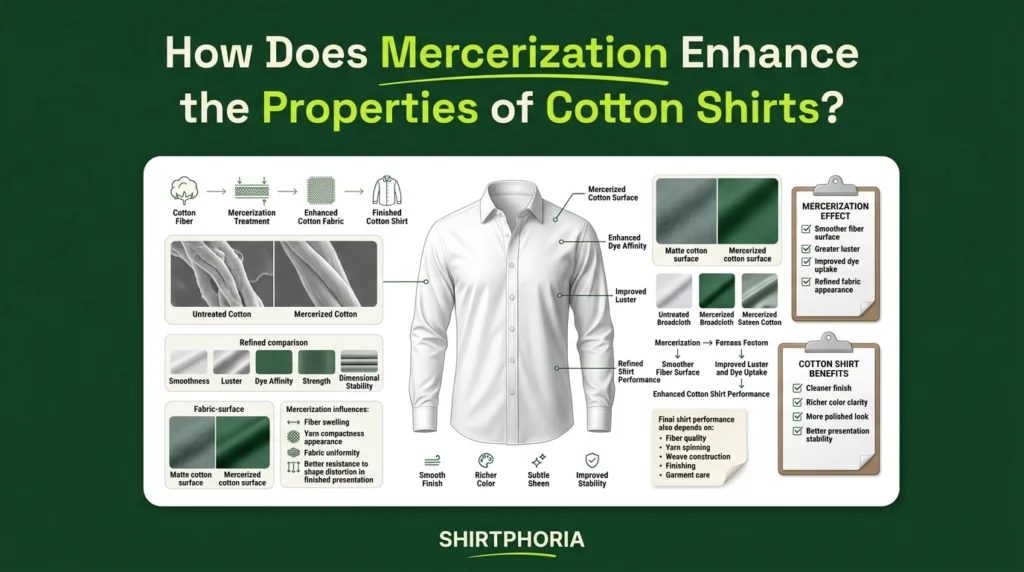
Mercerization enhances selected properties of cotton shirts by treating cotton yarn or fabric with concentrated sodium hydroxide under controlled conditions, causing the fibers to swell and restructure in ways that can modify luster, visual smoothness, dye affinity, tensile behavior, absorbency, and dimensional stability.
The central process can be summarized as:
Mercerizing treatment → cotton fiber swelling and structural change → altered fiber geometry and accessibility → changed optical, dyeing, moisture, and mechanical behavior
A mercerized cotton shirt usually contains yarn or fabric that was mercerized during textile production. The treatment does not necessarily happen after the shirt has already been sewn.
Mercerization also changes the cotton substrate itself. It is not simply a glossy coating placed on the finished fabric.
However, the word mercerized should not be treated as a complete quality grade. Cotton quality, yarn construction, fabric structure, finishing, stitching, and garment construction still influence how the final shirt performs.
What Is Mercerization and Why Is It Used for Cotton Shirts?
Mercerization is a controlled cotton treatment in which yarn or fabric is exposed to concentrated sodium hydroxide under managed process conditions to alter the cotton substrate and modify selected textile properties.
Sodium hydroxide is also known as caustic soda.
CottonWorks describes mercerization as a preparation process in which fiber, yarn, or fabric is treated with a high concentration of caustic soda under tension. The treatment causes cotton to swell and can increase dye affinity and luster.
How Does Mercerization Treat Cotton Yarn or Fabric?
Conventional mercerization treats cotton yarn or fabric with concentrated sodium hydroxide, also called caustic soda, causing the cotton substrate to swell and undergo structural change.
The process can be applied at different stages.
Cotton yarn may be mercerized before weaving or knitting, while fabric can be treated after its structure has already been formed.
The basic relationship is:
Sodium hydroxide treatment → causes → cotton fiber swelling
This is more than simply applying a chemical to the surface. The alkali changes the physical and internal structure of the cotton fiber.
The material is later washed and neutralized so that residual alkali is removed.
Why Is Tension Important During Cotton Mercerization?
Controlled tension is important during cotton mercerization because alkali-swollen cotton can contract, and restraining that dimensional change helps control the geometry and appearance produced by the treatment.
When cotton encounters concentrated sodium hydroxide, the fibers swell and their dimensions change.
If this dimensional movement is controlled through tension, the resulting fiber and fabric geometry can differ from treatment performed without equivalent restraint.
This relationship is especially important for appearance and dimensional behavior:
Controlled tension → limits → alkali-induced dimensional change
Tension is therefore an important mercerization variable, but it does not independently control every property of the finished shirt.
Why Does Cotton Respond Strongly to Mercerization?
Cotton responds to mercerization because it is a cellulose-based fiber whose structure can be substantially swollen and reorganized by strong alkali under suitable treatment conditions.
Cellulose is the main structural material in cotton fibers.
The interaction between cellulose and concentrated sodium hydroxide allows mercerization to change the fiber more substantially than a simple surface treatment would.
Those changes help explain why mercerized cotton can behave differently in dyeing, light reflection, moisture uptake, and some mechanical properties.
How Does Mercerization Change the Fiber Structure of Cotton Shirts?
Mercerization changes cotton fibers by causing substantial alkali swelling, modifying fiber geometry, and reorganizing the internal cellulose structure under controlled treatment conditions.
These fiber-level changes form the basis of many later appearance and performance differences.
How Does Sodium Hydroxide Make Cotton Fibers Swell?
Sodium hydroxide makes cotton fibers swell by penetrating the cellulose structure and increasing accessibility within the fiber.
Untreated cotton fibers have an irregular natural geometry.
During mercerization, strong alkali enters the cotton substrate and causes substantial swelling.
The process changes fiber dimensions and creates a more accessible internal structure.
The central relationship is:
Alkali penetration → produces → fiber swelling
This greater accessibility becomes particularly important when explaining dye uptake and liquid interaction.
How Does Mercerization Make Cotton Fibers Rounder and Smoother?
Mercerization can make cotton fibers rounder and geometrically more regular because alkali swelling modifies the irregular cross-sectional form of untreated cotton.
The fiber’s shape becomes more regular as it swells.
This change can affect how light interacts with the fiber and how the resulting yarn or fabric surface appears.
However, microscopic geometric smoothness should not automatically be interpreted as proof that every mercerized shirt will feel softer against the skin.
Three concepts should remain separate:
Microscopic fiber geometry
Visible fabric-surface smoothness
Tactile smoothness or fabric hand
They can influence one another, but they are not identical properties.
How Does Mercerization Reorganize Cellulose Inside Cotton Fibers?
Conventional sodium-hydroxide mercerization can reorganize native cotton cellulose toward a cellulose II structure, representing an internal structural transformation rather than a simple surface-polishing effect.
Natural cotton mainly contains cellulose in what is called the cellulose I form.
Strong alkali treatment can reorganize this structure during mercerization, producing cellulose II after the appropriate treatment and washing sequence.
CottonWorks’ technical dyeing material describes this cellulose I to cellulose II transformation during conventional sodium-hydroxide mercerization.
The important point for shirt performance is that mercerization changes more than appearance. It modifies the internal cotton substrate.
How Do Fiber Swelling and Cellulose Restructuring Change Cotton-Shirt Behavior?
Fiber swelling and cellulose restructuring can change cotton-shirt behavior by altering fiber geometry and accessibility, which can influence optical reflection, dye uptake, moisture interaction, and mechanical performance.
The process can be viewed as:
Fiber swelling + structural reorganization + changed geometry → altered property potential
The word potential matters.
Evidence that mercerization improves one property does not prove that every other property improves to the same degree.
For example, increased luster does not automatically prove increased dimensional stability or tactile softness.
A simplified process sequence is:
Untreated cotton fiber → alkali treatment → swelling and restructuring → controlled processing → washing and neutralization → mercerized cotton substrate
Why Do Mercerized Cotton Shirts Look Smoother and More Lustrous?
Mercerized cotton shirts can look smoother and more lustrous because treatment changes fiber geometry in ways that can make the fabric surface appear more regular and reflect light differently from untreated cotton.
The sheen associated with mercerized cotton comes from structural and optical changes rather than from a glossy coating.
Why Do Mercerized Cotton Fibers Reflect More Light?
Mercerized cotton fibers can reflect light more regularly because their altered geometry reduces some of the irregularity associated with untreated cotton fibers.
A more regular fiber surface can interact with incoming light differently.
Instead of light being scattered as irregularly by natural fiber geometry, more consistent reflection can increase visible luster.
The basic relationship is:
More regular fiber geometry → supports → more regular light reflection
This produces the polished or lustrous appearance often associated with well-mercerized cotton.
How Does Tension Strengthen Mercerization Luster?
Controlled tension can strengthen the lustrous effect of mercerization by limiting alkali-induced dimensional change and helping preserve the geometry associated with a more regular optical surface.
The final sheen depends on more than sodium hydroxide alone.
Treatment conditions, tension, starting yarn quality, fabric structure, and process control all influence how visible the effect becomes.
This is one reason two garments labeled mercerized cotton may not look identical.
How Does Mercerization Change the Visible Surface of a Cotton Shirt?
Mercerization can give a cotton shirt a cleaner and more refined visible surface because fiber-level geometric changes can translate into greater fabric-surface regularity.
A more regular-looking surface may appear:
- cleaner,
- more polished,
- more even,
- and more lustrous.
That visible regularity should not automatically be described as tactile softness.
| Structural Change | Mechanism | Shirt-Level Result |
|---|---|---|
| Fiber geometry becomes more regular | Light interacts differently with the fiber surface | Greater luster potential |
| Visible surface becomes more regular | Reduced optical irregularity | Cleaner appearance |
| Fiber is processed under controlled tension | Dimensional change is restrained during treatment | More controlled surface and luster result |
Why Do Mercerized Cotton Shirts Show Greater Dye Affinity and Richer Color?
Mercerized cotton can show greater dye affinity because swelling and structural reorganization can increase accessibility within the cellulose substrate, allowing stronger dye uptake under suitable dyeing conditions.
This is one of the most important functional effects of mercerization.
Why Can Mercerized Cotton Accept Dye More Readily?
Mercerized cotton can accept dye more readily because structural changes increase accessibility within the cotton substrate.
When the cotton swells and its internal structure changes, dye molecules can interact with the substrate differently.
The relationship is:
Greater cellulose accessibility → increases → dye-affinity potential
This means mercerized cotton can become more receptive to dye than otherwise comparable untreated cotton.
How Can Greater Dye Affinity Make Cotton-Shirt Colors Appear Richer?
Greater dye affinity can support stronger color yield because a more receptive cotton substrate can take up dye more effectively when dye chemistry and processing are appropriate.
The result can be:
- deeper coloration,
- brighter appearance,
- stronger color yield,
- and visually richer shades.
The final appearance still depends on the dye itself and the quality of the dyeing process.
Mercerization cannot compensate for every dye formulation or processing problem.
How Can Mercerization Support More Uniform Coloration?
Mercerization can support more uniform coloration when its effect on substrate receptivity reduces variability that would otherwise contribute to uneven dye uptake.
A consistently prepared substrate provides a better foundation for uniform dyeing.
However, uneven yarn quality, poor preparation, incorrect dye formulation, or poor process control can still create coloration problems.
Mercerization is therefore one contributor to consistent dyeing rather than a guarantee of perfect uniformity.
Does Greater Dye Affinity Automatically Mean Better Colorfastness?
Greater dye affinity does not automatically guarantee better colorfastness because dye uptake and long-term dye retention are different performance issues.
Dye affinity describes how receptive the substrate is to dye.
Colorfastness describes how well coloration resists changes caused by factors such as washing, rubbing, or light exposure.
Colorfastness can depend on:
- dye chemistry,
- fixation,
- rinsing,
- finishing,
- laundering,
- and care conditions.
Therefore:
Higher dye affinity ≠ guaranteed colorfastness
A mercerized shirt may have excellent coloration, but the mercerization label alone cannot establish its wash, rub, or light fastness.
Why Can Mercerization Increase Cotton-Shirt Strength and Dimensional Stability?
Properly controlled mercerization can modify strength-related performance, water and chemical uptake, and dimensional behavior, but each outcome must be evaluated at the correct fiber, yarn, or fabric measurement level.
This distinction prevents a common mistake: turning one measured strength improvement into a claim about complete shirt durability.
How Can Mercerization Increase Cotton Tensile Strength?
Mercerization can modify tensile performance, but the evidence must specify whether it measures fiber strength, yarn breaking behavior, or fabric tensile or breaking performance.
These are different measurement levels.
A study showing improved yarn breaking performance does not automatically prove that every shirt made from that yarn will last longer.
The levels should remain separate:
Cotton fiber strength
Yarn tensile or breaking performance
Fabric tensile or breaking performance
Finished-shirt durability
Garment durability depends on much more than one tensile measurement.
How Can Mercerization Support Dimensional Stability?
Correctly controlled mercerization can contribute to dimensional stability by modifying the cotton substrate under controlled processing conditions, but final dimensional behavior also depends on fabric construction, later finishing, relaxation, laundering, and use.
Dimensional stability means the ability of a textile to maintain its intended dimensions through processing, relaxation, wear, or care.
It is broader than shrinkage alone.
Therefore:
Improved dimensional stability ≠ zero shrinkage
A mercerized shirt can still experience dimensional change depending on its fabric construction and subsequent processing.
How Does Mercerization Affect Water and Chemical Absorbency?
Mercerization can increase water and chemical uptake because swelling and structural changes can make the cotton substrate more accessible to liquids and processing chemicals.
The mechanism can be summarized as:
Fiber swelling and accessibility → can increase → water and chemical uptake
Absorbency should remain separate from several related properties:
- air permeability,
- drying rate,
- moisture transport,
- ventilation,
- and breathability.
A fabric absorbing more liquid does not automatically mean air passes through it more easily.
Therefore:
Higher absorbency ≠ automatically higher breathability
Does Higher Tensile Strength Mean Every Mercerized Cotton Shirt Is More Durable?
A measured strength improvement at the fiber, yarn, or fabric level does not mean every mercerized cotton shirt is automatically more durable because garment durability emerges from the complete material and construction system.
Durability can be influenced by:
- cotton fiber quality,
- yarn construction,
- fabric structure,
- fabric weight,
- finishing,
- seam construction,
- abrasion exposure,
- laundering,
- and wearer use.
Mercerization is one contributing variable inside this larger system.
Which Processing Variables Control Mercerization Effects in Cotton Shirts?
Mercerization effects depend on controlled processing variables because alkali concentration, tension, temperature, treatment time, substrate quality, and processing stage influence how strongly the cotton responds.
This explains why the label mercerized cotton does not predict an identical result across every shirt.
How Does Alkali Concentration Influence Mercerization?
Alkali concentration influences mercerization by affecting the degree of swelling and structural change produced during treatment.
A stronger treatment condition can create a different substrate response from a weaker one.
However, concentration should not be interpreted by itself.
The final outcome also depends on other process conditions, including time, temperature, tension, and substrate characteristics.
There is no single concentration that automatically guarantees the highest-quality shirt in every construction.
How Do Tension, Temperature, and Treatment Time Influence the Result?
Tension, temperature, and treatment time interact with the chemical treatment to influence the extent and character of the resulting cotton modification.
Different properties can respond differently to processing variables.
For example, conditions that affect luster may not influence dimensional behavior or tensile properties in exactly the same way.
The mercerization process therefore needs to be controlled as a system rather than as a single-variable treatment.
How Does Starting Cotton Quality Affect Mercerization?
Starting cotton quality affects the final mercerized result because the process modifies an existing substrate rather than replacing its fiber, yarn, preparation, or fabric characteristics.
Important starting variables can include:
- fiber maturity,
- yarn quality,
- yarn twist,
- fabric construction,
- and preparation quality.
The key rule is:
Mercerization modifies the starting cotton; it does not erase the starting material’s limitations.
A poorly constructed substrate does not automatically become a premium fabric because it has been mercerized.
Does Yarn Mercerization Produce the Same Result as Fabric Mercerization?
Yarn and fabric mercerization use the same broad treatment principle but may produce different final outcomes because the processing stage changes how swelling, tension, yarn arrangement, and fabric construction interact.
Yarn mercerization treats yarn before the final fabric is formed.
Fabric mercerization treats the textile after weaving or knitting.
Because the material is in a different structural state during treatment, the resulting appearance and performance expression may differ.
The two processes should therefore not be assumed to be completely interchangeable.
| Process Variable | Fiber/Substrate Response | Main Property Influence |
|---|---|---|
| Alkali concentration | Alters degree of swelling and structural response | Overall mercerization intensity |
| Controlled tension | Restrains dimensional change during treatment | Geometry, luster, dimensional behavior |
| Temperature / treatment time | Influence treatment conditions | Extent of structural and property response |
| Starting cotton quality | Defines the substrate being modified | Limits final achievable outcome |
| Yarn / fabric stage | Changes how treatment interacts with construction | Appearance and performance expression |
How Do Mercerized and Unmercerized Cotton Shirts Compare?
Mercerized cotton shirts can differ from otherwise comparable unmercerized cotton shirts through changes in luster, visible surface regularity, dye receptivity, color yield, absorbency, strength-related behavior, and dimensional performance.
These comparisons describe tendencies under comparable conditions.
| Property | Unmercerized Cotton Shirt | Mercerized Cotton Shirt | Main Reason for Difference |
|---|---|---|---|
| Luster | Usually more matte | Can be more lustrous | Changed fiber geometry and optical behavior |
| Visible surface appearance | More natural surface irregularity | Can appear smoother or more refined | Fiber swelling and geometric change |
| Tactile smoothness | Construction-dependent | Must be evaluated separately | Fiber geometry alone does not determine hand |
| Dye affinity | Normal cotton receptivity | Can be increased | Greater substrate accessibility |
| Color yield | Standard processing outcome | Can appear richer or brighter | Improved dye uptake under suitable conditions |
| Strength-related performance | Depends on measurement level | Can change at supported measurement level | Treatment-induced structural change |
| Water/chemical uptake | Normal cotton behavior | Can increase | Greater substrate accessibility |
| Dimensional stability | Construction and process dependent | Can improve under suitable processing | Controlled substrate modification |
| Overall quality | Depends on total construction | Still depends on total construction | Mercerization is one variable |
Which Properties Show the Clearest Mercerization Difference?
The clearest mercerization differences should be described only where technical evidence supports the relevant property directly.
Commonly discussed effects include:
- luster,
- visible surface regularity,
- dye affinity,
- color yield,
- absorbency,
- strength-related behavior,
- and dimensional behavior.
Cotton Incorporated’s textile glossary similarly notes that mercerization swells the cotton substrate and results in increased dye affinity and luster.
Each additional property should still be evaluated independently.
Which Mercerization Differences Matter Most When Evaluating a Shirt?
The most meaningful mercerization differences depend on the wearer’s priorities and on whether the claimed benefit is actually one that mercerization can influence directly.
Someone prioritizing a polished appearance may care most about luster and surface regularity.
Someone prioritizing rich coloration may care more about dye receptivity and color yield.
A technical buyer may be interested in dimensional or mechanical performance, but those claims require more than visible inspection.
The important interpretation rule is:
Mercerization can modify several useful cotton properties, but “mercerized” is not a complete shirt-quality grade.
Which Cotton-Shirt Properties Does Mercerization Not Improve by Itself?
Mercerization does not improve every cotton-shirt property by itself because it is one processing treatment within a larger fiber, yarn, fabric, finishing, garment, wear, and care system.
Several common assumptions need to be separated from what the process actually does.
Why Is Mercerization Not the Same as High-Quality Cotton Fiber?
Mercerization is not the same as high-quality cotton fiber because mercerization is a processing treatment, while staple length, fineness, maturity, strength, and other raw-fiber properties are separate characteristics.
A poor raw material does not become equivalent to premium cotton simply because it has been mercerized.
Raw fiber quality and finishing treatment answer different questions.
Why Is Mercerization Not the Same as Wrinkle-Resistant Finishing?
Mercerization is not the same as wrinkle-resistant finishing because its primary mechanism is alkali-induced cotton modification rather than the separate finishing systems used specifically to control wrinkling or easy-care behavior.
A mercerized shirt can still wrinkle.
If wrinkle resistance is a priority, the shirt must be evaluated for the finishing systems specifically responsible for that property.
The word mercerized should therefore not be treated as shorthand for easy care or wrinkle free.
Why Does Mercerization Not Guarantee Better Breathability?
Mercerization does not guarantee better breathability because air permeability depends on airflow pathways and fabric construction rather than liquid absorbency alone.
A more absorbent fiber can take up more liquid without necessarily allowing more air to pass through the fabric.
Breathability can also be affected by:
- weave or knit structure,
- yarn density,
- fabric thickness,
- fabric weight,
- finishing,
- and garment design.
Therefore:
Higher absorbency ≠ higher air permeability
Why Does Mercerization Not Determine Shirt Durability by Itself?
Mercerization does not determine total shirt durability by itself because durability emerges from interactions across fiber quality, yarn engineering, fabric construction, finishing, garment construction, wear, and care.
The full system is:
Fiber → yarn → fabric → finishing → garment → use and care
Mercerization sits inside this chain as one textile treatment.
Even if a particular tensile measurement improves, poor stitching or weak fabric construction can still limit garment life.
Why Does Mercerization Not Guarantee Colorfastness or Premium Overall Quality?
Mercerization does not guarantee colorfastness or premium overall quality because dye retention and finished-shirt quality depend on multiple processes and construction variables beyond substrate receptivity.
Colorfastness can depend on:
- dye selection,
- dye chemistry,
- fixation,
- rinsing,
- finishing,
- and care.
Overall quality also depends on:
- fiber quality,
- yarn quality,
- fabric construction,
- finishing,
- stitching,
- fit,
- and garment construction.
One finishing label cannot replace evaluation of the complete shirt.
When Should You Choose Mercerized Cotton Shirts?
Mercerized cotton is most useful when the wearer values properties that mercerization can directly influence, such as luster, visible surface refinement, dye receptivity, color yield, or selected mechanical and dimensional behavior.
The decision should be based on a desired property rather than on the prestige of the word mercerized.
When Is Mercerized Cotton Useful for a More Polished Appearance?
Mercerized cotton can be useful when a cleaner, more regular, and more lustrous visible shirt surface is a priority.
The treatment can change fiber geometry and light reflection, helping the surface appear more polished.
This makes luster one of the more directly observable reasons to consider mercerized cotton.
It still does not guarantee a softer tactile feel.
When Is Mercerized Cotton Useful for Rich or Clean Coloration?
Mercerized cotton can be useful when strong color yield matters because increased dye receptivity can support richer or more visually uniform coloration under suitable dyeing conditions.
This can be useful for garments where deep or clean coloration is an important design objective.
However, dye chemistry, fixation, and processing quality still affect the final color.
When Do Strength and Dimensional Stability Make Mercerization Relevant?
Mercerization can be relevant when supported evidence shows meaningful strength-related or dimensional benefits at the measurement level that matters for the intended shirt.
Before treating strength as a buying advantage, ask what was actually measured:
- fiber strength,
- yarn strength,
- fabric strength,
- or finished-garment performance?
The same principle applies to dimensional stability.
Technical claims are useful only when they correspond to the property being evaluated.
What Else Should Be Compared Before Judging Mercerized Cotton Quality?
Mercerization should be evaluated alongside cotton fiber quality, yarn construction, fabric structure, fabric weight, other finishing treatments, stitching, garment construction, and intended use before judging overall shirt quality.
| Shirt Priority | Does Mercerization Help? | What Else Should You Check? |
|---|---|---|
| Luster | Strongly relevant | Yarn/fabric surface and process quality |
| Rich color | Strongly relevant | Dye chemistry, fixation, dyeing quality |
| Visual smoothness | Strongly relevant | Yarn quality, fabric structure, finishing |
| Tactile smoothness | Potentially relevant but not guaranteed | Fabric hand, yarn, construction, finishing |
| Strength | Relevant only at supported measurement level | Fiber, yarn, and fabric construction |
| Dimensional stability | Relevant | Construction, finishing, relaxation, care |
| Breathability | Indirect / limited | Fabric structure, density, weight, airflow |
| Wrinkle resistance | Not its primary function | Easy-care or wrinkle-control finishing |
| Overall durability | One contributing factor | Entire shirt system |
The practical selection rule is:
Choose mercerized cotton because its specific property changes match your priorities, not because “mercerized” sounds like a complete premium-quality label.
How Can You Verify What Mercerization Actually Adds to a Cotton Shirt?
The value of a mercerized cotton shirt should be evaluated by connecting the treatment claim to the specific properties mercerization can influence and by separating observable appearance evidence from technical performance evidence.
A shopper can inspect:
- the fiber-content label,
- product descriptions,
- visible luster,
- color appearance,
- and surface regularity.
However, unaided visual inspection or touch cannot verify laboratory-level changes in cellulose structure, dye affinity, tensile strength, absorbency, or dimensional stability.
How Strong Is the Mercerization Evidence?
Strong mercerization evidence: The mercerization treatment is clearly documented, and major claimed properties are supported by evidence appropriate to the specific property and measurement level.
Partial mercerization evidence: The treatment itself is documented, but some downstream performance claims are not fully supported.
Appearance-only evidence: Luster, color, or visible surface differences can be observed, but mechanical, absorbency, or dimensional benefits remain unverified.
Label-only / insufficient evidence: The garment is described as mercerized, but there is not enough information to judge the magnitude or range of property changes.
These categories describe evidence quality rather than numerical shirt-quality scores.
What Final Questions Should You Ask Before Choosing Mercerized Cotton?
Before choosing a mercerized cotton shirt, identify the property you expect the treatment to improve and determine whether that outcome is directly connected to mercerization and adequately supported.
Ask four questions:
- Which property am I expecting mercerization to improve?
- Is that property directly connected to the mercerization mechanism?
- Does the evidence support that exact property at the correct measurement level?
- Am I evaluating the complete shirt rather than relying only on the “mercerized” label?
These questions help separate a meaningful processing benefit from a vague marketing claim.
Mercerized Cotton Verification Checklist
Conclusion
In conclusion, mercerization enhances selected cotton-shirt properties by modifying the cotton substrate through alkali-induced swelling, structural reorganization, and controlled processing, which can change optical, dyeing, absorbency, mechanical, and dimensional behavior.
The complete relationship is:
Mercerization process → cotton-fiber modification → changed geometry and accessibility → property-specific optical, dyeing, moisture, mechanical, and dimensional effects
Mercerization can increase luster and dye receptivity, change fiber geometry, and influence other selected textile properties.
However, each benefit should be evaluated separately.
Fiber, yarn, and fabric strength are not interchangeable.
Visual smoothness and tactile smoothness are not interchangeable.
Absorbency and breathability are not interchangeable.
Dye affinity and colorfastness are not interchangeable.
Dimensional stability is broader than shrinkage.
The magnitude of mercerization’s effect also depends on process control, starting cotton quality, yarn construction, fabric construction, finishing, and garment quality.
Consumers can observe some appearance characteristics, but technical performance such as cellulose transformation, tensile performance, absorbency, or dimensional stability cannot be reliably verified from appearance or touch alone.
Mercerization is therefore best understood as one potentially valuable textile-processing advantage rather than a complete shirt-quality score.
Mercerization can enhance a cotton shirt, but the mercerization label is most useful when each claimed benefit is traced to the correct process mechanism, measurement level, and place within the complete fiber → yarn → fabric → finish → garment system.