What Makes Knitted Cotton Shirts Stretchable Compared to Woven Alternatives?
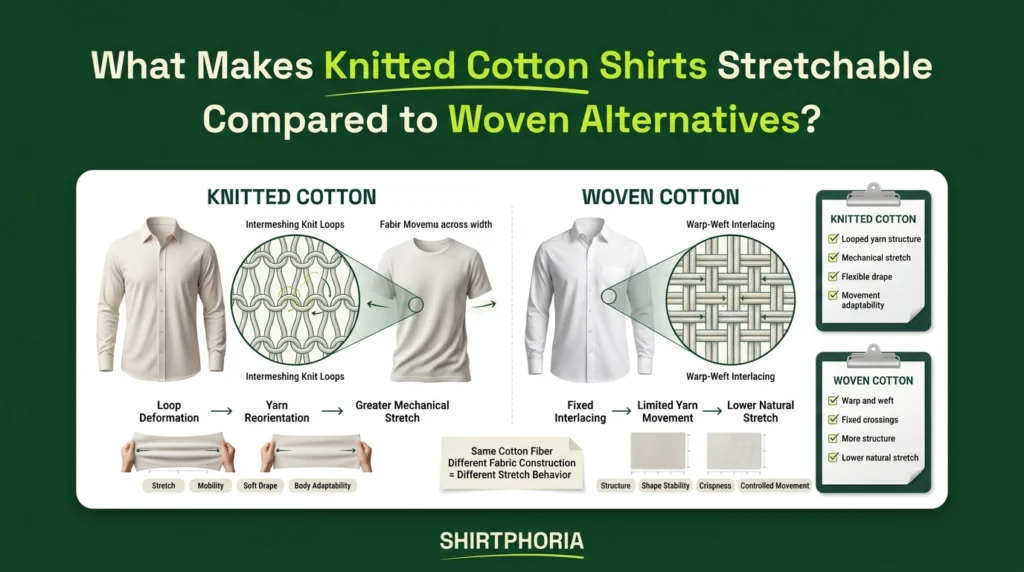
Knitted cotton shirts usually stretch more readily than conventional woven cotton shirts because knitting bends yarn into intermeshed loops that can change shape under tension, while woven construction restrains relatively straighter warp and weft yarns through repeated interlacing.
The key difference is structural.
Intermeshed loops → geometric movement → greater natural extension
Compared with:
Warp and weft interlacing → greater yarn restraint → generally lower natural extension
Much of the natural stretch in a 100% cotton knit comes from the geometry of the fabric rather than from cotton behaving like a highly elastic fiber. The loops can open, rotate, and change dimensions as force is applied.
Conventional woven cotton is not completely rigid. Yarn crimp, bias deformation, looser construction, mechanical stretch engineering, and elastic fibers can all increase its extensibility. The comparison therefore describes a general tendency under otherwise comparable construction conditions, not a rule that every knit must stretch more than every woven fabric.
Why Are Knitted Cotton Shirts More Stretchable Than Woven Cotton Shirts?
Knitted cotton shirts are generally more stretchable than conventional woven cotton shirts because their yarns follow curved, intermeshed loop paths that can deform under tension, while woven warp and weft yarns are held within a more restrained interlaced grid.
Knitting gives the yarn more geometric freedom before significant yarn elongation is required.
How Does Knitting Store More Movable Yarn Inside the Fabric?
Knitting stores movable yarn inside the fabric by bending yarn into curved loop paths that provide geometric reserve for dimensional change.
A relaxed knit loop does not follow a straight path. The yarn bends through the stitch structure.
When the fabric is pulled, some of this curved structure can open and reorient. The fabric can therefore become wider or longer without requiring the cotton yarn itself to lengthen by the same amount.
Curved knit loops → provide → structural extension capacity
This geometric reserve is one of the main reasons knitted cotton fabrics can feel naturally flexible.
Why Does Woven Construction Restrain Yarn Movement More Strongly?
Woven construction generally restrains yarn movement more strongly because lengthwise warp yarns and widthwise weft yarns repeatedly interlace within a comparatively constrained grid.
Warp forms one yarn direction. Weft forms the other.
Their repeated crossover relationships restrict how freely individual yarns can rearrange relative to the larger loop shapes found in knitting.
Under comparable construction conditions:
Warp-weft interlacing → increases → structural yarn restraint
That does not mean woven fabric cannot deform. Its extension simply occurs through different mechanisms and is often more limited in the warp and weft directions.
How Does Structural Freedom Improve Cotton-Shirt Movement?
Greater loop mobility can improve shirt movement because the knitted fabric can expand and conform as body dimensions change during motion.
This matters around areas such as the:
- chest,
- shoulders,
- sleeves,
- upper back,
- waist,
- and torso.
When you raise an arm, rotate your torso, bend your elbow, or expand your chest, the fabric needs to accommodate temporary dimensional changes.
A knitted structure can respond by deforming its loop network.
Why Is Greater Extensibility Different From Greater Stability?
Greater extensibility and dimensional stability are different performance properties, so a fabric can provide substantial movement without automatically providing strong recovery or long-term shape retention.
Three concepts should remain separate:
Extensibility: how readily and how far the fabric can extend.
Recovery: how effectively it returns after the force is removed.
Dimensional stability: how effectively it maintains intended dimensions through wear, relaxation, laundering, and other influences.
A knit can extend substantially yet recover incompletely.
The central comparison is therefore:
Intermeshed loops → greater geometric deformation potential → generally greater natural fabric extension
Compared with:
Warp/weft interlacing → greater structural restraint → generally lower natural extension under comparable conditions
Recovery and dimensional stability still depend on yarn, construction, finishing, relaxation, and use.
What Is the Looped Structure That Gives Knitted Cotton Shirts Their Stretch?
The stretchable structure of knitted cotton shirts consists of intermeshed yarn loops arranged into horizontal courses and vertical wales, with each stitch providing geometric freedom that can be redistributed under tension.
CottonWorks describes the fundamental knit structure through knit basics, including loops, courses, wales, stitch components, tuck stitches, floats, and stitch length.
What Does Knitting Mean Structurally?
Knitting creates fabric by forming yarn into loops and intermeshing those loops with neighboring stitches rather than crossing two independent yarn systems as weaving does.
This distinction is fundamental.
A woven fabric is constructed mainly from two intersecting yarn systems.
A knitted fabric is constructed from connected loops.
Because those loops contain curved sections that can change shape, a knitted structure normally has more natural geometric mobility.
What Are Courses in Knitted Cotton Fabric?
Courses are horizontal rows of knit stitches and provide the primary structural reference for coursewise deformation in common weft-knit cotton fabrics.
If you examine a typical T-shirt knit, courses travel across the fabric.
They help define the direction often described as coursewise or widthwise.
Many common weft knits can extend substantially in this direction, although the exact stretch behavior depends on the construction.
What Are Wales in Knitted Cotton Fabric?
Wales are vertical columns of interconnected stitches and provide the main reference for walewise or lengthwise structural behavior.
They run perpendicular to the courses.
The wale direction helps describe how the fabric behaves vertically or lengthwise, but its extension does not have to match the course direction.
Which Parts of a Knit Loop Create Geometric Freedom?
Curved stitch sections such as the loop legs and crown create geometric freedom because their shape and orientation can change when tension is applied.
The loop legs form the side portions of the stitch.
The crown, sometimes called the head, forms a curved part of the loop.
These components do not stay geometrically fixed when the fabric is loaded. Their curves can open and reorient as the connected knit structure deforms.
Why Is Knit Construction Different From Cotton Composition?
Knit construction and cotton composition describe different aspects of a shirt because cotton identifies the fiber material while knitting identifies how the cotton yarn is structurally arranged.
The distinction is:
Cotton = fiber material
Yarn = strand made from fibers
Knit = structural arrangement of yarn
This is why two shirts labeled 100% cotton can behave very differently.
One can be knitted and naturally extensible, while another can be woven and comparatively restrained.
| Structural Term | Meaning | Role in Stretch |
|---|---|---|
| Loop | Curved intermeshed yarn unit | Changes geometry under tension |
| Course | Horizontal row of loops | Reference for coursewise deformation |
| Wale | Vertical column of loops | Reference for walewise deformation |
| Stitch length | Yarn length contained within a stitch | Influences loop size, tightness, and deformation potential |
| Weave interlacing | Warp/weft structural relationship | Restrains yarn rearrangement relative to knit loops |
How Do Knit Loops Physically Stretch a Cotton Shirt?
Knit loops stretch a cotton shirt primarily by changing geometry. Curved yarn paths open, rotate, redistribute loop dimensions within the connected stitch network, and become progressively straighter as tension increases.
The process happens through structural rearrangement before yarn elongation becomes the dominant requirement.
How Do Knit Loops Open Under Tension?
Knit loops begin extending when tension causes their relaxed curved paths to open and become less compact.
Think of the relaxed loop as a curved yarn path with unused geometric movement available inside its shape.
When force is applied:
Applied tension → opens → curved knit loops
The fabric can therefore expand before large elongation of the cotton yarn itself is necessary.
How Do Knit Loops Rotate Toward the Direction of Force?
Knit loops can rotate and reorient toward the direction of applied force, allowing the connected stitch network to accommodate dimensional change.
The loop structure is interconnected, so movement in one part affects neighboring stitches.
As the fabric is pulled, portions of the loop can shift their orientation toward the loading direction.
This contributes to visible fabric extension.
How Is Yarn Redistributed Between Neighboring Loop Segments?
During deformation, connected stitches can redistribute yarn path and loop dimensions within the knit network rather than behaving as completely isolated loops.
This does not mean yarn moves freely through the entire fabric.
Instead, tension changes how the available yarn path is geometrically distributed through neighboring connected stitch segments.
One part of a loop may become more extended while another changes its curvature.
Why Does the Yarn Path Become Straighter as Stretch Increases?
The yarn path becomes progressively straighter as loops open because more of the curved geometric reserve has already been used to extend the fabric.
At the beginning of deformation, substantial structural movement can occur through loop opening.
As extension continues, less unused loop curvature remains.
The fabric gradually approaches a point where additional extension requires greater resistance to be overcome.
What Limits Further Knit Stretch?
Further knit stretch becomes increasingly limited once much of the available loop geometry has been used because additional extension depends more heavily on yarn elongation, fiber behavior, stitch resistance, and overall fabric construction.
Natural knit stretch is therefore finite.
The sequence can be summarized as:
Relaxed loop → tension → loop opens → loop reorients → loop dimensions redistribute → yarn path straightens → structural extension limit approaches
Cotton yarn itself can elongate, but that is different from the early geometric deformation of the knit structure.
Why Do Many Common Weft-Knit Cotton Shirts Stretch More Across Their Width?
Many common weft-knit cotton shirts show substantial coursewise or widthwise extensibility, although the dominant stretch direction depends on stitch structure, yarn, stitch length, gauge, density, finishing, seams, and test conditions.
Widthwise dominance is a common tendency in many weft knits, not a universal law.
Why Do Many Weft Knits Extend Readily Across the Course Direction?
Many weft-knit structures can extend readily across the course direction because their loop geometry permits substantial lateral reorientation and opening under tension.
This is one reason common T-shirt fabrics can often be pulled sideways relatively easily.
The loops can rearrange across the course direction as force is applied.
However, a different stitch architecture can produce different directional behavior.
How Does Widthwise Stretch Change Shirt Dimensions?
Widthwise loop deformation allows a knitted shirt to expand across garment zones such as the chest, waist, sleeves, and upper back.
This expansion helps the fabric accommodate temporary changes in body dimensions.
For example, chest circumference changes during breathing and arm movement, while shoulder and back dimensions change as the arms move forward.
The loop network can deform to accommodate some of this movement.
Why Are Widthwise and Lengthwise Stretch Often Different?
Widthwise and lengthwise stretch often differ because loop orientation, stitch architecture, and structural restraint are not identical along the course and wale directions.
Directional behavior can be affected by:
- stitch structure,
- stitch length,
- knitting gauge,
- yarn properties,
- course density,
- wale density,
- finishing,
- seams,
- and test conditions.
This is why a universal statement such as “knits always stretch twice as much sideways” would be unreliable without specifying the fabric.
How Can Warp-Knit Behavior Differ From Common Weft Knits?
Warp-knit fabrics organize loops differently from common weft knits, so their directional deformation can differ from the coursewise stretch patterns often associated with T-shirt structures.
The distinction matters because “knitted” describes a broad family of textile structures.
Not every knit has the same loop orientation or directional extensibility.
| Direction | Structural Reference | Common Weft-Knit Tendency |
|---|---|---|
| Coursewise / widthwise | Along courses | Often substantial extension |
| Walewise / lengthwise | Along wales | Often different or more restrained, depending on structure |
| Diagonal | Across both references | Combined structural deformation |
These are tendencies rather than a universal stretch ranking.
How Does Woven Construction Limit Stretch Compared With Knitted Cotton Shirts?
Conventional woven construction generally limits natural extensibility because relatively straight warp and weft yarns are repeatedly restrained through interlacing, leaving less geometric freedom for dimensional expansion than intermeshed knit loops.
Woven fabric can still extend, but it uses different structural mechanisms.
How Do Warp-and-Weft Intersections Restrict Woven Stretch?
Warp-and-weft interlacing restricts woven stretch by organizing neighboring yarns within a grid that limits structural rearrangement relative to most knit-loop systems.
Each warp yarn repeatedly crosses weft yarns.
Those intersections restrain independent yarn movement and reduce the amount of geometric reorganization available in the main yarn directions.
Why Are Woven Yarn Paths Straighter Than Knit Loops?
Woven yarn paths are relatively straighter than knit loops because they contain crimp around interlacing points rather than the larger intermeshed loop curves found in knitted structures.
A woven yarn is not perfectly straight.
It moves over and under opposing yarns, creating a wavy path called crimp.
However, this geometry generally contains less structural reserve than the larger curved loop paths found in knitting.
How Does Crimp Straightening Allow Limited Woven Extension?
Woven fabrics can extend modestly when yarn crimp straightens under tension, allowing some structural movement without using the same loop-deformation mechanism as knitting.
As the fabric is loaded, the waviness around crossover points can decrease.
This permits limited extension before greater yarn elongation becomes necessary.
Why Can Woven Fabric Move More on the Bias?
Woven fabric can deform more readily on the bias because diagonal loading allows warp and weft yarns to rotate and distort the grid relative to their normal orthogonal orientation.
The bias lies diagonally across the warp and weft directions.
When force is applied diagonally, the originally square or rectangular grid can distort toward a diamond-like shape.
This is different from the opening and reorientation of knit loops.
How Can Engineered Stretch Wovens Change the Comparison?
Engineered stretch wovens can reduce or reverse the default comparison when elastic fibers, mechanical-stretch engineering, open structures, or other construction choices provide substantial extension.
CottonWorks demonstrates this exception through its natural stretch technology for mechanically engineered 100% cotton woven fabrics.
The practical rule is:
Conventional knit vs. conventional woven → knit generally provides greater natural extensibility
But:
Engineered stretch woven vs. restrained knit → the result can differ
Elastane is one way to increase woven extension, but it is not the only method.
| Feature | Knitted Cotton | Conventional Woven Cotton |
|---|---|---|
| Yarn arrangement | Intermeshed loops | Interlaced warp + weft |
| Main natural stretch mechanism | Loop deformation | Crimp straightening + grid movement |
| Structural yarn freedom | Generally greater | Generally lower |
| Natural extensibility | Generally higher | Generally lower |
| Body conformity | Often greater | Often more structured |
| Recovery | Must be evaluated separately | Must be evaluated separately |
| Dimensional stability | Construction-dependent | Often greater structural restraint, but not guaranteed |
How Do Different Knit Structures Change Cotton-Shirt Stretch?
Different knit structures produce different stretch behavior because changing the arrangement of knit, tuck, and float elements changes how freely the stitch network can deform.
The word knitted does not describe one fixed stretch level.
How Stretchable Is Single Jersey?
Single jersey commonly provides substantial natural extensibility and conformity because its basic interconnected stitch structure permits considerable geometric deformation.
It is one of the most familiar constructions used in cotton T-shirts.
Its loop network provides a useful baseline for understanding other knit structures.
Actual extension still varies with yarn, stitch length, gauge, density, finishing, and other construction variables.
Why Does Rib Knit Stretch Strongly Across Its Width?
Rib knit can provide strong widthwise extension because alternating face and back wales can open apart from their more compact relaxed arrangement when tension is applied.
In a relaxed rib, some wales sit behind neighboring wales.
As widthwise force is applied, the structure can unfold and open.
Compact rib-wale arrangement → opens under tension → strong widthwise extension potential
This is why rib structures are commonly used in:
- neckbands,
- cuffs,
- waistbands,
- and fitted garment zones.
Different rib ratios do not behave identically.
Why Is Interlock Generally More Stable?
Interlock is generally more structurally stable than basic single jersey because its interconnected double-knit architecture produces a more substantial and restrained fabric system.
Interlock can still extend.
Its extension is simply more controlled than many lightweight single-jersey constructions.
Its double-knit structure also gives it different thickness and dimensional behavior.
How Can Tuck Stitches in Common Pique Constructions Modify Stretch?
Many common pique constructions incorporate tuck stitches, and these altered stitch relationships can change fabric width, thickness, surface texture, directional extensibility, and recovery.
Pique should not be treated as one universal structure.
Many polo-shirt pique fabrics use tuck relationships, but different pique constructions can arrange stitches differently.
The tuck mechanism changes the normal stitch network and therefore changes how the fabric deforms.
Why Can Float-Containing Knits Be Less Extensible?
Float-containing knit structures can be less extensible in a given direction because floated yarn segments follow straighter paths that can restrict the loop network compared with freely deformable knit stitches.
A float skips normal loop formation across part of the structure.
The straighter segment can therefore impose additional restraint in a particular direction.
Its effect depends on the location and arrangement of the floats.
| Knit Structure | Structural Feature | Relative Stretch Tendency | Common Shirt Context |
|---|---|---|---|
| Single jersey | Basic interconnected stitches | Moderate to high potential | T-shirts |
| Rib | Alternating face/back wales | Often high widthwise potential | Collars, cuffs, fitted zones |
| Interlock | Interconnected double-knit structure | Moderate / controlled | Substantial knit shirts |
| Pique / tuck-based construction | Modified stitch relationships | Structure-dependent / controlled | Polo shirts |
| Float-containing knit | Straighter floated sections | Can reduce extension in relevant direction | Patterned / structured knits |
Exact behavior also depends on stitch length, gauge, density, yarn, finishing, relaxation, and fabric specifications.
What Construction Variables Modify the Stretch of Knitted Cotton Shirts?
The stretch of knitted cotton shirts is modified by stitch length, gauge, structural density or tightness, yarn characteristics, and finishing because these variables interact with the knit architecture to change loop mobility.
No single variable predicts stretch by itself.
How Does Longer Stitch Length Affect Stretch?
Increasing stitch length generally creates larger, less tightly constrained loops and can increase deformation potential, but its effect on measured stretch and recovery depends on knit structure, yarn, gauge, direction, density, and finishing.
Stitch length describes the amount of yarn contained in a stitch.
Increasing that amount can produce a looser loop geometry.
The effect should not be simplified into a universal rule that longer stitches always produce greater stretch.
How Does Shorter Stitch Length Restrict Stretch?
Shorter stitch length generally increases structural tightness, which can restrict loop deformation under otherwise comparable construction conditions.
Tighter loops have less geometric freedom available for opening and rearrangement.
However, yarn properties, stitch structure, gauge, density, and stretch direction can alter this relationship.
How Does Knitting Gauge Modify Stretch?
Knitting gauge modifies stretch indirectly by influencing stitch size, spacing, and the overall architecture that results when gauge interacts with yarn size and stitch length.
Gauge broadly refers to the fineness or spacing of the knitting system.
A finer gauge does not automatically mean lower or higher stretch.
The important factor is how gauge combines with yarn dimensions and loop geometry to create the final structure.
How Does Fabric Density Affect Loop Mobility?
Greater structural tightness or density can reduce loop mobility under otherwise comparable conditions, but the result depends on which density measure is used and how it interacts with stitch length, yarn, and knit structure.
Several different measurements can be involved:
- course density,
- wale density,
- stitch density,
- fabric tightness,
- and mass per unit area.
These terms should not be used interchangeably.
A heavier fabric, for example, does not automatically have the same structural characteristics as a fabric with greater stitch density.
How Do Yarn Characteristics Modify Knit Stretch?
Yarn characteristics modify knit stretch because yarn count, twist, ply, fiber blend, and intrinsic yarn mechanics affect how the loop structure responds under load.
Two fabrics with similar loop geometry can behave differently if their yarns differ.
Important yarn variables include:
- yarn count,
- twist,
- ply,
- fiber composition,
- elongation,
- and elastic behavior.
The fabric response is therefore the result of both structure and material.
How Can Finishing Change Knit Stretch and Stability?
Finishing can preserve, reduce, or stabilize knit mobility by altering relaxation, shrinkage, width, growth, and dimensional behavior.
A knitted fabric can change after knitting as internal stresses relax or as processing modifies its dimensions.
Finishing is therefore one part of the final stretch and stability system.
The complete relationship is:
Knit structure + stitch length + gauge/tightness + structural density + yarn properties + finishing + relaxation/wear history → realized stretch and recovery behavior
This is an interacting system, not a standardized equation.
Why Are Stretch and Recovery Different in Knitted Cotton Shirts?
Stretch and recovery are different properties because stretch describes how far a fabric extends under load, while recovery describes how effectively it returns toward its original dimensions after that load is removed.
A shirt can stretch easily without snapping completely back into its previous dimensions.
Why Does Much of Natural Cotton-Knit Stretch Come From Loop Geometry?
Much of the natural extension in a 100% cotton knit can come from loop geometry because the fabric can substantially rearrange its curved stitch paths before large yarn or fiber elongation is required.
The knit structure therefore creates fabric-level extensibility even though cotton itself is not functioning like a high-performance elastic fiber.
Cotton yarn can elongate, but that is a separate mechanism.
How Is Fabric Stretch Different From Fiber or Yarn Elongation?
Fabric stretch describes dimensional expansion of the textile structure, while fiber or yarn elongation describes actual lengthening of the material forming that structure.
Consider a curved loop.
If the loop opens and becomes wider, the fabric dimension changes even if the yarn itself has lengthened only slightly.
This explains how structural fabric extension can be much greater than the material elongation needed at the beginning of the process.
What Is Elastic Recovery?
Elastic recovery is the ability of a stretched fabric to return toward its original dimensions after the applied force is removed.
The distinction is:
Stretch = extension under load
Recovery = return after load removal
These properties must be evaluated separately.
A fabric that extends easily does not necessarily recover strongly.
Why Can 100% Cotton Knits Grow or Sag?
A 100% cotton knit can be highly extensible yet recover imperfectly, allowing repeated or prolonged loading to contribute to growth, bagging, sagging, or localized distortion.
Possible effects include:
- elbow deformation,
- neckline distortion,
- localized bagging,
- fabric growth,
- or loss of original dimensions.
These are possible outcomes, not unavoidable characteristics of every cotton knit.
Construction and finishing strongly influence the result.
How Does Elastane Change Recovery?
Elastane can substantially increase elastic restoring force and recovery potential while working alongside the geometric mobility already provided by the knit structure.
The knit loops still provide the basic structural deformation mechanism.
Elastane adds greater elastic force that can help the stretched fabric return.
This can improve:
- snap-back,
- shape retention,
- close-fitting performance,
- and recovery after repeated movement.
Why Can Elastane Percentage Alone Not Predict Stretch?
Elastane percentage alone cannot predict finished stretch and recovery because knit structure, yarn construction, stitch length, gauge, elastane placement, fabric density or tightness, and finishing also influence the result.
Two fabrics with the same fiber percentages can therefore behave differently.
The complete construction must be considered.
A useful concept separation is:
Loop geometry → major source of structural extensibility
Loop recovery + yarn/fiber mechanics + construction + finishing → recovery behavior
Elastane → substantially increases elastic restoring force and recovery potential
How Does Knit Stretch Affect the Fit and Movement of Cotton Shirts?
Knit stretch can improve movement and conformity because deformable loops allow the fabric to expand as body dimensions change during shoulder movement, arm bending, torso rotation, and chest expansion.
This translates structural fabric mechanics into practical garment behavior.
How Do Knitted Cotton Shirts Follow Body Movement?
Knitted cotton shirts follow body movement by allowing their loop structure to deform as the wearer’s dimensions change during motion.
The fabric can respond to:
- shoulder movement,
- arm bending,
- torso rotation,
- and chest expansion.
The loops change geometry rather than requiring the garment to resist every temporary dimensional change.
Why Can Knit Shirts Require Less Extra Ease for Movement?
Stretchable knit fabrics can permit less positive ease, and in purpose-designed close-fitting garments sometimes zero or negative ease, when the fabric’s measured extension, recovery, weight, structure, and intended fit support that pattern decision.
Ease describes the relationship between garment dimensions and body dimensions.
Positive ease means the garment is larger than the corresponding body measurement.
A stretchable garment can sometimes function with less extra room because the fabric itself provides movement capacity.
However, the word knit alone does not determine appropriate ease.
Why Can Knits Support Closer-Fitting Shirts?
Knitted cotton can support closer-fitting garments because fabric conformity can accommodate movement while remaining near the body’s changing dimensions.
The fabric can expand when needed and relax when tension is reduced.
Comfort still depends on recovery, pressure, fit, garment design, seams, fabric weight, and other variables.
A close-fitting knit is therefore not automatically comfortable.
What Is the Tradeoff Between Stretch and Structure?
The stretch-versus-structure tradeoff describes competing design priorities rather than a universal inverse law. Greater knit conformity can improve movement, while recovery, dimensional stability, crispness, and shape retention depend on additional construction variables.
Potential characteristics of a highly conforming knit can include:
- less crisp structure,
- greater visibility of body contours,
- greater reliance on recovery,
- and possible growth where recovery is limited.
Conventional woven restraint provides a different performance profile rather than automatically higher quality.
The relationship is:
Greater structural extensibility → greater movement and conformity potential
Greater structural restraint → greater defined-shape potential
Recovery and dimensional stability → must be evaluated separately
How Can You Test Stretch and Recovery in Knitted and Woven Cotton Shirts?
Stretch and recovery can be screened qualitatively by applying gentle, comparable tension in multiple fabric directions and observing both extension and return after release.
This is a consumer screening method, not a standardized laboratory stretch or recovery test.
A hand-pull test should not be converted into laboratory percentages or standardized performance ratings.
How Should Widthwise Stretch Be Tested?
Widthwise stretch can be screened by applying gentle, controlled tension across a small comparable section of fabric and observing how readily it extends.
Observe:
- how easily extension begins,
- how much relative movement appears,
- and whether resistance increases as the fabric extends.
Avoid aggressive pulling that could distort or damage the garment.
How Should Lengthwise Stretch Be Compared?
Lengthwise stretch can be screened using similar gentle tension so the reader can compare directional deformation without assuming one direction must dominate.
Use approximately comparable force in both directions.
The purpose is not to produce a percentage.
It is simply to observe whether one direction appears more structurally extensible than another.
How Should Recovery Be Evaluated After Release?
Recovery can be screened after release by observing how quickly and how completely the fabric appears to return toward its original dimensions.
Observe whether it:
- returns quickly,
- returns gradually,
- returns only partly,
- or remains visibly distorted.
This remains a qualitative observation.
How Should Knit and Woven Shirts Be Compared Under Similar Conditions?
Knit and woven shirts should be screened under as similar conditions as practical so differences in extension, directional behavior, recovery, conformity, and distortion are interpreted more meaningfully.
Compare:
- ease of extension,
- relative extension,
- directional behavior,
- apparent recovery,
- surface distortion,
- and conformity.
Do not pull one fabric aggressively and the other gently and then treat the result as a meaningful comparison.
Why Must Fiber Composition Be Checked Before Explaining the Result?
Fiber composition should be checked before attributing observed stretch entirely to fabric construction because elastane and other elastic components can materially change extension and recovery.
Look at the garment’s composition label.
Remember:
Structure = one contributor
Fiber and yarn composition = another contributor
A cotton-elastane knit should not be interpreted as though all of its behavior comes from cotton loop geometry.
How Should the Results Be Interpreted?
High natural extensibility / strong apparent recovery: The fabric extends readily and appears to return close to its starting shape after gentle screening.
High extensibility / limited apparent recovery: The fabric extends readily but remains partly enlarged or distorted after release.
Low extensibility / structurally restrained: The fabric shows relatively limited deformation under comparable gentle screening.
Indeterminate: Structure, fiber composition, loading conditions, garment seams, finishing, or inconsistent comparison conditions prevent a meaningful interpretation.
An indeterminate result is more accurate than forcing a conclusion from poor evidence.
Which Cotton-Shirt Structure Better Fits Stretch, Recovery, and Stability Priorities?
Knitted cotton generally better suits priorities centered on natural extensibility, conformity, and freedom of movement, while conventional woven cotton generally better suits priorities centered on structural restraint and a defined silhouette.
These are directional tendencies for conventional constructions, not universal rankings.
| Priority | Knitted Cotton Shirt | Conventional Woven Cotton Shirt |
|---|---|---|
| Natural extensibility | Generally higher | Generally lower |
| Body conformity | Often higher | Usually more structured |
| Widthwise movement | Often substantial in many weft knits | Usually more limited |
| Crisp shape | Usually lower | Generally higher potential |
| Dimensional stability | Construction-dependent | Often greater structural restraint, but not guaranteed |
| Structural stretch without elastane | Strong natural advantage in many knits | Usually limited, though engineered exceptions exist |
| Recovery after extension | Variable; evaluate separately | Recovery cannot be inferred from weave alone |
| Close fit with movement | Often well suited where stretch and recovery support it | Usually requires additional ease or stretch engineering |
| Structured appearance | More conforming | Generally better suited |
When Should a Knitted Cotton Shirt Be Chosen?
A knitted cotton shirt is generally better suited when natural movement, body conformity, flexible comfort, and structural extensibility are primary priorities.
Its loop architecture is particularly useful when the fabric needs to accommodate changing body dimensions.
The main priorities are:
- natural stretch,
- conformity,
- freedom of movement,
- and flexible comfort.
Recovery should still be checked separately.
When Should a Woven Cotton Shirt Be Chosen?
A conventional woven cotton shirt is generally better suited when structural restraint, a defined silhouette, lower natural extensibility, and crispness are primary priorities.
Its warp-and-weft architecture generally resists geometric rearrangement more strongly than a typical knit loop system.
This is a performance distinction, not a statement that woven fabrics are automatically higher quality or more durable.
When Can Engineered Construction Override the Basic Rule?
Engineered construction can override the default knit-versus-woven tendency because stretch-engineered wovens can extend substantially while tightly constructed or highly stabilized knits can remain comparatively restrained.
When evaluating an actual shirt, consider:
- fiber composition,
- knit or weave architecture,
- tightness and density,
- yarn properties,
- finishing,
- recovery,
- and intended performance.
If these variables are unknown, the most accurate conclusion may be indeterminate.
A practical decision rule is:
Choose knit when natural movement and conformity are dominant priorities. Choose woven when structural restraint and crispness are dominant priorities. Then check construction, composition, and recovery evidence for exceptions.
What Are the Key Takeaways About Stretchable Knitted Cotton Shirts?
The key takeaway is that knitted cotton shirts are generally more naturally extensible than conventional woven alternatives because intermeshed loops provide geometric freedom that can be used under tension, while woven warp-and-weft interlacing provides greater structural restraint.
The Most Important Facts About Knitted Cotton-Shirt Stretch
☐ Knitted cotton shirts stretch mainly through loop geometry rather than unusually elastic cotton fiber behavior.
☐ Knit loops can open, reorient, redistribute loop dimensions, and become progressively straighter under tension.
☐ Fabric extensibility and yarn or fiber elongation are different properties.
☐ Conventional woven cotton generally restrains yarn movement more strongly through warp-and-weft interlacing.
☐ Many common weft knits show substantial coursewise or widthwise extensibility, but the dominant direction is not universal.
☐ Jersey, rib, interlock, pique or tuck-based structures, and float-containing knits do not stretch equally.
☐ Stitch length, gauge, structural density or tightness, yarn properties, and finishing interact to modify deformation.
☐ Stretch and recovery are separate properties.
☐ A 100% cotton knit can be highly extensible while recovering incompletely.
☐ Growth, bagging, or sagging are possible when extension is not followed by sufficient recovery.
☐ Elastane can substantially improve elastic restoring force and recovery potential but does not create the original knit-loop mechanism.
☐ Greater extensibility does not automatically mean lower dimensional stability because stability depends on the complete fabric system.
☐ Woven cotton is not completely non-stretch because crimp, bias deformation, construction openness, engineered stretch, and elastic fibers can increase extension.
☐ A hand-pull comparison is consumer screening, not standardized textile testing.
☐ The complete performance model is structure + construction modifiers + yarn/fiber mechanics + finishing → extensibility, recovery, dimensional behavior, and wearer outcome.
Practical Stretch Checklist
Frequently Asked Questions
Knitted cotton uses intermeshed loops that can open, rotate, and reorient under tension, while conventional woven cotton restrains yarn movement more strongly through warp-and-weft interlacing.
No. Much of the natural extension comes from loop geometry rather than unusually elastic cotton fiber behavior.
Stretch describes extension under load, while recovery describes how effectively the fabric returns toward its original dimensions after the force is removed.
Many common weft knits allow substantial coursewise deformation, but the dominant direction depends on the specific knit structure and construction.
Yes. Crimp straightening, bias deformation, looser construction, and mechanical stretch engineering can all increase woven extension.
No. Structure, stitch length, gauge, density, yarn construction, elastane placement, finishing, and recovery behavior also matter.
Terms Explained
| TERM | DEFINITION |
|---|---|
| Loop | A curved intermeshed yarn unit that can change geometry under tension. |
| Course | A horizontal row of knit stitches. |
| Wale | A vertical column of interconnected knit stitches. |
| Stitch length | The amount of yarn contained within a stitch. |
| Gauge | The fineness or spacing of the knitting system. |
| Crimp | The waviness of woven yarns as they pass over and under opposing yarns. |
| Extensibility | How readily and how far a fabric can extend under load. |
| Recovery | How effectively a fabric returns toward its original dimensions after load removal. |
| Dimensional stability | How effectively a fabric maintains intended dimensions through wear, relaxation, and laundering. |
| Elastane | An elastic fiber used to increase restoring force and recovery potential. |
Shirtphoria provides educational information about shirts, fabrics, construction, care, styling, and textile performance. This content is for general informational purposes only and does not guarantee specific product performance, durability, comfort, stretch, recovery, or suitability.
Conclusion
In conclusion, knitted cotton shirts are generally more stretchable than conventional woven alternatives because knitting organizes cotton yarn into flexible, interconnected loops that can change geometry under tension.
The main structural relationship is:
Intermeshed cotton-yarn loops → geometric deformation → greater fabric extension potential → greater conformity and movement potential
Natural knit extension comes primarily from loop geometry rather than unusually high cotton-fiber elasticity.
As tension is applied, loops can open, rotate, redistribute their dimensions, and progressively straighten. This allows substantial fabric extension before yarn elongation becomes the dominant mechanism.
Actual stretch still depends on the complete construction. Knit type, stitch length, gauge, structural density or tightness, yarn characteristics, finishing, and elastic fibers can all modify the result.
Stretch, elastic recovery, and dimensional stability should also remain separate concepts. A cotton knit can stretch readily but recover incompletely, while another knit can combine high extension with stronger recovery.
Conventional knits generally provide greater natural extensibility and conformity. Conventional woven fabrics generally provide greater structural restraint. Engineered constructions can override either tendency, so the actual fabric should always take priority over the general rule.
The key difference is not simply cotton versus cotton, but looped cotton construction versus interlaced cotton construction: one stores greater geometric mobility in deformable stitches, while the other organizes yarns within a more structurally restrained grid.