How Is the Interlacing Pattern Structured in Woven Cotton Shirts?
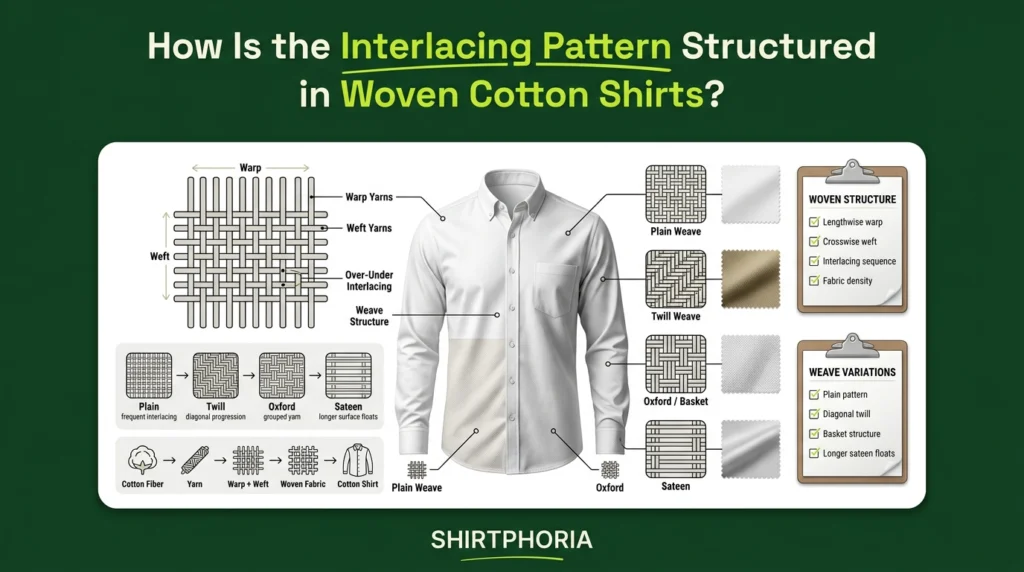
The interlacing pattern in woven cotton shirts is created by crossing two perpendicular yarn systems, warp yarns running lengthwise and weft yarns running across the fabric, in controlled over-and-under sequences that form crossover points and a repeating weave structure.
This basic relationship explains how separate cotton yarns become a continuous woven fabric. Warp and weft do not simply lie across one another. Their positions are deliberately organized so that one yarn passes over or under another according to a prescribed weave design.
The structural pathway is:
Warp + weft → controlled interlacing → crossover points → weave repeat → woven fabric structure
Woven cotton does not describe one single weave pattern. Cotton describes the fiber material, while weaving describes how yarns are constructed into fabric. Cotton yarns can therefore be arranged into plain weave, basket-derived structures such as Oxford, twill, satin or sateen, and many other woven constructions.
Weave architecture can influence yarn restraint, surface continuity, flexibility, drape, and other fabric characteristics. However, the weave does not determine every property by itself. Yarn size, yarn density, cotton fiber characteristics, fabric weight, finishing, and garment construction can all modify how the finished shirt behaves.
Why Does the Interlacing Pattern Matter in Woven Cotton Shirts?
The interlacing pattern matters in woven cotton shirts because repeated warp-and-weft crossings convert separate yarn systems into a coherent fabric network and determine how those yarns restrain, expose, and move relative to one another.
Without a controlled relationship between warp and weft, there is no stable woven architecture. The location and repetition of their intersections establish the basic structure from which different weave families are created.
How Does Interlacing Turn Separate Cotton Yarns Into Woven Fabric?
Interlacing turns separate cotton yarn systems into woven fabric by repeatedly organizing lengthwise warp yarns and crosswise weft yarns into a controlled network of structural intersections.
Warp and weft begin as different directional systems. The warp follows the fabric length, while the weft crosses its width. As the two systems repeatedly pass over and under one another, the individual yarns become part of a continuous woven structure.
The important relationship is simple:
Warp-weft interlacing → creates → coherent woven fabric
The exact arrangement of those intersections determines what type of woven structure develops.
How Do Crossover Points Restrain Warp and Weft Movement?
Crossover points restrain warp and weft movement because each interlacing location reduces the amount of independent movement available to the yarns relative to longer uninterlaced segments.
When yarns interlace frequently, they tend to restrain one another more often. When the distance between interlacings increases, longer portions of a yarn can remain uninterrupted.
Under otherwise comparable construction conditions, more frequent interlacing can therefore increase local yarn restraint.
That does not mean a fabric with more crossover points is automatically stronger, more durable, or better. Yarn properties, density, finishing, fabric weight, and construction remain important.
How Does Interlacing Establish the Structural Identity of Cotton Shirtings?
Interlacing establishes the structural identity of woven cotton shirtings because changing the order, spacing, and progression of over-under relationships creates different weave architectures.
For example:
- Plain weave uses frequent alternating crossings.
- Basket weave and Oxford structures use grouped relationships derived from plain-weave logic.
- Twill shifts interlacing positions progressively.
- Satin and sateen use more widely spaced binding points and longer floats.
All use warp and weft. What changes is how those yarn systems interact.
Why Must Cotton Material Be Separated From Weave Structure?
Cotton material must be separated from weave structure because cotton describes the fiber, yarn describes the spun strand, and weave describes how warp and weft yarns are structurally arranged within the fabric.
The distinction can be represented as:
Cotton fiber → cotton yarn → warp/weft orientation → interlacing sequence → repeating weave → woven cotton-shirt fabric
A cotton shirt can therefore use several different weave architectures even though the underlying fiber remains cotton.
Terms such as cotton, Oxford, twill, and plain weave should not be treated as equivalent classifications. They describe different levels of the fabric’s construction.
What Are Warp and Weft Yarns in Woven Cotton Shirts?
Warp and weft are the two perpendicular yarn systems in woven cotton shirts: warp yarns run lengthwise through the fabric, while weft yarns cross them widthwise.
CottonWorks explains these basic directional relationships in its guide to weaving basics.
Understanding these directions is necessary before trying to identify an interlacing pattern.
What Are Warp Yarns?
Warp yarns form the lengthwise yarn system of woven cotton fabric and are commonly called ends in textile terminology.
They extend along the length of the woven cloth and provide one of the two directional systems required for weaving.
An individual warp yarn can therefore be called a warp end.
What Are Weft Yarns?
Weft yarns form the crosswise yarn system of woven cotton fabric and are inserted across the warp as picks or filling.
Each new weft insertion adds another crosswise element to the developing fabric. In textile terminology, one inserted weft is commonly described as a pick.
Why Must Warp and Weft Intersect?
Warp and weft must intersect repeatedly because woven structure depends on controlled over-under relationships between the two directional yarn systems.
A weave design determines which yarn passes over and which passes under at different positions.
Not every geometric crossing has the same structural meaning. The important factor is the prescribed relationship created by the weave design.
How Is Yarn Direction Different From Weave Pattern?
Yarn direction identifies where warp and weft run, while weave pattern identifies how those yarns pass over and under one another through the repeating structure.
Seeing vertical and horizontal yarns therefore tells you about orientation, not necessarily the weave family.
| Structural Element | Direction / Position | Textile Term | Role in Woven Cotton Shirts |
|---|---|---|---|
| Warp | Lengthwise | Ends | Forms the longitudinal yarn system |
| Weft | Widthwise | Picks / filling | Crosses the warp to build the fabric |
| Crossover / interlacing point | Warp-weft structural relationship | Interlacing point | Helps define the weave architecture |
How Do Warp and Weft Yarns Interlace to Form Woven Cotton Fabric?
Warp and weft yarns form woven cotton fabric through a repeated sequence in which selected warp yarns create an opening for weft insertion and the prescribed over-under relationships are repeated according to the weave design.
The machinery used to accomplish this can vary, but the structural principle remains the same.
What Is a Shed in Weaving?
A shed is the temporary opening created between separated groups of warp yarns so that a weft pick can pass through the warp system.
The shed provides a controlled path for the crosswise yarn. Its formation allows the weft to enter the correct structural position relative to selected warp yarns.
How Is the Weft Inserted Through the Warp?
The weft is inserted through the open shed from one side of the fabric to the other, adding one new crosswise pick to the developing woven structure.
That pick does not enter randomly. It becomes part of the prescribed over-under sequence established by the weave design.
How Do Warp Positions Change According to the Weave Design?
Warp positions change according to the weave design because selected warp yarns must occupy different over-under relationships on successive picks.
A simple weave may alternate these relationships frequently, while more complex structures can group them, extend them, or shift their positions progressively.
How Do Crossover Points Form?
Crossover or interlacing points form according to the prescribed warp-over and weft-over relationships within the weave design.
Their distribution is one of the major structural features used to distinguish weave architectures.
Interlacing distribution → defines → weave architecture
How Does the Interlacing Sequence Build Continuous Fabric?
The interlacing sequence builds continuous fabric by repeating the prescribed warp-and-weft relationships across the width and length of the cloth.
The basic process can be summarized as:
Warp system organized → shed created → weft pick inserted → prescribed warp/weft relationship formed → structural sequence advances → repeat continues across the fabric
Repeated execution turns a small structural sequence into a full piece of woven cloth.
What Is a Weave Repeat in Woven Cotton Shirts?
A weave repeat is the smallest complete arrangement of warp ends and weft picks that contains the full interlacing sequence before that structure begins again.
A weave repeat is structural. It should not be confused with a printed graphic, decorative motif, or color pattern placed on the fabric.
What Does the Smallest Repeating Interlacing Unit Mean?
The smallest repeating interlacing unit contains the complete set of over-under relationships required to reproduce the same weave continuously.
Once every necessary warp and weft relationship has occurred, the sequence can start again.
How Does a 1/1 Plain-Weave Repeat Work?
A 1/1 plain-weave repeat alternates each warp yarn over one weft and under the next, while the adjacent warp follows the opposite sequence.
A simplified relationship looks like this:
Warp A: over 1 → under 1 → over 1 → under 1
Adjacent Warp B: under 1 → over 1 → under 1 → over 1
The alternating arrangement produces the basic checkerboard-like structure associated with plain weave.
How Do Larger Weave Repeats Create More Complex Structures?
Larger weave repeats permit more complex structures by accommodating longer floats, grouped yarn relationships, multiple over-under positions, and progressive shifts in interlacing.
A larger repeat can contain:
- longer floats,
- several consecutive over positions,
- several consecutive under positions,
- progressive interlacing shifts,
- or grouped yarn relationships.
These possibilities help create structures such as twill, satin or sateen, basket weave, and related variations.
How Is Weave-Repeat Size Different From Yarn Density?
Weave-repeat size describes the structural sequence required before the interlacing pattern repeats, while yarn density describes how closely the warp and weft yarn systems are packed within the fabric.
They are separate variables:
Weave repeat = structural sequence
Yarn density = yarn population or packing within the fabric
A large weave repeat does not automatically mean that a fabric is loose, light, open, or unstable.
How Is Plain-Weave Interlacing Structured in Cotton Shirts?
Plain-weave interlacing is structured by alternating warp and weft relationships in a regular over-one/under-one sequence, creating a frequent and highly regular crossover pattern.
Because its structure is simple and easy to follow, plain weave provides a useful baseline for understanding more complex woven architectures.
How Does the Over-1/Under-1 Sequence Work?
The basic plain-weave sequence follows an over-1/under-1 arrangement, with adjacent warp yarns reversing that sequence to create a checkerboard-like interlacing pattern.
Each yarn changes its relationship repeatedly.
Where one warp passes over a weft, the neighboring warp typically passes under it. The opposing positions repeat across the structure.
Why Does Plain Weave Have Frequent Crossover Points?
Plain weave has frequent crossover points because the warp and weft interlace repeatedly in alternating order.
The relatively short uninterrupted segments create frequent yarn-to-yarn restraint.
Under comparable construction conditions, this can contribute to strong local restraint, although final fabric behavior also depends on yarn size, yarn density, finishing, and other variables.
Why Is Plain Weave the Baseline for Understanding Other Weaves?
Plain weave provides the clearest structural baseline because warp direction, weft direction, interlacing points, and repeat logic appear in a simple alternating form.
Once this pattern is understood, other weaves can be interpreted as controlled changes in interlacing relationships. CottonWorks provides structural examples of woven fabric designs, including plain, basket, Oxford, and twill structures.
Some structures group yarns. Others shift crossover positions. Others increase the distance between binding points.
How Does Basket Weave Modify Plain-Weave Interlacing?
Basket weave modifies plain-weave logic by grouping yarns so that multiple ends or picks can act together within the over-under sequence.
Instead of every individual yarn alternating independently at every opportunity, grouped yarns can pass together over or under opposing yarns.
This changes individual crossover frequency and creates a more visibly grouped surface structure.
Basket constructions do not all use one universal grouping ratio.
How Does Oxford Interlacing Adapt the Basket Principle?
Oxford interlacing adapts basket-weave logic by grouping yarn relationships to produce a distinct shirting structure while retaining the underlying over-under architecture of the plain-weave family.
The important point is structural: Oxford uses grouped interlacing rather than the simple individual alternation seen in a basic plain weave.
Specific Oxford variants can differ, so one exact construction should not automatically be applied to every fabric carrying the Oxford name.
Why Is Weave Family Different From Finished Fabric Identity?
Weave family is only one part of finished fabric identity because yarn size, yarn color, yarn density, fabric weight, finishing, and other construction variables can distinguish fabrics that share related interlacing principles.
Names such as broadcloth, poplin, chambray, and Oxford can therefore involve more than a basic statement about weave family.
| Structure | Interlacing Logic | Structural Effect |
|---|---|---|
| Plain weave | Alternating individual over-under relationships | Frequent crossings and regular structure |
| Basket weave | Grouped over-under relationships | Reduced individual crossover frequency and more visible grouping |
| Oxford | Basket/plain-weave-derived grouped interlacing | Textured shirting structure |
How Does Crossover Frequency Change Woven Cotton-Shirt Structure?
Crossover frequency changes woven cotton-shirt structure by controlling how frequently warp and weft restrain one another: frequent interlacing increases local restraint, while fewer interlacings create longer floats and greater local yarn freedom.
Crossover frequency should not be confused with yarn density. One describes how often yarn systems bind; the other describes how closely yarns are packed.
How Does Higher Crossover Frequency Increase Yarn Restraint?
Higher crossover frequency can increase yarn restraint because more frequent warp-weft interlacings limit independent yarn movement under otherwise comparable construction conditions.
This greater restraint can contribute to structural stability and resistance to yarn displacement.
However:
More crossover points do not automatically mean a better or more durable shirt.
The finished result also depends on yarn properties, density, finishing, fabric balance, garment construction, and use conditions.
How Do Fewer Crossover Points Create Longer Floats?
Fewer crossover points create longer floats because a warp or weft yarn travels across several opposing yarns before interlacing again.
A float is therefore a section of yarn extending over or under multiple opposing yarns without binding at every crossing.
Floats are not automatically defects. Many woven structures deliberately use them.
How Can Longer Floats Increase Surface Continuity?
Longer floats can increase surface continuity because larger uninterrupted sections of yarn remain exposed between interlacing points.
This structural arrangement can contribute to:
- a smoother visual surface,
- greater flexibility,
- and increased drape potential.
These are tendencies rather than guaranteed outcomes. Yarn characteristics, yarn density, fabric weight, and finishing can substantially change the finished fabric.
What Tradeoffs Can Longer Floats Create?
Longer floats can reduce local yarn restraint, which may increase susceptibility to snagging, yarn displacement, or related structural movement under certain construction and use conditions.
The mechanism is straightforward: the longer a yarn remains unbound between intersections, the more uninterrupted length is available for local movement.
That does not mean every long-float fabric will snag, slip, or fail.
If seam slippage or yarn displacement occurs, weave architecture may be one contributing factor among others such as seam geometry, stitch variables, yarn mobility, fabric balance, and garment construction.
Why Is Crossover Frequency Different From Yarn Density?
Crossover frequency and yarn density are different variables because a fabric can contain a relatively dense yarn population while using longer floats, or a lower yarn population while using frequent interlacings.
Remember:
- Crossover frequency: how frequently warp and weft interlace.
- Yarn density: how closely yarns are packed.
Thread or yarn density should therefore not be used as a substitute for identifying weave architecture.
The structural relationship can be summarized as:
More frequent interlacing → greater local yarn restraint → generally greater structural restraint under comparable conditions
Fewer interlacings → longer floats → potentially greater surface continuity and flexibility, but reduced local restraint
How Do Plain, Twill, and Satin Interlacings Compare in Cotton Shirts?
Plain, twill, and satin/sateen interlacings differ primarily in the frequency, spacing, and progression of their warp-weft relationships: plain weave alternates frequently, twill shifts interlacing positions progressively, and satin/sateen structures use more widely spaced binding relationships and longer floats.
| Weave Family | Core Interlacing Logic | Crossover Pattern | Float Character | Typical Structural Tendency |
|---|---|---|---|---|
| Plain | Frequent alternating over-under relationships | Regular and frequent | Short | High local restraint and regularity |
| Twill | Interlacing positions shift progressively | Diagonal progression | Variable by twill design | Diagonal structure with a different restraint/flexibility balance |
| Satin / sateen | Interlacings are more widely distributed | Widely spaced | Longer | Greater surface continuity and fluidity potential |
These tendencies should be interpreted under comparable construction conditions. Yarn properties, density, fabric weight, finishing, and garment construction can change the final result.
Why Does Twill Develop a Diagonal Structure?
Twill develops a diagonal structure because successive interlacing positions shift relative to the preceding row, creating a repeated diagonal progression across the fabric.
Instead of placing each new interlacing directly above the previous one, the binding position advances across the repeat.
Progressive interlacing shift → creates → diagonal twill alignment
The precise twill ratio, direction, angle, and rib structure depend on the particular twill design.
Why Does Satin/Sateen Create Longer Surface Floats?
Satin/sateen structures create longer surface floats because their binding or interlacing positions are spaced farther apart than in a frequent-interlacing structure such as plain weave.
The greater distance between binding points leaves larger uninterrupted portions of yarn visible at the surface.
This can increase surface continuity while reducing local yarn restraint.
Different satin and sateen constructions can use different repeat structures, so they should not all be treated as mechanically identical.
Why Should the Three Weaves Be Compared Structurally Rather Than Qualitatively?
Plain, twill, and satin/sateen should be compared structurally rather than ranked as better or worse because each architecture creates a different balance of yarn restraint, float length, surface continuity, flexibility, and drape potential.
No weave is automatically the best in every shirt.
The appropriate structure depends on the desired fabric construction, and its final characteristics depend on more than interlacing alone.
How Can You Identify the Interlacing Pattern in a Woven Cotton Shirt?
The interlacing pattern in a woven cotton shirt can be evaluated by establishing the two yarn directions, tracing visible over-under relationships, and checking whether those relationships form a repeat characteristic of a known weave family.
Identification should rely on structural evidence rather than softness, weight, or appearance alone.
How Do You Identify Warp and Weft Direction First?
Warp and weft direction should be established as confidently as possible before identifying the weave because the structural sequence is easier to interpret when the two yarn systems are oriented correctly.
Possible clues include:
- fabric length and width,
- garment-panel orientation,
- seam direction,
- selvage evidence when available,
- and magnification.
Do not assume that every visually vertical yarn is automatically warp. Once fabric has been cut into shirt pieces, garment orientation can make this assumption unreliable.
If the evidence is weak, treat the direction as uncertain.
How Do You Trace One Yarn Through Successive Crossovers?
One visible yarn should be followed through successive interlacings to determine whether it alternates, groups, shifts progressively, or floats across several opposing yarns.
Look for whether the yarn:
- passes over one and under one,
- participates in grouped interlacing,
- moves through progressively shifted positions,
- or travels across several yarns as a float.
Do not classify a weave from one isolated crossover. Follow the yarn through several relationships and look for repetition.
What Structural Signatures Identify the Main Weave Families?
The dominant structural signature can indicate the likely weave family because plain, basket/Oxford, twill, and satin/sateen use different repeating interlacing arrangements.
Useful signals include:
- Checkerboard alternation: likely plain-weave family.
- Grouped alternation: possible basket or Oxford-derived structure.
- Diagonal progression: likely twill family.
- Long floats with widely spaced interlacings: possible satin/sateen family.
These are identification signals, not automatic proof.
The repeat should be traced where visibility permits.
How Do You Identify the Smallest Weave Repeat?
The smallest weave repeat is identified by tracing the structural sequence until the same arrangement of over-under relationships begins again.
When the individual yarns are visible, observe both warp and weft positions and count how many are required before the same arrangement returns.
Successfully identifying the repeat increases confidence in the classification.
Fine yarns, finishing, or garment construction can make the exact repeat difficult to see.
When Should Magnification Be Used?
Magnification is useful when fine shirting yarns make individual interlacing points difficult to distinguish at normal viewing distance.
A basic magnifier can help. A close macro photograph from a phone may also make individual yarn relationships easier to examine.
Magnification improves visibility, but it cannot guarantee that every finished shirt fabric will be identifiable.
Why Should Weave Not Be Identified From Feel or Weight Alone?
Weave should not be identified from texture, softness, or weight alone because yarn size, yarn density, cotton properties, finishing, and wear can alter how fabrics within the same structural family feel.
Avoid shortcuts such as:
- Soft ≠ automatically satin
- Heavy ≠ automatically twill
- Rough ≠ automatically plain weave
Actual yarn relationships provide stronger structural evidence.
Use three confidence levels when identifying a weave:
High-confidence identification: Warp/weft orientation, interlacing signature, and repeat are sufficiently visible and consistent.
Probable identification: A strong weave-family signature is visible, but the complete repeat cannot be traced confidently.
Indeterminate: Fine yarns, finishing, garment cutting, limited visibility, or ambiguous evidence prevent reliable classification.
When the structure cannot be seen clearly enough, leaving the result indeterminate is more accurate than forcing a classification.
What Can Disrupt the Intended Interlacing Pattern in Woven Cotton Shirts?
The intended interlacing pattern can be disrupted when a warp or weft yarn fails to follow the prescribed over-under sequence, creating unexpected structural relationships or breaks in the expected weave repeat.
An unusual visible yarn does not automatically prove that the fabric is defective. It first needs to be compared with the surrounding weave structure.
What Is an Unintended Float?
An unintended float occurs when a yarn travels across opposing yarns in a way that does not match the intended weave repeat.
If an expected interlacing is missed, a localized yarn segment can extend farther than the surrounding structure predicts.
However, long floats are normal features of certain weave architectures. Their presence alone does not establish a weaving defect.
How Can Incorrect Yarn Movement Break the Weave Repeat?
Incorrect yarn movement can break the weave repeat when a warp or weft follows a relationship that differs from the prescribed structural sequence.
One unexpected over-under relationship can interrupt an otherwise consistent repeating arrangement.
The surrounding fabric therefore provides the comparison needed to determine whether the relationship belongs to the intended weave.
Incorrect interlacing → disrupts → intended weave repeat
How Do You Distinguish an Intended Float From a Defect?
An intended float follows the repeating weave design, while a possible defect appears where the observed yarn relationship conflicts with the surrounding structural repeat.
The practical distinction is:
Intended float: deliberately part of the weave architecture.
Possible unintended float: does not match the expected repeat.
Twill, satin, and sateen naturally contain floats. A long yarn segment should therefore never be labeled defective simply because it looks unusual.
Use this as a screening rule:
If the float follows the repeating weave design → structural feature
If the float conflicts with the repeating weave design → possible weaving defect
If the repeat itself cannot be established → diagnosis remains indeterminate
What Are the Key Takeaways About Interlacing in Woven Cotton Shirts?
The key takeaway is that woven cotton-shirt structure is created by organizing lengthwise warp yarns and crosswise weft yarns into repeating over-under relationships whose crossover positions, spacing, and repeat pattern define the weave.
The Most Important Facts About Woven Cotton-Shirt Interlacing
☐ Woven cotton shirts use two perpendicular yarn systems: Warp runs lengthwise and weft runs across the fabric.
☐ Interlacing converts directional yarn systems into woven structure: Repeated warp-weft relationships organize the yarn systems into cloth.
☐ Crossover positions define yarn relationships: Their location, frequency, and progression help shape the weave architecture.
☐ The weave repeat is the smallest complete structural sequence: Once completed, the same arrangement begins again.
☐ Plain weave uses a frequent alternating pattern: Warp and weft repeatedly alternate through a simple sequence.
☐ Basket and Oxford modify plain-weave logic: Grouped yarn relationships alter the way individual interlacings appear.
☐ Crossover frequency influences yarn restraint: More frequent interlacing generally creates greater local restraint under comparable conditions.
☐ Fewer interlacings create longer floats: Longer uninterrupted yarn segments can increase surface continuity while reducing local restraint.
☐ Twill shifts interlacing positions progressively: This progression creates diagonal structural alignment.
☐ Satin and sateen use longer floats and more widely spaced binding relationships: Their structures create different surface and restraint characteristics from plain weave.
☐ Weave structure and yarn density are different variables: One describes interlacing architecture; the other describes yarn packing.
☐ Intended floats are not defects: A float is structurally correct when it follows the prescribed repeat.
☐ Weave identification should be evidence-based: Actual interlacing provides stronger evidence than texture, weight, or softness alone.
☐ Uncertain structures should remain uncertain: Do not force a weave classification when the crossover pattern or repeat cannot be observed clearly.
How Does Basic Interlacing Extend Into Twill’s Diagonal Structure?
Twill uses the same warp-and-weft interlacing system as other woven fabrics, but successive interlacing positions shift across the repeat to create diagonal structural alignment.
Instead of repeating each crossover in the same position, twill progressively displaces the interlacing relationship. Once repeated across the fabric, that progression creates the characteristic diagonal arrangement associated with the twill family.
Where Should Readers Continue to Learn About Twill Interlacing?
The next structural question is how progressive crossover shifts transform general warp-and-weft interlacing into the diagonal rib associated with twill shirts.
Analyzing the basic interlacing pattern is essential context before studying a specific weave type, such as twill diagonal rib.
Weave Identification Checklist
Frequently Asked Questions
Warp yarns run lengthwise through the fabric and are commonly called ends. Weft yarns run across the fabric and are inserted as picks or filling.
A weave repeat is the smallest complete arrangement of warp ends and weft picks that contains the full over-under sequence before the same structure begins again.
Plain weave alternates warp and weft relationships in an over-one and under-one sequence, so the two yarn systems interlace frequently and restrain one another often.
Twill shifts the position of successive interlacings across the repeat. This progressive displacement creates the characteristic diagonal structural alignment of twill.
No. Long floats are intentional features in several weave architectures, including satin and sateen. A float becomes a possible defect only when it conflicts with the expected repeating weave structure.
No. Texture, softness, and weight can be changed by yarn size, yarn density, finishing, cotton properties, and wear. Actual warp and weft relationships provide stronger structural evidence.
Terms Explained
| TERM | DEFINITION |
|---|---|
| Warp | The lengthwise yarn system in woven fabric, commonly described as ends. |
| Weft | The crosswise yarn system inserted through the warp, also called picks or filling. |
| Interlacing point | A prescribed warp-weft structural relationship where one yarn passes over or under another. |
| Shed | The temporary opening between separated warp yarns through which a weft pick is inserted. |
| Weave repeat | The smallest complete over-under arrangement that contains the full structural sequence before it repeats. |
| Float | A section of warp or weft yarn extending over or under several opposing yarns without interlacing at every crossing. |
| Plain weave | A frequent alternating over-one and under-one interlacing structure. |
| Basket weave | A plain-weave-derived structure in which yarns are grouped within the over-under sequence. |
| Twill | A weave family in which interlacing positions shift progressively to create diagonal alignment. |
| Satin / sateen | Weave structures with more widely spaced binding points and longer surface floats. |
| Yarn density | How closely the warp and weft yarn systems are packed in the fabric. |
| Crossover frequency | How often warp and weft yarns interlace within the structure. |
Shirtphoria provides educational information about shirts, fabrics, construction, care, styling, and textile performance. This content is for general informational purposes only and does not guarantee specific product performance, durability, comfort, texture, or suitability. Actual results can vary depending on materials, manufacturing quality, garment construction, use, care, and individual preferences.
Conclusion
In conclusion, woven cotton shirts are structured by systematically organizing lengthwise warp yarns and crosswise weft yarns into repeating interlacing relationships, and the location, frequency, and repetition of those relationships establish the fabric’s weave architecture.
The complete structural pathway is:
Warp + weft → controlled interlacing → crossover relationships → weave repeat → woven fabric structure → visible and functional shirt characteristics
Changing the interlacing sequence can substantially change the structure even when the fiber material remains cotton.
Crossover frequency, float length, weave-repeat size, and yarn density should always be treated as separate variables. Plain weave, basket weave, Oxford structures, twill, and satin/sateen differ because their warp and weft yarns are organized through different interlacing arrangements.
Those structural differences can influence restraint, flexibility, surface continuity, drape, and related characteristics, but weave architecture is only part of the finished fabric system. Yarn properties, yarn density, finishing, fabric weight, and garment construction can alter the final result.
The same caution applies when identifying a shirt’s weave. When the yarn direction, crossover sequence, or repeat cannot be observed reliably, the correct conclusion may simply be indeterminate.
The key to understanding woven cotton shirts is not simply knowing what yarns are present, but recognizing where they interlace, how frequently those relationships occur, how the sequence repeats, and how changing that sequence transforms the finished fabric.