What Technical Features Define a High-Performance Running Shirt?
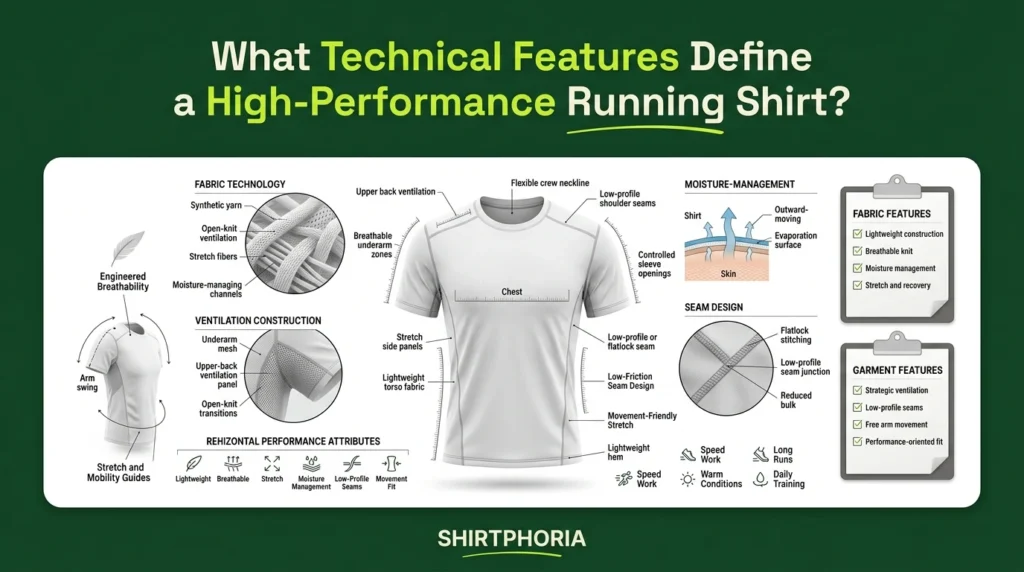
A high-performance running shirt is defined by the interaction of moisture behavior, drying rate, airflow, fit, friction control, garment stability, and durability rather than by a brand logo or one fiber percentage.
A shirt that feels lightweight when dry may still cling, chafe, retain odor, overheat, or lose shape after sweat, motion, washing, and pack contact are introduced.
For this reason, technical running shirts should be evaluated as complete garments rather than judged from a fabric label alone.
Running-shirt performance develops across several technical levels.
At the fiber level, chemistry, moisture regain, diameter, cross-section, surface characteristics, and crimp can influence behavior.
At the yarn level, filament count, Micro-Denier Yarns, twist, texturing, and capillary pathways influence how liquid and air move through the textile.
At the fabric level, knit structure, mass, thickness, porosity, liquid spreading, absorbency, Drying Rate, Air Permeability, surface friction, and chemical finishes become important.
At the garment level, fit, seam placement, hems, Body Mapping, stretch recovery, wet cling, and hydration-vest contact can change the runner’s experience.
Finally, performance depends on the runner and environment: sweat rate, skin sensitivity, intensity, duration, temperature, humidity, wind, sun exposure, and equipment all affect the outcome.
This guide explains how to assess moisture management, drying, odor control, seam construction, body mapping, fabric selection, fit, and durability through measurable evidence and practical inspection.
How Do Running-Shirt Features Affect Comfort and Performance?
Running-shirt features affect comfort by changing fabric wetness, heat and moisture exchange, garment movement, skin contact, and friction during repeated motion.
Running involves thousands of repeated arm and torso movements.
As distance increases, small garment problems can become more noticeable. A seam that feels harmless during a short fitting may create irritation after prolonged contact. A shirt that hangs correctly while dry may cling or twist when saturated.
Technical features therefore matter most when they continue working under realistic conditions.
A running shirt does not directly create speed or endurance simply because it is labeled technical.
Its more defensible role is to reduce avoidable clothing-related discomfort while supporting movement and heat-management needs.
How Do Technical Specifications Affect Long-Distance Comfort?
Technical specifications influence long-distance comfort when fabric wetness, garment mass, fit, seams, and pack contact remain stable during repeated movement.
When a shirt becomes wet, several changes can occur.
The garment may gain mass.
Fabric may cling more closely to the skin.
Wet folds can increase localized rubbing.
Seams may become more noticeable.
The shirt may bunch beneath a hydration vest.
A loose garment may flap or twist.
Heat discomfort may increase in warm weather, while dampness may feel cold when pace decreases in cool or windy conditions.
These effects can contribute to distraction and discomfort.
They should not be overstated into unsupported physiological claims.
A wet shirt does not automatically cause muscle cramps, directly create fatigue, or independently cause hypothermia.
Climate changes the interpretation.
A useful running shirt therefore needs to manage both movement and moisture in the conditions where it will actually be used.
How Can Runners Separate Testable Features from Marketing Claims?
Runners can separate testable features from marketing language by looking for disclosed fabric construction, test methods, garment weight, seam layout, fit information, and wash-durability evidence.
Technical claims can be placed into three broad categories.
Measured Claim
A strong measured claim identifies:
- A named test method
- A measurement unit
- Sample condition
- Comparison baseline
- Wash history
- Environmental conditions
For example, a drying claim is more useful when the manufacturer identifies how much water was applied, how drying was measured, and under which conditions.
Descriptive Claim
Common descriptive words include:
- Lightweight
- Breathable
- Technical
- Cooling
- Quick dry
- Anti-odor
These terms may describe a genuine feature, but they do not provide sufficient evidence by themselves.
“Breathable,” for example, could refer to Air Permeability, water-vapor transmission, garment ventilation, or simply a subjective wear impression.
Unsupported Claim
Claims deserve more caution when they promise outcomes such as:
- Guaranteed chafe-free wear
- Odor-free use for days
- Maximum wicking
- Instant cooling
- Permanent antimicrobial protection
- Race-proven performance without test disclosure
The same evidence principle applies throughout broader technical performance shirts: the useful question is not whether a marketing term sounds advanced, but which measurable property the garment actually demonstrates.
How Does Moisture Management Work in a High-Performance Running Shirt?
Moisture management in a running shirt depends on how the fabric wets, spreads liquid, transfers moisture, permits evaporation, and dries under the runner’s actual climate and activity level.
“Moisture-wicking” should not be treated as one universal performance measurement.
Several different processes can occur:
- Wetting
- Absorption
- Adsorption
- Liquid spreading
- Vertical wicking
- Horizontal wicking
- Transfer between fabric faces
- Evaporation
- Drying
- Vapor transmission
These terms describe related but different behaviors.
A fabric can perform well in one property while performing moderately in another.
What Is the Difference Between Wicking and Absorption?
Wicking describes liquid movement through capillary pathways, while absorption describes liquid entering or being retained within a material; both can occur in the same running-shirt fabric.
Capillary Action occurs when liquid moves through small spaces created within yarns or textile structures.
The process is influenced by:
- Fiber wetting characteristics
- Yarn spacing
- Filament diameter
- Knit geometry
- Fabric thickness
- Surface finishes
- Inner-versus-outer fabric construction
- Liquid volume
- Temperature
- Humidity
The fundamental relationship is:
Yarn and knit geometry → create capillary pathways → influence liquid spreading and directional transport.
Hydrophobic Fibers have relatively low affinity for water.
Hydrophilic Fibers have greater affinity for water.
However, Hydrophobic Fibers do not actively “push” sweat away from the body.
A hydrophobic polyester fabric may still transport liquid effectively because its yarn and knit construction create favorable capillary pathways or wetting gradients.
Likewise, a more absorbent material may retain some liquid within the fiber while also allowing additional liquid transport.
AATCC TM195 provides an objective framework for evaluating liquid-moisture-management behavior, including liquid spreading and transport properties rather than relying on fiber-percentage assumptions.
Source: AATCC TM195 — Liquid Moisture Management Properties of Textile Fabrics
Wicking and absorption are therefore not opposites.
They are separate properties that can interact within one fabric.
How Should Quick-Dry Technology Be Evaluated?
Quick-dry performance should be evaluated through a documented drying test rather than inferred from polyester, nylon, Micro-Denier Yarns, or fabric thinness alone.
Micro-Denier Yarns are yarns constructed from very fine filaments.
They may:
- Increase potential fiber surface area
- Change hand feel
- Create smaller capillary pathways
- Change fabric density
- Change fabric mass
- Influence moisture distribution
These effects may support useful moisture behavior, but micro-denier construction does not automatically guarantee rapid drying.
Drying depends on several variables:
- Initial water volume
- Fabric mass
- Fabric thickness
- Fiber moisture regain
- Airflow
- Temperature
- Humidity
- Fabric orientation
- Garment fit
A thin polyester shirt may dry rapidly in one environment and considerably more slowly in humid, still air.
AATCC TM201 evaluates fabric Drying Rate using a controlled heated-plate method after a prescribed amount of liquid is applied. This illustrates why a proper drying claim requires defined test conditions instead of phrases such as “dries faster than skin.”
Source: AATCC TM201 — Drying Rate of Fabrics: Heated Plate Method
Drying and wicking should therefore remain separate evaluation categories.
A fabric can spread liquid effectively without achieving the shortest Drying Rate.
How Should Evaporation and Cotton Be Interpreted in Running Shirts?
Evaporation can support body cooling during warm running, while prolonged fabric wetness may increase mass, cling, friction, or post-exercise chilling depending on the environment.
Evaporation is one of the body’s important heat-loss mechanisms during exercise.
Sweat that evaporates removes heat.
For a runner in warm conditions, this cooling can be useful.
The objective should therefore not be to eliminate evaporation.
Moisture-management fabrics instead influence where liquid accumulates, how widely it spreads, and how long the textile remains wet.
Cotton requires similar nuance.
Cotton generally has greater moisture regain and liquid absorption than polyester and often dries more slowly, but the finished garment’s behavior still depends on fabric mass, knit construction, airflow, humidity, and fit.
A cotton running shirt may be less suitable when:
- Sweat volume is high
- Rapid drying is important
- Conditions are cool and windy
- The run includes long stops
- Wet weight becomes uncomfortable
- Fabric cling creates friction
That does not mean every cotton running shirt is unsafe.
A lightweight cotton garment used for short, low-intensity exercise in suitable weather should not be treated as equivalent to prolonged wet-cold exposure.
Context determines whether retained moisture becomes a significant problem.
How Do Anti-Odor Treatments Affect Running-Shirt Wearability?
Anti-odor treatments may reduce odor development under defined conditions, but treatment chemistry, application method, laundering, drying, storage, and the wearer’s skin microbiome influence the result.
Textile odor is not simply “sweat smell.”
Odor development can involve:
- Skin secretions
- Microbial metabolism
- Retained odor compounds
- Fiber chemistry
- Fabric drying
- Detergent residue
- Storage while damp
- Laundering effectiveness
Different fabrics can therefore develop or retain odors differently even when worn during similar activity.
The terms anti-odor, antibacterial, and hygiene should also remain separate.
Antibacterial activity does not automatically prove odor reduction.
Odor reduction does not establish medical hygiene.
A treated running shirt still requires appropriate laundering and storage.
How Should Silver- and Zinc-Based Treatments Be Evaluated?
Silver- and zinc-based textile treatments should be evaluated by their named chemistry, application method, antibacterial test, odor test, and retained effectiveness after laundering.
Treatments may be:
- Incorporated into fibers
- Applied as coatings
- Deposited on fabric surfaces
- Encapsulated
- Bound through other finishing methods
A Silver-Based Finish is a treatment category, not one single chemistry.
Silver Salt, Silver Chloride, Silver Ion, metallic silver, and silver nanoparticles should not automatically be treated as identical materials.
Likewise, a Zinc-Based Finish does not automatically mean Zinc Pyrithione.
A treatment label identifies an ingredient or treatment category; it does not independently prove odor reduction, wash durability, skin compatibility, or long-term hygiene.
Useful evidence should identify:
- The chemistry
- Application method
- Relevant antibacterial test
- Relevant odor test
- Number of laundering cycles
- Performance after washing
Without this information, a silver or zinc label remains primarily descriptive.
How Do Anti-Odor Solutions Compare?
Anti-odor solutions should be compared by treatment type, intended mechanism, evidence method, laundering durability, and limitations rather than by unverified “high” or “permanent” ratings.
| Technology TypeIntended ContributionEvidence RequiredMain Limitation | |||
|---|---|---|---|
| Silver-Based Finish | May inhibit selected microorganisms or reduce bacterial-odor formation | Named chemistry, antibacterial result, odor result, and post-wash testing | Effect varies by formulation, attachment, organism, use, and laundering |
| Zinc-Based Finish | May inhibit selected microorganisms or alter odor development | Named zinc compound, application method, test result, and wash durability | Zinc compound and delivery method cannot be assumed from the label |
| Other Applied Antibacterial Finish | May reduce bacterial growth or bacterial odor under defined tests | Product-specific chemistry and relevant textile test | Antibacterial activity does not automatically prove odor reduction |
| Merino Wool or Wool Blend | May retain and release odor compounds differently from synthetic fabrics | Comparative garment or fabric testing under equivalent use | Not an applied antibacterial guarantee; performance varies by construction |
| No Applied Treatment | Relies on fiber, fabric, washing, and drying behavior | Wear and laundering comparison | May develop odor sooner under some conditions |
No row guarantees an odor-free or hygienic garment over repeated runs.
AATCC TM211 evaluates reduction of bacterial odor generated from textiles treated with antibacterial finishes under defined conditions. It provides a more relevant evidence pathway for odor claims than simply stating that a shirt contains an antibacterial ingredient.
Source: AATCC TM211 — Reduction of Bacterial Odor on Antibacterial-Treated Textiles
An antibacterial result should therefore not be automatically converted into a promise of odor-free wear.
How Should a Running Shirt Be Reused Across Multiple Runs?
Reusing a running shirt safely depends more on drying, storage, soil level, odor, skin condition, and laundering instructions than on an anti-odor label alone.
Practical care should include:
- Allowing the garment to dry fully after use
- Avoiding storage while wet in a sealed bag
- Following the care label
- Washing when visibly soiled
- Washing when persistent odor develops
- Washing when skin irritation appears
- Avoiding treatment of antibacterial finishes as replacements for laundering
No fixed number of odor-free wears can be promised across runners.
A person with a high sweat rate, humid climate, sensitive skin, or limited drying conditions may need to wash a shirt more frequently than someone using the same garment under different conditions.
For multi-day running or travel, useful priorities include:
- Rapid drying
- Practical care access
- Backup shirts
- Packability
- Documented odor-management evidence
- Skin comfort
What Running-Shirt Construction Features May Reduce Chafing Risk?
Running-shirt construction may reduce chafing risk by controlling seam profile, seam placement, garment movement, fabric bunching, wet cling, and contact beneath packs or hydration vests.
Chafing should be treated as a system rather than a seam-only problem.
Risk can involve:
- Repeated motion
- Skin moisture
- Fabric moisture
- Fabric surface
- Seam profile
- Seam placement
- Garment fit
- Salt residue
- Running duration
- Body shape
- Hydration-vest or pack contact
No shirt construction guarantees a chafe-free run.
The useful goal is to reduce avoidable sources of repeated friction.
How Can Flatlock Seams Affect Running Comfort?
Flatlock Seams can create a lower-profile joint than some conventional seam constructions, potentially reducing localized ridge pressure in high-contact zones.
Flatlock construction typically joins or flattens fabric edges into a relatively low-profile seam.
Potential benefits include:
- Reduced bulky seam allowance
- Less concentrated ridge height
- Better next-to-skin comfort
- Greater flexibility in fitted garments
However, Flatlock Seams still contain thread and texture.
They can still irritate the skin when placement, thread tension, moisture, fit, or repeated movement create unfavorable conditions.
Flatlock construction therefore may reduce seam bulk but does not eliminate friction.
Overlock Seams are also legitimate professional garment construction.
Overlock should not be treated as inherently low quality.
Comfort depends on:
- Seam allowance
- Thread
- Stitch density
- Placement
- Thread tension
- Cover stitching
- Garment fit
A carefully placed covered overlock seam may feel more comfortable in a particular garment than a poorly positioned flatlock seam.
How Should Stitch Types Be Compared for Running Comfort?
Stitch type should be inspected together with seam placement, thread texture, seam allowance, fit, and movement rather than used as an instant prediction of chafing.
| Stitching TypeTypical ProfilePotential Comfort BenefitEvaluation Boundary | |||
|---|---|---|---|
| Flatlock | Low profile with flattened or joined edges | May reduce bulky seam allowance | Does not guarantee low friction in every location |
| Overlock | Looped edge finish with internal seam allowance | Strong, flexible, and widely used | Comfort depends on seam allowance, placement, and cover construction |
| Covered Overlock | Overlock seam covered by additional stitching | May create a smoother skin-facing finish | Still requires wear testing |
| Bonded Seam | Adhesive-bonded or taped joint | May reduce thread and bulk | Can stiffen, peel, or delaminate |
| Seamless or Engineered Knit Zone | Reduces some cut-and-sew seams | May reduce specific seam-contact points | Fabric texture, fit, and zone transitions can still irritate |
The best construction is therefore the one that works with the garment pattern and the runner’s contact zones.
How Can Body Mapping Affect Ventilation and Fit?
Body Mapping uses changes in knit structure, mesh, stretch, thickness, or reinforcement to address selected heat, sweat, movement, or abrasion zones.
Different garments may place these zones in different locations.
Possible factors include:
- Shirt pattern
- Runner anatomy
- Sex-specific design
- Climate
- Running intensity
- Hydration-vest use
- Laboratory testing
- Wear testing
Mesh at the center back or underarm can be useful examples.
They should not be treated as universal requirements.
A road-racing singlet may prioritize low mass and ventilation.
A trail-running shirt worn under a hydration vest may require greater abrasion resistance across shoulders and back.
Shoulder reinforcement may therefore be relevant for:
- Trail running
- Hydration vests
- Backpacks
- Repeated strap contact
But dense shoulder panels are not automatically necessary in every running shirt.
Body Mapping can also fail.
Potential problems include:
- Mesh overstretch
- Uneven wet cling
- Abrasion where zones meet
- Poor airflow beneath a pack
- Unstable fit when saturated
Body-mapped construction should therefore be judged from the runner’s actual use case.
How Can Laser-Cut and Bonded Hems Affect Comfort?
Laser-cut and bonded hems may reduce folded bulk and weight, but their comfort and durability depend on edge softness, adhesive quality, stretch, laundering, and placement.
Potential advantages include:
- Fewer folded fabric layers
- Lower edge bulk
- Clean appearance
- Reduced weight
However, these construction methods also have potential limitations.
Possible failure modes include:
- Edge stiffness
- Curling
- Adhesive delamination
- Cracking
- Heat-damaged edges
- Reduced stretch
- Local skin irritation
A bonded hem should therefore not automatically be considered superior to a sewn hem.
The useful question is whether the edge remains soft, stable, flexible, and durable after repeated running and laundering.
How Do Technical Running-Shirt Fabrics Compare?
Running-shirt fabrics should be compared by completed-fabric construction, mass, moisture behavior, Drying Rate, airflow, durability, odor behavior, and skin feel rather than by fiber name alone.
Polyester, nylon, Merino Wool, and blends can all perform well when designed appropriately.
Their strengths and limitations vary with yarn construction, Knit Structure, fabric mass, finishes, and garment design.
| Technical Fabric TypeCommon Performance StrengthImportant Trade-OffBest-Fit Use Pattern | |||
|---|---|---|---|
| Lightweight Polyester Knit | Low fiber moisture regain and potentially rapid drying | Odor behavior, cling, durability, and airflow vary by knit and finish | High-sweat training or racing when verified by fabric data |
| Nylon or Polyamide Knit | Often soft, abrasion-resistant, and durable | Moisture regain and drying behavior vary by construction | Trail running, pack contact, or durability-focused use |
| Polyester–Nylon Blend | Can combine drying, softness, and durability | Blend percentages do not prove performance | General training when construction and fit are suitable |
| Merino Wool Blend | Moisture buffering, variable-weather comfort, and distinctive odor behavior | Higher mass, slower drying in some constructions, cost, and abrasion variation | Travel, cool conditions, or multi-day use |
| Lightweight Engineered Mesh | High airflow and low mass | Reduced sun coverage, snagging, transparency, or pack abrasion | Hot-weather running without severe pack contact |
| Elastane-Containing Blend | May support stretch and close fit | More elastane does not automatically mean better recovery | Garments requiring fitted movement and shape retention |
No fiber should receive a universal ranking.
Polyester does not always dry fastest.
Nylon does not always dry slower.
Merino Wool should not automatically be described as providing less cooling without defining the property being measured.
A garment also does not need a fixed minimum synthetic percentage to qualify as technical.
Likewise, there is no universal elastane percentage that guarantees good stretch recovery.
Completed-fabric evidence is more useful than composition thresholds.
How Can the Technical Features of a Running Shirt Be Evaluated?
A running shirt should be evaluated through documented fabric evidence, garment inspection, movement testing, wet-state observation, laundering history, and use-case compatibility.
The garment should ideally be tested under conditions similar to its intended use.
Running-Shirt Technical Evaluation Checklist
- Use-Case Check: Define the distance, pace, temperature, humidity, wind, sun exposure, sweat rate, and hydration-vest or pack use.
- Fabric-Composition Check: Record fiber percentages without treating them as direct proof of moisture or drying performance.
- Fabric-Mass Check: Record garment or fabric weight when available and compare only similar sizes and constructions.
- Moisture-Management Check: Prefer a named liquid-moisture-management method instead of relying only on “wicking” marketing language.
- Drying-Rate Check: Prefer Drying Rate data that discloses method, water volume, temperature, and sample condition.
- Airflow Check: Evaluate Air Permeability or ventilation separately from moisture transport.
- Wet-Cling Check: Observe whether damp fabric adheres excessively to the torso or restricts movement.
- Anti-Odor Check: Identify the named treatment and look for relevant odor and wash-durability evidence.
- Care Check: Confirm whether laundering, heat, bleach, or fabric softener affects the finish.
- Seam-Profile Check: Inspect seam height, allowance, thread texture, and skin-facing finish.
- Seam-Placement Check: Confirm that seams avoid known high-friction areas where practical.
- Fit Check: Confirm that the shirt does not flap excessively, constrict breathing, or create persistent folds.
- Movement Check: Test arm swing, torso rotation, bending, and normal running posture.
- Hydration-Vest Check: Inspect shoulder, side, back, and underarm contact beneath the intended vest.
- Hem Check: Evaluate edge softness, stretch, curling, and garment ride-up.
- Stretch-Recovery Check: Stretch the material within its normal use range and observe recovery without applying a universal elastane threshold.
- Wet-State Check: Repeat fit, cling, seam, and movement checks after controlled dampening.
- Laundering Check: Reassess fit, odor, finish, bonding, and recovery after the documented wash history.
- Evidence Check: Reject guarantees or numerical claims without a test method, sample condition, and comparison baseline.
Running-Shirt Diagnostic Outcomes
| OutcomeRequired EvidenceInterpretation | ||
|---|---|---|
| Hot-Weather Race Match | Low mass, suitable airflow, controlled cling, measured moisture behavior, and stable fit | Suitable for high-output warm-condition running |
| Cool-Weather Running Match | Balanced moisture handling, appropriate coverage, controlled airflow, and low wet discomfort | Suitable for cool or windy conditions within tested limits |
| High-Sweat Moisture Match | Documented spreading or transport, short drying time, stable wet fit, and low wet mass | Suitable for runners with high sweat output |
| Hydration-Vest Compatible | Stable shoulder and back construction, low seam irritation, and acceptable abrasion response | Suitable for trail or long-distance vest use |
| Chafing-Risk Concern | High seam ridge, bunching, wet cling, unstable fit, or irritation during movement | Change fit, seam placement, fabric, or garment design |
| Slow-Drying Concern | Persistent wetness under comparable drying conditions | Review construction, fabric mass, and climate suitability |
| Odor-Treatment Unverified | Treatment label exists without odor result or wash-durability evidence | Do not assume multi-run odor control |
| Bonded-Hem Durability Concern | Curling, stiffness, cracking, or delamination | Prefer another finish or verify durability |
| Poor-Recovery Fit | Sagging, twisting, ride-up, or incomplete recovery after wetting and washing | Change size, pattern, or fabric construction |
| Insufficient Evidence | Fiber percentage, brand language, or one dry hand-feel check is the only proof | Do not assign a high-performance rating |
Running-Shirt Condition Zones
Ideal Performance Zone
A running shirt is closer to its ideal performance zone when:
- The use case is clearly defined.
- Moisture and drying claims include test methods.
- Fit remains stable when dry and damp.
- Seams do not produce persistent irritation.
- The shirt does not bunch excessively.
- The garment does not flap excessively.
- Airflow matches the climate.
- Anti-odor evidence includes laundering history.
- Hems remain soft and stable.
- Hydration-vest contact does not cause significant abrasion.
- Care requirements are practical.
These conditions suggest that the garment’s technical features are aligned with the intended runner and environment.
Transition Zone
A running shirt may enter a transition zone when:
- Minor cling appears during heavy sweating.
- Drying is adequate but not particularly fast.
- One seam becomes noticeable late in a run.
- Mesh works well without a pack but becomes less effective beneath straps.
- Anti-odor evidence is limited.
- Bonded edges remain intact but feel slightly stiff.
- Fit requires one size or pattern adjustment.
A transition-zone shirt may still be suitable if these issues remain manageable.
Correction-Required Zone
A running shirt requires reevaluation when:
- Performance claims rely only on fiber percentages.
- The shirt remains heavily saturated.
- Seams repeatedly irritate the skin.
- Fabric bunches during arm swing.
- The garment flaps excessively.
- The shirt repeatedly rides upward.
- A hydration vest creates significant rubbing.
- Bonded areas peel or curl.
- An antimicrobial label lacks relevant evidence.
- Odor-free or chafe-free guarantees are used without evidence.
- Skin irritation persists.
- Product claims lack methods or conditions.
These signs suggest that garment construction, fit, or evidence quality does not match the intended use.
Error-Proof Verification Protocol
A running-shirt comparison should follow a repeatable sequence.
- Define running distance, intensity, climate, and equipment.
- Record garment size, fiber composition, and fabric construction.
- Record available garment or fabric mass.
- Identify disclosed moisture-management and drying tests.
- Identify any antimicrobial or anti-odor treatment.
- Record available wash-durability evidence.
- Inspect seam type, seam placement, and hem construction.
- Check dry fit through complete running movements.
- Test the garment with the intended hydration vest or pack.
- Apply a controlled, comparable amount of moisture.
- Recheck cling, fit, seams, transparency, and movement.
- Observe drying under comparable conditions.
- Launder according to the care label.
- Reassess dimensions, stretch recovery, odor, seams, and bonded edges.
- Select one diagnostic outcome.
- Correct one variable at a time.
- Repeat the comparison using the same conditions.
- Limit the conclusion to the tested garment and environment.
When a running shirt underperforms, isolate fabric mass, knit structure, liquid distribution, Drying Rate, airflow, wet cling, fit, seam placement, pack contact, treatment durability, and laundering before blaming the fiber name alone.
A comparison is repeatable only when shirt size, moisture amount, environment, activity, drying conditions, wash history, and evaluation criteria remain comparable.
A technical claim without a named property, test method, sample condition, wash history, and comparison baseline must be classified as insufficient evidence.
Running-Shirt Technical Evaluation Checklist
Frequently Asked Questions
No. Fiber type is only one variable. Yarn construction, knit structure, fabric mass, moisture behavior, airflow, fit, seams, and durability also determine performance.
No. Wicking describes liquid movement through capillary pathways, while drying describes how quickly moisture leaves the textile under defined conditions.
No. Flatlock seams can reduce seam bulk, but friction also depends on moisture, fit, placement, distance, body shape, fabric texture, and equipment contact.
No. Anti-odor treatments do not replace proper drying, storage, washing, and care according to the garment instructions.
Terms Explained
| TERM | DEFINITION |
|---|---|
| Micro-Denier Yarns | Yarns made from very fine filaments that can alter surface area, hand feel, capillary pathways, and fabric behavior. |
| Capillary Action | Liquid movement through small spaces created within yarns and textile structures. |
| Drying Rate | The rate at which moisture leaves a textile under specified test conditions. |
| Body Mapping | The use of different knit, mesh, stretch, thickness, or reinforcement zones to address selected heat, sweat, movement, or abrasion areas. |
| Flatlock Seam | A low-profile seam construction that can reduce bulky seam allowance in skin-contact areas. |
| Overlock Seam | A professional edge-finishing seam using looped stitching and an internal seam allowance. |
| Silver-Based Finish | A treatment category using a specific silver chemistry that requires product-specific testing for antibacterial or odor claims. |
| Zinc-Based Finish | A treatment category using a specific zinc compound whose performance depends on chemistry, application, testing, and laundering durability. |
| Wet Cling | The tendency of damp fabric to adhere more closely to the body and potentially alter comfort or movement. |
Conclusion
A high-performance running shirt is a use-case-aligned garment whose moisture behavior, drying, airflow, fit, friction control, odor management, and durability remain suitable under the runner’s intended conditions.
No brand name or fiber percentage proves performance.
Hydrophobic Fibers do not actively push water.
Wicking and Drying Rate are different properties.
Evaporation can provide useful cooling in warm conditions but may become uncomfortable when a wet runner slows down in cool or windy weather.
Cotton should be evaluated according to actual garment construction and environment rather than exaggerated moisture-capacity claims.
Micro-Denier Yarns can alter capillary pathways and fabric structure, but they do not guarantee rapid drying.
Antibacterial activity is not the same as odor reduction.
Silver-Based Finish and Zinc-Based Finish claims require product-specific chemistry and testing.
Anti-odor treatments do not replace laundering.
Merino Wool may behave differently from many synthetic fabrics in moisture and odor retention, but its behavior should not be attributed mainly to lanolin or treated as universally superior.
Flatlock Seams may reduce seam bulk, but they cannot guarantee freedom from chafing.
Overlock Seams remain a legitimate professional construction technique.
Body Mapping is garment-specific rather than a fixed formula applied to every running shirt.
Laser-cut and bonded hems can reduce bulk but also introduce stiffness, curling, cracking, or delamination.
Polyester, nylon, Merino Wool, and blends should all be evaluated as completed fabrics.
Elastane percentage alone does not determine stretch recovery.
Complete garment testing under dry and wet conditions provides more useful evidence than fabric composition or hand feel alone.
There is also no single rigid certification that makes every garment labeled “high performance” technically equivalent.
The most reliable running-shirt choice is the garment whose measured fabric behavior, fit, seam placement, wet-state comfort, and durability match the runner’s actual distance, climate, sweat rate, and equipment.