How Can a Running Shirt Support Performance Through Fit and Technical Features?
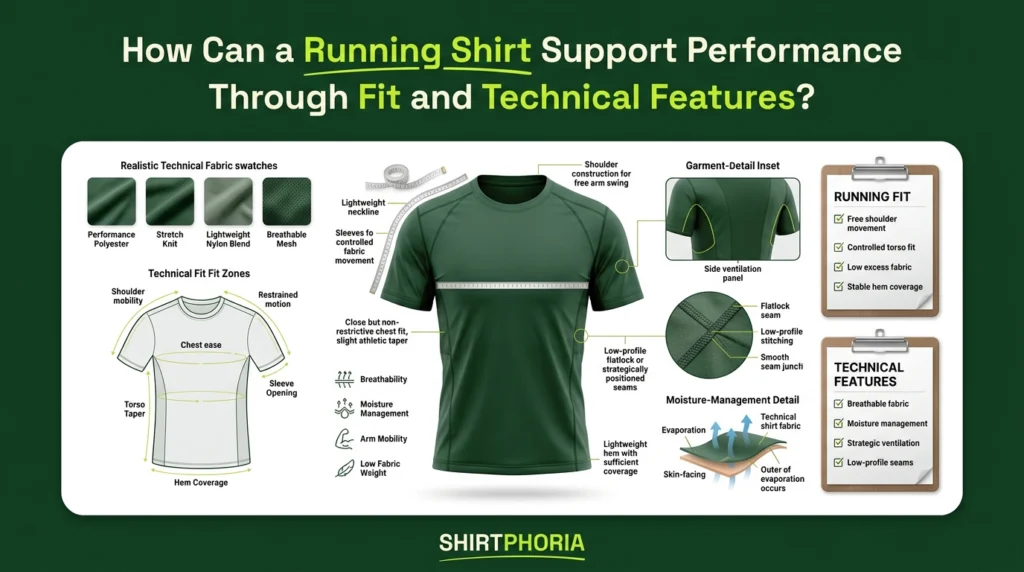
A running shirt can support performance by maintaining a stable, movement-friendly fit while managing sweat, heat, airflow, friction, and changing environmental conditions. The best design does not simply fit tightly or use a synthetic fabric; its fit, fabric construction, ventilation, seams, coverage, and moisture behavior must work together for the runner’s activity and environment.
Running generates metabolic heat and, depending on intensity and weather, substantial perspiration. Clothing sits between the skin and the environment, so the shirt can influence how heat, water vapor, liquid sweat, and air move around the body.
Research on sports clothing shows that fabric properties, moisture behavior, air permeability, garment construction, and fit can affect the clothing microclimate and thermal comfort during exercise. However, fabric specifications do not automatically translate into the same outcome for every runner or environment.
A running shirt should therefore be treated as a performance-support garment rather than a direct performance-producing device.
Its job is to reduce avoidable clothing-related problems while allowing the runner’s body to move and regulate heat effectively.
Why Does Fit Matter in a Running Shirt?
Fit matters in a running shirt because it affects movement, fabric-to-skin contact, ventilation, moisture transport, garment stability, and friction.
The ideal fit is not universally tight or universally loose.
Instead, it should remain stable enough to avoid excessive movement while giving the shoulders, arms, chest, and torso enough freedom for natural running mechanics.
A useful fit should:
- Allow unrestricted arm swing
- Avoid pulling across the shoulders
- Remain stable around the torso
- Avoid excessive fabric flapping
- Prevent the hem from repeatedly riding upward
- Maintain comfortable neck and arm openings
- Avoid restricting breathing
- Avoid unnecessary pressure
- Support the intended moisture-management design
Different running conditions can favor different levels of looseness.
A close-fitting shirt may provide stable skin contact and reduce excess material, while a looser shirt may increase air circulation around the body.
Research comparing clothing fit suggests the thermoregulatory effects are more complicated than simply saying tight is better. Tight clothing can reduce the insulating air space between skin and fabric, while looser clothing may encourage greater airflow and heat dissipation in some warm conditions. Direct research comparing fit types during exercise remains limited.
The practical goal is therefore controlled fit, not maximum tightness.
How Should a Running Shirt Fit Across the Shoulders and Arms?
A running shirt should allow the shoulders and arms to move through the running cycle without fabric tension, restriction, or repeated seam movement.
During running, the arms swing thousands of times.
A shirt that fits poorly around the shoulders can repeatedly pull across the upper back, underarms, or chest. Even a small restriction can become more noticeable over a long run.
The shoulder area should therefore allow:
- Natural forward and backward arm swing
- Comfortable elbow movement
- Torso rotation
- Full breathing expansion
- Stable seam positioning
Sleeves should also remain controlled.
A sleeve that is too tight may create pressure or friction around the upper arm. A sleeve that is excessively loose may move repeatedly and contribute to distraction or rubbing.
The exact cut can vary between a relaxed running shirt, athletic fit, sleeveless singlet, or close-fitting performance top.
What matters is whether the design stays compatible with the runner’s movement.
Should a Running Shirt Be Tight or Loose?
A running shirt should be close enough to remain stable but not so tight that it restricts movement, airflow, or comfort.
There is no universal requirement for compression.
A close athletic fit may work well when the runner wants:
- Minimal loose fabric
- Stable moisture contact
- Reduced fabric movement
- Easy layering
A regular or slightly relaxed fit may work well when the priority is:
- Greater airflow
- Reduced skin contact
- Warm-weather comfort
- Less body compression
A shirt can also fail in either direction.
Too Tight: The garment may restrict shoulder movement, feel hotter, increase pressure, or interfere with comfort.
Too Loose: Excess material may flap, shift, retain moisture against unpredictable areas, or rub repeatedly against the skin.
A study of higher-compression sports clothing found that greater compression affected clothing-physiology comfort and was associated with increased skin temperature and sweating under the study conditions. That does not mean every close-fitting shirt causes these outcomes, but it shows why tighter should not automatically be interpreted as better.
The correct fit is the one that maintains stable coverage and freedom of movement for the specific runner and conditions.
How Do Technical Fabrics Support Running-Shirt Performance?
Technical fabrics support running-shirt performance by controlling the movement of liquid moisture, water vapor, heat, and air while remaining light and flexible enough for repetitive movement.
A performance fabric should not be judged only by its fiber name.
Polyester, nylon, Merino Wool, polypropylene, and blended materials can all appear in running clothing.
Their actual behavior depends on:
- Fiber properties
- Yarn construction
- Knit geometry
- Fabric thickness
- Fabric mass
- Surface treatments
- Air permeability
- Moisture transport
- Drying behavior
- Stretch
- Garment construction
Two polyester shirts can therefore perform very differently even though their fiber labels look similar.
Modern performance shirts use these relationships between fabric technology, garment design, and intended activity to achieve different performance priorities.
How Does Moisture Management Help a Running Shirt?
Moisture management helps a running shirt by reducing concentrated wet areas and moving sweat toward locations where it can spread, evaporate, or progress through the clothing system.
Sweat management involves several related processes.
Moisture pickup occurs when liquid sweat contacts the fabric.
Wicking uses capillary pathways within yarns and fabric structures to move liquid.
Spreading distributes moisture across a larger surface area.
Evaporation converts liquid into vapor, removing heat.
Drying describes how quickly moisture leaves the textile under particular conditions.
These processes should not be treated as interchangeable.
A fabric can wick effectively but dry slowly.
Another may absorb little liquid into the fiber but still transport moisture effectively because its yarn and knit structure create strong capillary pathways.
Research on sports textiles shows that moisture management depends on fabric structure as well as fiber composition, and that breathability and moisture behavior contribute to thermo-physiological comfort.
The useful mechanism is:
Sweat contact → liquid transport and spreading → greater opportunity for evaporation when environmental conditions allow it.
However, wicking does not guarantee that a runner will stay completely dry.
During intense running, sweat production may exceed the rate at which the clothing system and environment can remove moisture.
Why Does Fast Drying Matter?
Fast drying matters because a shirt that releases retained moisture more quickly may remain lighter and more comfortable during prolonged or repeated activity.
A wet running shirt can:
- Feel heavier
- Cling differently to the skin
- Increase friction in some areas
- Change thermal sensation
- Become uncomfortable when activity stops
- Take longer to become ready for another session
Drying performance depends on more than fiber chemistry.
Important variables include:
- Amount of retained water
- Fabric thickness
- Fabric structure
- Exposed surface area
- Temperature
- Relative humidity
- Wind
- Body heat
- Airflow
- Whether another layer covers the shirt
A shirt that dries quickly in a laboratory or warm dry environment may behave differently in humid weather.
Therefore, “quick drying” should ideally be linked to a stated test rather than treated as an absolute property.
How Does Air Permeability Affect a Running Shirt?
Air permeability affects running-shirt performance by controlling how readily air can move through the textile.
Greater airflow can support heat dissipation and evaporation during activity.
However, higher Air Permeability is not universally better.
In hot weather, ventilation may be highly desirable.
In cold or windy conditions, excessive airflow may increase unwanted cooling.
The useful relationship is:
More open fabric structure → potentially greater airflow → potentially greater ventilation when the environment and garment configuration permit it.
But fabric permeability is only one part of ventilation.
Air also moves through:
- The neckline
- Sleeve openings
- The hem
- Mesh panels
- Zippers
- Loose areas of the garment
Movement itself can pump air through these openings.
This means a running shirt’s ventilation depends on both textile construction and garment design.
How Do Ventilation Zones Improve Running-Shirt Function?
Ventilation zones can improve running-shirt function by increasing air and moisture exchange in areas where heat and sweat commonly accumulate.
Designers may use:
- Mesh panels
- Open knits
- Laser-cut openings
- Thinner fabric zones
- Body-mapped knit structures
- Perforated sections
Common locations include:
- Upper back
- Underarms
- Side torso
- Chest
- Central back
These zones should not simply be added everywhere.
A very open area can reduce coverage, alter durability, change stretch, or increase cooling in windy conditions.
The value of body-mapped ventilation depends on the fabric, opening size, garment fit, running intensity, and environment.
Wear-trial research has found that ventilative designs such as mesh can affect heat and moisture transfer and thermal-comfort variables, supporting the idea that garment construction—not just fiber content—matters during exercise.
Does More Ventilation Always Improve Performance?
No. More ventilation does not always improve performance.
Running clothing must balance heat release with protection from the environment.
During a hot race, greater ventilation may help the body release heat.
During a cold, windy run, the same highly open structure may create excessive convective cooling.
This is why a runner should consider:
- Temperature
- Humidity
- Wind
- Sun exposure
- Running speed
- Exercise intensity
- Duration
- Other clothing layers
The shirt should match the environment rather than maximize one technical property.
Why Are Seams Important in Running-Shirt Design?
Seams matter because they sit directly against moving skin while the arms and torso repeat the same movements for thousands of running steps.
A poorly positioned seam can create concentrated pressure or friction.
Moisture may increase the problem by changing the way skin and fabric interact.
Performance running shirts often use:
- Flat seams
- Flatlock construction
- Bonded seams
- Reduced seam counts
- Strategically relocated seams
- Soft seam finishes
These features are mainly about comfort and friction management.
They should not be presented as major thermoregulatory technologies unless testing establishes such an effect.
How Can Seam Placement Reduce Chafing Risk?
Seam placement can reduce chafing risk by keeping bulky or raised construction away from high-movement contact zones.
Potential friction areas include:
- Underarms
- Side torso
- Nipples and chest
- Shoulders
- Neckline
- Areas beneath hydration packs or running vests
However, a flat seam does not guarantee that chafing will never occur.
Chafing also depends on:
- Fit
- Fabric roughness
- Moisture
- Distance
- Body shape
- Running mechanics
- Pack straps
- Repeated garment movement
The design goal is therefore to reduce avoidable friction, not promise complete elimination.
A stable shirt with smooth, well-positioned seams may create fewer opportunities for repeated rubbing than a garment that twists, rides up, or bunches during movement.
How Does Stretch Support Running Movement?
Stretch supports running movement by allowing the shirt to follow shoulder, arm, and torso motion without excessive resistance or permanent deformation.
Stretch can come from:
- Knit geometry
- Elastane
- Mechanical stretch
- Fiber elasticity
- Garment cut
The presence of elastane alone does not define a high-performance shirt.
A useful running fabric should combine stretch with recovery.
Recovery describes the fabric’s ability to return toward its original shape after being stretched.
Poor recovery may cause:
- Sagging
- Neckline distortion
- Sleeve movement
- Hem instability
- Excess fabric movement
Too much resistance creates the opposite problem.
The garment may pull against the runner rather than moving with them.
The ideal balance allows mobility while maintaining the intended fit.
How Does Fabric Weight Affect Running-Shirt Performance?
Fabric weight affects running-shirt performance through its influence on bulk, coverage, moisture capacity, drying behavior, thermal resistance, and garment feel.
Lightweight fabrics are commonly useful for running because they can reduce bulk and may dry quickly.
However, lighter does not automatically mean better.
An extremely thin shirt may provide:
- Less coverage
- Less warmth
- Less durability
- More transparency
- Less protection from wind or sun
A heavier fabric may provide:
- Greater coverage
- More warmth
- Greater structure
- Potentially greater durability
But it may also retain more moisture or feel excessively warm during high-output running.
Fabric weight should therefore be selected according to the running environment and intended use.
| Running ConditionUseful Shirt PriorityPossible Design Direction | ||
|---|---|---|
| Hot, dry running | Heat release and low bulk | Lightweight fabric, strong ventilation, comfortable fit |
| Hot, humid running | Moisture spreading and airflow | High-permeability construction, low bulk, minimal cling |
| Mild conditions | Balanced comfort | Lightweight or midweight technical knit |
| Cool running | Moisture management with moderate warmth | Slightly more coverage or fabric thickness |
| Cold, high-output running | Sweat control with compatible layers | Technical Base Layer beneath adjustable insulation |
| Windy conditions | Controlled cooling | Running shirt combined with an appropriate wind-resistant layer |
These are use-case principles rather than universal temperature ratings.
Individual thermal preference and running intensity also matter.
How Should a Running Shirt Manage Heat During High-Output Exercise?
A running shirt should manage heat by interfering as little as practical with the body’s ability to release metabolic heat while controlling moisture and maintaining required coverage.
Running converts a large amount of metabolic energy into heat.
As intensity rises, heat production rises as well.
Sweat evaporation becomes especially important during exercise in warm conditions.
The International Olympic Committee’s heat guidance notes that clothing can add a thermoregulatory burden and recommends minimizing unnecessary interference with sweat evaporation during exercise in the heat.
This does not mean the correct running shirt is simply the least amount of fabric possible.
Clothing may also need to provide:
- Sun protection
- Modesty
- Weather protection
- Race-number support
- Pack compatibility
- Temperature control
The design must balance these requirements.
Why Is the Clothing Microclimate Important?
The clothing microclimate is the small environment between the skin and clothing.
Its temperature and humidity change continuously during running.
The microclimate is influenced by:
- Sweat production
- Body heat
- Fabric moisture content
- Air movement
- Shirt fit
- Ventilation
- External temperature
- Humidity
- Wind
A shirt that allows heat and vapor to leave effectively may help keep this microclimate more comfortable.
A shirt that becomes saturated or prevents sufficient ventilation may feel increasingly warm, wet, or clingy.
Sports-clothing research identifies moisture management, air permeability, and garment characteristics as interacting factors in thermoregulation and comfort rather than isolated fabric benefits.
How Should a Running Shirt Perform in Different Weather Conditions?
A running shirt should adapt its technical priorities to the conditions rather than use one construction for every environment.
Hot Weather
In hot conditions, priorities often include:
- High ventilation
- Low bulk
- Efficient moisture spreading
- Fast drying
- Minimal unnecessary insulation
- Comfortable coverage
The goal is to support heat release while preventing the garment itself from becoming a major thermal burden.
Hot and Humid Weather
High humidity can reduce the effectiveness of sweat evaporation.
The shirt should therefore avoid unnecessary thickness and moisture accumulation.
A fabric may spread sweat effectively without making it evaporate quickly if the surrounding air is already humid.
This distinction is important.
Moisture transport and evaporation are connected, but they are not the same process.
Cool Weather
In cooler conditions, a runner still produces substantial metabolic heat.
A very heavy shirt may therefore cause overheating during sustained running.
Moderate coverage and effective moisture transport may be more useful than maximum insulation.
Cold Weather
Cold-weather running introduces a balance between insulation and sweat control.
A technical running shirt may function as a Base Layer beneath an insulating Mid-Layer or wind-resistant Outer Shell.
The runner should avoid assuming that a single thick shirt must provide all cold protection.
During running, excessive insulation can create heavy sweating.
When the runner stops, damp clothing may increase discomfort and chilling.
Windy Weather
A highly breathable running shirt may permit substantial airflow.
That can be useful during hot conditions but uncomfortable in cold wind.
Rather than requiring the Base Layer to become fully windproof, a separate lightweight wind shell may provide more adjustable protection.
Which Technical Features Are Most Useful in a Running Shirt?
Useful technical features are those that solve a defined running problem without creating a larger problem elsewhere.
| Technical FeaturePrimary FunctionImportant Limitation | ||
|---|---|---|
| Moisture-spreading fabric | Reduces concentrated wet areas | Does not guarantee instant drying |
| High Air Permeability | Supports ventilation | Can increase cooling in wind |
| Mesh panels | Increase local airflow | Benefit depends on placement and conditions |
| Flat or low-profile seams | Reduce bulky friction points | Cannot eliminate all chafing |
| Stretch construction | Supports body movement | Excess stretch without recovery may distort fit |
| Lightweight fabric | Reduces bulk | Does not automatically provide best durability or coverage |
| Close athletic fit | Improves stability and contact | Should not restrict movement or ventilation |
| Relaxed fit | Can increase airflow | Excess fabric may move or rub |
| Reflective detailing | Improves nighttime visual conspicuity when properly designed and illuminated | Does not replace safe running practices |
| Longer rear hem | Helps maintain coverage | Must remain stable rather than flap or bunch |
| Raglan or movement-oriented sleeves | Can support shoulder mobility | Actual benefit depends on cut and fit |
Technical features should therefore be judged by function, not by the number of features listed on the product label.
How Can You Check Whether a Running Shirt Fits Correctly?
A running shirt should be tested through actual running movements rather than judged only while standing still.
Running-Shirt Fit and Technical-Feature Checklist
- Shoulder Check: Swing both arms naturally and confirm that the shirt does not pull across the shoulders.
- Breathing Check: Take several deep breaths and confirm that the chest and torso remain unrestricted.
- Arm Check: Move the arms through an exaggerated running swing without sleeve binding.
- Torso Check: Rotate the upper body and confirm that the shirt follows movement without excessive twisting.
- Hem Check: Raise both arms and confirm that the hem returns to a stable position.
- Neck Check: Confirm that the neckline does not rub or apply uncomfortable pressure.
- Underarm Check: Inspect seams and fabric folds for likely friction points.
- Moisture Check: Observe where sweat accumulates during a normal run.
- Drying Check: Note whether heavily wet zones remain saturated long after activity.
- Ventilation Check: Determine whether airflow matches the weather and running intensity.
- Cling Check: Confirm that wet fabric does not become excessively restrictive or distracting.
- Seam Check: Inspect high-movement areas for rubbing or irritation.
- Stretch Check: Confirm that fabric stretches with movement and recovers afterward.
- Ride-Up Check: Make sure the shirt does not continually rise during running.
- Layering Check: If used in cold weather, test the shirt beneath the intended Mid-Layer and Outer Shell.
- Pack Check: If using a hydration vest or pack, confirm that straps do not create problematic seam or fabric pressure.
- Distance Check: Evaluate the shirt over the actual distance for which it is intended.
- Weather Check: Test performance in conditions similar to the intended use.
A five-minute indoor fitting may reveal obvious sizing problems, but longer running can expose moisture, friction, and movement issues that are not visible immediately.
What Problems Indicate a Running Shirt Is Not Performing Correctly?
Running-shirt problems can often be traced to fit, fabric, moisture, ventilation, or interaction with other equipment.
| Observed ProblemPossible CausePractical Interpretation | ||
|---|---|---|
| Shirt repeatedly rides upward | Incorrect length, cut, or stretch recovery | Fit correction may be needed |
| Shoulder restriction | Shirt too tight or poorly shaped | Select a different cut or size |
| Heavy wet cling | Moisture accumulation or unsuitable construction | Review fabric and environmental fit |
| Excessive flapping | Garment too loose for the runner or conditions | Consider a more stable cut |
| Underarm rubbing | Seam placement, fabric movement, or fit | Review seam construction and size |
| Excess heat | Too much coverage, low ventilation, or excessive fabric mass | Increase ventilation or reduce insulation |
| Cold wind discomfort | High permeability with inadequate protection | Add appropriate wind protection |
| Slow drying | Fabric retains substantial moisture | Consider use case and drying requirements |
| Neck irritation | Collar construction or fit problem | Change neckline or size |
| Pack-area chafing | Shirt and equipment interaction | Test garment beneath the actual pack |
A single symptom does not identify the cause with certainty.
For example, wetness can result from low moisture transport, extreme sweat production, high humidity, low evaporation, excessive layering, or several factors acting together.
What Is the Best Way to Evaluate Running-Shirt Performance?
Running-shirt performance should be evaluated under the conditions in which the garment will actually be used.
A repeatable evaluation can follow this order:
- Define the running distance and expected intensity.
- Record the temperature, humidity, wind, and precipitation.
- Identify the garment’s intended role.
- Check fiber composition and fabric construction.
- Put the shirt on and assess shoulder and torso movement.
- Check the neckline, sleeves, seams, and hem.
- Add any hydration vest, pack, or outer clothing normally used.
- Begin with a shorter run.
- Observe ventilation and thermal comfort.
- Identify where moisture accumulates.
- Check whether the garment rides up, twists, or flaps.
- Inspect for friction after the run.
- Observe wet cling and drying behavior.
- Repeat during the intended distance or intensity.
- Compare shirts only under reasonably similar conditions.
- Change one variable at a time when diagnosing a problem.
A shirt should not be rated solely because it contains polyester, feels light in the hand, has mesh panels, or uses marketing terms such as “advanced wicking.”
Actual performance depends on how the features interact during running.
Running-Shirt Fit and Technical-Feature Checklist
Frequently Asked Questions
It should be controlled rather than universally tight or loose. The best fit stays stable while preserving movement, breathing, ventilation, and comfort.
No. Wicking can move and spread liquid, but dryness also depends on evaporation, humidity, airflow, sweat rate, and fabric drying behavior.
No. Extra ventilation can help in hot conditions but may increase unwanted cooling in cold or windy weather.
No. Low-profile seams can reduce bulky friction points, but chafing also depends on fit, moisture, distance, body shape, movement, fabric texture, and equipment contact.
Terms Explained
| TERM | DEFINITION |
|---|---|
| Controlled Fit | A fit that remains stable during movement without unnecessary compression, flapping, or restriction. |
| Wicking | Liquid movement through capillary pathways within yarns and fabric structures. |
| Air Permeability | How readily air can move through a textile under defined conditions. |
| Clothing Microclimate | The small changing environment of temperature and humidity between the skin and clothing. |
| Flatlock Seam | A low-profile seam construction commonly used to reduce bulky friction points. |
| Stretch Recovery | The ability of a fabric to return toward its original shape after being stretched. |
| Body-Mapped Ventilation | Placement of more open or breathable fabric structures in selected high-heat or high-sweat zones. |
| Moisture Spreading | Distribution of liquid across a larger textile area to reduce concentrated wet zones. |
Conclusion
The final rule for running-shirt performance is to match fit, fabric construction, moisture transport, ventilation, seams, stretch, coverage, weather, and running intensity as one integrated system.
Fit should support movement rather than force compression.
A close cut can improve stability and moisture contact, while a slightly relaxed cut can increase airflow. Neither is universally superior.
Moisture-wicking fabric can redistribute sweat, but wicking does not guarantee dryness.
Air Permeability can improve ventilation, but excessive airflow may become undesirable in cold wind.
Mesh zones can increase local ventilation, but their usefulness depends on location and environmental conditions.
Low-profile seams can reduce bulky friction points but cannot guarantee freedom from chafing.
Stretch can support running movement, but adequate recovery is needed to maintain stable fit.
Lightweight fabrics can reduce bulk, yet low fabric mass alone does not prove superior comfort or performance.
The best running shirt is therefore not the garment with the most technical claims. It is the one whose features solve the problems created by the runner’s movement, sweat production, intensity, distance, and environment without introducing unnecessary restriction, friction, heat retention, or instability.
A running shirt supports performance most effectively when its fit remains stable and unrestricted while its fabric, ventilation, moisture control, seams, and coverage remain aligned with the runner’s actual activity and conditions.