Why Does a Thermal Shirt Serve Its Purpose Through Fabric and Cold-Weather Functionality?
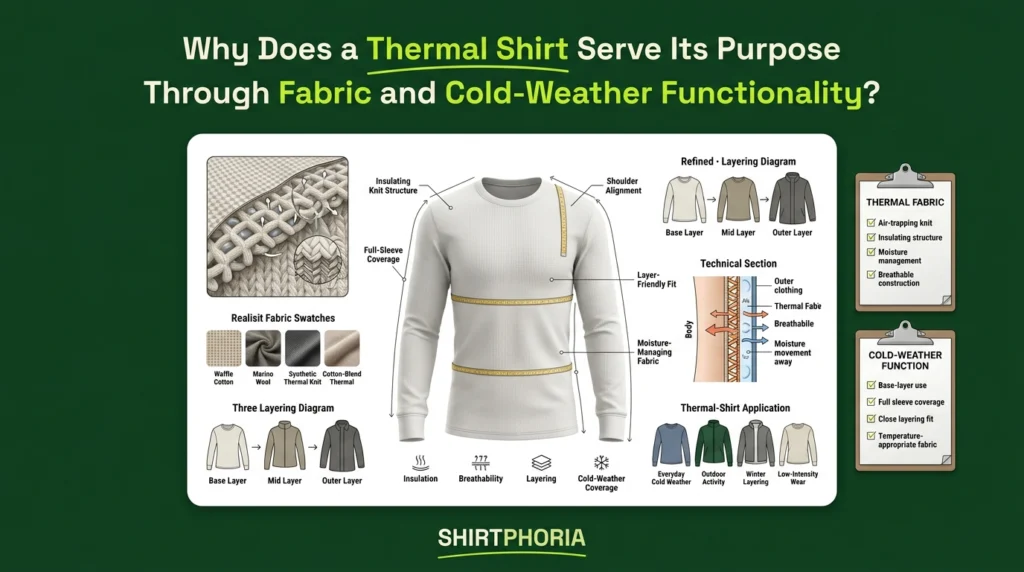
A thermal shirt supports cold-weather performance by combining fabric structure, controlled air retention, moisture transfer, suitable next-to-skin fit, and compatible outer layers to reduce avoidable heat loss and manage sweat.
A thick shirt can still perform poorly if it traps excessive moisture, allows uncontrolled ventilation, compresses its own loft, or conflicts with the mid-layer and outer shell.
A thermal shirt should therefore be understood as one component of a complete cold-weather clothing system. It commonly functions as a Base Layer worn directly against or close to the skin, although some heavier designs can also function as lightweight insulating layers.
A Mid-Layer adds additional loft and insulation. An Outer Shell controls wind and precipitation while also influencing ventilation and moisture escape.
A thermal shirt cannot independently guarantee protection from hypothermia, frostbite, cold stress, wet exposure, or rapidly changing weather. Safe cold-weather clothing also depends on suitable layering, unrestricted circulation and movement, weather conditions, exposure duration, dry replacement clothing, and proper preparation.
Source: CDC/NIOSH — Cold and Work: Types, Causes, and Preparation
This guide explains the heat-transfer science, fabric structures, moisture mechanisms, fit requirements, activity variables, and layering decisions that determine whether a thermal shirt performs effectively.
Why Is Heat and Moisture Management the Main Function of a Thermal Shirt?
Heat and moisture management are the main functions of a thermal shirt because the garment must reduce unnecessary heat transfer while limiting the cooling and discomfort associated with accumulated sweat.
The human body continuously produces metabolic heat.
Physical activity such as walking, running, climbing, skiing, or outdoor work can substantially increase heat production. At the same time, the body loses heat to the surrounding environment and may produce sweat to control temperature.
A normal thermal shirt does not create body heat. Instead, it changes the rate at which heat and moisture move between the skin, fabric, other clothing layers, and the environment.
This becomes especially important when activity intensity changes.
During demanding activity, the wearer may generate substantial heat and sweat. When movement slows or stops, metabolic heat production decreases while moisture can remain in the clothing.
A clothing system that felt comfortable during movement may therefore become noticeably colder during rest.
Individual response also differs. Physiology, body size, circulation, acclimatization, fatigue, activity intensity, and environmental exposure can all affect how warm the same thermal shirt feels.
Why Does Moisture Management Affect Thermal-Shirt Performance?
Moisture management affects thermal-shirt performance because retained liquid can displace insulating air, increase conductive heat transfer, alter fabric behavior, and intensify evaporative cooling when conditions permit evaporation.
Moisture accumulation changes the relationship between the skin, fabric, and surrounding air.
A useful moisture-management system involves several connected processes:
- Sweat pickup
- Liquid spreading
- Transfer through the fabric
- Vapor permeability
- Evaporation
- Drying
- Moisture movement through outer layers
These processes occur together rather than in one perfectly ordered sequence.
Liquid water has substantially greater thermal conductivity than still air. This helps explain why wet clothing often feels colder than dry clothing, but the difference should not be converted into a universal percentage for human heat loss.
The result depends on moisture quantity, wind, fabric structure, activity, temperature, humidity, and the surrounding layers.
Cotton provides a useful example.
Cotton can retain moisture and may dry slowly compared with many lightweight synthetic fabrics. That can make it a weak option for active wet-cold environments where a person may sweat heavily and remain exposed afterward.
However, this does not mean every use of cotton in cool, dry, low-output conditions is automatically unsafe.
Merino Wool, polyester, cotton, and blended materials behave differently when damp, but no fiber should be declared universally superior without considering the complete textile construction and actual conditions.
Fabric structure, permeability, moisture behavior, and garment design jointly influence thermoregulation.
Source: The Role of Sports Clothing in Thermoregulation, Comfort, and Performance
How Does a Thermal Shirt Reduce Conductive, Convective, Evaporative, and Radiative Heat Loss?
A thermal shirt can reduce conductive and convective heat transfer, modify evaporation, and add a limited barrier to radiative exchange, but the effect depends on fabric, air layers, moisture, wind, fit, and outer clothing.
Four heat-transfer mechanisms help explain thermal-shirt performance.
Conduction is heat transfer through direct contact between materials.
Heat can move from warmer skin toward colder clothing or surrounding surfaces. Dry textile structures that hold relatively still air can slow this heat transfer.
Convection is heat transfer caused by moving air or fluid.
Wind moving through a clothing system can remove warmed air. Open cuffs, necklines, hems, or highly air-permeable structures may also allow unwanted ventilation.
Evaporation occurs when liquid moisture changes into vapor.
This process requires energy and therefore produces cooling. During intense exercise, evaporative cooling can help control overheating. When activity slows in cold conditions, excessive moisture can instead contribute to chilling.
Radiation is heat transfer through electromagnetic emission without direct contact.
Clothing can provide some resistance to radiative exchange, although its effect depends on material, thickness, surface characteristics, and the surrounding clothing system.
An Outer Shell may reduce wind penetration, but a shell that restricts vapor escape or ventilation can allow additional moisture to accumulate during high-output activity.
The clothing Microclimate therefore changes continuously as body heat, sweat, wind, humidity, movement, and ventilation change.
How Does Thermal-Shirt Fabric Structure Create Insulation?
Thermal-shirt fabric structure creates insulation by holding relatively still air within the textile and garment while maintaining enough moisture and air exchange for the intended activity.
Warmth depends on much more than fabric density.
Important variables include:
- Thickness
- Loft
- Porosity
- Knit structure
- Brushing
- Grid geometry
- Fiber crimp
- Layer count
- Compression
- Moisture
- Wind
- Garment air gaps
A heavier fabric is therefore not automatically the warmer choice in every situation.
How Do Fabric Structure and Trapped Air Affect Thermal Resistance?
Fabric structure affects thermal resistance by controlling how much relatively still air is held, how stable that air remains during movement, and how easily wind or compression can disturb it.
Still air has low thermal conductivity compared with many solid and liquid materials.
Textile structures can therefore increase Thermal Resistance by retaining relatively stable air between fibers, yarns, raised surfaces, and clothing layers.
The basic relationship is:
Lofted textile structure → retains relatively still air → can increase thermal resistance.
The effect has limits.
Excessive compression can flatten loft and reduce the amount of insulating air retained within the structure.
An excessively open textile may allow wind to carry warmed air away.
Likewise, very loose clothing may create unwanted air exchange through the neck, cuffs, or hem.
Not every garment air gap is harmful. Some controlled air space can contribute to insulation.
The goal is to retain useful air while avoiding uncontrolled ventilation.
Moisture can alter the result again because water changes conductivity, drying behavior, fabric feel, and evaporation.
How Do Merino Wool, Polyester, Blends, and Grid Fabrics Compare?
Merino Wool, polyester, blended fabrics, and grid structures differ in moisture sorption, drying behavior, loft, durability, odor retention, skin feel, and warmth-to-weight performance.
There is no universal winner.
The right material depends on what property matters most under the intended conditions.
Merino Wool
Merino Wool can absorb water vapor within the fiber.
This moisture-buffering ability can help the fabric remain comfortable as humidity near the skin changes.
Depending on its construction, Merino may continue to provide useful insulation when damp.
It is also commonly valued for odor control and comfort.
However, Merino is not universally superior.
Many lightweight polyester fabrics dry faster.
Merino garments can also vary considerably in:
- Durability
- Softness
- Fabric weight
- Knit structure
- Stretch
- Cost
The actual fabric construction remains important.
Polyester and Synthetic Knits
Polyester fibers absorb relatively little liquid water into the fiber itself.
That characteristic can support fast drying.
However, Hydrophobic does not automatically mean good wicking.
A hydrophobic fiber has relatively low affinity for water, but effective moisture movement depends on the way the fiber is constructed into yarn and fabric.
Synthetic fabrics can use carefully engineered channels and structures to encourage Capillary Action, allowing liquid to move through small spaces in the textile.
Their performance can depend on:
- Yarn geometry
- Knit construction
- Fiber shape
- Surface treatment
- Fabric thickness
- Skin contact
Some polyester garments may also retain odor more readily than wool, although treatment, laundering, fabric construction, and individual use affect the outcome.
Wool–Synthetic Blends
Wool–synthetic blends can combine properties from multiple fiber types.
Depending on the construction, a blend may balance:
- Drying
- Moisture buffering
- Durability
- Stretch
- Recovery
- Skin comfort
- Odor behavior
The percentage of each fiber and the way the yarn and fabric are constructed determine the final result.
A wool-polyester blend should therefore be judged as a complete fabric rather than simply as “wool” or “synthetic.”
Grid Fleece and Grid Knits
Grid fabrics use raised zones separated by thinner channels.
The raised sections can provide localized loft, while the channels can reduce bulk and support ventilation or moisture transfer.
Depending on thickness and garment design, a grid structure may function as a Base Layer or light Mid-Layer.
Polartec Power Grid is one specific example of a bi-component grid fabric designed around lightweight warmth, breathability, and moisture transfer.
Source: Polartec — Power Grid
These characteristics apply specifically to Power Grid. They should not automatically be generalized to every fleece, grid knit, synthetic fabric, or Polartec textile.
These fiber, knit, fit, and use-case relationships also appear throughout modern performance shirts.
How Does Fabric Science Translate into Wearable Thermal-Shirt Performance?
Fabric science translates into wearable performance only when the material’s properties remain compatible with garment fit, body movement, sweat production, outer layers, and weather exposure.
A fabric swatch tested in a laboratory is not the same thing as a complete shirt worn outdoors.
Performance may be evaluated through several different levels:
- Fabric test
- Garment test
- Clothing-system test
- Human-wear trial
- Field performance
These results should not automatically be treated as interchangeable.
For example, a fabric may show strong laboratory wicking but perform poorly as a finished shirt if:
- The fit prevents reliable skin contact
- Outer clothing compresses its loft
- Seams retain moisture
- Outer layers prevent moisture escape
- The garment provides excessive insulation
- Wind penetrates the system
- The wearer produces more sweat than the system can release
The same fiber can therefore perform very differently in two different fabrics.
How Does Thermal-Shirt Design Affect Cold-Weather Performance?
Thermal-shirt design affects cold-weather performance through next-to-skin contact, coverage, seam placement, ventilation control, fabric recovery, and compatibility with the surrounding layers.
The design must balance several requirements:
- Contact
- Comfort
- Circulation
- Range of motion
- Moisture transport
- Loft preservation
- Coverage
- Layer compatibility
Maximizing one property while ignoring the others can reduce overall performance.
How Does Moisture Transport Support the Clothing Microclimate?
Moisture transport supports the clothing microclimate by moving or spreading sweat away from concentrated wet zones and helping moisture progress toward surfaces where it can evaporate or pass through outer layers.
Two textile terms are especially useful.
Hydrophobic means having relatively low affinity for water.
Hydrophilic means having greater affinity for water.
Neither property alone determines whether a garment wicks effectively.
Wicking may depend on:
- Fiber surface properties
- Capillary channel size
- Yarn structure
- Knit geometry
- Textile finishes
- Contact with the skin
- Temperature gradients
- Humidity gradients
Capillary Action allows liquid to move through narrow spaces within yarns and textile structures.
A hydrophobic polyester fiber can therefore still be part of an effective moisture-moving fabric when the yarn and knit geometry create useful capillary pathways.
Likewise, a hydrophilic material may absorb moisture without rapidly moving it away from the skin.
Moisture can reduce effective insulation and increase discomfort, but the degree of performance loss depends on the amount of moisture, fabric structure, fiber type, wind, and other layers.
The complete clothing system matters.
A Base Layer may spread sweat efficiently, but if the Mid-Layer or Outer Shell prevents moisture from moving farther outward, the clothing system may still become damp.
What Fit Should a Thermal Base Layer Have?
A thermal base layer should fit close enough to maintain stable coverage and moisture contact without acting as restrictive compression or flattening the fabric’s intended insulating structure.
Compression is not universally necessary.
A suitable Base Layer generally has a close, comfortable fit.
The garment should:
- Remain reasonably close to the torso
- Avoid large openings at the neck, hem, or cuffs
- Allow unrestricted breathing
- Permit complete arm movement
- Avoid numbness or excessive circulation pressure
- Stay in position during activity
- Keep seams stable
- Preserve its intended loft or grid structure
Two opposite fit problems can occur.
Too Tight: The shirt may restrict movement or circulation and compress the fabric’s intended loft.
Too Loose: The shirt may reduce reliable moisture contact and allow unwanted ventilation through openings.
Appropriate Fit: The garment maintains coverage, comfort, contact, circulation, and movement.
Cold-weather clothing should preserve circulation and movement, and a multi-layer system allows protection to be adjusted as activity and exposure change.
Source: CDC/NIOSH, Cold and Work: Types, Causes, and Preparation.
Some air space within the garment can still contribute to insulation.
The goal is not to remove all air gaps but to avoid uncontrolled ventilation.
How Should a Thermal Shirt Work Within a Layering System?
A thermal shirt works within a layering system by managing the next-to-skin environment while the mid-layer adds insulation and the outer shell controls wind, precipitation, and ventilation.
Each layer has a different role.
Base Layer
The Base Layer is worn next to or close to the skin.
Its main functions include:
- Managing skin-adjacent moisture
- Maintaining stable coverage
- Providing light-to-moderate insulation depending on structure
It does not normally provide all the insulation required for very cold conditions.
Mid-Layer
The Mid-Layer provides additional loft and thermal resistance.
Common insulating materials include:
- Fleece
- Wool
- Synthetic insulation
- Down
The Mid-Layer holds more relatively still air and can often be added, removed, opened, or vented as activity changes.
Outer Shell
The Outer Shell manages environmental exposure.
Depending on its design, it can:
- Reduce wind penetration
- Resist rain
- Resist snow
- Allow water vapor transmission
- Provide mechanical ventilation
A low-permeability or fully closed shell may increase moisture accumulation during high-output activity, especially when ventilation is limited; it does not inevitably cause freezing.
Activity transitions are particularly important.
During intense movement, excessive insulation may produce heavy sweating.
When activity slows, damp clothing can increase chilling.
Adjusting layers before heavy sweating occurs is therefore often more effective than waiting until clothing becomes heavily saturated.
Layered clothing is useful partly because individual components can be adjusted as activity and weather change.
Source: CDC/NIOSH, Cold and Work: Types, Causes, and Preparation.
How Should Thermal-Shirt Weight Be Matched to Activity and Weather?
Thermal-shirt weight should be matched to activity intensity, temperature, wind, precipitation, duration, metabolic output, and the insulation provided by the rest of the clothing system.
Terms such as Lightweight, Midweight, and Heavyweight are useful categories, but they are not standardized equally across every brand.
A product should therefore not receive a universal temperature rating simply because it is described as heavyweight.
| Fabric WeightBest-Fit Activity PatternCommon Material OptionsMain Selection Priority | |||
|---|---|---|---|
| Lightweight | Running, fast hiking, ski touring, climbing, or other sustained high-output activity | Lightweight polyester, synthetic knit, lightweight Merino, or blends | Moisture transfer, fast drying, mobility, and low bulk |
| Midweight | Stop-and-start hiking, resort skiing, climbing, travel, fieldwork, or variable output | Merino, polyester, wool–synthetic blend, grid knit, or light fleece | Balance of warmth, moisture management, and ventilation |
| Heavyweight Base Layer | Low-output work, slow movement, extended cold exposure, or use beneath carefully managed layers | Heavy knit wool, thick synthetic knit, or heavy blend | Greater insulation with acceptable mobility and moisture control |
| Insulating Mid-Layer | Static rest, belay use, camp, or low-output extreme-cold periods | Fleece, wool sweater, lofted synthetic insulation, or down | High thermal resistance and adjustable system warmth |
The same thermal shirt can behave differently depending on what surrounds it.
It may be worn under:
- A breathable wind shell
- A waterproof shell
- A thick fleece
- A down jacket
- No outer layer
Environmental exposure also changes performance.
High wind can reveal excessive air permeability that was not noticeable in calm conditions.
Rain or wet snow can increase the importance of weather protection.
A waterproof shell can block precipitation but may require active ventilation during exercise.
Fabric weight should therefore never be selected from temperature alone.
How Should Thermal-Shirt Weight Match Activity Intensity?
Thermal-shirt weight should decrease as sustained heat and sweat production rise, while lower-output exposure may require more insulation from the base layer, mid-layer, or both.
High-output activity often favors:
- Lower bulk
- Faster drying
- Strong moisture transfer
- Mobility
- Easy ventilation
Running, fast hiking, ski touring, and climbing are common examples.
Variable-output activity often benefits from an adjustable system.
Instead of wearing one extremely warm garment, the wearer can use a moderate Base Layer and add or remove insulation as activity changes.
Low-output activity commonly requires more insulation because the body is producing less metabolic heat.
However, simply choosing a thicker Base Layer is not always the best approach.
Static or low-movement exposure may require a comfortable Base Layer combined with a substantial insulating Mid-Layer and an effective Outer Shell.
Wind and precipitation may sometimes matter more than the weight of the Base Layer.
Individual cold tolerance also varies.
Heavyweight clothing may increase overheating and moisture accumulation during sustained high-output activity, especially when the wearer cannot vent or remove layers.
The higher-output cooling and moisture priorities used in running shirts provide a useful contrast with low-output thermal insulation.
How Can Thermal-Shirt Performance Be Verified?
Thermal-shirt performance should be verified through documented fabric properties, fit inspection, movement testing, moisture behavior, layer compatibility, environmental context, and observed wearer response.
Marketing terms such as “thermal,” “wicking,” “warm,” or “performance” should not be treated as complete evidence.
Useful verification connects measurable properties with the conditions in which the garment will actually be worn.
What Is the Correct Thermal-Shirt Functionality Model?
Thermal-shirt functionality operates as a coupled system rather than a strict one-direction engine.
ACTIVITY + ENVIRONMENT
↓
BODY HEAT AND SWEAT PRODUCTION
↕
FABRIC INSULATION + MOISTURE TRANSFER + AIR PERMEABILITY
↕
FIT + GARMENT COVERAGE + VENTILATION
↕
MID-LAYER + OUTER-SHELL PERFORMANCE
↓
OBSERVED WARMTH, DRYNESS, COMFORT, AND COLD-RISK OUTCOME
The model is interactive because several mechanisms occur simultaneously.
Insulation and moisture transfer happen at the same time.
Activity changes both metabolic heat and sweat production.
Wind, temperature, humidity, and precipitation affect the clothing system.
Fit changes skin contact, air exchange, and fabric behavior.
The Mid-Layer changes thermal resistance.
The Outer Shell affects wind protection, precipitation resistance, ventilation, and moisture escape.
Layer adjustments can therefore change the final result even when the thermal shirt itself remains the same.
No single property guarantees warmth.
What Checklist Verifies a High-Performance Thermal Shirt?
Use this checklist to determine whether a thermal shirt’s documented construction, fit, moisture behavior, and layering role match the intended activity and environment.
Thermal-Shirt Fabric, Fit, and Layering Verification Checklist
- Use-Case Check: Define the activity, expected output level, exposure duration, temperature, wind, precipitation, and available outer layers.
- Garment-Role Check: Confirm whether the product is designed as a Base Layer, light Mid-Layer, or insulating Mid-Layer.
- Fabric-Composition Check: Verify the percentages of wool, polyester, nylon, elastane, cotton, or other fibers on the garment label.
- Fabric-Mass Check: Record fabric mass in GSM when reliable manufacturer information is available.
- Thickness Check: Record fabric thickness only when a defined test method or dependable product specification is provided.
- Thermal-Resistance Check: Look for Thermal Resistance measurements such as Rct or clo only when test conditions are available.
- Evaporative-Resistance Check: Look for Ret or comparable Evaporative Resistance measurements when available.
- Air-Permeability Check: Determine whether the fabric allows enough air movement for the activity without becoming excessively wind-permeable.
- Wicking Check: Prefer documented wicking-distance, liquid-spreading, or moisture-management testing instead of unsupported percentages.
- Drying-Time Check: Compare drying results only when samples, starting moisture, temperature, airflow, and test duration are stated.
- Fit Check: Confirm close but non-restrictive torso contact, normal breathing, good circulation, stable coverage, and unrestricted movement.
- Loft Check: Confirm that the garment and surrounding layers do not excessively flatten the intended fabric loft.
- Seam Check: Inspect for chafing, pulling, exposed roughness, or bulky areas that retain moisture.
- Coverage Check: Confirm that the hem, neck, sleeves, and cuffs remain positioned during reaching, bending, and walking.
- Movement Check: Test walking, running, climbing, reaching, sitting, and activity-specific movements.
- Layering Check: Confirm that the Mid-Layer and Outer Shell can release or vent the moisture created by the planned activity.
- Wet-State Check: Determine how the garment feels and functions after moderate moisture exposure instead of evaluating only its dry performance.
- Overheating Check: Confirm that the wearer can vent, remove, or replace layers before heavy sweating develops.
- Safety Check: Carry dry backup layers and do not treat the thermal shirt as guaranteed protection against cold injury.
Thermal-Shirt Diagnostic Outcomes
| OutcomeRequired EvidenceInterpretation | ||
|---|---|---|
| High-Output Base-Layer Match | Lightweight construction, close non-restrictive fit, strong moisture transfer, fast drying, and compatible shell ventilation | Suitable for sustained high-output cold activity |
| Variable-Output Layering Match | Balanced insulation and moisture performance with removable or ventable layers | Suitable for stop-and-start activity |
| Low-Output Cold Match | Comfortable Base Layer combined with substantial Mid-Layer insulation and weather protection | Suitable for lower metabolic heat production |
| Static-Cold System Match | Base Layer, high-loft insulation, wind or precipitation protection, and emergency backup clothing | Suitable for prolonged low-movement exposure within stated limits |
| Over-Insulated | Heavy sweating, excessive warmth, limited ventilation, or inability to remove layers | Reduce insulation or increase ventilation |
| Moisture-Transport Concern | Persistent wet areas, slow drying, Outer-Shell blockage, or chilling after activity slows | Review fabric, fit, output, and shell permeability |
| Fit Correction Required | Restriction, numbness, seam distortion, ride-up, large openings, or unstable coverage | Change size, cut, or garment design |
| Layering-System Conflict | Base Layer transports moisture but outer layers trap it, or shell ventilation is inadequate | Adjust the Mid-Layer or Outer Shell |
| Insufficient Evidence | No test data, unclear garment role, missing environmental conditions, or unsupported marketing claims | Do not assign a confident performance rating |
Thermal-Shirt Condition Zones
Ideal Performance Zone
A thermal-shirt system is closer to its ideal performance zone when:
- The garment role is clearly defined.
- Fabric composition is verified.
- Fit remains close and non-restrictive.
- Range of motion is complete.
- Moisture does not remain concentrated in one area.
- Layers can be adjusted.
- Persistent overheating is avoided.
- The Outer Shell controls wind and precipitation appropriately.
- The shirt remains comfortable as activity changes.
- Safety planning exists for prolonged or wet exposure.
Transition Zone
A thermal-shirt system may enter a transition zone when:
- Minor dampness develops during high output.
- The shirt feels warm during movement but cooler during rest.
- The hem shifts slightly.
- Some seams retain moisture.
- Outer layers require periodic venting.
- The wearer needs to add or remove a Mid-Layer.
- Performance remains manageable through adjustment.
These conditions do not automatically mean the thermal shirt has failed.
They indicate that activity, ventilation, fit, or layering may need adjustment.
Correction-Required Zone
The system requires correction when:
- The garment restricts breathing or circulation.
- Heavy sweat accumulates without a ventilation option.
- The shirt remains persistently wet.
- Outer layers retain substantial moisture.
- The wearer becomes increasingly cold when activity slows.
- Wind penetrates the clothing system.
- The shirt rides up and exposes skin.
- Fabric or seams cause severe discomfort.
- Marketing claims cannot be connected to defined test conditions.
- Cold-stress symptoms develop.
No thermal shirt guarantees protection against hypothermia, frostbite, cold stress, wet exposure, or rapidly changing environmental conditions.
Stop exposure, seek shelter, replace wet clothing, and follow appropriate cold-stress procedures when the wearer develops uncontrolled shivering, confusion, loss of coordination, numbness, or other warning signs.
Error-Proof Verification Protocol
A thermal shirt should be tested systematically rather than judged from marketing language alone.
Follow this order:
- Define the activity and expected metabolic output.
- Record temperature, wind, humidity, precipitation, and exposure duration.
- Identify whether the garment functions as a Base Layer or Mid-Layer.
- Verify fiber composition.
- Record available GSM, thickness, Rct, Ret, permeability, wicking, or drying data.
- Reject performance percentages that do not provide test conditions.
- Put on the garment and check breathing, circulation, movement, and coverage.
- Add the intended Mid-Layer and Outer Shell.
- Test activity-specific movement.
- Begin activity at moderate output.
- Monitor warmth, moisture, ventilation, and garment position.
- Adjust layers before heavy sweating develops.
- Recheck comfort when activity slows.
- Inspect moisture concentration after use.
- Select one diagnostic outcome.
- Correct one variable at a time.
- Repeat the test with the intended layer system.
- Keep the conclusion limited to the tested conditions.
When thermal performance is poor, isolate activity intensity, fit, fabric wetness, loft compression, wind exposure, mid-layer insulation, and shell ventilation before blaming the fiber alone.
A result is repeatable only when garment size, test conditions, activity, duration, layer system, and evaluation criteria remain comparable.
Product claims without fabric data, garment testing, environmental conditions, or comparison methods must be labeled insufficient evidence.
Thermal-Shirt Fabric, Fit, and Layering Verification Checklist
Frequently Asked Questions
A thermal shirt does not create body heat. Its fabric structure and retained air add thermal resistance, while moisture management and compatible outer layers help control heat loss and sweat.
No. Merino and polyester offer different advantages. The better choice depends on drying, moisture buffering, odor behavior, durability, fabric construction, activity, and weather.
It should fit close and comfortably rather than acting as restrictive compression. The garment should maintain coverage and moisture contact without limiting breathing, circulation, movement, or intended loft.
No. A heavier garment can increase dry insulation, but excessive insulation may also increase sweating. Activity level, wind, moisture, fit, and the complete layer system all affect warmth.
Terms Explained
| TERM | DEFINITION |
|---|---|
| Base Layer | A garment worn next to or close to the skin to manage moisture, maintain coverage, and provide light-to-moderate insulation depending on construction. |
| Mid-Layer | An insulating layer that adds loft and thermal resistance above the base layer. |
| Outer Shell | The outer clothing layer used to control wind, precipitation, ventilation, and moisture escape. |
| Thermal Resistance | The resistance a material or clothing system provides to heat transfer. |
| Microclimate | The changing temperature and moisture environment between the skin, clothing layers, and surrounding air. |
| Hydrophobic | Having relatively low affinity for water. |
| Hydrophilic | Having greater affinity for water. |
| Capillary Action | Liquid movement through narrow spaces in yarns or textile structures. |
| Evaporative Resistance | A measure describing resistance to water-vapor transfer through a textile or clothing system. |
Conclusion
The final thermal-shirt selection rule is to match fabric construction, moisture behavior, non-restrictive fit, garment weight, activity level, weather exposure, and surrounding layers as one complete system.
A normal thermal shirt does not create body heat.
Its fabric structure and retained air instead contribute Thermal Resistance, helping reduce unnecessary heat transfer.
Moisture changes that performance.
A garment that effectively spreads or transports sweat during high-output activity may help reduce concentrated wet areas, but wicking does not guarantee warmth.
Likewise, a thick fabric may provide considerable dry insulation but perform poorly if it causes excessive sweating.
Merino Wool and polyester provide different advantages and limitations.
Merino can absorb water vapor within the fiber and may remain comfortable across variable conditions.
Polyester absorbs relatively little moisture into the fiber and can be engineered into rapidly drying fabrics with effective capillary pathways.
Neither material should be declared universally superior without specifying the fabric construction, property being tested, and actual conditions.
Polartec Power Grid provides one example of a specific grid construction designed to combine localized loft, breathability, and moisture movement. Its properties should not be automatically attributed to unrelated grid or fleece fabrics.
Compression is not universally necessary.
A thermal Base Layer should generally remain close enough for stable coverage and moisture contact while preserving breathing, circulation, movement, and the intended textile structure.
Some controlled air space can contribute insulation.
Excessive looseness, however, may create unwanted ventilation around garment openings.
Thick fleece is also commonly better classified as an insulating Mid-Layer rather than automatically as a next-to-skin thermal shirt.
Outer clothing remains critical.
The Outer Shell influences wind penetration, precipitation protection, moisture escape, and ventilation. The Mid-Layer determines much of the additional loft available for lower-output or colder conditions.
Activity intensity, weather, exposure duration, and individual physiology must therefore be considered together.
Unsupported universal percentages for insulation, wicking, or core-heat retention should not be used without defined testing.
No thermal shirt guarantees protection against cold injury.
Too little insulation increases exposure to cold, while excessive insulation can produce sweat that raises chilling risk when activity slows.
A thermal shirt performs effectively only when its fabric, fit, moisture behavior, activity level, and surrounding layers remain aligned with the actual cold-weather conditions.