How Does the Performance Shirt Integrate Fabric Technology, Functional Design, and Use-Case Alignment?
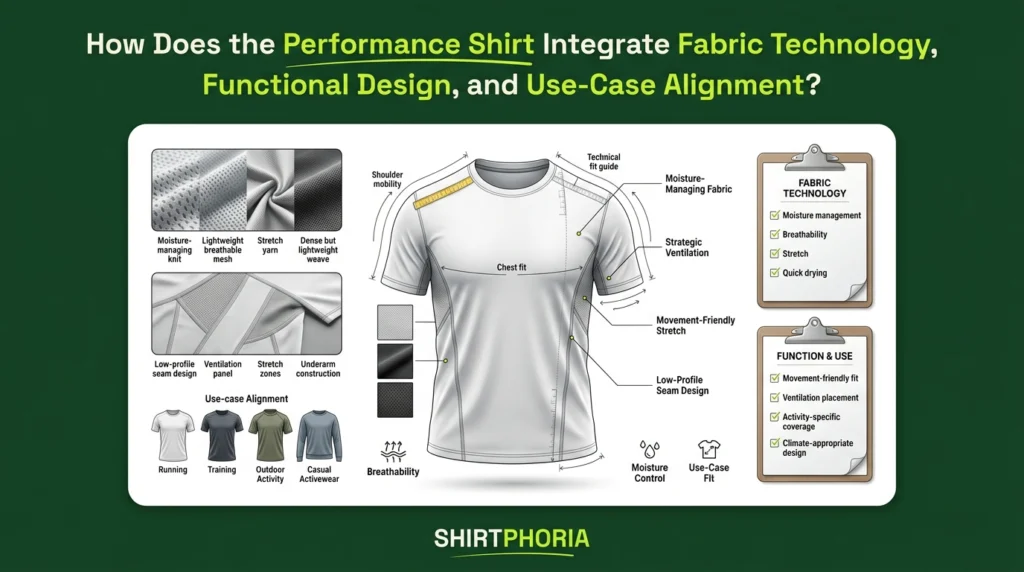
A performance shirt integrates successfully when its tested textile properties, fit and construction match the activity and environment without creating unacceptable moisture, friction, movement or protection failures. Performance Shirt Integration is therefore not a single fabric treatment or design feature. It is the compatibility between fabric technology, functional garment design and the conditions in which the shirt will actually be worn.
Performance shirts also serve different purposes. A running shirt, hiking shirt, travel shirt, compression shirt and technical business shirt may require very different combinations of moisture behaviour, coverage, fit and construction. Moisture-wicking is only one property within this larger system.
The three main pillars are Fabric Technology, Functional Design and Use-Case Alignment. Each can succeed or fail independently. A technically capable fabric can perform poorly when the fit restricts movement, while good garment construction cannot validate an unsupported moisture or protection claim. For that reason, performance terminology should be separated from measurable evidence and evaluated in relation to the intended task.
Quick Answer
A good performance shirt is not defined by one technology. Its moisture transport, drying, fit, seam placement, coverage and protection claims should match the intended activity. Wicking does not prove quick drying, compression does not guarantee better athletic output, and a technology name does not replace test evidence. The strongest choice is the shirt that completes its intended task with the fewest important functional conflicts.
Definition
Performance Shirt Integration is the compatibility between measurable textile properties, garment construction and conditions of use. A feature is useful only when it supports the intended task without creating a more important problem elsewhere in the garment system.
Which Performance Shirt Is Being Evaluated?
Before comparing features, identify the primary category:
- High-intensity or running
- Gym or training
- Outdoor or hiking
- Travel
- Compression
- Technical business or work
- Hybrid or unclear
A feature that works well in one category may be unnecessary or even counterproductive in another.
Why Is Performance Shirt Integration More Important Than a Single Feature?
Performance Shirt Integration matters because an isolated fabric or construction feature cannot compensate for a garment that conflicts with the wearer’s movement, environment or intended task.
Performance shirts belong within a broader shirt type framework in which fabric, fit, construction, design and function work together. A fabric can perform well in one measurable area while the complete shirt still fails in practice.
For example, strong liquid transport does not solve a problem caused by restrictive shoulder construction. A low-profile seam does not help if that seam repeatedly rubs an area of skin during running. A lightweight shirt may still become uncomfortable if it retains moisture or clings excessively when wet.
Performance should therefore be treated as a system rather than a collection of impressive-sounding features.
How Can an Isolated Performance Shirt Feature Fail?
An isolated performance-shirt feature fails when its benefit is outweighed by a more important conflict elsewhere in the garment system.
A fabric may move liquid away from one location but retain enough moisture to remain wet longer than the activity requires. The moisture-transport feature still exists, but its practical value becomes limited by retention and drying behaviour.
A low-profile seam may reduce bulk yet still sit directly in a repetitive friction zone. Likewise, a close athletic fit may maintain stable fabric contact while restricting reaching, rotation or breathing comfort.
Protection can also fail through garment design. A material may carry a tested UPF rating, but that rating cannot protect areas of skin the shirt leaves uncovered.
The important relationship is:
Misaligned feature → system conflict → reduced intended-task performance.
How Should Performance Shirt Integration Success Be Defined?
Performance Shirt Integration succeeds when the garment completes the intended activity without a critical fit, moisture, friction, thermal or protection failure.
A practical success standard asks whether:
- the intended task can be completed;
- movement remains functional;
- the wearer does not need repeated garment correction;
- persistent painful friction does not develop;
- moisture behaviour remains acceptable for the activity;
- and any required protective claims have suitable evidence.
Success should not automatically be defined through claims such as improved athletic output, core-temperature control, muscle support or multi-day hygiene. Those outcomes require their own evidence rather than being inferred from garment labels.
How Does Fabric Technology Shape Performance Shirt Integration?
Fabric technology shapes Performance Shirt Integration through separate moisture, drying, thermal, protection and treatment properties that must be evaluated individually.
The AATCC testing standards illustrate why technical properties should not be collapsed into one general idea of “performance.” Separate methods exist for areas such as liquid-moisture management, wicking, drying, water-vapour transmission, antibacterial finishes, bacterial-odor reduction, odor adsorbency and ultraviolet-radiation blocking.
A test result for one property therefore does not prove every other property. Fabric-level testing must also be separated from garment-level outcomes such as chafing, movement comfort or wearer cooling.
How Do Wicking and Spreading Affect Performance Shirt Integration?
Wicking and spreading describe how liquid moves through or across a performance-shirt fabric rather than how quickly the fabric becomes dry.
Vertical wicking describes liquid movement along the material in a vertical direction. Horizontal wicking considers movement across a more horizontal textile area. Liquid spreading refers to the redistribution of liquid over or through the fabric.
The direction and rate of movement may be influenced by fibre surfaces, yarn construction, textile structure, finishes and the amount of liquid applied.
This matters because moisture transport and drying are different processes. A fabric can redistribute moisture over a larger surface without proving that the moisture will leave the fabric quickly.
Capillary movement can contribute to liquid transport, but it does not independently prove faster evaporation.
The useful relationship is:
Liquid-moisture transport → redistributes applied liquid → does not independently establish drying or cooling.
How Does Drying Affect Performance Shirt Integration?
Drying affects Performance Shirt Integration through the time or rate at which retained moisture leaves the textile under defined conditions.
Drying time generally describes how long a material takes to reach a stated dryness condition. Drying rate describes how rapidly moisture leaves during part or all of that process.
Results depend on testing conditions. Airflow, heat, starting moisture, sample area, ambient temperature and humidity can all affect the result.
A credible quick-dry claim should therefore identify a relevant method, measured result, comparator or another clear performance basis.
Quick-dry should not automatically be interpreted as low absorption. A fabric can absorb moisture and still release it relatively quickly under suitable conditions. Likewise, a fast laboratory drying result does not guarantee wearer comfort because fit, sweat rate, environmental conditions and garment coverage also matter.
How Should Moisture Retention Be Used in Performance Shirt Integration?
Moisture retention affects Performance Shirt Integration when the fabric holds enough liquid to change wet mass, cling, drying duration or perceived comfort.
Vague descriptions such as “saturation resistance” are less useful unless saturation is defined and measured. More specific variables include:
- absorbent capacity;
- retained moisture;
- wet mass;
- drainage;
- and drying rate.
Lower absorption may be useful in some applications because the material holds less liquid. However, it does not automatically mean superior moisture performance. A material that absorbs very little may spread liquid differently from one designed to distribute moisture through a larger textile area.
Higher absorption can also be acceptable where the fibre system, garment design and activity make that behaviour useful.
There is no universal moisture-retention target for every performance shirt.
How Should Thermal Claims Be Bounded in Performance Shirt Integration?
Thermal claims within Performance Shirt Integration require more than a fibre name because heat exchange depends on the complete garment, wearer, activity and environment.
Relevant variables include fabric mass, thickness, air permeability, moisture level, fit, coverage, activity intensity, wind, temperature and humidity.
A thin shirt may feel suitable in one warm environment but provide insufficient coverage or structure in another. A heavier fabric may increase insulation or bulk, yet its actual effect still depends on construction and conditions.
For this reason, fabric descriptions should use bounded language. A property may influence heat and moisture exchange or perceived thermal comfort, but a shirt should not be described as regulating core temperature or guaranteeing cooling from a fibre label alone.
Those stronger claims require controlled garment-level or wearer testing.
How Should Antibacterial and Odor Claims Be Separated in Performance Shirt Integration?
Antibacterial and odor claims must be separated within Performance Shirt Integration because bacterial activity, bacterial odor and odor adsorption are different evaluation targets.
AATCC lists separate methods for antibacterial finishes, bacterial-odor reduction and odor adsorbency. That separation is important because a result in one category does not automatically establish performance in another.
A treatment such as Polygiene, for example, is a named technology. The name identifies a claimed treatment system, but it does not by itself prove the finished shirt’s odor performance, treatment durability or suitable duration of wear.
Antibacterial activity concerns the measured effect of a treatment on selected bacteria under stated test conditions. It does not automatically prove hygiene, odor-free wear or reduced laundering.
Odor performance may instead involve bacterial-odor reduction, odor adsorption, odor capture or another defined mechanism.
The product should therefore provide evidence for the exact claim being made.
How Does Functional Design Shape Performance Shirt Integration?
Functional design shapes Performance Shirt Integration through fit, seam profile, seam placement, sleeve geometry, underarm construction and interaction with the wearer’s movement.
Two shirts made from similar fabrics can behave differently when their patterning, seam locations or fit categories differ. Construction should therefore be judged through the movements and conditions required by the intended activity.
How Do Fit Categories Affect Performance Shirt Integration?
Fit categories affect Performance Shirt Integration by changing skin contact, movement allowance, fabric displacement and local pressure.
Relaxed Technical Fit
A relaxed technical fit may provide more garment ease, reduced continuous skin contact and space for layering.
Possible limitations include excessive fabric movement, snagging, additional bulk and less stable fabric contact during movement.
Close Athletic Fit
A close athletic fit may keep the fabric in a more controlled position, reduce loose material and maintain closer contact where moisture transfer is intended.
However, excessive tightness may create pulling, seam pressure, heat discomfort or movement restriction.
Compression Fit
Compression fit intentionally creates very close body contact or pressure. It should not be treated simply as a tighter version of an athletic fit.
Possible problems include discomfort, rolling, excessive pressure, incorrect sizing and a restricted breathing sensation.
A 2025 systematic review and meta-analysis of compression garments and running found no significant improvement in race time or time to exhaustion in the pooled analysis. Although reduced soft-tissue vibration was reported, that should not be interpreted as guaranteed improvement in speed or endurance, and the certainty of evidence was reported as low to very low.
Fit should therefore be selected according to task completion and wearer comfort rather than a presumed performance hierarchy.
How Do Seams Affect Performance Shirt Integration?
Seams affect Performance Shirt Integration through profile, location, thread, elasticity, finish and repeated contact with the body.
Performance shirts may use flatlock seams, cover seams, overlock seams, bonded joins, taped joins or seamless knitting. None is universally required.
A flatlock seam can reduce local bulk when correctly positioned, but its appearance alone does not guarantee comfort. Problems may still occur when the seam is located in a repetitive friction area, the thread feels abrasive, the garment places excessive pressure on the seam or moisture increases skin friction.
A more useful evaluation is:
Compatible seam and location → reduce avoidable local bulk → may lower friction risk during intended movement.
How Do Raglan Sleeves Affect Performance Shirt Integration?
Raglan sleeves affect Performance Shirt Integration by relocating shoulder seams and changing how sleeve and torso panels interact.
A raglan sleeve typically extends toward the neckline rather than attaching at the conventional shoulder-armhole boundary used by a set-in sleeve.
This construction can change seam location and the way material moves around the shoulder. However, a raglan sleeve does not automatically improve mobility.
Both raglan and set-in sleeves can support movement when they are patterned correctly. Evaluation should include shoulder reach, arm elevation, fabric stretch, torso fit, sleeve rotation and the position of seams during actual movement.
How Do Underarm Gussets Affect Performance Shirt Integration?
Underarm gussets affect Performance Shirt Integration by adding or reshaping material where the sleeve and torso meet.
A gusset may be useful when its shape, dimensions and material properties support the required movement. Its effect also depends on stretch direction, seam placement, sleeve geometry and body fit.
A poorly designed gusset can create extra bulk or move seams into uncomfortable areas. Its presence therefore does not guarantee additional range of motion.
The question is not whether a shirt contains a gusset, but whether the complete underarm construction supports the required movement.
Three-Point Design Check
Basic construction uses conventional patterning, general-purpose seam placement and one primary fabric system.
Partially specialized construction adds one or more technical materials, seam choices or performance features but may have limited activity-specific patterning or supporting evidence.
Integrated construction selects fit, materials, panels and seams for a defined activity while supporting critical technical claims with relevant product-level evidence.
Integrated construction does not mean adding more components. It means reducing conflicts between the components that are actually needed.
How Does Use-Case Alignment Complete Performance Shirt Integration?
Use-case alignment completes Performance Shirt Integration by matching the garment’s verified properties and construction to the activity, exposure and wearing duration.
The same feature can have different value depending on whether the shirt is used for running, hiking, travel or work.
What Performance Shirt Integration Suits Running and High-Intensity Training?
Performance Shirt Integration for running and high-intensity training should prioritize movement, friction control and moisture behaviour appropriate to the expected sweat rate and environment.
Useful evaluation points include activity duration, climate, fit, seam location, wet mass, drying evidence, visibility for road use where required and the wearer’s history of chafing.
An extremely light fabric is not automatically superior. Durability does not always need to be sacrificed for low mass, and compression should not be selected on the assumption that it improves speed or endurance.
Flatlock seams are also optional rather than mandatory. Their value depends on where they sit and how they behave during repeated motion.
What Performance Shirt Integration Suits Outdoor and Hiking Use?
Performance Shirt Integration for outdoor and hiking use should balance coverage, tested protection, movement, drying, pack interaction and environmental exposure.
Relevant variables include body coverage, UPF evidence, fabric stretch under pack straps, wetness, abrasion zones, ventilation, fabric mass and compatibility with other layers.
The Australian Radiation Protection and Nuclear Safety Agency guidance on sun-protective clothing explains that UPF relates to the ultraviolet protection provided by tested material. Protection applies to the area covered by the garment and can be affected by conditions such as stretch, wetness, wear and chemicals.
The correct relationship is:
Tested UPF material → reduces solar UV transmission through covered fabric → lowers exposure on the skin it covers under labelled conditions.
A UPF rating does not protect uncovered skin, and the garment’s coverage remains a separate design consideration.
What Performance Shirt Integration Suits Travel?
Performance Shirt Integration for travel should balance drying, appearance, comfort, packability and evidence-supported odor management without promising a fixed number of wear days.
Travel conditions vary widely. Washing access, humidity, drying conditions, climate changes, wrinkle behaviour, repeated-wear comfort and treatment durability can all matter.
A useful travel shirt may dry acceptably after hand washing while also maintaining an appearance suitable for repeated use. However, a branded antimicrobial or odor treatment should not be translated into guaranteed hygiene or a fixed continuous-wear period.
The more accurate term is odor-management claim, and the claim should be supported by evidence relevant to the finished product.
What Performance Shirt Integration Suits Technical Business Use?
Performance Shirt Integration for technical business use should preserve workplace-appropriate appearance while supporting movement, stretch and climate comfort.
Unlike activewear, a business-oriented shirt may need to maintain collar shape, placket alignment, opacity, sleeve structure and an appropriate level of formality. These requirements overlap with conventional dress shirt structure, even when technical materials or performance features are added.
Stretch or discreet ventilation may support movement and comfort, but these remain design options rather than universal requirements.
A feature that works well in casual training apparel may be unsuitable when it changes the silhouette, transparency or structure expected in a professional environment.
How Should Evidence Be Verified in Performance Shirt Integration?
Evidence in Performance Shirt Integration should be verified by matching every technical claim to a named property, test method, result and intended use.
A useful evidence hierarchy contains four levels.
Level 1: Generic Marketing Claim
Terms such as “performance fabric,” “advanced comfort,” “cooling technology,” “freshness” or “technical fit” describe positioning rather than proof.
They identify what the manufacturer wants the product to represent, but they do not establish a measurable result.
Level 2: Published Specification
Specifications may include fibre content, fabric mass, UPF rating, fit category or the name of a treatment.
These details provide useful identification, but they do not validate every performance outcome associated with them.
Level 3: Named Test and Result
Evidence becomes stronger when a manufacturer provides a relevant test method and product-specific result.
Examples include a measured wicking result, drying time, antibacterial reduction, odor result or UPF report.
Conditions and sample identity still matter because a test only establishes what was actually measured.
Level 4: Garment-Level or Wearer Evidence
Some claims extend beyond textile samples and require assessment of the complete shirt.
Examples include movement testing, chafing evaluation, environmental wear trials or controlled physiological studies.
A fabric test alone cannot establish these complete-garment outcomes.
What the Evidence Establishes
- Liquid-moisture management, wicking, drying, antibacterial activity and odor performance require separate evaluation methods.
- UPF applies to tested material and covered skin, while stretch, wetness and wear may affect protection.
- Compression garments should not be promoted as guaranteed running-speed or endurance enhancers.
These principles help verify product claims; they do not prove that a particular performance shirt passed any test unless product-level results are supplied.
How Does the Shirtphoria F50 Protocol Evaluate Performance Shirt Integration?
The Shirtphoria F50 Performance Shirt Integration Protocol is an editorial comparison and intended-use system. It is not an AATCC, ASTM or ISO laboratory test, a UPF certification, a medical compression assessment or a physiological trial.
Its purpose is to create a repeatable way to evaluate whether a shirt’s claims, construction and fit make sense for a defined activity.
Standard Observation Record
Record the product category, intended activity, expected duration, temperature or exposure conditions, layering plan, fit category, fibre content and published fabric mass.
Then record the shirt’s moisture, drying, antibacterial, odor and UPF claims, including whether a test method and test result are supplied.
Construction observations should include seam type, seam locations, sleeve construction and whether an underarm gusset is present.
Finally, record movement restriction, friction locations, repeated garment correction, discomfort and the overall outcome.
Test 1: Use-Case Definition
Define the activity, duration, environment, required coverage, required protection and expected movement.
Pass: The intended use is specific enough to evaluate.
Conditional: Several uses are possible, but priorities remain unclear.
Fail: No intended use has been defined.
Test 2: Claim-to-Evidence Mapping
For each important claim, record the property, stated test, stated result, relevant comparison and exact product identity.
Pass: Critical claims have relevant product-level evidence.
Conditional: The property is identified, but part of the evidence is missing.
Fail: A critical buying claim depends only on generic marketing language.
Test 3: Static Fit Check
Check the neckline, chest, shoulder, torso, sleeves, hem and any compression areas.
Pass: The shirt stays in the intended position without pain, severe distortion or repeated adjustment.
Conditional: A minor cosmetic issue exists without functional restriction.
Fail: Pain, excessive pressure, rolling, severe pulling or breathing discomfort occurs.
Test 4: Movement Check
Perform activity-relevant movements such as arm elevation, forward reach, torso rotation, running arm swing, overhead reach, squatting, simulated pack use or seated work posture.
Pass: Required movements are completed without meaningful restriction.
Conditional: Minor garment displacement occurs but does not stop the task.
Fail: The shirt binds, rolls, rides excessively, creates problematic pressure or blocks movement.
Test 5: Friction Check
Repeat the intended motion for a consistent comparison period and record contact points, seam position, moisture condition, redness, pain and repeated rubbing.
Pass: No persistent painful friction develops.
Conditional: Contact is noticeable but does not worsen or prevent use.
Fail: Painful or progressively worsening friction appears.
This is a practical wear screen rather than a clinical or dermatological test.
Test 6: Moisture-Claim Check
Identify whether the shirt claims wicking, drying, absorption, moisture retention or another measurable moisture property.
Pass: The relevant claim is supported by an appropriate named method and result.
Conditional: The property is identified, but supporting evidence is incomplete.
Fail: Wicking, drying and cooling are combined into one unsupported marketing claim.
Test 7: UPF-Claim Check
Apply this check when solar protection is required.
Pass: The shirt has suitable UPF evidence, appropriate coverage and is used within stated limitations.
Conditional: Rated material is present, but coverage, stretch or garment condition may narrow protection.
Fail: The UV claim is unsupported or the shirt does not provide the required coverage.
Test 8: Antibacterial and Odor-Claim Check
Pass: The exact claim, method and relevant result are identified.
Conditional: A treatment name is supplied without sufficient product-level evidence.
Fail: The product promises hygiene, guaranteed odor-free wear or a fixed wear duration without suitable evidence.
Test 9: Compression-Claim Check
Use this only for compression products.
Pass: Pressure is tolerable, the purpose is clear and the buying decision does not depend on an unsupported athletic-performance promise.
Conditional: The wearer prefers the pressure or perceived support, but objective performance evidence is absent.
Fail: Pain, numbness, breathing discomfort or movement restriction occurs, or the purchase depends on guaranteed speed or endurance improvement.
Final Diagnostic Outcomes
The protocol produces four possible verdicts.
Evidence-Supported Integrated Match: Critical claims are supported, required movements pass and no major fit, friction or protection conflict exists.
Functionally Promising but Evidence-Limited: Practical movement and comfort are acceptable, but one or more important technical claims lack product-level evidence.
Conditional Match: The shirt has no critical failure but works only within narrower conditions.
Poor Match: A critical claim is unsupported, movement fails, painful friction develops, protection is inadequate or the garment conflicts with its intended activity.
What Dualities Define Performance Shirt Integration?
Performance Shirt Integration operates within functional ranges because too little or too much of the same feature can create different failures.
Fit Duality
Too much looseness can create fabric movement, snagging or excessive bulk. Too much tightness can create pressure, restriction, heat discomfort or seam loading.
The functional zone is the fit that completes the required movement without harmful pressure or uncontrolled garment displacement.
Moisture-Transport Duality
Too little liquid movement may leave concentrated wet zones against the skin. Rapid spreading combined with high retention may simply create a larger wet area and greater wet mass.
The functional zone depends on whether liquid transport and drying suit the actual activity and environment.
Fabric-Mass Duality
Very little structure may increase transparency, cling or durability problems. Excessive mass can increase bulk and may slow drying or increase thermal discomfort in some situations.
Fabric mass should therefore be interpreted as mass per unit area rather than as a universal performance score.
Seam Duality
High-profile or badly positioned seams may increase pressure and friction. Insufficient seam stability can lead to distortion or structural failure.
The functional zone is a seam system that remains secure while remaining compatible with repeated movement.
Treatment Duality
Weak treatment evidence creates unsupported bacterial or odor claims. Excessive dependence on a treatment can lead to hygiene or wear-duration promises that the evidence does not establish.
The functional zone is a specific, tested claim used within its documented limits.
Protection Duality
Insufficient UPF evidence or coverage may leave the garment unsuitable for the required solar exposure. Excessive coverage or heavy construction can create thermal or movement conflicts in some conditions.
The appropriate balance depends on exposure, climate and activity.
Failure Cascade
Performance failures often build on one another.
Unsupported moisture claim → incorrect activity selection → unexpected moisture retention or drying delay → wet cling or friction → repeated adjustment → poor use-case result.
Another example is:
Compression selected for presumed speed improvement → excessive or incorrect pressure → discomfort or movement restriction → altered movement or early garment removal → intended-task failure.
What Does the Performance Shirt Integration Matrix Show?
The Performance Shirt Integration Matrix identifies which properties deserve the most attention in different use cases.
| Use Case | Priority Properties | Useful Design Options | Evidence or Failure Boundary |
|---|---|---|---|
| Running or high-intensity | Defined moisture behaviour, drying, friction control | Compatible fit, low-profile or displaced seams, visibility where required | Compression, ultralight weight and flatlock construction do not guarantee better output |
| Gym or training | Movement, stretch recovery, seam placement, comfort | Set-in or raglan sleeves, gusset where useful, close or relaxed fit | Feature presence does not prove mobility |
| Outdoor or hiking | Coverage, tested UPF, drying, pack compatibility | Ventilation, compatible panels, abrasion-zone planning | UPF applies to tested material and covered skin |
| Travel | Drying, appearance, packability, bounded odor claims | Stretch, wrinkle management and layer compatibility | Do not promise fixed wear duration or hygiene |
| Compression | Pressure, fit tolerance and intended purpose | Anatomically compatible panels and stable openings | Do not promise speed or endurance improvement |
| Technical business | Appearance, movement, stretch and climate comfort | Controlled ventilation, stable collar and appropriate fit | Activewear features must remain compatible with workplace requirements |
The matrix identifies evaluation priorities rather than one mandatory feature list for every shirt.
What Checklist Confirms Performance Shirt Integration?
A buyer should confirm Performance Shirt Integration by matching verified properties and functional construction to the intended activity.
Key Takeaway
Performance Shirt Integration is not the accumulation of technical features. It is the compatibility between verified fabric properties, garment construction and the intended task. Wicking, drying, compression, UPF and odor-control claims should be evaluated separately, and no feature deserves performance credit when it creates a more important fit, friction, thermal, protection or evidence failure elsewhere in the garment.
Frequently Asked Questions
No. Wicking and spreading describe liquid movement through or across the textile. Drying describes how quickly retained moisture leaves under defined conditions, so the two claims require separate evidence.
No. Compression fit may change pressure and body contact, but it should not be treated as a guaranteed speed or endurance enhancer. Fit should be judged by purpose, tolerance, movement, and relevant evidence.
No. Raglan construction changes seam location and sleeve geometry, but both raglan and set-in sleeves can support movement when correctly patterned. Actual shoulder and arm movement should be tested.
No. A UPF rating applies to the tested material and the skin covered by the garment. Coverage, stretch, wetness, wear, and labelled limitations still matter.
No. A treatment name identifies a technology or treatment system. The finished product still needs evidence for the exact antibacterial or odor-management claim being made.
Terms Explained
| TERM | DEFINITION |
|---|---|
| Performance Shirt Integration | The compatibility between measurable textile properties, garment construction, and conditions of use. |
| Wicking | Liquid movement through or along a textile; it does not independently prove quick drying. |
| Drying Rate | How rapidly moisture leaves a material during part or all of a defined drying process. |
| Moisture Retention | The amount of liquid held by a textile, which can affect wet mass, cling, and drying duration. |
| UPF | A material-based ultraviolet protection rating that applies to covered skin under labelled conditions. |
| Compression Fit | A fit designed to create very close body contact or pressure; it is not simply a tighter athletic fit. |
| Flatlock Seam | A low-profile seam construction that may reduce local bulk when its placement and materials suit the intended movement. |
| Underarm Gusset | An added or reshaped fabric section at the sleeve-torso junction intended to alter movement or fit. |
| Fabric Mass / GSM | Fabric mass per unit area; it is not a universal score of performance or durability. |
What Is the Final Principle of Performance Shirt Integration?
The final principle of Performance Shirt Integration is task compatibility: each material, fit and construction choice must support the intended activity without creating a more important failure elsewhere.
Fabric Technology determines properties such as liquid movement, drying and protection. Functional Design determines how fit, seams, sleeves and panels behave on the body. Use-Case Alignment determines whether those properties are actually relevant to running, hiking, travel, compression or technical work.
Moisture properties remain separate, and construction features such as flatlock seams, raglan sleeves or gussets remain options rather than guarantees. Strong technical claims require product-level evidence.
The final result may be an Evidence-Supported Integrated Match, Functionally Promising but Evidence-Limited, Conditional Match or Poor Match.
A performance shirt is successfully integrated only when its verified properties, construction and intended use lead to the same functional conclusion.