What Defines the Placket Construction of a Rugby Shirt?
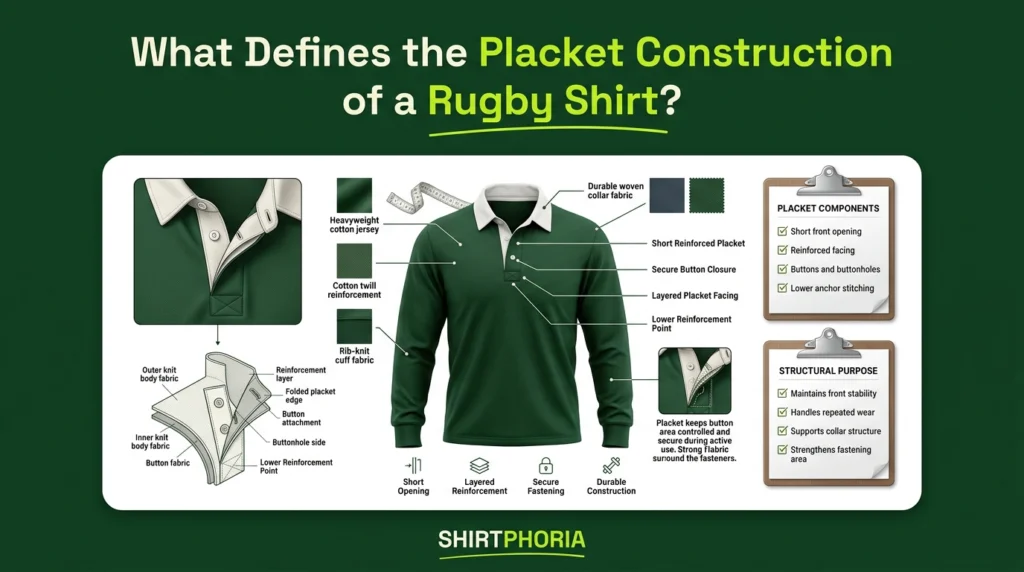
A heritage-style rugby shirt placket is defined by how its opening, facing, reinforcement, seams, buttons, and buttonholes work with the knitted body fabric rather than by one mandatory material or stitch pattern.
A rugby shirt placket is the partial front opening below the collar that allows the neckline to open and close. Heritage-style shirts often make this area visually prominent, but construction varies considerably between products. Modern match jerseys may use a much smaller opening, reduced collar, or a completely different performance-oriented system.
Placket quality is therefore local evidence rather than proof of whole-garment durability. The body fabric, shoulder seams, cuffs, collar attachment, vents, fit, finishing, and dimensional stability still matter.
Five connected systems deserve attention: facing material, reinforcement or interlining, seams, buttons and buttonholes, and the placket-base junction.
Visual inspection can expose distortion or poor sewing, but it cannot determine laboratory seam strength.
Quick Answer
A well-constructed rugby-shirt placket uses materials and sewing methods that remain compatible with the knitted body, buttons, and laundering conditions. Check alignment, seam integrity, buttonhole fit, and local distortion. Cotton drill, tape, fusible interlining, and sew-in support can all work; no single material or construction method proves quality by itself.
Which Rugby-Shirt Placket Does This Guide Evaluate?
This guide primarily evaluates the heritage-style rugby-shirt placket used on retro, casual, and traditional rugby-inspired garments.
It uses modern matchwear only as a comparison.
The guide does not assume that every rugby garment contains:
- heavy cotton drill;
- herringbone tape;
- fusible interlining;
- sew-in interlining;
- rubber buttons;
- a square base;
- an angled base;
- a box stitch;
- a triangular reinforcement;
- identical internal support.
The central rule is:
Identify the garment category before judging its construction.
A fashion rugby-style shirt may reproduce the collar, stripes, placket, or other heritage cues without using construction designed for the same loads as a traditional sporting garment.
Why Is Rugby Shirt Placket Construction an Important Quality Signal?
Rugby shirt placket construction is an important quality signal because several materials, seams, closures, and alignment points meet within a small garment area.
This concentration makes the placket a high-information inspection zone.
A buyer can often observe:
- cutting accuracy;
- material alignment;
- seam control;
- buttonhole execution;
- button attachment;
- finishing consistency;
- local puckering;
- material compatibility.
A good placket still does not cancel problems elsewhere.
A shirt with a clean front opening can have weak side seams, poor cuff recovery, unstable body fabric, or excessive shrinkage.
The placket should therefore be used as one part of a complete garment assessment.
How Does a Rugby Shirt Placket Combine Structure and Appearance?
A rugby shirt placket combines structure and appearance by supporting the opening and closures while maintaining the intended neckline shape.
Its functional jobs can include:
- creating the partial opening;
- supporting buttonholes;
- providing attachment areas for buttons;
- managing the transition between knitted and supporting materials;
- maintaining front alignment.
The relationship is:
Compatible Placket Components → Support Closure and Alignment → Reduce Avoidable Local Distortion
Common problems include:
- curling;
- puckering;
- spreading;
- twisting;
- seam opening;
- buttonhole distortion.
A placket that twists strongly when buttoned may indicate an alignment problem, material mismatch, or sewing issue.
A placket that feels extremely rigid can also be unsuitable if it forces a soft knitted body to buckle around it.
Maximum stiffness is not the objective.
The placket does not independently establish whole-garment durability.
What Do Heritage Rugby Shirt Placket Examples Establish?
Heritage rugby shirt examples establish that traditional-looking plackets can use different reinforcement and closure details rather than one mandatory construction.
For example, Canterbury currently describes one long-sleeved retro jersey as using rubber buttons, herringbone tape at the placket, traditional stitch detailing, and triple bar-tack detailing at the side vents. This documents one real heritage-style product configuration rather than an industry-wide standard.
Canterbury retro rugby jersey example
That example demonstrates why visible heritage features should be interpreted carefully.
Herringbone tape is not mandatory.
Rubber buttons are not mandatory.
Triple bar tacks do not automatically prove seam strength.
Each detail needs to be judged by how it functions within the actual garment.
How Do Materials Stabilize Rugby Shirt Placket Construction?
Materials stabilize rugby shirt placket construction when their stretch, weight, shrinkage, and stiffness remain compatible with the body fabric and intended opening.
Several material systems can appear in or around a rugby placket:
- a facing;
- woven reinforcement;
- tape;
- interlining;
- the knitted body itself.
A placket facing is a fabric layer or folded component that forms or supports the opening.
Reinforcement means added material or sewing intended to support a specific area.
Interlining is a supporting layer placed between garment components where extra stability, body, or handling performance is required.
These terms describe different functions.
They should not be treated as interchangeable.
Other collared knitted shirts can use different partial-opening systems, as illustrated by broader polo shirt construction, but a rugby placket should be evaluated from its own materials and assembly rather than assumed to follow a polo formula.
How Can Woven Fabric Support Rugby Shirt Placket Construction?
A woven facing can support rugby shirt placket construction by providing different stretch and shape characteristics from the knitted body.
Traditional-looking shirts may use:
- cotton drill;
- twill;
- poplin;
- another woven fabric.
Cotton drill is a woven cotton fabric normally recognized by its diagonal twill structure.
A compatible woven facing can potentially provide:
- local button support;
- controlled front shape;
- reduced uncontrolled stretching;
- a distinct visual finish.
The relationship is:
Compatible Woven Facing → Modifies Local Stretch and Shape → Supports the Intended Opening
However, the woven material must work with the knitted body.
Possible failures include:
- excessive stiffness;
- differential shrinkage;
- puckering;
- edge distortion;
- body-fabric buckling.
A heavy facing may feel substantial but can create problems if the body knit is lightweight or highly flexible.
Material compatibility matters more than simply choosing the heaviest option.
How Can Tape Reinforce Rugby Shirt Placket Construction?
Tape can reinforce rugby shirt placket construction by stabilizing a selected edge or seam without requiring a complete heavy facing.
Possible materials include twill tape and herringbone tape.
Herringbone tape uses a characteristic V-shaped woven pattern.
Twill tape uses a diagonal weave structure.
Their performance depends on more than their names.
Relevant variables include:
- width;
- fibre composition;
- stretch;
- placement;
- stitch method;
- body-fabric compatibility.
Tape can be used selectively where a designer wants control along an edge or opening.
It should not automatically be interpreted as cheaper or weaker than a full woven facing.
A badly placed heavy tape can cause distortion.
A correctly matched lighter tape can work effectively.
The finished behaviour is the useful evidence.
How Does Interlining Affect Rugby Shirt Placket Construction?
Interlining affects rugby shirt placket construction by adding support between layers where the design requires greater stability, flexibility, or shape control.
Two broad categories are relevant.
Fusible interlining contains an adhesive system that bonds the support layer to another fabric through a controlled manufacturing process.
Sew-in interlining is mechanically incorporated into the component without permanently bonding its full surface through adhesive.
Both are legitimate construction methods.
Freudenberg Performance Materials describes shirt interlinings as being available in both fusible and non-fusible forms and in different materials, weights, and thicknesses. It also identifies plackets among the shirt components where interlining may be used.
Freudenberg shirt interlining guide
Selection can depend on:
- body fabric;
- facing fabric;
- desired stiffness;
- desired flexibility;
- drape;
- laundering conditions;
- adhesive compatibility;
- manufacturing method.
When Can Fusible Interlining Fail?
Potential failure conditions can include:
- inadequate bonding;
- incompatible adhesive;
- unsuitable processing conditions;
- fabric incompatibility;
- laundering beyond the system’s intended conditions.
Visible problems may include:
- bubbling;
- delamination;
- ridging;
- localized stiffness;
- distortion.
Delamination means bonded layers begin separating.
A correctly selected fusible system does not inherently have to bubble.
The failure depends on the complete material and processing system.
When Can Sew-In Interlining Fail?
Sew-in support can also fail.
Possible problems include:
- shifting;
- bunching;
- excessive bulk;
- poor anchoring;
- shrinkage mismatch.
Sew-in construction is therefore not automatically more durable or higher quality.
Interlining Type → Changes Support Method → Does Not Establish Quality by Itself
The correct question is whether the chosen system remains compatible with the facing, knitted body, seams, and care process.
How Do Rugby Shirt Placket Components Work Together?
Rugby shirt placket components work together through the interaction of the opening, facing, seams, buttons, buttonholes, and base junction.
The finished placket should operate as one system.
A stable facing can still perform poorly if the buttons and buttonholes are badly matched.
Strong buttonholes can still become distorted if the facing shrinks differently from the body fabric.
A reinforced base can still fail visually if seam tension causes severe puckering.
What Function Does the Rugby Shirt Placket Facing Perform?
The rugby shirt placket facing forms or supports the opening and provides material around the button and buttonhole locations.
A facing can take several forms:
- folded fabric extension;
- separate woven strip;
- layered knitted component;
- tape-supported system.
It is not necessarily visible.
It is also not necessarily woven.
When evaluating a facing, inspect:
- front alignment;
- edge control;
- seam allowances where visible;
- material compatibility;
- local puckering;
- twisting;
- curling.
A useful facing keeps the opening controlled without causing the surrounding knit to behave unnaturally.
How Do Buttons Affect Rugby Shirt Placket Quality?
Buttons affect rugby shirt placket quality through their size, attachment, flexibility, and compatibility with the buttonholes.
Some heritage products use rubber buttons.
Others may use:
- plastic;
- resin;
- metal;
- other button materials.
Button material alone does not establish construction quality.
More useful inspection points are:
- secure attachment;
- smooth edges;
- appropriate diameter;
- compatibility with the buttonhole;
- practical replaceability.
Button Too Small
An undersized button may:
- release too easily;
- allow gaping;
- reduce closure security.
Button Too Large
An oversized button may:
- require excessive force;
- stretch the buttonhole;
- distort surrounding material;
- accelerate edge wear.
Functional Range
The button should pass through the opening with normal fastening force and remain secure during intended wear.
How Do Buttonholes Affect Rugby Shirt Placket Quality?
Buttonholes affect rugby shirt placket quality through their length, edge coverage, end security, and compatibility with the selected buttons.
A buyer should inspect for:
- uncut fibres;
- fraying;
- skipped stitches;
- loose thread;
- incomplete ends;
- puckering;
- excessive stiffness.
More stitching is not automatically better.
A very dense buttonhole can become rigid or potentially damage the surrounding material if poorly executed.
A very loose buttonhole may fray or open.
The objective is controlled coverage and useful closure.
Button + Compatible Buttonhole → Secure Closure → Reduced Unnecessary Local Distortion
The button should not need destructive force to pass through the opening.
Why Is the Rugby Shirt Placket Base Junction Important?
The rugby shirt placket base junction is important because the opening ends at a transition where facing, body fabric, and reinforcement seams may meet.
This creates a locally complex construction area.
Possible risks include:
- concentrated seams;
- puckering;
- downward tearing;
- thread breakage;
- fabric distortion.
Manufacturers may use different reinforcement methods, including:
- box-shaped stitching;
- triangular stitching;
- Bar Tacks;
- additional fabric;
- other product-specific solutions.
A Bar Tack is a dense localized group of stitches used to reinforce a selected point.
Visible reinforcement can indicate where additional construction has been applied.
It does not prove tested strength.
How Should Rugby Shirt Placket Base Construction Be Compared?
Rugby shirt placket base construction should be compared through alignment, material handling, and seam execution rather than through a universal ranking of square and angled finishes.
The geometry tells the reader how the component has been finished.
It does not independently reveal durability.
How Does a Square Rugby Shirt Placket Base Function?
A square or rectangular rugby shirt placket base creates a defined horizontal termination where the opening meets the shirt body.
Construction may include:
- horizontal stitching;
- Box Reinforcement;
- a Bar Tack;
- another seam configuration.
The buyer should inspect:
- symmetry;
- corner puckering;
- stitch continuity;
- seam opening;
- fabric damage.
A clean square base can perform well.
A badly sewn square base can distort or fail.
The shape itself is not proof of greater strength.
How Does an Angled Rugby Shirt Placket Base Function?
An angled or miter-like rugby shirt placket base changes how the facing edges meet and how the junction appears.
The exact geometry varies.
It should not automatically be described as a precise 45-degree construction unless the garment actually uses that angle.
Useful inspection points include:
- matching angles;
- flatness;
- controlled seam allowance;
- puckering;
- left-to-right symmetry.
An angled finish can look carefully executed when its components align cleanly.
It can also perform poorly if the sewing or material handling is inaccurate.
Which Rugby Shirt Placket Base Is Better?
Neither rugby shirt placket base is universally better because performance depends on material, seam type, reinforcement, manufacturing accuracy, and intended use.
A square base can pass or fail.
An angled base can pass or fail.
The buyer should compare:
- alignment;
- seam integrity;
- distortion;
- reinforcement;
- material compatibility.
Base geometry identifies the construction method; execution determines whether that method works.
How Do Seams Determine Rugby Shirt Placket Quality?
Seams determine rugby shirt placket quality through their type, thread, dimensions, material compatibility, and resistance to opening or slippage.
A stitch is an individual thread formation.
A seam is the structural join where materials are assembled.
These concepts should not be confused.
Coats describes seams as joins where layers are held together by stitches and notes that assembly seams can be load-bearing. Its technical guidance also distinguishes properties such as seam size, seam-slippage strength, and seam strength.
Coats seam types technical guide
Visible stitch quantity therefore does not provide a complete seam-quality verdict.
Structural stitching should also be distinguished from decorative Topstitching.
What Can Visible Rugby Shirt Placket Stitching Reveal?
Visible rugby shirt placket stitching can reveal consistency and defects, but it cannot establish seam strength without testing.
Check for:
- skipped stitches;
- broken thread;
- loose loops;
- inconsistent spacing;
- seam puckering;
- crooked stitch lines;
- needle damage.
A clean row provides useful evidence that the sewing operation appears controlled.
Several clean rows can indicate that several lines of stitching were applied.
They do not reveal exactly how much force the seam can withstand.
Excessive or poorly controlled stitch density can also cause problems.
Too many needle penetrations in a small area may:
- perforate fabric;
- increase stiffness;
- create puckering;
- contribute to local damage.
The functional target is sufficient, consistent stitching without damaging the materials being joined.
What Requires Testing Beyond Rugby Shirt Placket Inspection?
Rugby shirt placket inspection cannot determine the force required to break, slip, or open a seam.
Controlled testing is required to establish properties such as:
- Seam Strength;
- Seam Slippage;
- repeated-load fatigue;
- defined button-pull performance.
A buyer pulling forcefully on a shirt in a store does not reproduce those tests.
Manual inspection can identify:
- already-open seams;
- damaged thread;
- obvious instability;
- visible distortion.
Product-level strength evidence needs to come from the manufacturer or a relevant testing body.
What the Evidence Establishes
- A documented Canterbury retro rugby jersey uses rubber buttons and herringbone tape at its placket, demonstrating one real heritage-style configuration.
- Shirt interlinings can be fusible or sew-in, with different materials, weights, and thicknesses providing different support characteristics.
- Seam quality involves seam construction, dimensions, slippage, and strength rather than visible stitch-row count alone.
These sources define valid construction principles and examples; they do not certify the quality of a specific rugby shirt without product-level inspection or testing.
How Can a Rugby Shirt Placket Be Inspected Consistently?
A rugby shirt placket can be inspected consistently by recording its category, material information, alignment, closure condition, base construction, visible defects, and post-wash behaviour under repeatable conditions.
This is a practical Shirtphoria buyer-inspection method.
It is not:
- an ASTM test;
- an ISO test;
- a seam-strength certification;
- a button-pull certification;
- a lifespan guarantee.
Step 1: Identify the Garment Category
Determine whether the product is:
- heritage-style;
- modern matchwear;
- fashion rugby-inspired.
Record available:
- fibre information;
- care-label information;
- placket specifications.
Separate published facts from visual assumptions.
Strong result: Product category and relevant specifications are clear.
Conditional result: Some information is missing, but no unsupported technical guarantee is made.
Poor result: Strong construction or durability claims are made without usable specifications or evidence.
Step 2: Check Rugby Shirt Placket Alignment
Lay the garment flat without stretching it.
Fasten all buttons.
Observe the intended centreline at:
- top;
- middle;
- base.
Where precise comparisons are needed, a ruler can be used to record deviation in millimetres.
Do not convert the measurement into a universal industry limit.
Strong result: The placket remains functionally aligned and buttons close without abnormal tension.
Conditional result: Minor cosmetic deviation exists without changing closure or intended appearance.
Poor result: Persistent twisting, severe asymmetry, spreading, or repeated manual repositioning interferes with use.
Step 3: Check Button and Buttonhole Compatibility
Open and close each button several times using normal force.
For a repeatable comparison, the same short sequence can be used on each garment.
Inspect before and after for:
- fraying;
- stretching;
- skipped stitches;
- distortion;
- button loosening.
A five-cycle comparison can be used as an editorial consistency method, but it is not a durability or fatigue test.
Strong result: Buttons operate normally without visible damage or accidental release.
Conditional result: Minor resistance or cosmetic irregularity occurs without functional failure.
Poor result: A button detaches, the buttonhole tears, fastening requires excessive force, or the closure opens unintentionally.
Step 4: Inspect the Rugby Shirt Placket Base Junction
Inspect the base with the placket open.
Then inspect it with the buttons closed.
Look for:
- puckering;
- broken thread;
- fabric splitting;
- seam opening;
- geometry differences.
Where seam opening is visible, record its size for comparison rather than assigning an unsupported universal limit.
Strong result: The junction remains closed, aligned, and functional.
Conditional result: Minor cosmetic puckering exists without opening or progressive damage.
Poor result: Fabric splitting, open seams, broken reinforcement, or functional distortion is present.
Step 5: Check Material Compatibility
Compare the placket and body materials through gentle normal handling.
Do not pull destructively.
Look for:
- differential curling;
- puckering;
- buckling;
- an overly stiff placket forcing the body knit out of shape.
Strong result: Components remain compatible during normal handling.
Conditional result: Minor differences in stiffness or drape appear without functional distortion.
Poor result: The placket buckles, pulls the body fabric, persistently curls, or interferes with normal closure.
Step 6: Check Wash Stability After Purchase
This check applies only after ownership and only when the care label is followed.
Before washing, record:
- placket length;
- width;
- centreline position;
- facing flatness;
- buttonhole condition;
- base-junction condition.
Then:
- follow the care label;
- reshape only as directed;
- dry as instructed;
- allow the garment to settle;
- repeat the observations.
Strong result: The placket remains functional without unacceptable distortion, delamination, or seam opening.
Conditional result: Measurable change occurs, but the opening remains functional and acceptable for the intended use.
Poor result: Bubbling, Delamination, severe puckering, seam opening, or closure failure prevents normal use.
One home laundering cycle is ownership validation, not proof of long-term durability.
What Final Rugby Shirt Placket Assessment Can Be Made?
The final assessment should reflect both what was observed and the level of evidence available.
Evidence-Supported Placket
Use this conclusion when:
- inspection passes;
- relevant specifications are clear;
- strong performance claims have product-level support.
Structurally Promising but Unverified
Use this conclusion when:
- visual and functional inspection passes;
- laboratory or manufacturing evidence is unavailable.
This is often the most defensible conclusion from ordinary consumer inspection.
Conditional Placket
Use this conclusion when:
- no critical failure exists;
- one or more limitations narrow the intended use.
Poor Match or Defective Placket
Use this conclusion when:
- closure fails;
- seams open;
- buttons detach;
- material distortion prevents normal use;
- serious post-wash failure appears.
What Failure Modes Affect Rugby Shirt Placket Construction?
Rugby shirt placket construction fails when material support, flexibility, alignment, or closure moves outside the functional range required by the garment.
Stability Failure
Too little support may produce:
- curling;
- spreading;
- buttonhole stretching;
- poor visual alignment.
Too much support may produce:
- excessive stiffness;
- knitted-body buckling;
- discomfort;
- poor drape.
Functional zone: The placket remains stable without forcing the surrounding knit to distort.
Interlining Failure
Insufficient or incompatible support may produce:
- collapse;
- stretching;
- buttonhole distortion.
Excessive or incompatible support may produce:
- stiffness;
- bubbling;
- ridging;
- shrinkage mismatch.
Functional zone: The support system remains compatible with facing, body fabric, and care method.
Buttonhole Failure
Too loose may produce:
- accidental opening;
- gaping;
- poor closure security.
Too tight may produce:
- difficult fastening;
- edge damage;
- stretching;
- distortion.
Functional zone: The button passes with normal force and remains secure.
Stitching Failure
Too little or inconsistent stitching may produce:
- incomplete coverage;
- loose ends;
- seam opening;
- fraying.
Excessive or poorly controlled stitching may produce:
- perforation;
- puckering;
- stiffness;
- needle damage.
Functional zone: The stitches secure the materials without unnecessarily damaging them.
Base-Junction Failure
Insufficient reinforcement may produce:
- local seam opening;
- fabric splitting;
- downward tearing.
Excessive or poorly placed reinforcement may produce:
- stiffness;
- puckering;
- concentrated stress;
- distortion.
Functional zone: The junction remains closed and structurally compatible with the rest of the opening.
How Can One Rugby Shirt Placket Failure Trigger Another?
A material mismatch can cause a sequence of problems:
Incompatible Interlining or Facing → Differential Shrinkage → Placket Puckering → Button Misalignment → Concentrated Buttonhole Stress → Closure Failure
Another possible sequence is:
Poor Base-Junction Sewing → Thread Breakage → Seam Opening → Fabric Distortion → Increased Loading Around Remaining Stitches → Progressive Local Damage
Differential shrinkage means different materials change dimensions by different amounts during laundering or other exposure.
It is especially important where a stable woven element meets a stretchier knitted body.
What Should a Buyer Check in Rugby Shirt Placket Construction?
A buyer should evaluate rugby shirt placket construction through alignment, component compatibility, visible seam condition, and closure function rather than through one traditional feature.
What Does the Rugby Shirt Placket Construction Matrix Show?
Rugby Shirt Placket Construction and Evidence Matrix
| Component | Potential Function | Buyer-Observable Signals | What Requires Testing or Specification |
|---|---|---|---|
| Placket Facing | Forms and supports the opening | Alignment, curling, puckering, edge quality | Fibre, weave, shrinkage, material performance |
| Tape Reinforcement | Stabilizes selected edge or seam | Placement, width, stitch consistency | Tensile and repeated-load behaviour |
| Interlining | Adjusts stability, flexibility, or shape | Bubbling, ridging, excessive stiffness | Type, weight, adhesive system, laundering compatibility |
| Button | Creates closure | Attachment, edges, size, flexibility | Material identity and defined pull performance |
| Buttonhole | Receives and secures button | Fraying, fit, coverage, end security | Repeated-cycle and load performance |
| Base Junction | Terminates and supports opening | Symmetry, puckering, seam opening, splitting | Seam Strength and Seam Slippage |
| Visible Stitching | Secures or decorates components | Skipped stitches, broken thread, consistency | Structural role and seam performance |
| Finished Placket | Supports use and appearance | Closure, alignment, post-wash condition | Long-term wear and laboratory durability |
Visual inspection can support a buying decision.
It cannot certify Seam Strength or garment lifespan.
Key Takeaway
A rugby-shirt placket should be judged as a system. Facing, tape, interlining, seams, buttons, and buttonholes must remain compatible with the knitted body and care process. Traditional materials can be useful, but no material, base geometry, button type, or stitch pattern proves quality without competent execution and product-level evidence.
Frequently Asked Questions About Rugby Shirt Placket Construction
A good rugby-shirt placket uses compatible materials, controlled alignment, secure seams, properly matched buttons and buttonholes, and a stable base junction without forcing the knitted body to distort.
No. Cotton drill can be used as a woven facing, but twill, poplin, tape-supported systems, knitted facings, fusible support, or sew-in support can also work when they are compatible with the garment.
No. Both can perform well when correctly specified. Fusible systems can fail through bubbling or delamination, while sew-in systems can fail through shifting, bunching, or excess bulk.
Neither is universally better. Square and angled bases should be judged by alignment, seam execution, reinforcement, distortion control, and material compatibility rather than geometry alone.
No. Visible stitching can reveal skipped stitches, puckering, broken thread, or poor control, but laboratory or manufacturer evidence is needed to establish seam strength, seam slippage, repeated-load fatigue, or button-pull performance.
Terms Explained
| TERM | DEFINITION |
|---|---|
| Rugby shirt placket | The partial front opening below the collar that allows a rugby shirt neckline to open and close. |
| Placket facing | A fabric layer or folded component that forms or supports the opening. |
| Reinforcement | Added material or sewing used to support a specific garment area. |
| Interlining | A support layer placed between garment components to add stability, body, or handling performance. |
| Fusible interlining | Interlining bonded to fabric using an adhesive system and controlled heat and pressure. |
| Sew-in interlining | A support layer mechanically sewn into a garment component without full-surface adhesive bonding. |
| Herringbone tape | A woven tape with a characteristic V-shaped pattern used for local reinforcement or stabilization. |
| Buttonhole compatibility | The relationship between button size, buttonhole size, edge control, and normal fastening force. |
| Base junction | The lower end of the placket where facing, body fabric, seams, and reinforcement may meet. |
| Seam slippage | Movement of fabric yarns or material at a seam under load, potentially creating an opening without thread breakage. |
| Differential shrinkage | Unequal dimensional change between different materials during laundering or other exposure. |
| Bar tack | A dense localized stitch formation used to reinforce a selected point. |
What Is the Final Principle of Rugby Shirt Placket Construction?
The final principle of rugby shirt placket construction is compatibility: every layer, seam, and closure must support the opening without creating a new source of distortion or failure.
Facing and reinforcement should control the opening without forcing the knitted body out of shape. Fusible and sew-in interlining can both work when correctly specified. Buttons and buttonholes should operate together without destructive force.
Square and angled bases should be judged by execution rather than geometry alone, while visible stitching can reveal defects without proving Seam Strength.
The practical outcomes remain evidence-supported, structurally promising but unverified, conditional, or poor match.
The placket is a useful quality-inspection area, but it is not the sole indicator of the shirt’s durability.
A rugby-shirt placket demonstrates quality when its materials, alignment, seams and closures continue to perform as one compatible system.