How Should a Work Shirt Provide Utility Through Fabric Performance and Functional Fit?
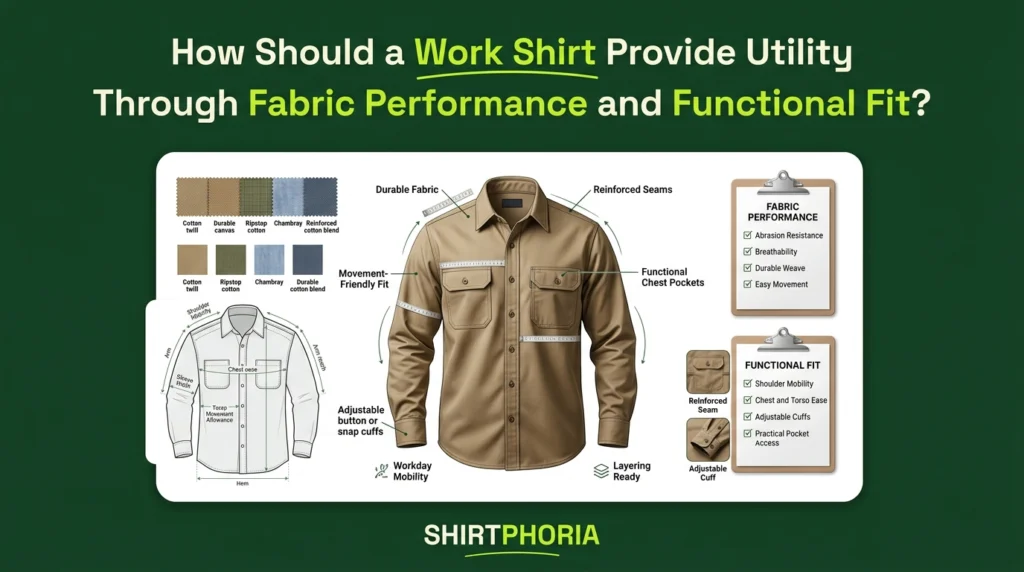
A work shirt provides utility through two connected systems: fabric performance, which supports durability and environmental comfort, and functional fit, which allows movement without unnecessary pulling, binding, or exposure.
Work shirt utility depends on both material behavior and body movement. A shirt is not automatically useful for work because it looks rugged, uses heavy fabric, or includes multiple pockets. Its materials and construction need to match the actual tasks, climate, movement demands, and wear conditions.
A durable fabric can still perform poorly if the shirt restricts reaching, bending, or lifting. A highly mobile fit can also fail if the fabric wears quickly, remains uncomfortable when wet, or lacks the protection needed for the work environment.
The correct fabric and fit can support comfort, movement, coverage, and task readiness. They do not replace certified protective equipment, job-site safety procedures, sun-protection practices, or ergonomic controls.
This guide explains how to evaluate a work shirt through fabric durability, moisture behavior, UPF protection, stretch, gusseting, torso coverage, reinforcement, and movement tests.
This work-task focus is different from the everyday comfort logic of a casual shirt.
Why Does Work Shirt Utility Depend on Both Fabric and Fit?
Work shirt utility depends on both fabric and fit because fabric determines how the shirt handles abrasion, moisture, sun, and repeated wear, while fit determines whether the wearer can move without avoidable restriction.
The relationship is:
Fabric + Fit → Task Compatibility → Work Shirt Utility
These two systems are separate but connected.
Fabric performance influences how well the material tolerates the conditions surrounding the wearer.
Functional fit influences how effectively the garment accommodates the body’s movements.
A highly durable fabric is not enough if the shirt pulls sharply across the shoulders every time the wearer reaches overhead.
A loose and mobile shirt is also not enough if the fabric tears quickly when repeatedly exposed to rough surfaces.
The most useful work shirt balances both.
How Can Fabric Performance Support Work Comfort?
Fabric performance supports work comfort by influencing how the shirt handles abrasion, moisture, heat, sunlight, and repeated wear.
Abrasion resistance matters when the shirt repeatedly contacts:
- Tools
- Straps
- Rough wood
- Metal
- Brush
- Equipment
- Work surfaces
- Harnesses
Repeated friction can weaken a fabric over time.
A fabric selected for frequent contact with rough materials should therefore provide enough resistance for that task.
Moisture behavior matters for a different reason.
A shirt that absorbs substantial sweat and remains saturated can become:
- Heavy
- Damp
- Clingy
- Slow to dry
- Uncomfortable against the skin
This does not mean one moisture-management technology works best for every user.
Climate, humidity, activity level, fiber, fabric construction, and personal comfort all affect the result.
Fabric can support work comfort, but it does not directly guarantee better productivity.
How Can Functional Fit Support Work Movement?
Functional fit supports work movement by giving the shoulders, sleeves, underarms, and torso enough room to move without excessive pulling or fabric lift.
Many work tasks require the body to move beyond a neutral standing position.
The wearer may need to:
- Bend
- Twist
- Reach
- Lift
- Climb
- Squat
- Work overhead
- Extend the arms repeatedly
NIOSH identifies awkward postures and overhead work among physical risk factors associated with work-related musculoskeletal disorders. NIOSH
This does not mean that a restrictive work shirt directly causes an injury.
The more accurate relationship is:
Restrictive Fit → Can Encourage Awkward Movement Compensation → May Increase Movement Discomfort
A compensatory posture is a body adjustment used to complete a task when normal movement is limited or awkward.
For example, if a shirt is too tight through the upper back, a worker may rotate the torso or raise the shoulder differently to gain additional reach.
A well-fitted work shirt should reduce garment-caused interference rather than force the wearer to move around the clothing.
Work Shirt Utility Matrix: How Do Fabric and Fit Create Performance Tiers?
A work shirt utility matrix helps separate basic rugged shirts from higher-utility work shirts by comparing fabric performance, fit features, and likely task outcome.
| Level | Fabric Performance | Functional Fit | Utility Outcome |
|---|---|---|---|
| Basic | Heavy cotton or cotton drill with limited active moisture control | Boxy standard cut with limited specialized mobility features | Durable for lighter work but may become warm or restrictive during highly active tasks |
| Advanced | Cotton/poly blend, ripstop, or treated fabric with improved moisture behavior or durability | Back pleats, suitable armholes, and task-friendly torso length | Better balance between movement, durability, and comfort in mixed work settings |
| Pro-Utility | Reinforced ripstop, CORDURA® panels or blends, rated UPF, stretch fibers, or task-specific finishes | Underarm gussets, articulated sleeves, reinforced seams, and coverage-aware torso length | High work utility when the features match the actual job and environment |
The highest feature count is not automatically the best choice.
A heavily reinforced work shirt may be unnecessary for light indoor work.
A lightweight shirt may be more appropriate in a hot environment with limited abrasion exposure.
The correct tier depends on the task.
How Should Fabric Performance Be Evaluated for Work Shirt Utility?
Fabric performance should be evaluated for work shirt utility by checking durability, moisture behavior, sun protection, stretch, and finish claims against the work environment.
Thickness alone is not a complete performance test.
A thick fabric may still:
- Restrict movement
- Retain too much heat
- Dry slowly
- Have weak seams
- Provide poor comfort for the specific climate
Likewise, a lighter fabric may be highly useful when heat, movement, and low bulk matter more than maximum abrasion resistance.
The correct approach is to identify the dominant work condition first.
Abrasion-Heavy Work
Look for materials and construction designed to tolerate repeated friction.
Possible features include:
- Dense woven fabric
- Reinforced panels
- Ripstop construction
- CORDURA® reinforcement
- Strong seam construction
- Reinforced elbows or shoulders
Hot or Sweat-Heavy Work
Prioritize:
- Comfortable fabric weight
- Airflow
- Moisture behavior
- Drying characteristics
- Movement freedom
Outdoor Sun Work
Look for a clear UPF rating when ultraviolet protection is an important requirement.
Light Wet Exposure
A water-repellent finish may help with light moisture, but it should not be confused with waterproof outerwear.
Movement-Heavy Work
Look for:
- Elastane or Spandex
- Underarm gussets
- Back pleats
- Articulated sleeves
- Movement-compatible armholes
Not every job requires every feature.
How Do Ripstop and CORDURA® Affect Work Shirt Durability?
Ripstop and CORDURA® affect work shirt durability by adding tear-control structure or high-abrasion-resistance materials to areas that face repeated wear.
Ripstop is a woven structure that typically includes stronger reinforcing yarns arranged in a grid.
Its practical purpose is to help control the spread of damage after a tear begins.
The useful relationship is:
Reinforced Fabric → Resists Abrasion or Tear Spread → Can Extend Workwear Use
Ripstop should not be described as tear-proof.
Its performance still depends on:
- Fiber type
- Yarn strength
- Fabric weight
- Weave
- Finish
- Seam construction
- Type of damage
CORDURA® materials are also associated with durability-focused workwear and equipment. CORDURA® describes its Classic Fabric as offering excellent tear strength and resistance to abrasion. CORDURA®
In work shirts, reinforcement may be especially useful around:
- Shoulders
- Elbows
- Pocket edges
- Cuffs
- High-contact zones
There is also a tradeoff.
More reinforcement can increase:
- Weight
- Stiffness
- Heat retention
- Bulk
The strongest possible fabric is not automatically the most useful shirt fabric.
Durability needs to match the actual abrasion level.
How Should Moisture, Heat, and DWR Claims Be Treated?
Moisture, heat, and DWR claims should be treated as task-specific fabric claims rather than automatic proof that a work shirt has high utility.
A moisture-wicking claim should be interpreted in the context of:
- Fiber
- Fabric construction
- Humidity
- Sweat rate
- Air movement
- Garment fit
- Temperature
The user’s actual environment matters more than a marketing term alone.
Cotton provides a useful example.
Cotton can feel breathable, familiar, and comfortable in many work settings.
However, when heavily saturated with sweat or water, some cotton fabrics may become heavier and remain damp for longer.
That does not make cotton unsuitable for all work.
Its usefulness depends on the job.
What Does DWR Mean?
DWR means Durable Water Repellent.
A DWR finish can help some fabrics shed light surface moisture.
It does not automatically make a work shirt:
- Waterproof
- Rainproof
- Stormproof
- Impermeable
A DWR-treated work shirt may be useful when the wearer encounters light splashes or short periods of moisture exposure.
The result depends on the treatment, fabric, wear condition, laundering, and exposure.
How Does UPF Improve Work Shirt Sun Protection?
UPF improves work shirt sun protection by rating how effectively fabric reduces ultraviolet radiation passing through the garment.
UPF means Ultraviolet Protection Factor.
The Skin Cancer Foundation describes UPF 30 to 49 as very good protection and UPF 50+ as excellent. Skin Cancer Foundation
The functional relationship is:
Rated UPF Fabric → Reduces UV Transmission → Supports Protection of Covered Skin
The phrase covered skin matters.
A UPF work shirt does not protect uncovered areas such as:
- Face
- Hands
- Exposed neck
- Other uncovered skin
A UPF garment should therefore be part of a larger sun-protection strategy where prolonged outdoor exposure occurs.
A stated UPF rating is more useful than assuming protection from fabric thickness or color alone.
How Should Functional Fit Geometry Be Evaluated for Work Shirt Utility?
Functional fit geometry should be evaluated for work shirt utility by testing whether the shirt supports reaching, bending, twisting, and lifting without excessive pulling or exposure.
A work shirt does not need to be oversized to be functional.
The goal is controlled movement room.
Important areas include:
- Shoulders
- Upper back
- Armholes
- Underarms
- Sleeves
- Elbows
- Torso
- Hem
Static fitting is not enough.
The shirt should be tested through the movements required by the job.
How Do Underarm Gussets Support Mechanical Reach?
Underarm gussets support mechanical reach by adding fabric at the armpit so the sleeve can move without pulling the entire shirt body upward.
An Underarm Gusset is an additional fabric panel inserted into the underarm area.
It provides extra material where the sleeve and torso meet.
The functional relationship is:
Underarm Gusset → Decouples Sleeve Movement → Improves Overhead Reach
When the arm rises, a conventional sleeve may pull the body of the shirt upward depending on the cut.
A gusset can give the sleeve more movement capacity.
This may be useful for:
- Overhead lifting
- Reaching
- Climbing
- Equipment handling
- Repetitive arm work
A gusset does not guarantee good mobility.
Its performance still depends on:
- Overall shirt size
- Shoulder fit
- Sleeve shape
- Armhole construction
- Fabric stretch
A poorly fitted shirt does not become functional simply because it includes an underarm gusset.
How Do Articulated Sleeves Support Work Movement?
Articulated sleeves support work movement by shaping the sleeve closer to the positions the arm commonly takes during work.
An Articulated Elbow uses pattern shaping to accommodate a bent-arm position.
This may be created through:
- Darts
- Curved seams
- Multiple pattern panels
- Pre-shaped construction
The benefit is most relevant when the wearer repeatedly bends the elbows or holds the arms in working positions.
Articulation should still be proportional to the task.
A heavily articulated sleeve may provide little practical advantage for work involving limited arm movement.
How Do Torso Length and Hem Coverage Affect Work Shirt Fit?
Torso length and hem coverage affect work shirt fit by determining whether the shirt stays positioned during bending, reaching, and lifting.
The relationship is:
Adequate Torso Length → Maintains Coverage → Reduces Lower-Back Exposure
A work shirt that is too short may rise excessively when the wearer:
- Bends forward
- Reaches overhead
- Squats
- Climbs
- Lifts
A slightly longer torso can provide greater coverage.
Length can also become excessive.
A very long shirt may interfere with:
- Toolbelts
- Harnesses
- Trouser pockets
- Equipment
- Seated work
Tucked and untucked work shirts may therefore need different proportions.
Practical Coverage Test
Wear the shirt exactly as it will be worn during work.
Then:
- Reach overhead.
- Bend forward.
- Twist both directions.
- Squat.
- Sit down.
Check whether the lower torso remains appropriately covered without excessive fabric interfering with equipment.
How Do Stretch Fibers Affect Work Shirt Mobility?
Stretch fibers affect work shirt mobility by allowing the fabric to extend during reaching or bending and recover when the movement ends.
Elastane and Spandex refer to highly elastic fibers used to increase stretch and recovery.
The relationship is:
Elastane / Spandex → Adds Elastic Movement and Recovery → Can Reduce Pulling During Movement
Stretch can be useful around:
- Shoulders
- Upper back
- Sleeves
- Elbows
- Torso
Stretch should not be confused with durability.
A highly elastic fabric may still provide poor abrasion resistance for a particular task.
Too little useful stretch can cause restriction.
Too much uncontrolled stretch may cause:
- Bagging
- Sagging
- Reduced shape stability
The correct amount depends on the job and fabric construction.
How Does Work Shirt Utility Compare With a Standard Shirt?
Work shirt utility differs from a standard shirt because it prioritizes task durability, movement support, coverage stability, and rated performance features over ordinary daily comfort alone.
| Performance Metric | Work Shirt Utility | Standard Shirt Baseline | Practical Result |
|---|---|---|---|
| Abrasion Resistance | May use canvas, ripstop, CORDURA® panels, or reinforced high-wear areas | Usually uses fabric selected primarily for everyday comfort and appearance | A correctly specified work shirt can tolerate repeated rough contact more effectively |
| Stretch and Reach | May use elastane, gussets, pleats, or articulated sleeves | Often uses conventional shirt geometry | Work-oriented construction can reduce garment pulling during broader movement |
| Moisture Behavior | May use blends or finishes selected for sweat-heavy environments | Everyday cotton or linen fabrics vary widely in moisture behavior | Task-specific fabrics may improve comfort when matched to climate |
| Sun Protection | May include a stated UPF rating | Often carries no stated UPF specification | A rated work shirt gives clearer information for covered-skin sun protection |
| Reinforcement | May use reinforced seams, shoulders, cuffs, pockets, or abrasion panels | Usually uses construction intended for normal daily wear | Reinforcement can increase durability but may also add heat or stiffness |
| Torso Coverage | May use additional length for bending and active movement | Length commonly follows everyday or dress-shirt proportions | Work-oriented length can maintain better coverage during movement |
| Mobility Features | May include gussets, articulated elbows, pleats, or movement-oriented armholes | Often relies on standard sleeve and armhole construction | Mobility features can reduce garment-caused interference when correctly designed |
A standard shirt is not automatically inferior.
It serves a different purpose.
Work Shirt Utility Diagnostic Checklist
A work shirt should be evaluated through practical performance checks rather than an arbitrary point score.
Abrasion Check
The fabric should match the level of repeated contact expected during work.
Pay particular attention when the shirt regularly touches:
- Tools
- Straps
- Wood
- Metal
- Brush
- Equipment
Tear-Control Check
If tear propagation is a realistic concern, inspect whether the shirt includes:
- Ripstop construction
- Reinforcement
- Durable fabric
- Appropriate seams
No work shirt should be treated as tear-proof without specific evidence.
Moisture Check
Evaluate whether the fabric becomes excessively:
- Damp
- Heavy
- Clammy
- Slow to dry
Use the actual work climate as the standard.
UPF Check
If prolonged sun exposure is important, look for a stated UPF rating.
Do not infer a specific rating from appearance alone.
Stretch Check
Reach, bend, and twist.
The material should support the necessary motion without severe strain or permanent sagging.
Gusset and Mobility Check
For overhead or repetitive arm work, check whether the shirt’s:
- Gussets
- Armholes
- Pleats
- Sleeves
- Articulation
reduce unnecessary pulling.
Hem Coverage Check
Bend and reach.
The torso length should preserve coverage without interfering with:
- Toolbelts
- Harnesses
- Pockets
- Equipment
Seam Reinforcement Check
Inspect high-stress areas such as:
- Shoulders
- Underarms
- Side seams
- Cuffs
- Pockets
The reinforcement should match the actual task.
Comfort Boundary Check
Added durability becomes counterproductive if the shirt becomes excessively:
- Heavy
- Stiff
- Hot
- Restrictive
Safety Claim Check
A standard work shirt should not be treated as personal protective equipment unless it meets the relevant certified protective requirements.
What Failure Modes Can Reduce Work Shirt Utility?
Work shirt utility fails when fabric or fit attributes move too far in either direction, because both underbuilt and overbuilt designs can reduce comfort, movement, durability, or task compatibility.
| Attribute | Too-Low Failure | Too-High Failure | Corrective Hypothesis |
|---|---|---|---|
| Fabric Durability | Shirt abrades, tears, or wears too quickly for the task | Shirt becomes excessively heavy, stiff, or hot | Match durability to actual abrasion exposure rather than choosing the heaviest fabric |
| Moisture Management | Fabric remains damp, heavy, or clingy | A fast-drying fabric may still feel uncomfortable or inappropriate for the wearer | Match fiber and weave to climate, sweat level, and comfort |
| Stretch Recovery | Shirt restricts reaching, bending, and twisting | Fabric bags out or loses shape | Select moderate stretch with useful recovery |
| Underarm Mobility | Shirt binds or pulls upward during overhead movement | Excess fabric bunches and interferes with close work | Match gusset, sleeve, and armhole geometry to the task |
| Torso Length | Lower back becomes exposed during bending | Hem interferes with belts, harnesses, pockets, or seated work | Match length to wearing method and equipment |
| UPF Protection | No defined rating exists when sun exposure is important | Dense protective fabric may become uncomfortable in hot conditions | Balance stated UPF with ventilation and climate needs |
| Reinforcement | Stress areas fail prematurely | Reinforcement creates rubbing, heat, or stiffness | Reinforce the zones that actually receive repeated stress |
| DWR / Water Shedding | Fabric absorbs light moisture quickly | An unsuitable finish may affect comfort or deteriorate with wear | Use water-shedding finishes where light liquid exposure is relevant |
The central principle is balance.
More durability is not automatically better.
More stretch is not automatically better.
More reinforcement is not automatically better.
Each feature should solve a real work problem.
Checklist: How Can You Verify Work Shirt Utility Before Buying?
You can verify work shirt utility before buying by testing the shirt’s movement, fabric behavior, construction details, and specification labels against your real work tasks.
Reach Test
Raise both arms overhead.
Check whether:
- The shoulders bind
- Underarms restrict movement
- The hem rises excessively
- The placket pulls sharply
Forward-Reach Test
Extend both arms forward.
Look for severe tension across the upper back or shoulders.
Cross-Body Test
Move each arm across the chest.
Check whether the sleeve or armhole blocks the movement.
Bend Test
Bend forward and twist slightly.
Confirm that:
- Lower-back coverage remains appropriate
- The torso does not bind
- The hem does not interfere with tools
Fabric Specification Check
Look for available information on:
- Fiber content
- Ripstop
- CORDURA®
- Elastane / Spandex
- UPF
- DWR
- Moisture-management claims
Treat each claim according to what it actually measures.
Seam Check
Inspect:
- Shoulder seams
- Side seams
- Underarms
- Cuffs
- Pocket attachments
Look for construction appropriate to the level of stress expected.
Base-Layer Check
Try the work shirt over the layer normally worn underneath.
A shirt that fits comfortably over bare skin may become restrictive over a thermal or undershirt.
Comfort Check
Ask whether the durability features make the garment unnecessarily:
- Hot
- Heavy
- Stiff
- Bulky
Task-Match Check
Identify the primary requirement.
Is the shirt mainly needed for:
- Abrasion?
- Sun exposure?
- Sweat?
- Light moisture?
- Overhead work?
- Bending?
- Climbing?
- Toolbelt use?
Choose based on that requirement.
Claim Check
Treat marketing terms as claims to verify rather than proof of performance.
What Are the Key Takeaways of Work Shirt Utility?
What Are the Key Takeaways of Work Shirt Utility?
The key takeaways of work shirt utility show that a useful work shirt must combine task-appropriate fabric with movement-supporting fit.
Work Shirt Utility Summary
- Fabric and Fit Work Together: Durable material is insufficient if the shirt restricts movement, while excellent mobility is insufficient if the fabric cannot tolerate the work environment.
- Durability Must Match the Task: Ripstop, CORDURA®, canvas, and reinforced fabrics are most useful when abrasion or tear exposure justifies them.
- Movement Must Be Tested: Reaching, bending, twisting, and overhead tests reveal restrictions that static fitting may miss.
- Gussets Are Conditional: Underarm gussets can improve reach but work only as part of the complete fit system.
- Stretch Has Limits: Elastane or Spandex can improve movement without automatically increasing durability.
- Coverage Matters: Torso length should provide useful coverage without interfering with tools, belts, harnesses, or seated work.
- UPF Should Be Rated: A stated rating provides clearer information when sun protection is a major job requirement.
- DWR Has Limits: Water-repellent treatment can help with light moisture but does not make an ordinary work shirt waterproof.
- Reinforcement Has Tradeoffs: Reinforced zones can improve wear resistance while also adding heat, stiffness, or bulk.
- Comfort Matters: A shirt that is excessively heavy, hot, or restrictive may lose utility even if it is highly durable.
- Safety Boundaries Matter: Ordinary work shirts do not replace certified PPE or workplace safety controls.
- Marketing Claims Need Verification: Evaluate labels, materials, construction, fit, and real movement rather than rugged appearance alone.
Educational note: This guide explains work-shirt fabrics, fit, movement, coverage, and performance claims for general educational purposes. A standard work shirt does not replace certified PPE, job-site safety procedures, sun-protection practices, or ergonomic controls.
Interactive Work Shirt Utility Checklist
Frequently Asked Questions About Work Shirt Utility
The best work shirt fabric depends on the task. Abrasion-heavy work may benefit from ripstop, reinforced fabrics, canvas, or durable blends. Hot work may favor lighter moisture-conscious fabric, while prolonged outdoor work may benefit from rated UPF protection. No single fabric is ideal for every job.
A work shirt should provide enough room for reaching, bending, twisting, and planned base layers without becoming excessively loose. Tight construction can restrict movement, while too much volume can bunch or interfere with tools. The correct fit is task-specific and should be tested in motion.
Underarm gussets are not required on every work shirt. They can be useful for climbing, lifting, overhead reaching, and repetitive arm movement because they add movement capacity near the armpit. Their effectiveness still depends on the shirt’s overall size, armholes, sleeves, and fabric.
Cotton can work well when natural feel, comfort, and the fabric construction suit the job. Its performance depends on weight, weave, finish, climate, and moisture exposure. In sweat-heavy or wet conditions, some cotton fabrics may become saturated and feel heavier.
Terms Explained
| TERM | DEFINITION |
|---|---|
| Ripstop | A woven construction using reinforcing yarns arranged to help limit tear propagation. |
| CORDURA® | A durability-focused textile family associated with high abrasion and tear resistance in appropriate constructions. |
| DWR | Durable Water Repellent, a finish that can help fabric shed light surface moisture without automatically making it waterproof. |
| UPF | Ultraviolet Protection Factor, a rating indicating how effectively fabric reduces ultraviolet radiation reaching covered skin. |
| Underarm Gusset | An added fabric panel at the underarm that can provide extra movement capacity where the sleeve and torso meet. |
| Articulated Elbow | Pattern shaping that accommodates a bent-arm working position using darts, curved seams, or multiple panels. |
| Elastane / Spandex | Highly elastic fibers used to add stretch and recovery to fabric. |
| Functional Fit | Garment fit designed to accommodate task movements such as reaching, bending, twisting, lifting, and climbing. |
Conclusion
In conclusion, true work shirt utility comes from the balanced interaction of fabric performance and functional fit, not from rugged styling alone.
Fabric performance supports durability, environmental comfort, and task-specific material behavior.
Abrasion-resistant or reinforced textiles can provide greater wear resistance where rough contact occurs.
Ripstop can help control tear propagation.
CORDURA® materials can provide high abrasion and tear resistance when used appropriately.
Moisture behavior affects comfort in hot and sweat-heavy environments.
A stated UPF rating gives useful information when the wearer spends extended periods outdoors.
Functional fit supports a different part of the system.
The shoulders, upper back, armholes, sleeves, underarms, torso, and hem must accommodate the movements required by the job.
Underarm gussets may improve overhead reach.
Articulated sleeves may support repeated elbow bending.
Stretch fibers can reduce fabric pulling.
Appropriate torso length can preserve coverage during bending and lifting.
Each benefit also has a limit.
A heavily reinforced fabric can become too hot or stiff.
Excess stretch can reduce shape stability.
Too much underarm material can bunch.
An overly long shirt can interfere with belts and equipment.
A short shirt can expose the lower back during movement.
The useful work shirt therefore sits between underbuilding and overbuilding.
It matches durability to abrasion exposure, moisture behavior to climate, UPF to sun exposure, stretch and gusseting to movement, reinforcement to stress zones, and hem length to the actual work posture.
A work shirt can support comfort, movement, coverage, and task readiness, but it does not replace certified PPE, job-site safety practices, ergonomic controls, or other protective measures required for the work.
Choosing a work shirt well means matching fabric, fit, reinforcement, and coverage to the work your body actually performs.