Why Are Flap Chest Pockets a Signature Feature in Western Shirt Design?
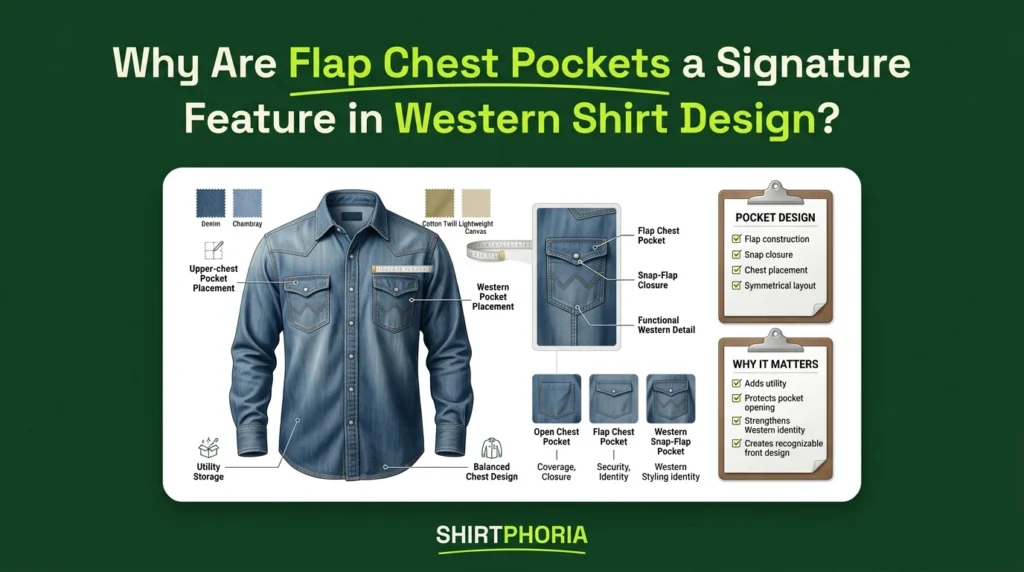
Flap chest pockets are a signature feature in Western shirt design because they improve small-item retention during riding and active work while also creating the balanced, decorative front architecture associated with classic Western shirts.
These pockets should be understood first as functional storage.
An open chest pocket provides convenient access, but riding, bending, leaning, and repeated body movement can make small items shift toward the opening. Adding a flap covers that opening. Adding a snap or button provides another retention point.
That practical system later became an important part of Western shirt identity.
Many classic Western shirts use two chest pockets, snap-fastened flaps, pointed or sawtooth shapes, and visible stitching. The exact construction varies, so two flap pockets should not be treated as mandatory on every Western shirt.
Stan Ray’s history of the Western shirt specifically connects flap pockets with keeping personal possessions more secure during long periods on horseback. (Stan Ray)
Modern manufacturers continue to use the same visual language. Wrangler currently sells Western shirts combining pointed yokes with two sawtooth snap-flap chest pockets, showing how the pocket system remains a recognizable category marker. (Wrangler)
This guide explains how flap chest pockets on Western shirts combine storage utility, snap closure mechanics, sawtooth geometry, and heritage styling into one recognizable garment feature.
Pocket design is one part of the broader Western shirt system.
How Did Flap Chest Pockets Become Common on Western Shirts?
Flap chest pockets became common on Western shirts because covered pockets were better suited to riding, ranch work, and active movement than open-top shirt pockets.
Horseback movement changes the angle and position of the torso repeatedly.
The rider sits, leans, reaches, bounces, mounts, dismounts, and turns. Small objects inside an uncovered chest pocket can shift as the body moves.
A flap changes that opening from completely exposed storage into a covered storage zone.
Stan Ray describes Western-shirt flap pockets as helping keep valued possessions secure during long days spent riding on horseback.
This supports the functional history of the design without requiring the stronger claim that flap chest pockets were invented by one person specifically for horseback use.
They became common because the construction suited active Western clothing.
Why Are Open Shirt Pockets Less Reliable During Riding?
Open shirt pockets are less reliable during riding because movement, bouncing, and forward body angles can make small items shift upward or fall out.
The mechanical relationship is straightforward:
Riding Movement → Shifts Pocket Contents → Increases Item-Loss Risk
Consider a conventional open patch pocket.
Its side and bottom edges contain an object, but the upper edge remains exposed.
When the torso stays upright, that may be adequate for light everyday storage.
During repeated movement, an item can migrate toward the opening.
Potential examples historically or practically might include:
- Notes
- Spectacles
- Small tools
- A tally book
- A tobacco tin
- Tickets
- Other small personal objects
This does not mean every item will fall from an open pocket.
Pocket depth, item size, fabric friction, body angle, and activity all influence retention.
The useful distinction is therefore:
Open pocket: easier immediate access, less opening control.
Covered pocket: greater opening control, usually better retention during movement.
How Does a Secured Flap Improve Pocket Retention?
A secured flap improves pocket retention by covering the pocket opening and adding a closure point that helps keep small items inside the chest pocket.
The construction sequence is:
Pocket Flap + Closure → Covers Opening → Improves Retention
A flap extends over the upper pocket opening.
That alone creates an additional physical barrier.
A snap or button can then hold the flap against the pocket body.
The result is not a locked compartment.
It is a secured pocket opening.
Actual retention still depends on several variables:
- Pocket depth
- Flap depth
- Closure strength
- Item size
- Fabric stiffness
- Placement
- Activity level
A shallow pocket remains shallow even when it has a strong snap.
A poorly positioned flap may leave part of the opening exposed.
A very strong closure can also become inconvenient if it requires excessive pulling force.
Good pocket design balances security with access.
What Is the Functional Purpose of Flap Chest Pockets on Western Shirts?
The functional purpose of flap chest pockets on Western shirts is to improve item retention, protect pocket contents from light exposure to dust or weather, and keep small essentials accessible at chest level.
Retention is the strongest functional claim.
The flap covers the opening.
The fastener controls the flap.
The pocket body contains the item.
Chest placement can also make the pocket accessible while the wearer is standing, riding, or seated.
Unlike a trouser pocket, the chest pocket does not require reaching toward the hip or waist.
That can be convenient when mobility around the lower body is restricted by seated posture, equipment, or other clothing.
How Do Snap Flaps Balance Security and Access?
Snap flaps balance security and access by fastening the pocket closed while still allowing the wearer to open the pocket quickly with one hand.
A Snap Flap combines a fabric pocket flap with press-fastening hardware.
The relationship is:
Snap Flap → Secures Pocket Opening → Allows Quick Access
Unlike a sewn button, a snap does not need to be guided through a buttonhole.
The wearer separates the two components by pulling them apart.
This can reduce the fine finger movement needed to access the pocket.
Western snap systems also have an important historical association with Rockmount Ranch Wear.
Rockmount explains that Jack A. Weil’s Western shirt design used snaps partly because they could release when caught rather than forcing the shirt material to absorb all of the pulling force.
That same snap principle can make chest-pocket access convenient.
However, pocket performance depends on construction.
Too weak: The flap may open during normal movement.
Balanced: The flap remains secure but opens without excessive force.
Too strong: The user may pull heavily on the fabric around the snap.
The snap should therefore be matched to the pocket fabric and reinforcement.
How Do Flaps Help Protect Pocket Contents from Dust and Weather?
Flaps help protect pocket contents from dust and light weather exposure by placing a fabric cover over the pocket opening.
The logic resembles a small overlapping shield.
Instead of leaving the pocket opening directly exposed, the flap covers it from above.
This can help block:
- Dust
- Light debris
- Some direct droplets
- Small particles
- Minor contact with the surrounding environment
The word help matters.
A Western shirt flap pocket is not automatically waterproof or weatherproof.
Protection depends on:
- Flap dimensions
- Fabric density
- Snap placement
- Pocket construction
- Wind
- Rain direction
- Duration of exposure
Water can still move around the flap or through the fabric.
The practical benefit is limited shielding, not sealed storage.
Utility pocket design also connects to cold-weather overshirt construction, where pockets, coverage, and layering work together.
How Does the Sawtooth Style Define Flap Chest Pockets on Western Shirts?
The sawtooth style defines many classic flap chest pockets on Western shirts by using a double-pointed flap shape that creates a sharper and more recognizable Western front design.
A Sawtooth Pocket is a chest pocket whose flap forms two downward points rather than one straight or softly curved lower edge.
The geometry creates visible angular lines across the chest.
Western-shirt references commonly identify pointed and sawtooth pocket flaps as characteristic details, while current Wrangler products continue to use two sawtooth snap-flap pockets with pointed Western yokes.
The sawtooth shape should not be given an unsupported origin story.
There is not enough evidence here to state that it was specifically invented to imitate Rocky Mountain peaks.
It is safer to say that the angular geometry became a recognizable Western design feature.
What Was Jack A. Weil’s Role in the Sawtooth and Diamond Snap Design?
Jack A. Weil’s role in the sawtooth and diamond snap design is best described through Rockmount’s signature Western shirt identity, which paired sawtooth pockets with diamond snaps after Rockmount began in 1946.
Rockmount states that Jack A. Weil established Rockmount Ranch Wear in Denver in 1946 and that the company’s signature Western shirt design featured sawtooth pockets and diamond snaps. (Rockmount)
A Diamond Snap in this context refers to the distinctive snap styling associated with Rockmount’s Western-shirt design.
It should not be treated as an authenticity requirement for every Western Shirt.
Other Western shirts may use:
- Pearl snaps
- Ring snaps
- Plain metal snaps
- Decorative snaps
- Buttons
Rockmount’s importance lies in how the company combined recognizable details into a long-running Western shirt identity.
That makes sawtooth pockets and diamond snaps important heritage references without requiring the claim that Jack A. Weil single-handedly invented every version of the sawtooth pocket.
How Does Sawtooth Geometry Shape the Western Shirt Front?
Sawtooth geometry shapes the Western shirt front by adding angular lines across the chest pocket area, which reinforces the broad, symmetrical visual structure associated with classic Western shirts.
The visual relationship is:
Double-Point Flap → Adds Angular Chest Lines → Strengthens Western Visual Identity
When two sawtooth pockets are positioned symmetrically, their angular edges can echo the shapes of pointed front yokes.
This gives the shirt a coordinated front architecture.
The eye encounters:
- Yoke points
- Pocket edges
- Snap locations
- Topstitching
- Front closure
These elements create repeated geometric cues.
The sawtooth shape can draw the eye outward and downward across the chest.
That is a visual effect, not an anatomical change.
The actual function of the flap still comes from covering and fastening the pocket opening.
Western Pocket Flap Styles
| Style Name | Flap Shape | Source-Safe Origin / Association | Primary Effect |
|---|---|---|---|
| Sawtooth | Double-point flap | Strongly associated with Rockmount and classic Western shirts | Creates a sharp and recognizable Western identity |
| Single Point | One V-shaped point | Common Western-style flap variation | Creates a simpler heritage appearance |
| Curved / Batwing | Curved or wing-like outline | Associated with decorative and rodeo-influenced Western styling | Creates greater visual movement |
| Straight Flap | Horizontal or slightly shaped flap | Common across workwear and casual shirts | Provides practical retention with less explicit Western emphasis |
Wrangler provides a modern example of how the sawtooth remains part of current Western-shirt construction, combining pointed yokes, snaps, and two sawtooth snap-flap pockets.
How Do Flap Chest Pockets on Western Shirts Compare to Dress Shirt Pockets?
Flap chest pockets on Western shirts differ from standard dress shirt pockets because they are usually more visible, more structured, and more focused on active retention.
| Feature | Flap Chest Pockets on Western Shirts | Standard Dress Shirt Pockets | Functional Result |
|---|---|---|---|
| Security | Commonly use a flap and snap or button closure to improve item retention | Usually use an open-top patch pocket or no chest pocket | Western pockets provide more opening control during movement |
| Quantity | Many classic versions use two symmetrical chest pockets | Many dress shirts use one left chest pocket or no pocket | Western shirts emphasize balanced utility, while dress shirts usually prioritize a cleaner front |
| Structure | Often use shaped flaps, snaps, topstitching, or decorative reinforcement | Usually keep the pocket visually simple | Western pockets become visible design features instead of receding into the shirt front |
| Purpose | Support storage of small items during work, riding, or active movement | Support lower-demand everyday storage | Western pockets combine active retention with category identity |
| Styling Signal | Commonly signal ranch, heritage workwear, or Western design | Commonly support office, business, or classic shirting | Pocket construction becomes one clue for classifying the complete shirt |
Neither system is universally better.
An open dress-shirt pocket is lighter and less visually intrusive.
A Western flap pocket offers more retention but introduces additional fabric, hardware, and visual weight.
The appropriate construction depends on what the shirt needs to do.
Western Flap Chest Pocket Diagnostic Checklist
Flap chest pockets on Western shirts can be evaluated by checking whether the pocket design has enough structural, functional, and visual markers to operate as part of a strong Western shirt system.
Flap Presence Check
A strong Western pocket system commonly uses a real flap that covers the pocket opening.
A decorative faux flap that does not open into a usable pocket contributes style but not storage utility.
Closure Check
Examine whether the flap actually fastens.
Possible closures include:
- Pearl Snap
- Diamond Snap
- Metal snap
- Ring snap
- Durable button
The fastener should hold the flap closed without requiring excessive force.
Dual Pocket Check
Many classic Western shirts use two chest pockets.
Wrangler’s current sawtooth Western shirts provide a clear modern example of this paired configuration.
However, two pockets are not mandatory.
A single-pocket shirt should be evaluated alongside the yokes, snaps, fabric, cut, stitching, and other Western features.
Shape Check
Look at the lower edge of the flap.
Sawtooth and pointed shapes create stronger Western category signals than a plain horizontal flap.
Curved and decorative shapes can also appear within Western design.
Symmetry Check
Paired Western pockets commonly create visual balance across the shirt front.
The two sides should usually appear intentionally aligned in:
- Height
- Size
- Flap shape
- Closure position
- Stitching
Intentional asymmetry can exist, but obvious accidental misalignment weakens construction quality.
Stitching Check
Visible topstitching may reinforce the flap edges or strengthen Western identity.
Some Wrangler designs use embroidered or distinctive stitching around sawtooth pockets.
Wrangler-style W stitching or another recognizable stitching treatment is a useful design cue, not a universal requirement.
Heritage Context Check
Rockmount’s combination of sawtooth pockets and diamond snaps provides a strong historical reference for Western pocket architecture.
That combination should be treated as a heritage marker rather than the only legitimate Western pocket configuration.
Function Check
Put a realistically sized small object inside the pocket.
Move, bend, and sit.
The pocket should provide useful retention without becoming:
- Too shallow
- Too deep
- Too stiff
- Too bulky
- Difficult to open
The best pocket balances storage security with access.
What Failure Modes Can Distort Flap Chest Pockets on Western Shirts?
Flap chest pockets on Western shirts fail when their main attributes move too far in either direction, because both under-built and over-built pockets can reduce function, comfort, or visual coherence.
| Attribute | Too-Low Failure | Too-High Failure | Corrective Hypothesis |
|---|---|---|---|
| Flap Coverage | Pocket opening remains exposed and item retention weakens | Flap becomes oversized and interferes with access or chest comfort | Adjust flap depth so it covers the opening without overwhelming the pocket |
| Snap / Button Strength | Closure opens too easily during ordinary movement | Closure becomes difficult to open or transfers excessive stress into the fabric | Match closure strength to fabric weight, reinforcement, and use |
| Pocket Depth | Small items can move out of the opening more easily | Items sit too low and become difficult to retrieve | Match pocket depth to the size of intended contents |
| Pocket Symmetry | Front can lose the balanced appearance common to classic Western shirts | Excessively rigid decorative symmetry can dominate an otherwise simple shirt | Coordinate pockets with yokes, snaps, fabric, and overall design |
| Sawtooth Geometry | Flap loses much of its Western visual distinction | Points become exaggerated and excessively decorative | Use angular shaping that supports rather than dominates the front |
| Stitching Detail | Construction may look visually weak or lack useful reinforcement | Heavy stitching adds clutter or stiffness | Use stitching where it supports edge control, reinforcement, or intentional identity |
| Pocket Bulk | Pocket feels flimsy and may lose shape | Pocket becomes stiff or uncomfortable against the chest | Adjust fabric weight, lining, flap size, and hardware |
Both extremes matter.
More coverage is not always better.
A massive flap may secure the opening but make access awkward.
A stronger snap is not always better.
If the closure requires more force than the surrounding fabric comfortably supports, repeated opening can stress the pocket.
Deeper pockets are not automatically more useful.
Storage becomes inconvenient if a small object drops so far that it is difficult to retrieve.
Western detail needs balance.
How to Spot Strong Flap Chest Pockets on Western Shirts
To spot strong flap chest pockets on Western shirts, evaluate the pocket as part of the whole shirt system rather than relying on one isolated detail.
- Check the Flap: Confirm that the flap genuinely covers a usable pocket opening rather than acting only as decoration.
- Check the Closure: Look for a functional Pearl Snap, Diamond Snap, metal snap, ring snap, or durable button that actually secures the flap.
- Check the Pairing: Determine whether the pocket works with other Western details such as pointed yokes, snaps, durable fabric, or Western-oriented stitching.
- Check the Shape: Sawtooth and pointed flap geometry provide strong Western signals, although curved and straight flaps can also appear.
- Check the Depth: The pocket should be deep enough to retain intended small items without making them difficult to reach.
- Check the Symmetry: When two pockets are present, compare height, shape, stitching, and fastener placement.
- Check the Stitching: Decorative stitching can strengthen Western identity, but stitching alone does not classify a pocket.
- Check the Function: The flap should improve retention without becoming too stiff, bulky, or difficult to open.
- Check the Heritage Context: Rockmount-style sawtooth pockets and diamond snaps provide strong historical cues, but they are not mandatory on every Western shirt.
- Check the Whole Shirt: Pocket design becomes more convincing when it agrees with the shirt’s yokes, front snaps, fabric, cuffs, and overall construction.
What Are the Key Takeaways of Flap Chest Pockets on Western Shirts?
The key takeaways of flap chest pockets on Western shirts show that this feature combines practical retention, visible Western identity, and heritage design language.
Flap Chest Pocket Summary
- Practical Retention: A flap covers the pocket opening and can reduce the chance of small items escaping during riding or active movement.
- Riding History: Stan Ray specifically connects Western flap pockets with keeping possessions secure during horseback activity.
- Snap Closure: A snap can secure the flap while allowing relatively quick opening without conventional buttonhole operation.
- Limited Weather Shielding: A flap can shield the pocket opening from some dust and direct exposure, but it does not make the pocket waterproof.
- Western Identity: Sawtooth, pointed, curved, and snap-flap pockets create stronger Western visual signals than a simple open patch pocket.
- Rockmount Association: Rockmount identifies sawtooth pockets and diamond snaps as part of its signature Western shirt design.
- Wrangler Recognition: Wrangler continues to produce Western shirts combining pointed yokes and two sawtooth snap-flap pockets.
- Functional Limits: Pocket performance depends on flap coverage, closure strength, pocket depth, fabric, and reinforcement.
- Classification Rule: Strong Western pocket construction should be identified through multiple coordinated features rather than one isolated snap or decorative point.
Educational note: This guide explains shirt construction and design for general educational purposes. Actual garment performance varies by fabric, hardware, pattern, manufacturing quality, and intended use.
Interactive Western Flap Chest Pocket Checklist
Frequently Asked Questions About Flap Chest Pockets on Western Shirts
This section answers the most common questions about the function, history, and style of flap chest pockets on Western shirts.
Many Western shirts use two chest pockets because paired pockets provide balanced storage and create the symmetrical front associated with classic Western construction. Current Wrangler Western shirts still use two sawtooth snap-flap pockets, but dual pockets should be treated as a common pattern rather than a requirement.
A sawtooth pocket is a Western shirt pocket flap with two pointed lower sections that create a sharp angular outline. The shape is strongly associated with classic Western shirts and is particularly connected with Rockmount’s long-running sawtooth-pocket and diamond-snap design.
Flap chest pockets are not only decorative. The flap still physically covers the pocket opening and can improve retention when paired with an effective closure. Modern shirts may emphasize the design more strongly, but the basic storage logic remains functional.
A Diamond Snap is a distinctive Western snap treatment strongly associated with Rockmount’s signature shirt design. Rockmount describes sawtooth pockets and diamond snaps as part of the design developed after the company’s founding in 1946. Diamond snaps are an important heritage cue, not a universal Western-shirt requirement.
Terms Explained
| TERM | DEFINITION |
|---|---|
| Flap Chest Pocket | A chest pocket with a fabric flap that covers its opening to improve retention and add structure. |
| Sawtooth Pocket | A Western shirt chest pocket whose flap uses a double-pointed angular lower edge. |
| Snap Flap | A pocket flap secured with press-fastening hardware for controlled closure and quick access. |
| Diamond Snap | A distinctive snap treatment strongly associated with Rockmount's signature Western shirt design. |
| Pearl Snap | A decorative press fastener with a pearlescent appearance commonly associated with Western shirts. |
| Pocket Retention | The ability of a pocket system to keep suitably sized contents inside during movement. |
Conclusion
In conclusion, flap chest pockets on Western shirts are best understood as a practical storage feature that evolved into one of the clearest visual markers of Western shirt design.
The functional logic begins with the opening.
An uncovered chest pocket provides easy access but less control over contents during repeated body movement.
A flap places fabric over that opening.
A snap or button can then hold the flap in position.
This gives the pocket greater retention potential without turning it into sealed storage.
Historical Western-shirt accounts connect this construction with keeping personal possessions secure during riding.
Sawtooth geometry then gives that practical pocket a stronger visual identity.
The double-pointed flap creates angular lines across the shirt front and works naturally with pointed Western yokes and snap hardware.
Rockmount Ranch Wear became particularly associated with the combination of sawtooth pockets and diamond snaps after Jack A. Weil founded the company in 1946.
Wrangler demonstrates that this construction language remains active rather than purely historical, with current Western shirts continuing to use pointed yokes and paired sawtooth snap-flap pockets.
Not every Western Shirt uses the same pocket formula.
Some use single-point flaps.
Some use curved flaps.
Some use different snap hardware.
Some modern versions reduce the functional emphasis and use Western geometry primarily as a design signal.
The correct approach is therefore to evaluate the pocket as part of the whole garment.
To understand how these pockets fit into the complete construction system, compare them with the broader Western shirt and the cold-weather overshirt.
Flap chest pockets work because they do more than decorate the shirt front: they cover, secure, classify, and visually anchor the Western shirt’s heritage identity.