How Do Casual Shirts Reflect Fabric Composition and Formality in Daily Use?
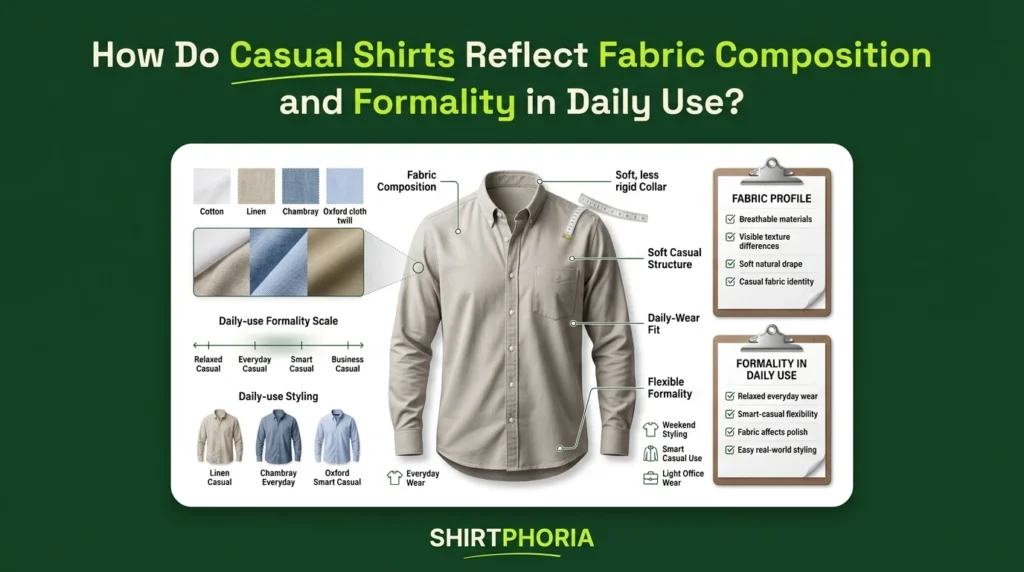
Casual shirt formality is strongly shaped by fabric composition, because fiber content, weave structure, handfeel, drape, wrinkle behavior, and color retention influence whether a shirt reads relaxed, practical, polished, or business casual.
Two shirts can have a similar color, collar, and overall cut but behave very differently because of their fabrics. One may hold a crisp surface throughout the day, while another develops visible wrinkles. One may feel dry and structured, while another hangs softly against the body. These physical differences affect comfort as well as the level of polish a shirt communicates.
Fabric composition does not determine formality by itself. Collar design, cut, fit, color, pattern, construction, and styling also influence how formal a shirt appears. Fabric establishes the material baseline that these other features build on.
Fabric composition is only one part of how casual shirts work, because fit, collar design, plackets, cuffs, and construction also shape daily utility.
This guide compares common casual shirt fabrics, explains how their physical properties influence daily formality, and provides a practical system for evaluating fabric before buying or wearing a shirt.
This article is an educational guide to casual-shirt fabric and perceived formality. Fabric performance and visual polish vary by fiber blend, weave, weight, finish, garment construction, climate, care routine, styling, and individual use.
Quick Answer: How Does Fabric Composition Affect Casual Shirt Formality?
Fabric composition affects casual shirt formality by changing the shirt’s surface smoothness, structure, drape, wrinkle behavior, breathability, color retention, and perceived polish. Smooth, stable, and relatively crisp fabrics usually support a more polished appearance, while highly textured, brushed, crinkled, or loose fabrics usually read as more relaxed. Fabric remains only one part of the final formality level.
Why Is Fabric Composition Foundational to Casual Shirt Formality?
Fabric composition is foundational to casual shirt formality because raw fiber content and fabric construction create physical cues associated with polished, relaxed, breathable, crisp, soft, rugged, or technical clothing.
A fabric with a smooth surface and controlled structure tends to maintain cleaner lines around the collar, placket, sleeves, and torso. A highly textured or loose fabric creates softer visual boundaries and often produces a more relaxed appearance.
Weave structure also matters. A tightly controlled plain weave can create a flat and neat surface, while a basket weave produces more visible texture and substance.
These fabric signals interact with the rest of the shirt. A smooth poplin shirt with a loose resort cut will not communicate exactly the same level of formality as a fitted poplin shirt with a structured collar. Likewise, a textured Oxford can look cleaner when paired with restrained colors, precise fit, and controlled construction.
The useful rule is simple: fabric creates the material signal, while design and styling determine how that signal is used.
How Do Handfeel and Drape Influence Perceived Shirt Quality?
Handfeel and drape influence perceived shirt quality because the way fabric feels and hangs changes whether a casual shirt looks clean, structured, soft, relaxed, or rumpled.
Handfeel is the tactile quality of a fabric. It describes characteristics such as smoothness, crispness, softness, roughness, dryness, or slickness when the material is touched.
Drape describes how fabric hangs and falls from the body.
A smooth handfeel combined with clean drape generally supports a more polished casual appearance because the fabric creates controlled surfaces and lines.
A loose, heavily brushed, crinkled, or rumpled surface generally signals a more relaxed use case. That does not mean the fabric is lower quality. It simply communicates a different visual and functional purpose.
Handfeel should therefore be evaluated against the intended setting rather than treated as proof of garment quality.
How Do Moisture Management and Thermal Regulation Affect Daily Use?
Moisture management and thermal regulation affect daily use because fabric composition influences how a casual shirt absorbs, releases, moves, or traps heat and moisture during wear.
Cotton is commonly valued for softness, absorbency, and breathable everyday comfort. CottonWorks also evaluates fabric comfort through variables related to airflow, moisture behavior, drying, and wicking, showing why fiber identity alone does not completely determine shirt performance. CottonWorks.
Linen is commonly selected for warm-weather shirts because lightweight constructions can support an airy, relaxed wearing experience. Fabric weight, weave density, garment fit, and environmental conditions still influence comfort.
Engineered synthetic fabrics can also support moisture movement or faster drying. Their actual performance depends on fiber selection, yarn construction, weave or knit structure, finishing, and overall garment design.
This makes breathability and moisture control functional variables rather than simple fiber labels. A buyer should evaluate how the finished fabric behaves instead of assuming that every natural or synthetic fabric performs identically.
Deconstructing Common Fabric Compositions and Their Impact on Casual Shirts
Common fabric compositions give casual shirts different formality levels because each material changes structure, surface texture, wrinkle behavior, breathability, and movement comfort.
The most useful comparison is not simply cotton versus linen or natural versus synthetic. The better approach is to examine the fiber together with the weave, weight, finishing, and intended use.
How Does 100% Cotton Shift Between Casual and Business Casual?
A 100% cotton casual shirt can shift from relaxed to business casual depending on whether the cotton is woven as crisp poplin, textured Oxford, fine twill, or soft flannel.
Cotton poplin usually supports one of the cleaner casual-shirt appearances. Its fine plain-weave construction can create a smooth surface, crisp handfeel, and relatively stable appearance. These qualities help it maintain cleaner lines and support polished everyday or business casual clothing.
Cotton Oxford has a different character. Its basket-weave construction normally produces a more substantial and visibly textured surface than fine poplin. That texture helps explain why Oxford shirts commonly read as more relaxed and everyday-oriented.
Fine cotton twill sits between rugged structure and polish. Its diagonal construction can produce a smooth yet subtly textured surface that works well for transitional casual and office wear.
Cotton flannel moves further toward relaxed daily wear. Its brushed surface emphasizes softness, warmth, and texture rather than the flat crispness associated with more polished shirting.
This is why a label reading “100% cotton” is not enough to predict shirt formality. Weave and finishing can change the material signal substantially.
How Do Linen and TENCEL Lyocell Affect Warm-Weather Formality?
Linen and TENCEL Lyocell affect warm-weather formality differently. Linen usually signals relaxed breathability through visible texture, while TENCEL Lyocell can signal softness and fluid drape through a smoother handfeel.
A 100% linen shirt commonly develops visible creasing during wear. In vacation, resort, warm-weather, or relaxed creative settings, those wrinkles can fit the visual context. In a business casual environment that expects a consistently clean surface, heavy rumpling may lower the perceived level of polish.
The structure of the actual linen fabric still matters. A carefully constructed linen shirt with controlled fit and restrained styling can appear considerably more refined than a loose, heavily wrinkled beach shirt.
TENCEL Lyocell creates a different material profile. The official TENCEL fiber information describes TENCEL Lyocell fibers as soft and smooth to the touch and highlights moisture-control properties that support a dry feeling during wear. TENCEL.
In casual shirting, those qualities can support softness and fluid drape. The final formality level still depends on the weave, blend, garment construction, color, collar, and fit.
Linen therefore tends to communicate textured warm-weather relaxation, while TENCEL Lyocell can create a smoother and softer form of relaxed polish.
How Do Synthetic Blends Add Function Without Always Increasing Formality?
Synthetic blends can add function to casual shirts by improving stretch, wrinkle resistance, quick drying, or durability, but these benefits do not automatically make a shirt more formal.
Polyester is frequently blended with cotton or other fibers to modify care requirements, stability, drying behavior, or wrinkle performance. The exact result depends on fiber percentage, fabric construction, finishing, and garment care.
Spandex and elastane are stretch fibers that can provide additional flexibility in woven casual shirts. Small amounts can support reaching, sitting, commuting, and other movement without turning the garment into highly elastic clothing.
More stretch is not automatically better. Excessive elasticity can reduce the crisp stability expected from a polished woven shirt.
Synthetic surface appearance matters too. A fabric with strong sheen or a very slick technical handfeel may communicate sportswear or performance clothing rather than business casual polish.
Function and formality must therefore be evaluated separately.
Comparison Matrix: Fabric Composition vs. Daily Formality Signal
A fabric composition comparison matrix helps readers judge casual shirt formality by linking each material to handfeel, daily use, wrinkle behavior, and formality signal.
| Fabric Composition | Primary Handfeel | Daily Use Utility | Wrinkle Behavior | Formality Signal |
|---|---|---|---|---|
| Cotton Poplin | Smooth, crisp, clean | Business casual, office wear, polished daily use | Moderate, depending on finish and care | 4 / 5 |
| Cotton Oxford | Substantial, textured, basket-woven | Everyday wear, casual office, durable shirting | Moderate | 3 / 5 |
| Fine Cotton Twill | Smooth with subtle diagonal texture | Polished casual, transitional office wear | Moderate to lower depending on weight and finish | 3.5 / 5 |
| Cotton/Poly Blend | Stable, smooth, sometimes slightly synthetic | Travel, easy care, wrinkle-conscious daily wear | Lower when engineered for wrinkle resistance | 3 / 5 |
| 100% Linen | Textured, airy, crisp to soft with wear | Warm weather, vacation, relaxed daily use | High | 2 / 5 |
| TENCEL Lyocell | Soft, smooth, fluid | Warm-weather comfort, relaxed polish, soft drape | Varies by blend and weave | 2.5 to 3 / 5 |
| Cotton Flannel | Brushed, soft, warm | Cold weather, layering, weekend casual | Wrinkles are often less visually dominant because of surface texture | 1 to 2 / 5 |
These scores are a practical style index, not a universal dress-code law.
Color, pattern, collar design, fit, construction, footwear, trousers, and the surrounding setting can move the perceived formality of each material up or down.
How Is Casual Shirt Formality Indexed by Fabric Composition for Daily Use?
Casual shirt formality can be indexed by fabric composition when the fabric is judged through structure, smoothness, wrinkle behavior, color retention, texture, and daily-use context.
A useful fabric formality assessment begins with several questions.
Does the fabric hold a clean shape?
Does its surface appear smooth or highly textured?
Does it wrinkle quickly?
Does it maintain color?
Does the material drape cleanly?
Does it appear natural, technical, rugged, or refined?
These variables create a practical formality signal.
Higher casual formality is generally supported by:
- Smooth surface texture
- Controlled drape
- Moderate structure
- Low visible rumpling
- Clean color appearance
- Restrained sheen
- Stable shirt shape
Lower casual formality is generally associated with:
- Heavy surface texture
- Brushed finishes
- Visible rumpling
- Loose or fluid structure
- Rugged fabric character
- Highly open weaves
- Strongly technical appearance
Fabric still works together with shirt construction. Fabric formality becomes easier to judge when compared with button-front shirts, where closure structure, collar design, fit, and material choice combine to create the final appearance.
How Does Colorfastness Affect Long-Term Casual Shirt Formality?
Colorfastness affects long-term casual shirt formality because fading, bleeding, or staining weakens the clean appearance that makes a casual shirt suitable for polished daily use.
Colorfastness describes a textile’s resistance to fading, color change, or dye transfer when exposed to conditions such as washing, light, rubbing, or perspiration. Intertek identifies washing, light, rubbing, and perspiration among the conditions used in textile colorfastness evaluation. Intertek.
Long-term color retention matters because a shirt that originally looks polished can become visibly worn when dark areas fade unevenly, dye transfers, or staining becomes difficult to control.
Colorfastness does not depend on fiber identity alone. Dye chemistry, fiber type, finishing, laundering, abrasion, perspiration, and light exposure can all affect the result.
A buyer should therefore avoid assuming that synthetic or natural fibers automatically provide superior color retention.
How Does Wrinkle Behavior Change the Formality Signal?
Wrinkle behavior changes the formality signal because fabrics that hold a cleaner surface usually appear more polished, while fabrics that rumple visibly usually appear more relaxed.
Linen provides a clear everyday example. Visible creasing often fits naturally into resort, vacation, coastal, and relaxed summer contexts. The same degree of rumpling may appear less appropriate in an office that expects business casual polish.
Cotton poplin generally creates a cleaner surface because of its smooth and compact construction, although cotton poplin can still crease.
Fine twill can also support a cleaner appearance because its diagonal structure tends to produce a different drape and surface behavior from crisp plain-weave fabrics.
Engineered blends may reduce visible creasing further, but wrinkle resistance should not be treated as a universal formality measurement.
A wrinkle is not automatically a defect. Its importance depends on context.
The better term is practical formality signal.
Diagnostic Thresholds and Failure Modes for Casual Shirt Fabric Formality
Casual shirt fabric formality can be diagnosed by checking whether structure, breathability, wrinkle behavior, colorfastness, handfeel, stretch, and fabric weight sit inside the correct daily-use range.
These are practical diagnostic ranges rather than laboratory thresholds.
| Variable | Too Low Failure | Ideal Zone | Too High Failure | Observable Test | Diagnostic Fix |
|---|---|---|---|---|---|
| Fabric Structure | Fabric collapses, clings, or looks too limp for polished daily use | Fabric holds enough shape for the intended setting without feeling stiff | Fabric feels rigid, hot, or unnecessarily dressy for casual use | Hang the shirt and inspect whether the front panel drapes cleanly | Choose poplin or fine twill for polish, Oxford for everyday structure, or linen and TENCEL for softer drape |
| Breathability | Fabric traps heat and moisture and becomes uncomfortable | Fabric provides enough airflow or moisture release for the climate and activity | Excessively open fabric may reduce opacity, coverage, or polish | Hold the fabric toward light and assess openness, opacity, and feel against the skin | Choose lighter linen or cotton for heat, or a stable blend for balanced daily use |
| Wrinkle Behavior | Heavy rumpling weakens a polished business casual appearance | Wrinkling matches the setting, from crisp office use to relaxed resort wear | An aggressively wrinkle-resistant fabric can sometimes feel stiff or overly technical | Compress a small section and observe how much creasing remains | Choose linen for relaxed settings, poplin or fine twill for polish, or suitable blends for travel |
| Colorfastness | Fading, bleeding, or staining reduces long-term polish | Color remains stable under expected care and exposure | Heavy dye appearance does not guarantee good fixation and may still present transfer risk | Review care instructions and watch for transfer from dark colors | Follow washing instructions and separate colors where appropriate |
| Handfeel | Fabric feels rough, papery, sticky, or uncomfortable | Handfeel suits the use case: crisp for polish, soft for comfort, textured for casual wear | Excessively slick or shiny fabric can appear technical | Rub the fabric between the fingers and compare the sensation with the intended setting | Use poplin for crispness, Oxford for substance, linen for texture, or TENCEL for softness |
| Stretch | Fabric restricts movement during sitting, reaching, or active use | Stretch supports movement while the shirt keeps its shape | Excessive stretch weakens crispness and shape retention | Stretch the fabric gently and observe recovery | Select a small elastane blend for movement or a stable woven fabric where crispness matters more |
| Fabric Weight | Fabric becomes transparent, clingy, or unstable | Weight provides enough opacity and structure without excessive heat | Fabric becomes heavy, hot, or stiff for the intended setting | Assess opacity, drape, thickness, and heat feel | Choose lighter fabric for heat, medium weight for broad daily use, and heavier material for cold conditions |
Both extremes can harm fabric formality and daily utility.
Too little structure can make the shirt collapse or cling. Too much structure can make it stiff and uncomfortable.
Too little breathability can trap heat. Too much openness can reduce coverage and polish.
Too little wrinkle control can weaken business casual presentation. Excessively technical wrinkle-resistant construction can create a surface that feels less natural for some casual contexts.
Poor colorfastness can make a shirt look faded or worn before the garment itself has reached the end of its useful life.
Too little stretch can restrict movement when mobility is important. Too much stretch can weaken shape retention.
Too little fabric weight can reduce opacity and stability. Too much fabric weight can increase heat and stiffness.
The correct target is a balanced range matched to the environment.
Casual Shirt Fabric Formality Scoring Key
A casual shirt fabric becomes easier to evaluate when each material variable is scored by whether it supports, weakens, or fails the intended daily-use formality level.
Score these seven variables:
- Fabric structure
- Breathability
- Wrinkle behavior
- Colorfastness
- Handfeel
- Stretch
- Fabric weight
Score Interpretation
The fabric strongly supports the intended daily-use setting.
The fabric can work, but one or two variables require compromise or correction.
The fabric is likely mismatched to the setting, climate, activity, or required level of polish.
This score is a buying aid rather than a scientific textile rating. Its purpose is to make fabric evaluation more consistent.
How to Select the Ideal Casual Shirt Composition for Your Daily Task
Selecting the ideal casual shirt composition requires matching fabric structure, breathability, wrinkle behavior, and formality signal to the physical and social demands of the day.
| Use Case | Recommended Composition | Formality Score | Key Utility Provided | Main Failure to Avoid |
|---|---|---|---|---|
| Business Casual Office | Cotton poplin, fine twill, or stable cotton blend | 4 / 5 | Structure, clean appearance, moderate wrinkle control | Heavy rumpling, excessive sheen, or fabric that collapses |
| Everyday Casual Office | Cotton Oxford, fine twill, or cotton blend | 3 / 5 | Durability, substance, easy daily wear | Fabric that is too thin, too stiff, or excessively wrinkled |
| Outdoor or High-Movement Day | Cotton and synthetic blend with a small elastane content | 2 to 3 / 5 | Stretch, durability, moisture management, easy care | Slick technical handfeel where greater polish is required |
| Warm Weather or Vacation | 100% linen, linen blend, lightweight cotton, or TENCEL Lyocell blend | 2 / 5 | Airflow, relaxed drape, softness, warm-weather comfort | Severe rumpling where business casual polish is expected |
| Cold Weather or Layering | Cotton flannel, brushed cotton, or heavier Oxford | 1 to 2 / 5 | Warmth, softness, layering comfort | Highly brushed or bulky fabric in polished office environments |
Business Casual Office
A business casual shirt benefits from fabric that maintains clean lines around the collar, placket, sleeves, and torso.
Cotton poplin is a strong candidate because its smooth surface and crisp structure support a polished appearance. Fine twill can provide a slightly softer alternative while still maintaining polish. Stable blends may help where easy care or reduced creasing is a priority.
Avoid fabrics whose surface becomes severely rumpled during normal office wear if the workplace expects a consistently neat appearance.
Everyday Casual Office
An everyday casual office allows more texture.
Cotton Oxford works well because its basket-weave texture creates visual substance while remaining compatible with many button-front shirt constructions.
Fine twill or balanced cotton blends can also work.
The goal is durability and comfort without moving so far toward ruggedness that the shirt looks disconnected from the workplace.
Outdoor or High-Movement Day
Movement changes fabric priorities.
A cotton blend containing a small amount of elastane can provide useful stretch while retaining much of the appearance of a woven casual shirt.
The main risk is choosing a fabric whose slick surface or strong sheen makes it look more like technical sportswear than everyday casual clothing.
Warm Weather or Vacation
Warm-weather clothing usually benefits from reduced weight, comfortable drape, and suitable moisture behavior.
Linen, lightweight cotton, and TENCEL Lyocell blends can all serve this role through different material characteristics.
Linen emphasizes visible texture and relaxed wear. Lightweight cotton can maintain more conventional shirt structure. TENCEL Lyocell provides a softer and smoother alternative.
The expected social setting should determine how much rumpling or relaxation is acceptable.
Cold Weather or Layering
Cold-weather casual shirts can use heavier and softer constructions.
Cotton flannel, brushed cotton, and heavier Oxford fabrics create more physical substance than lightweight poplin. Their texture also pushes the formality signal toward relaxed clothing.
These fabrics work especially well when warmth and layering are more important than crisp office presentation.
Checklist for Choosing Casual Shirt Fabric Composition
Choosing casual shirt fabric composition requires checking whether the material supports the intended formality level, climate, movement needs, and care routine.
FAQ: Casual Shirt Fabric Composition and Formality
The most common questions about casual shirt fabric composition and formality can be answered by comparing fiber content, weave structure, wrinkle behavior, breathability, and daily-use context.
There is no single best fabric for every casual shirt. Cotton poplin works well for polished daily use, Oxford provides textured everyday durability, linen suits relaxed warm-weather wear, TENCEL Lyocell supports a soft and smooth handfeel, and appropriately engineered blends can add stretch, easy care, or wrinkle control.
Linen usually reads more casual than crisp cotton poplin because linen commonly develops visible wrinkles and has a more relaxed surface character. However, a clean-cut linen shirt with controlled fit and restrained styling can still appear refined in warm-weather settings. The final formality depends on more than fiber content alone.
Cotton poplin is often suitable for business casual work because its smooth surface, crisp handfeel, and stable construction support a clean appearance. Its final level of formality still depends on collar construction, fit, color, pattern, trousers, footwear, and workplace expectations.
Synthetic blend casual shirts are not automatically better. Polyester, nylon, or elastane may add specific benefits such as easier care, stretch, recovery, or performance characteristics, but the result depends on construction and finishing. Excessive sheen, stretch, or slickness may also make a shirt appear more technical than polished.
A casual shirt generally looks more formal when the fabric has a smooth surface, controlled drape, moderate structure, restrained texture, limited visible rumpling, and a clean color appearance. Collar type, fit, cut, color, pattern, and styling then determine how strongly those fabric characteristics translate into overall formality.
Colorfastness affects shirt formality by helping preserve a clean and consistent appearance over repeated use. Resistance to washing, rubbing, light, and perspiration helps reduce fading, staining, and unwanted dye transfer that can weaken the visual polish of a casual shirt.
Terms Explained
| TERM | DEFINITION |
|---|---|
| Fabric Composition | The fiber content and material makeup of a fabric, such as cotton, linen, polyester, Lyocell, or a blend. |
| Handfeel | The tactile qualities perceived when touching fabric, including crispness, softness, smoothness, dryness, roughness, or slickness. |
| Drape | The way fabric hangs, folds, and falls over the body. |
| Poplin | A smooth, tightly controlled shirting fabric commonly associated with a clean and relatively crisp surface. |
| Oxford | A substantial woven shirting structure with visible basket-weave texture and a more relaxed appearance than fine poplin. |
| Twill | A woven structure identified by diagonal ribs that can provide stability, durability, and controlled drape. |
| Flannel | A soft, often brushed fabric associated with warmth, texture, and relaxed cold-weather clothing. |
| TENCEL Lyocell | A cellulosic fiber associated with a soft, smooth handfeel and fluid drape in many apparel constructions. |
| Colorfastness | A textile’s resistance to fading, color change, or dye transfer under washing, light, rubbing, perspiration, or other exposure. |
| Wrinkle Behavior | The tendency of fabric to develop, retain, or recover from visible creasing during wear and handling. |
| Fabric Formality Signal | The level of perceived polish or relaxation communicated by a fabric’s structure, texture, drape, wrinkle behavior, and surface appearance. |
| Elastane | A stretch fiber used in small percentages in some fabrics to increase flexibility and recovery. |
Conclusion
Ultimately, fabric composition strongly influences a casual shirt’s daily formality by shaping its structure, handfeel, drape, wrinkle behavior, color retention, breathability, and comfort.
Fiber content establishes an important material baseline, but it cannot be evaluated separately from weave structure. Cotton can become crisp poplin, textured Oxford, smooth twill, or soft flannel, with each construction producing a different daily-use signal.
Linen supports a more relaxed warm-weather character. TENCEL Lyocell can create softness and fluid drape. Synthetic blends can add stretch, stability, easy-care properties, or other functional benefits when appropriately engineered.
Formality still depends on the entire garment. Cut, collar structure, fit, color, pattern, construction, and setting determine how the material is ultimately interpreted.
The practical goal is therefore not to find one universally superior fabric. It is to select a fabric whose physical behavior matches the wearer’s climate, movement requirements, care routine, and expected level of polish.
By analyzing fiber, weave, drape, and wrinkle behavior together, the buyer can choose a casual shirt that fits both the day’s comfort needs and its formality expectations.