How Do Dress Shirts Express Collar Configuration, Formality Standards, and Fabric-Fit Attributes in Their Function?
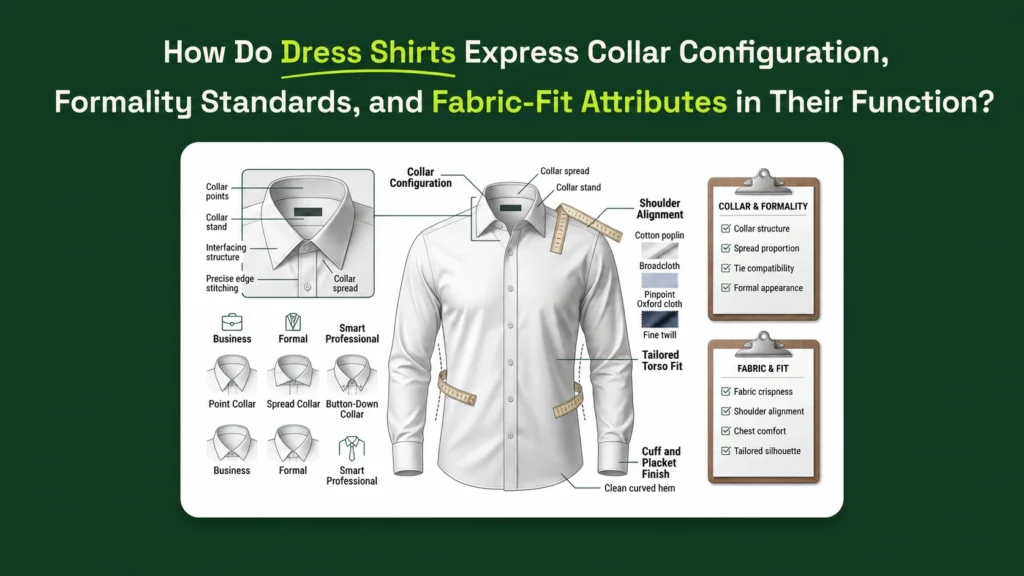
Dress shirt collar configuration expresses formality through the combined effect of collar spread, point length, collar height, stiffness, fabric choice, and neckwear compatibility.
Many collar mistakes happen because the wearer chooses a collar by appearance alone without checking the tie knot, jacket style, dress code, face framing, neck fit, and collar stiffness. Collar configuration and formality standards work best when these elements are evaluated as one connected system.
A dress shirt collar works as visual shorthand for formality because it sits next to the face and directly interacts with the tie, bow tie, jacket lapels, and neckline. Its prominent position makes it an important style cue, but collar geometry alone does not determine whether a shirt is formal.
The complete result also depends on the shirt fabric, cuffs, placket, colour, fit, jacket type, neckwear, and dress code. This guide explains how collar configuration, interlining, fabric, and fit help a dress shirt serve business, formal, and ceremonial functions.
Quick Collar Summary
The shape: Narrower Point Collars usually create a more conservative frame, while wider Spread and Cutaway Collars create a broader and more assertive frame.
The tie knot: Smaller tie knots usually work better with narrower collars. Larger knots generally need more space between the collar points.
The formality: Wing Collars are strongly associated with White Tie and selected traditional eveningwear settings. Spread Collars are widely used with modern Black Tie shirts.
The stiffness: Fused or firmer interlining can create a crisp business or formal collar, while softer construction usually creates a more relaxed expression.
The fabric: Crisp dress-shirt fabrics can support a cleaner collar appearance, while softer and more textured fabrics usually produce more relaxed collar behaviour.
Readers who need the wider taxonomy can start with the shirt types guide.
Why Is Collar Configuration the Primary Driver of Dress Shirt Formality Standards?
Collar configuration is a primary driver of dress shirt formality because the collar frames the face, controls the neckline, supports neckwear, and connects the shirt visually to the jacket lapels.
The collar occupies the visible area between the face, tie, and jacket. A well-proportioned collar can create a clean transition from the shirt to the jacket, while a poorly supported collar may collapse, gap, or expose an awkward section of the tie.
Collar configuration and formality standards still depend on the wider garment. The collar should work with the shirt’s fabric, shoulder fit, cuffs, placket, colour, and intended dress code rather than being judged as an isolated feature.
How the Collar Functions as a Sartorial Anchoring Point
A dress shirt collar functions as a sartorial anchoring point because the collar band and collar leaves create the structure around which a tie, bow tie, or open neckline is visually organised.
The collar band wraps around the neck and supports the visible collar leaves. Those leaves end in collar points, which guide the eye towards the wearer’s face and the centre of the jacket’s V-shaped opening.
This face-framing effect changes with the collar’s proportions. Longer, narrower points may create a more vertical impression, while a wider spread can create a broader horizontal frame. The best choice depends on the wearer’s face, neck, tie knot, jacket lapels, and intended level of formality.
Collar-style guidance from Gentleman’s Gazette also treats the collar as a face-framing feature whose shape and stiffness affect the shirt’s visual character. These principles are useful as general style guidance rather than fixed rules for every shirtmaker or wearer.
The collar must sit correctly beneath the jacket collar. It should remain visible without lifting, folding, or disappearing beneath the jacket.
A collar that collapses, spreads too far, or sits too low can weaken the formal line of a suit even when the shirt fabric is clean and properly pressed.
Connecting Collar Design to Technical Construction
A collar cannot perform its anchoring role through shape alone; its behaviour depends on interlining, fabric, stitching, collar height, and how well the shirt fits around the neck and shoulders.
A tie or bow tie creates tension around the neckline. The collar needs enough support to stay upright and frame the neckwear without becoming uncomfortable.
Too little structure may allow the points to curl or collapse. Excessive rigidity may press against the neck and make natural movement difficult.
Collar height also affects performance. A taller collar can create a stronger visual frame, especially on a longer neck, but it may feel restrictive if the band is too tight. A shorter collar may suit a shorter neck or a more restrained style, although it can disappear beneath a high jacket collar if the proportions are poorly matched.
A collar works best when the shirt body, neck size, shoulder fit, and fabric weight support the collar instead of pulling it out of position. Pulling across the shoulders can distort the collar band, while excessive space around the neck can produce visible gaps.
How Do Specific Collar Configurations Express Different Formality Standards?
Specific collar configurations express different formality standards by changing how narrow, wide, stiff, open, or ceremonial the neckline appears.
Collar configuration and formality standards are closely related, but no collar type carries one fixed meaning in every country, era, brand, or social setting. The same Spread Collar may look restrained in one collection and unusually wide in another.
The most reliable method is to evaluate the collar’s proportions, construction, neckwear compatibility, and dress-code context together.
Selecting Point, Spread, and Cutaway Collars for Business Formality
For business formality, Point Collars, Semi-Spread Collars, Spread Collars, and Cutaway Collars should be selected by balancing face shape, tie-knot size, jacket lapels, and the expected level of formality.
Spread is the distance between the two collar points when the collar is viewed from the front. Increasing this distance creates more horizontal space around the tie knot.
A Point Collar has a relatively narrow opening and downward-facing points. Its vertical shape commonly supports conservative business clothing, slimmer ties, and smaller knots such as the Four-in-Hand.
A Semi-Spread Collar creates a moderate opening between the points. It often works with standard business suits, balanced jacket lapels, and many small or medium-sized tie knots.
A Spread Collar opens more widely around the tie. It can support medium or larger knots and often complements broader jacket lapels. It is commonly used in modern business and formal dress shirts.
A Cutaway Collar extends the points farther apart, creating a very wide opening. It can accommodate a larger tie knot and produce a bold horizontal frame. Its suitability depends on the shirt construction, face shape, jacket proportions, and social setting.
Wider collars generally provide more room for larger knots, while narrower collars usually balance smaller knots more effectively. Spread width influences tie-knot compatibility rather than determining it through a universal rule. The collar styles provides a detailed overview of Point, Spread, Cutaway, Wing, and other collar styles.
A Point Collar often works well with a compact Four-in-Hand knot. A Semi-Spread or Spread Collar may support medium knots and many business suits. A Cutaway Collar often works better with a larger knot or a confident formal look because it leaves more horizontal space around the knot.
A small knot can look lost inside a very wide collar, while a large knot can crowd a narrow Point Collar or force its leaves outward.
Applying the Wing Collar for Ceremonial Formality Standards
The Wing Collar is a ceremonial collar configuration associated most strongly with White Tie and some traditional eveningwear settings.
White Tie represents the highest conventional level of Western evening dress. Men’s White Tie clothing commonly includes a black tailcoat, formal white waistcoat, white bow tie, and a white piqué shirt with a stiff front and wing-style collar.
Black Tie is less ceremonial. It commonly uses a dinner jacket, black bow tie, and formal white dress shirt. Modern Black Tie frequently uses a turndown or Spread Collar, while a Wing Collar may appear in more traditional interpretations. The dress-code guide explains the hierarchy between business attire, Black Tie, White Tie, and less formal dress codes.
A Wing Collar has a stand-up band and small folded points designed to frame a bow tie rather than cover it like a standard turndown collar.
Wing Collars are not required for every Black Tie event. The correct choice depends on the stated dress code, shirt front, bow tie, waist covering, jacket style, and level of traditional formality expected.
The Wing Collar should match the other eveningwear elements. Its stiffness, shirt front, studs, bow tie, waist covering, and jacket should communicate a consistent level of dress.
A Wing Collar looks wrong when the bow tie, shirt front, jacket, and dress-code level do not match the formality of the collar. Outside an appropriate eveningwear setting, it may appear costume-like rather than refined.
Data Support Table: Collar Geometry vs. Formality Matrix
| Collar Type | Spread/Shape | Formality Level | Best Functional Use Case | Risk If Misused |
|---|---|---|---|---|
| Wing Collar | Stand-up band with small folded points | Ceremonial or highest formality when used correctly | White Tie and selected traditional eveningwear contexts | Can look costume-like or mismatched outside strict eveningwear |
| Cutaway Collar | Very wide collar opening | High or bold business and formal styling | Larger tie knots, wider lapels, and confident dress-shirt styling | Can look empty or unstable without a tie |
| Spread Collar | Moderate to wide opening | Standard to high | Business suits, formal shirts, and medium tie knots | Very wide versions may overpower narrow faces or small knots |
| Semi-Spread Collar | Moderate opening | Standard business formality | Job interviews, office suits, and balanced tie knots | Can look too restrained if the rest of the outfit is highly ceremonial |
| Point Collar | Narrower opening with longer downward points | Conservative or traditional business | Smaller knots, slimmer ties, and conservative office dressing | Can crowd larger knots or emphasise a long face |
How Do Fabric-Fit Attributes Enhance the Function of Collar Configuration?
Fabric-fit attributes enhance collar configuration because collar shape only works when interlining, fabric, neck fit, and shirt construction help the collar hold its intended position.
Collar configuration and formality standards can lose visual clarity when the collar fabric, interlining, or shirt fit cannot support the intended shape. A collar’s shape becomes less effective when the fabric or interlining cannot support it.
Construction should provide enough stability for the intended use without producing unnecessary hardness or restricting the wearer’s neck.
How Interlining Controls Collar Rigidity and Formality Stance
Interlining controls collar rigidity because it sits between the outer collar fabrics and helps determine whether the collar feels crisp, firm, soft, or relaxed.
Interlining is the inner support layer placed between the collar’s outer fabric layers.
A Fused Collar uses heat and adhesive to attach the interlining to the outer collar fabric. This construction often creates a firm, smooth, and crisp appearance.
A Sewn Collar, also called a Non-Fused Collar, contains an interlining that is sewn into position rather than bonded across the fabric surface. This method may create a softer feel, greater flexibility, and a more natural collar roll. The collar construction explains these construction differences and how they influence collar stiffness.
Neither method is automatically superior or more appropriate for every formal setting. Fused collars are commonly used when a crisp business or formal appearance is desired. Softer Non-Fused Collars can work well when comfort, flexibility, collar roll, or a relaxed expression matters more.
The final result also depends on the type and weight of the interlining. A lightly fused collar may feel softer than a heavily supported sewn collar, so the construction category alone does not reveal the exact level of rigidity.
Too little stiffness can make the collar collapse under a jacket. Too much stiffness can feel harsh around the neck, resist natural movement, or appear overly rigid beside a softer shirt and relaxed jacket.
Using Fabric Choice to Support Collar Structure
Fabric choice can support collar structure because smoother, crisper dress-shirt fabrics usually create a cleaner collar appearance than softer, textured, or highly casual fabrics.
Broadcloth and Poplin are commonly associated with smoother dress-shirt appearances, while Oxford Cloth often creates a more textured and relaxed look. These are practical garment-selection associations rather than universal textile rules.
Broadcloth or Poplin may work well with a structured collar because the smooth surface can create a clean visual line. The result still depends on fabric weight, interlining, stitching, pressing, and the quality of construction.
Oxford Cloth is usually more casual than smooth formal shirtings, but its appropriateness depends on weave, colour, collar construction, jacket style, and dress code. A refined Oxford shirt may work in many professional settings, while a heavy and visibly textured version may suit business-casual or smart-casual clothing more naturally.
Crisper shirt fabrics can support a cleaner collar appearance when paired with appropriate interlining and construction. Softer fabrics can support comfortable, relaxed collars when they retain enough stability to avoid unwanted collapsing.
Fabric weight alone does not determine collar formality. A lightweight fabric can support a clean collar when appropriately constructed, while a heavier fabric may still behave casually if it has a loose texture and soft interlining.
A soft fabric with a weak collar may collapse beneath a jacket. An unusually stiff collar attached to a casual, textured shirt may look inconsistent because the collar and shirt body communicate different levels of structure.
How Do Formal Collar Configurations Transition into Everyday Practicality?
Formal collar configurations transition into everyday practicality when the shirt reduces stiffness, relaxes neckwear space, and prioritises comfort over ceremonial sharpness.
Collar configuration and formality standards do not require casual collars to imitate formal collars. A casual collar serves a different function. It may be designed for open-neck wear, layering, movement, and textured fabrics rather than supporting a tie beneath a structured jacket.
The transition from formal to casual commonly involves softer interlining, less rigid collar leaves, more relaxed fabric, and reduced dependence on neckwear.
Evaluating Soft vs. Structured Collar Construction for Practical Function
The clearest practical shift is the move from crisp structured collars towards softer collars that can be worn open, layered casually, or supported by button-down points.
A structured collar is useful when the shirt must support a tie, remain clean under a tailored jacket, or meet a defined dress code. A softer collar may be preferable when the shirt is worn open, beneath knitwear, with an unstructured jacket, or as part of a relaxed outfit.
A button-down collar uses buttons to hold the collar points in place, which gives it structure without requiring the same formal stiffness as a traditional dress collar.
Button-down collars are usually less suited to strict business-formal or ceremonial settings, but they can work well in business-casual, smart-casual, and relaxed professional environments. Their suitability also depends on the shirt fabric, colour, tie choice, jacket, and workplace expectations.
A collar that is too casual for a sharp suit can make the outfit appear inconsistent. A highly rigid collar worn with relaxed casual clothing may look stiff and disconnected from the rest of the outfit.
How Collar Design Adapts to Casualwear Contexts
Collar design adapts to casualwear by lowering stiffness, reducing tie-focused structure, and allowing the neckline to sit naturally without formal neckwear.
Casual collars often prioritise comfort, fabric texture, soft roll, and open-neck wear. The collar may be shorter, less heavily interlined, or shaped to remain controlled when the top button is open.
Soft collar construction also allows the shirt to move more naturally beneath knitwear, casual jackets, overshirts, or lightweight outer layers. The objective is controlled relaxation rather than structural failure.
Formal collars prioritise structure and neckwear compatibility, while casual collars usually prioritise comfort, fabric character, and relaxed movement. Neither approach is inherently better because each serves a different clothing context.
When the dress-code requirement drops, the next useful comparison is casual shirts.
What Is the Final Checklist for Evaluating Collar Configuration and Formality Standards?
Evaluating a dress shirt collar requires checking height, stiffness, spread, tie compatibility, fabric support, and neck comfort as one connected system.
Collar configuration and formality standards should be assessed while wearing the shirt with the intended tie, jacket, and fastening position. A collar that looks balanced on an open shirt may behave differently after the top button and tie are secured.
Collar Spread vs. Tie-Knot Compatibility
| Collar Opening | Common Knot Direction | Jacket Relationship | What to Check |
|---|---|---|---|
| Narrow Point Collar | Four-in-Hand or another compact knot | Often complements slimmer or restrained lapels | Confirm that the knot is not crowded |
| Semi-Spread Collar | Compact to medium knot | Works with many standard business lapels | Keep the knot centred and proportional |
| Spread Collar | Medium or moderately large knot | Often balances broader lapels | Avoid leaving excessive empty space |
| Cutaway Collar | Larger knot when proportionally suitable | Can complement wide lapels and bold tailoring | Confirm that the knot fills the opening naturally |
| Wing Collar | Bow tie | Used with appropriate eveningwear | Match the collar to the shirt front, jacket, and dress code |
Frequently Asked Questions About Collar Configuration and Formality
These answers clarify the most common questions about dress shirt collar configuration, especially where formality, neckwear, and construction overlap.
A Semi-Spread Collar is often a safe job-interview choice because it balances conservative business formality with enough width for standard tie knots. It is not universally required, but it works well with many office suits, neutral dress shirts, and professional first impressions.
A Cutaway Collar can be worn without a tie in some smart-casual settings, but it is usually strongest with neckwear because the wide spread leaves visible open space. Without a tie, the collar needs enough structure to sit cleanly beneath a jacket and around the open neckline.
A Point Collar has a narrower opening between its collar points, creating a more conservative and vertical frame. A Spread Collar has a wider opening, creating more room around the tie knot and a broader visual frame near the wearer’s face and jacket lapels.
A Wing Collar is most strongly associated with White Tie and traditional eveningwear. Modern Black Tie often uses formal turndown or Spread Collars, so the correct choice depends on the event’s dress code, shirt front, bow tie, waist covering, and jacket style.
Fused Collars are not automatically better. They often create a crisp and firm appearance, while sewn or Non-Fused Collars may feel softer and more flexible. The better choice depends on whether the shirt is intended for business formality, ceremonial wear, relaxed tailoring, or frequent open-neck use.
Terms Explained
These construction and styling terms make it easier to compare dress shirt collars without relying on vague appearance-based descriptions.
| Term | Definition |
|---|---|
| Collar band | The section that wraps around the neck and supports the visible collar leaves. |
| Collar leaves | The visible folded sections of a turndown collar that end in collar points. |
| Collar spread | The front-facing distance between the two collar points. |
| Collar height | The vertical height of the collar band and visible collar around the neck. |
| Interlining | The inner support layer placed between the collar’s outer fabric layers. |
| Fused collar | A collar whose interlining is bonded to the outer fabric with heat and adhesive. |
| Non-fused collar | A collar with a sewn-in interlining that can create a softer, more flexible feel. |
| Point collar | A narrower collar with downward-facing points and a relatively compact tie opening. |
| Spread collar | A collar with more horizontal space between the points for medium or larger tie knots. |
| Cutaway collar | A very wide collar opening that creates a bold horizontal frame around the tie. |
| Wing collar | A stand-up ceremonial collar with small folded points designed to frame a bow tie. |
| Four-in-Hand knot | A compact, slightly asymmetrical tie knot commonly paired with narrower collars. |
Conclusion
In conclusion, collar configuration is a functional formality cue shaped by collar spread, point length, height, interlining, fabric, tie compatibility, and dress-code context.
The collar frames the face, supports neckwear, interacts with jacket lapels, and helps signal whether a dress shirt belongs in a business, formal, ceremonial, or casual setting. That signal depends on the complete outfit rather than collar geometry alone.
A strong dress shirt collar is not chosen by style preference alone. It must match the wearer’s face, neck, tie knot, jacket, shirt fabric, construction, and required level of formality.
By mastering collar configuration, the wearer can choose a dress shirt that supports the right level of formality, comfort, and visual discipline for the occasion.